Beginners Guide to German Colonial Philately
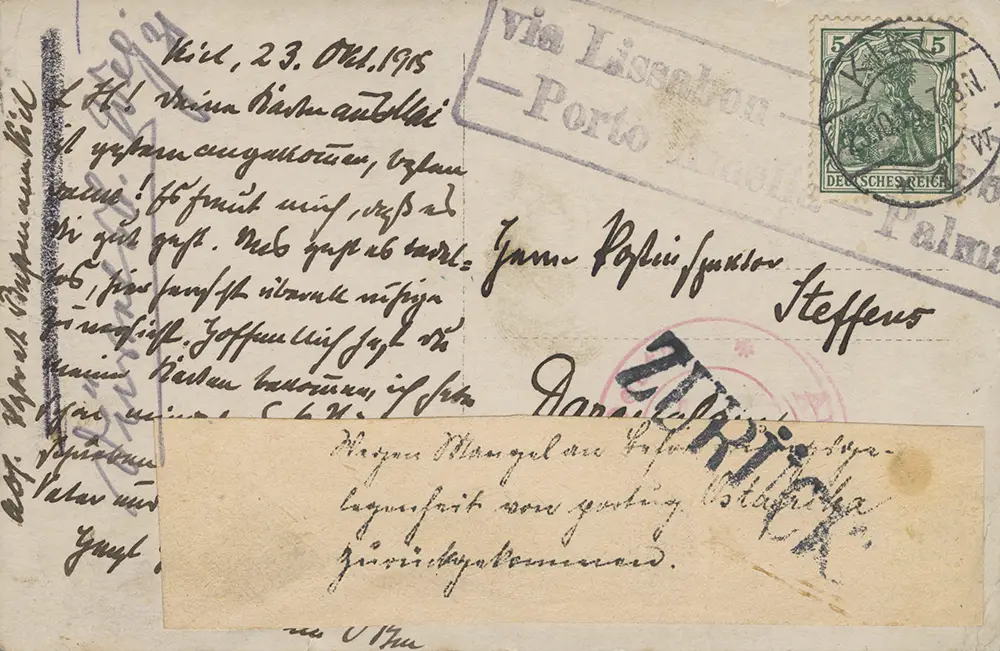
Postcard sent to D-OA via Portuguese East Africa, but returned to sender due to WWI
For Those Who are New to German Colonial Philately
Welcome to the world of German colonial philately! Our particular corner of the philatelic world deals with the postage stamps of the ten colonies and three overseas postal networks operated by the German Empire beginning in 1870 and ending with the First World War in 1919. This information is designed to introduce anyone with an interest in this area with some of the background of its postal history, key vocabulary and unique variations.
For ease of use, this guide is separated into sections – one for the Colonies and Post Offices Abroad generally, and one for each Colony and Post Office Abroad. The icons shown below will take you to the various sections, and will appear on each page to aid in navigation. Enjoy!
General
PO China
PO Morocco
PO Turkey
D-NG
D-OA
D-SWA
Kamerun
Karolinen
Kiautschou
Marianen

Marshall-In.
Samoa
Togo
General Overview of Colonial Collecting
By Gannon Sugimura
In this portion of the guide, you will find information on the Colonies & PO Abroad generally. This includes a short overview of each of the Colonies & PO Abroad – for more in depth info on each, see the links above – and an explanation of terms and concepts applicable across the Colonies & PO Abroad.
Other Colonial Postal Uses
German Post Offices Abroad
Imperial Germany ran three networks of post offices in countries outside of the Empire, located in Turkey (then the Ottoman Empire), Imperial China, and Morocco. Post offices abroad did offer a means of communication in countries that were not part of the Universal Postal Union, particularly in commercial areas. If a German happened to live in a city with a German post office abroad, it was a cheap, reliable way of keeping in touch with people at home. But in the 19th century, one country was only ever able to open a post office on another country’s territory because it was powerful enough to force the other country to allow it. Germany never opened offices in, for example, London, Paris, or New York That would have been an imposition that the UK, France, and the US would never have allowed—but it was one that Turkey, China, and Morocco were not able to deny.
Additionally, the post offices abroad were occasionally a precursor to actual colonization. German post offices abroad were established at Apia (Samoa), Bagamoyo, and Dar-Es-Salaam (East Africa) before both of those areas were officially German colonies. Occasionally, a German post office abroad would not lead to colonization. Germany also established short lived post offices at Lamu and Zanzibar, both in East Africa, and neither area was colonized—at least by the Germans.
After their Vorläufer periods ended, the various German offices abroad would issue stamps printed for use in Germany proper which had received overprints to show either the stamp’s equivalent value in the local currency, the name of the country in which the stamp was overprinted for use, or both. Germany never issued stamps with designs specific to use in its foreign offices the way that some countries (France, Russia, etc.) did at the same time, although colonial issues had a distinct design from 1900/1901.
China

German postal operations in Imperial China began with a postal agency insider Germany’s Shanghai consulate in August 1886. Over time, additional offices would open at nearly two dozen locations, primarily at coastal or river ports. A few offices also had some connection to the German-built railroad in Shandong province in the vicinity of the German colony of Kiautschou.
Stamps prepared for use in China would first appear in 1898, with an overprint reading “CHINA” applied diagonally across the face of 1889 series German definitives. These overprints exist in two settings, with the overprint set at 45° or 56° across the face of the stamp.
In 1902, 1900 series “Germania” stamps (inscribed “REICHSPOST”) with the word “CHINA” overprinted horizontally across the bottom of the stamps in “Lateinshrift“. Face values of these issues were in Pfennig and Marks, with the entire range of face values available in Germany proper also available at the German offices in China. When “Fraktur” overprints appeared on 1902 “Germania” stamps (inscribed “DEUTCHES REICH”), these overprints also included face value equivalents in Chinese currency. As several values had neither easy nor useful conversions into Chinese currency, several values were discontinued when this change was made.
Vorläufer period: 1886-1898
Kriegsdruck: Kreigsdruck printings were made for all stamps except the 2¢ on 5 Pf, 4¢ on 10 Pf, 10¢ on 20 Pf, and 20¢ on 40 Pf values.
Postal Stationery: Postal cards, including paid reply cards
Final Closure: 17 March 1917
PO China
Areas unique to this colonial outpost:
Due the Boxer Rebellion (August 1900-late 1902), a number of provisional issues were created which have no equivalent in other parts of the German colonial empire. Either the local supply of stamps was insufficient, or stamp stocks were exhausted and could not be replenished by additional stamps sent from Germany.
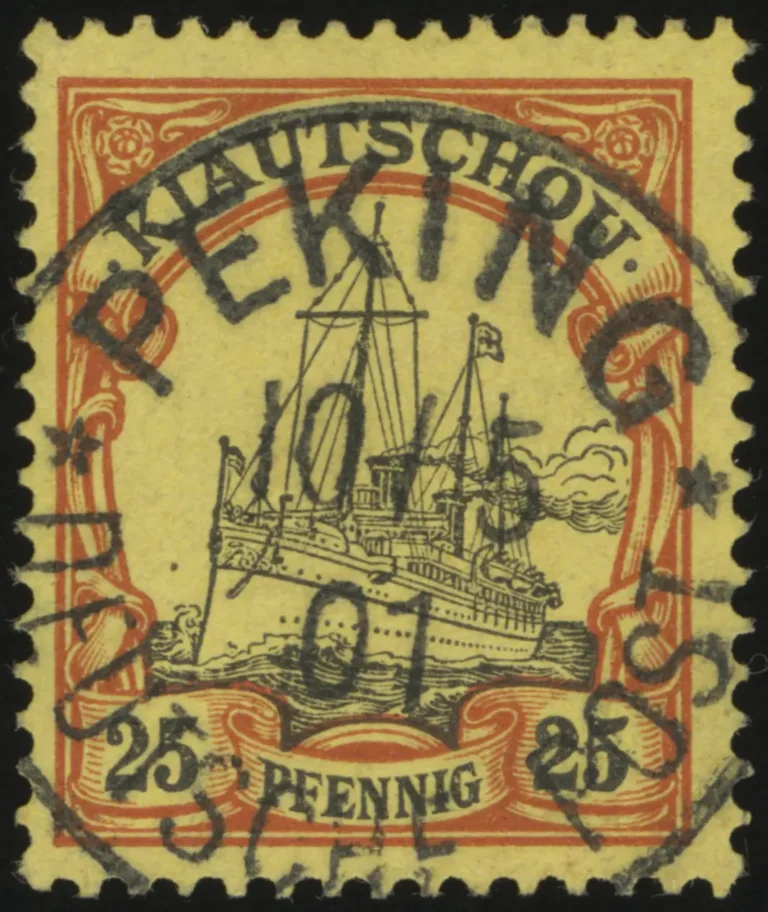
“Petschili” Usages (right) – The German Offices in China also accepted un-overprinted 1889- and 1900-series German definitives without overprint. As a result, military and civilian cancels can be found on all of these issues. The Peking (Beijing) office also issued stamps from the 1901 “Yacht” issue prepared for use in Kiautschou, which were not technically valid at German installations in China proper except during this short time period. Collectively, these are known as “Petschili” usages, and are actively sought by specialists.
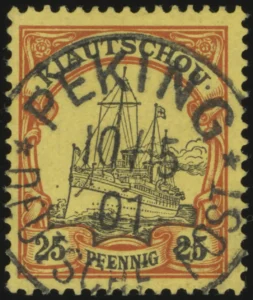
In addition to the Petschili uses, other provisional issues were also created during this time period elsewhere in China.
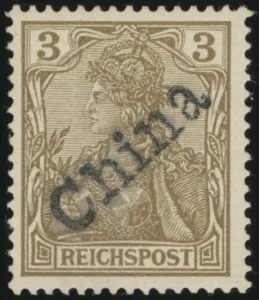
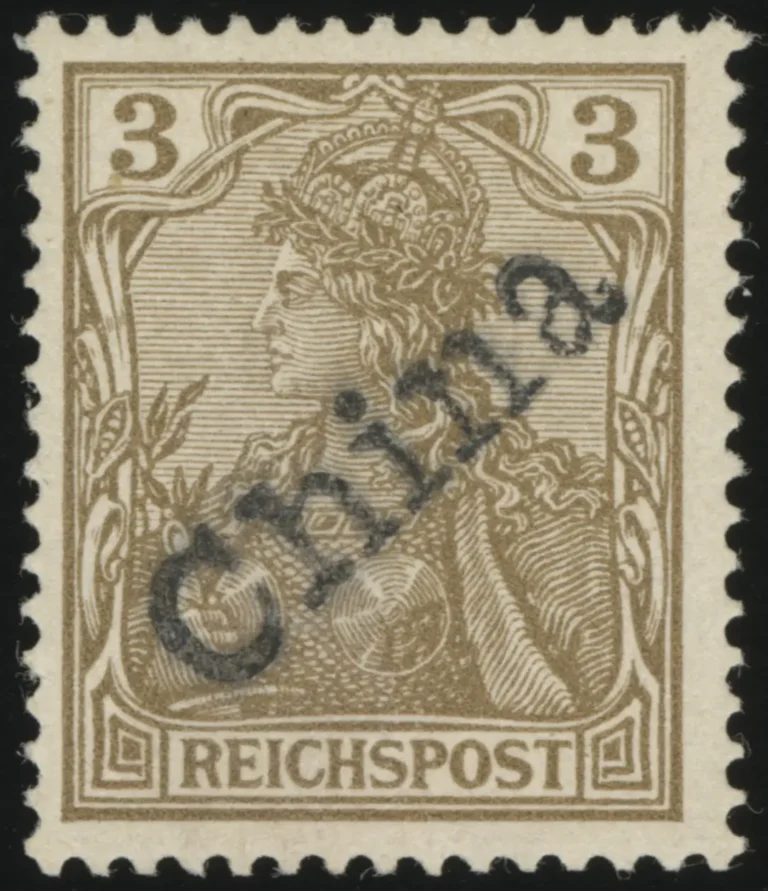
Tientsin Handstamps (right) – At the Tientsin office, provisionals were created by handstamping the word “CHINA” diagonally across the face of Germania stamps, resulting in a nearly full set of denominations.
Futschau Provisionals – At the Futschau office, 5 Pf stamps were created by handstamping that value over the bottom of 10 Pf stamps. These are routinely confused with the first issue of Kiautschou, which is also a 5 Pf on 10 Pf stamp. The difference here is that the value on the Futschau issue is stated as “5 Pf”, whereas the value on the Kiautschou overprint is stated as “5 pfg.” Most (but not all) of the Kiautschou issue also includes a blue or purple crayon line applied to “cancel” the stamp’s original face value; this feature is missing from the Futschau provisional.
Areas unique to this colonial outpost:
Due the Boxer Rebellion (August 1900-late 1902), a number of provisional issues were created which have no equivalent in other parts of the German colonial empire. Either the local supply of stamps was insufficient, or stamp stocks were exhausted and could not be replenished by additional stamps sent from Germany.
“Petschili” Usages (below) – The German Offices in China also accepted un-overprinted 1889- and 1900-series German definitives without overprint. As a result, military and civilian cancels can be found on all of these issues. The Peking (Beijing) office also issued stamps from the 1901 “Yacht” issue prepared for use in Kiautschou, which were not technically valid at German installations in China proper except during this short time period. Collectively, these are known as “Petschili” usages, and are actively sought by specialists.
In addition to the Petschili uses, other provisional issues were also created during this time period elsewhere in China.
Tientsin Handstamps (below)– At the Tientsin office, provisionals were created by handstamping the word “CHINA” diagonally across the face of Germania stamps, resulting in a nearly full set of denominations.
Morocco

The final German Office Abroad opened in Morocco on 20 December 1899. German postal facilities opened in roughly a dozen locations throughout the country. Morocco at the time was divided into French and Spanish zones of influence, as well as an international zone around the northern city of Tangiers. Germany operated postal facilities in all three. Stamps for the German Offices in Morocco were always issued only with overprints giving face value equivalents in Spanish pesetas and centimos, which were used at all the German facilities regardless of the zone in which they operated. No overprints stating just “Morocco” without a peseta equivalent were ever regularly issued, although unissued stamps and postal stationery that fit this description were prepared.
Vorläufer period: n/a. Distinctive issues for Morocco were provided to all German facilities from their first day of operations.
Kriegsdruck: Kreigsdruck printings were made for the equivalents of the 25- and 50-Pf values, as well as those equivalent to 1 M or higher. Unlike the other offices and colonies, the low value 3 Pf issue is not recorded as having a Kriegsdruck version.
Postal Stationery: Postal cards, including paid reply cards.
Final Closure: 5 August 1914 (French Zone), 12 June 1919 (Spanish Zone) and 19 August 1919 (Tangiers).
PO Morocco
Areas unique to this colonial outpost:
With the possible exception of some military facilities in German East Africa, the German post offices in the Spanish zone were the last colonial outposts of Imperial Germany anywhere in the world. By the date of the Armistice (11 November 1918), Germany had already lost control of all her other colonies and overseas post offices except for small areas in German East Africa which held out for a few weeks longer. The five German post offices in the Spanish zone remained open until 11 June 1919, when the Treaty of Versailles took effect.
Turkey (Ottoman Empire)

The first German post office anywhere outside of Germany was opened in Constantinople (Istanbul) in March of 1870 by the North German Confederation. Imperial Germany would eventually open three offices in Constantinople, as well as one each in Smyrna (Izmir), Beirut, Jerusalem, and Jaffa (Tel Aviv), all of which were inside the Ottoman Empire at the time.
Like all of the other offices, German issues for their Offices in Turkey were overprinted first with “Lateinshrift” inscriptions, in this case, an inscription which restated the stamp’s face value in Turkish lira. Later overprints were applied in “Fraktur” to “Germania” series stamps printed on both ordinary and watermarked paper.
Vorläufer period: 1870-c. 1884
Kriegsdruck: n/a. This was the only German colonial outpost for which Kriegsdruck printings were never made of any denomination.
Postal Stationery: Postal cards, newspaper wrappers
Final Closure: 30 September 1914
PO Turkey
Areas unique to this colonial outpost:
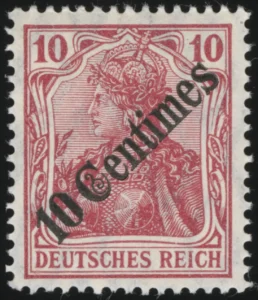
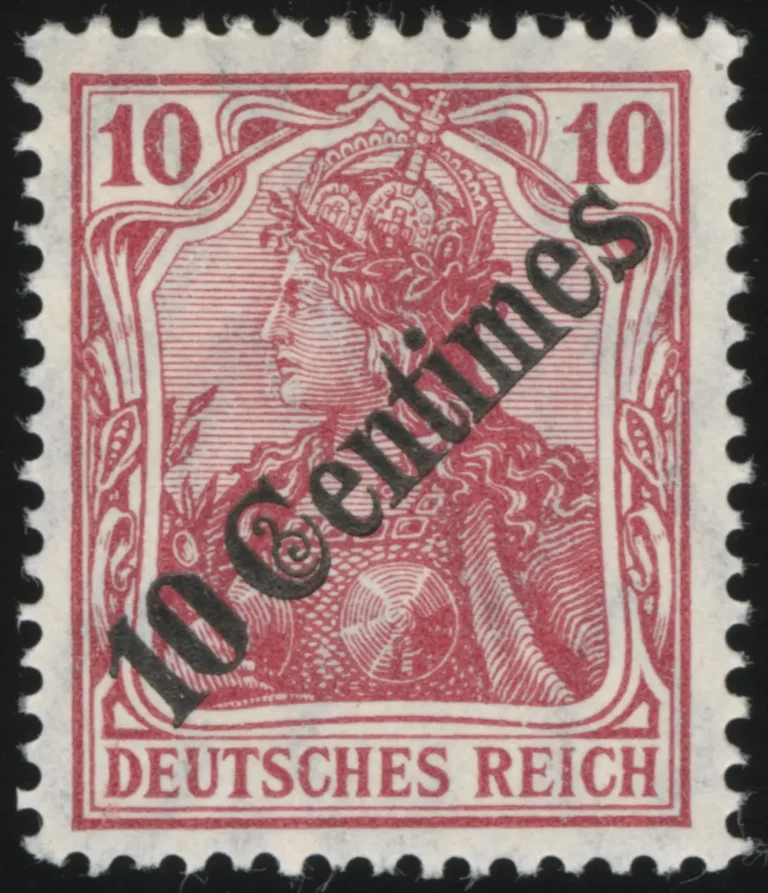
This was the only colonial postal system which never had a country name other than Germany’s associated with their stamps. In the case of all colonial issues and the other two offices abroad, the overprint includes the name of the country in which the stamps were prepared for use. German Offices in Turkey issues show only a new value in Turkish currency (Paras or Piasters) or in French currency (Centimes; as seen at right) and nothing else. The issue of stamps in two different non-German currencies was also unique to the offices in Turkey. It required the Germans to keep their books in three currencies, rather than just two as was the case in every other instance.
This was also the only colonial facility for which no wartime stamps were ever produced. The Ottomans viewed all the foreign post offices as an infringement on their sovereignty, and had been trying to close them down for years. The Germans, having sought to ally themselves with the Ottomans, were not about to antagonize them by planning to reopen their offices in Turkey. Although the civilian offices closed in September 1914, Germany operated numerous military mail post offices throughout Ottoman territory. As military mail did not require stamps, this sort of mail can only be collected as stampless entires; the cancels for such mail typically include Turkish inscriptions in Arabic script which make for visually very interesting items.
Areas unique to this colonial outpost:
This was the only colonial postal system which never had a country name other than Germany’s associated with their stamps. In the case of all colonial issues and the other two offices abroad, the overprint includes the name of the country in which the stamps were prepared for use. German Offices in Turkey issues show only a new value in Turkish currency (Paras or Piasters) or in French currency (Centimes; as seen below and nothing else. The issue of stamps in two different non-German currencies was also unique to the offices in Turkey. It required the Germans to keep their books in three currencies, rather than just two as was the case in every other instance.
This was also the only colonial facility for which no wartime stamps were ever produced. The Ottomans viewed all the foreign post offices as an infringement on their sovereignty, and had been trying to close them down for years. The Germans, having sought to ally themselves with the Ottomans, were not about to antagonize them by planning to reopen their offices in Turkey. Although the civilian offices closed in September 1914, Germany operated numerous military mail post offices throughout Ottoman territory. As military mail did not require stamps, this sort of mail can only be collected as stampless entires; the cancels for such mail typically include Turkish inscriptions in Arabic script which make for visually very interesting items.
German Colonies
Germany was a late entrant in the great race for European powers to secure colonial possessions around the world. It secured its first colony in Kamerun in 1884, and would go on to have 4 colonies in Africa – Deutsch-Ostafrika (German East Africa), Deutsch-Südwestafrika (German Southwest Africa), Kamerun, and Togo – and 6 colonies in the Pacific – Deutsch-Neuguinea (German New Guinea), Karolinen (Caroline Islands), Kiautschou (Kiauchau), Marianen (Mariana Islands), Marshall-Inseln (Marshall Islands), and Samoa. Germany would lose control of all its colonial possessions during World War I or as a result of the Versailles Treaty.
Deutsch-Neuguinea (German New Guinea)

The German New Guinea colony began as a private company controlling the north-eastern quarter of the island of New Guinea. The German government would eventually establish a “protectorate” over the area, which also included a number of adjacent islands such as Bougainville and the northern part of the Solomon Islands. Postal operations began on 15 February 1888. German New Guinea would issue the normal range of stamps, with “Deutsch- / Neu-Guinea” diagonal overprints on 1889 series stamps in 1897, and “Yacht” series stamps in 1900.
With the exception of Samoa and Kiautschou, all of Germany’s Pacific colonies were officially run from German New Guinea, which presided over Germany’s “Imperial Pacific Protectorates”. Many of the postal operations of these colonies were routed through New Guinea as a result.
Vorläufer period: 1888-1897
Kriegsdruck: Kreigsdruck printings were made of the 3 Pf, 5 Pf, 10 Pf, and 5 M values. These are a lot easier to identify than those of other colonies. Friedensdruck printings are all on unwatermarked paper, with a colony name reading “DEUTSCH-NEU-GUINEA.” The 3 Pf value on watermarked paper can only be Kriegsdruck. The other Kriegsdruck values have the name of the colony written as “DEUTSCH-NEUGUINEA”, without a hyphen between “NEU” and “GUINEA.
The New Guinea 5 M watermarked issue exists in three forms. The Friedensdruck printing correctly matches up the frame and vignette, which are supposed to be Type I. Three Kriegsdruck printings were made, two of which have the Type II vignette, the third of which has the Type III vignette.
Postal Stationery: Postal cards, including paid reply cards.
Final loss of control: The last areas of German control surrendered to the Australians and the British on 17 September 1914.
D-NG
Areas unique to this colonial outpost:
The Kieta post office, having run out of 3 Pf stamps, issued a hand stamped 3 Pf on 5 Pf provisional which was in use in February 1908.
Additionally, the German New Guinea company issued packet cards and other items resembling postal materials which were used in a manner similar to actual postal issues.
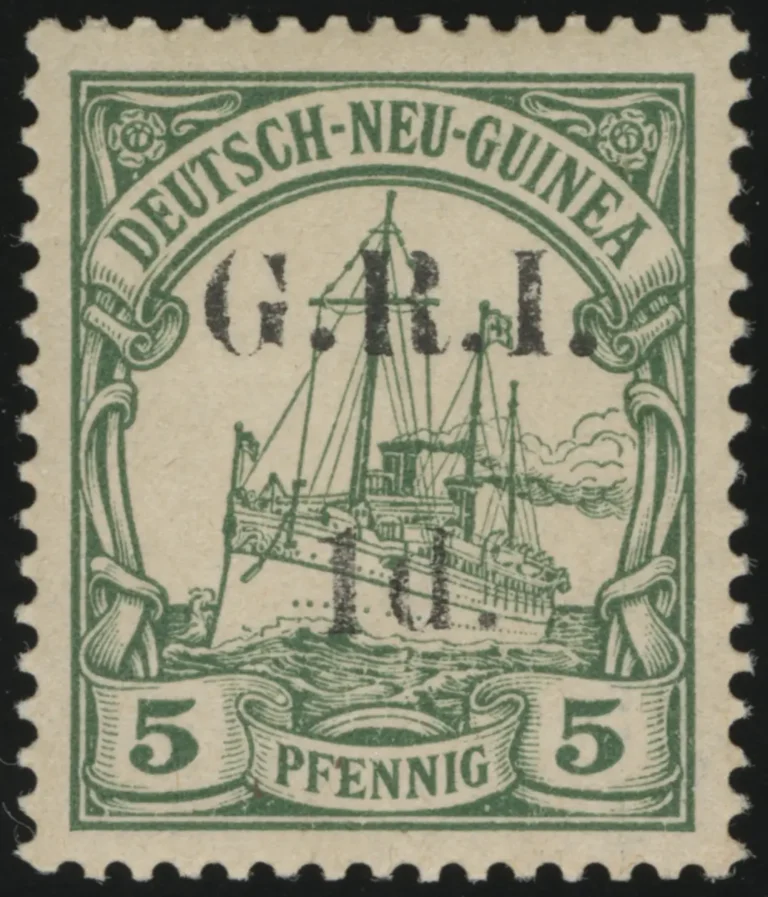
Collectors of occupation issues have a variety of items to collect related to this colony as well. The British overprinted captured German New Guinea stamps (right) for use during the occupation, including creating stamps out of registration labels held by the German postal facilities.
Areas unique to this colonial outpost:
The Kieta post office, having run out of 3 Pf stamps, issued a hand stamped 3 Pf on 5 Pf provisional which was in use in February 1908.
Additionally, the German New Guinea company issued packet cards and other items resembling postal materials which were used in a manner similar to actual postal issues.
Collectors of occupation issues have a variety of items to collect related to this colony as well. The British overprinted captured German New Guinea stamps (below) for use during the occupation, including creating stamps out of registration labels held by the German postal facilities.
Deutsch-Ostafrika (German East Africa)

German East Africa is one of two colonies where the postal operations officially started as a “Post Office Abroad” before a transition to a colonial postal service took place. (Samoa is the other.) The initial cancellations from the first two GEA offices at Dar-Es-Salaam and Bagamoyo read “Kaiserl. Deutche Postagentur” or “Imperial German Postal Agency”, a designation which also appears only in contemporary cancels of the German Offices in Turkey and China.
German East Africa never used the German Mark as its currency, so never had stamps in Mark denominations other than Vorläufer. GEA instead used the Indian / East African Rupie. The first issues prepared for East Africa were issued on 1 July 1893, and consists of 1889 series stamps overprinted horizontally with a single line showing new values in denominations from 2 Pesa to 25 Pesa. (1 Rupie = 64 Pesa) This issue did not include the name of the colony. A new issue appeared in 1896 which had a three-line diagonal overprint in the same values but including the colony’s name as “Deutsch-Ostafrika”.
Stamps of the “Yacht” series, initially denominated in Rupie and Pesa would appear in early 1901, but were replaced in 1905 when the Rupie was “decimalized” by discontinuing the Pesa and making the Rupie equivalent to 100 Heller. Watermarked versions of most values were issued.
Vorläufer period: 1890-1893
Kriegsdruck: Kriegsdruck printings were created for the 2 ½ H, 1 Rupie, 2 Rupien, and 3 Rupien values. Watermarked Friedensdruck printings for all values except the 2 Rupien made it to East Africa and were used there. The watermarked 1 Rupie value is exceptionally rare in used condition.
Postal Stationery: Postal cards, including paid reply cards.
Final loss of control: German East Africa was the final German colonial outpost to fall to the Allies. Although the British, Belgians, and Portuguese effectively controlled most of the colony by 1917, a German guerrilla force of about 1,000 soldiers kept the military campaign in full swing until 1919, several weeks after peace had been declared in Europe. The German guerrillas in East Africa would keep fighting until orders from Berlin to stand down were received.
D-OA
Areas unique to this colonial outpost:
Two postal outposts at Lamu (now in Kenya) and at Zanzibar are usually included with East Africa although neither was ever part of the German East Africa colony. Germany operated post offices abroad in these locations prior to the formation of the colony, but ceded those locations to England in the Helgoland-Zanzibar Treaty of 1890.
Shortages of postage during World War I led to several provisional postal issues and provisional means of denoting postage paid. These include:
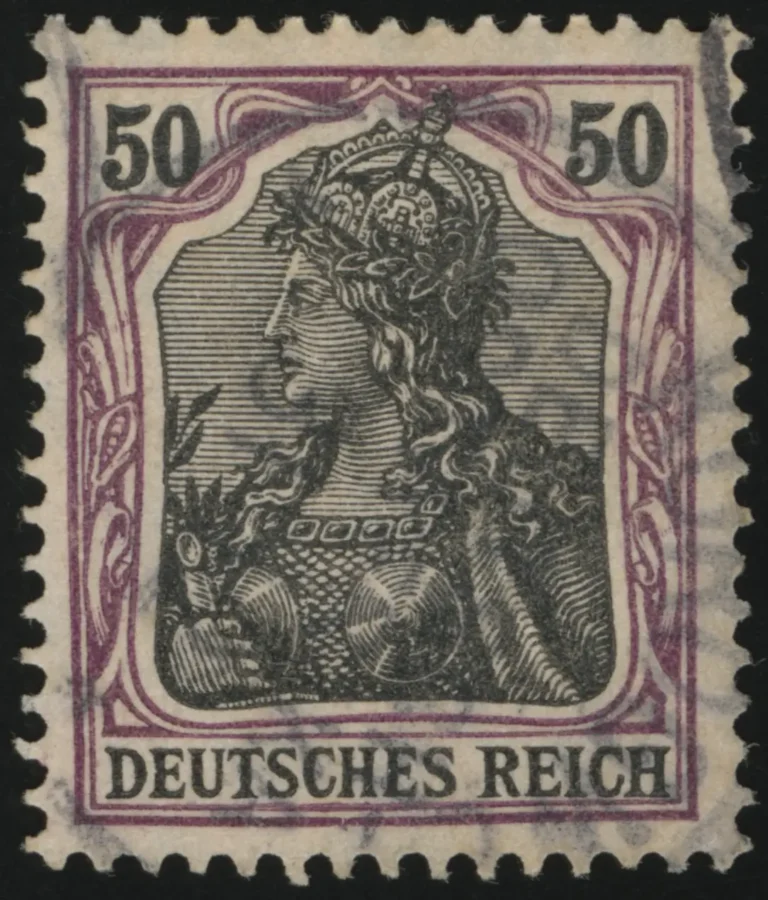
Königsberg / Möwe Provisionals (right) – un-overprinted Germania stamps salvaged from SMS Königsberg and SMS Möwe, German naval vessels which had been scuttled to prevent capture by the British. These were used in late 1915 and 1916.
Areas unique to this colonial outpost:
Two postal outposts at Lamu (now in Kenya) and at Zanzibar are usually included with East Africa although neither was ever part of the German East Africa colony. Germany operated post offices abroad in these locations prior to the formation of the colony, but ceded those locations to England in the Helgoland-Zanzibar Treaty of 1890.
Shortages of postage during World War I led to several provisional postal issues and provisional means of denoting postage paid. These include:
Königsberg / Möwe Provisionals (below) – un-overprinted Germania stamps salvaged from SMS Königsberg and SMS Möwe, German naval vessels which had been scuttled to prevent capture by the British. These were used in late 1915 and 1916.
Pre-Payment Envelopes – starting in 1915, smaller post offices were unable to procure enough stamps, so special envelopes for use within the colony were prepared which indicated payment had been made in cash.
Cash Pre-Payment Markings – special handstamps were also made to indicate cash pament of postage on items that were not franked with postage and which were not sent in the pre-payment envelopes.
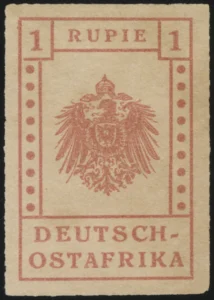
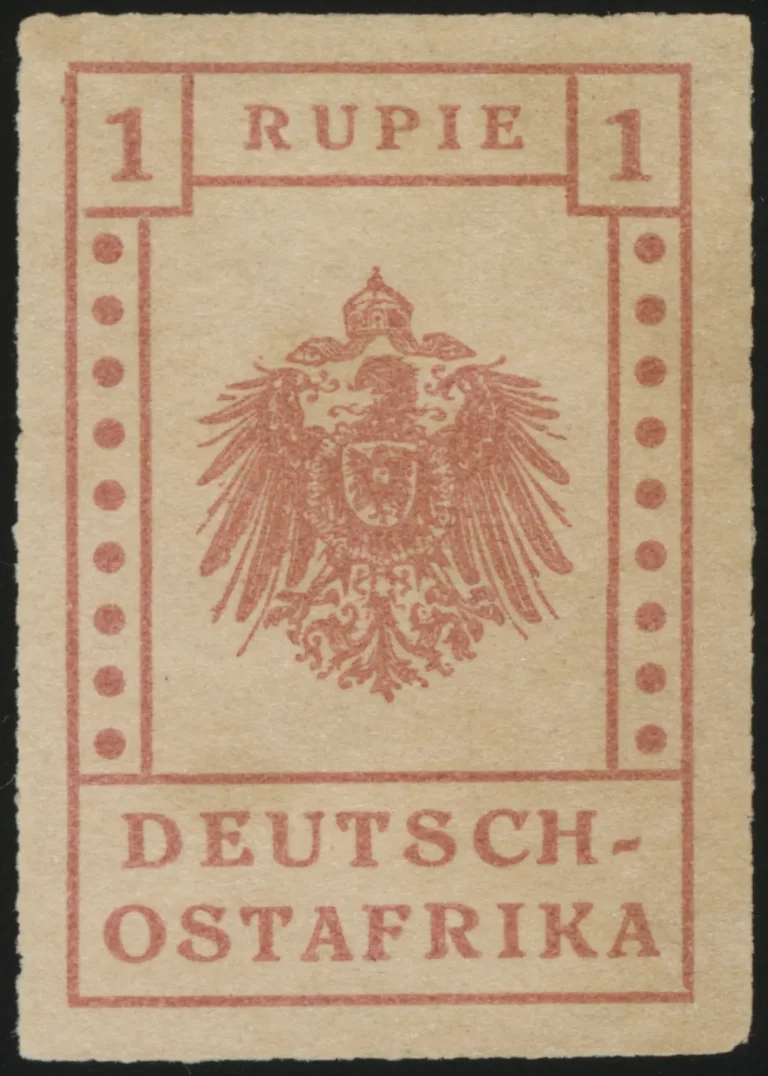
Wuga Provisionals (right) – early in 1916, locally-printed provisional issues of the 2 ½ H, 7 ½ H, and 1 Rupie values were prepared at the presses of missionaries located in the town of Wuga, but these were buried rather than being issued when new stamps arrived from Germany. A small number survived being buried.
Additionally, GEA was one of three African colonies which issued stamp booklets. Some panes from these booklets have se-tenant pairs with a stamp and an advertising label or a stamp and a blank label printed with an “X”.
GEA had an extensive German-built railroad, which eventually used railroad cancels on mail carried on these trains. Two different lines had such devices.
Pre-Payment Envelopes – starting in 1915, smaller post offices were unable to procure enough stamps, so special envelopes for use within the colony were prepared which indicated payment had been made in cash.
Cash Pre-Payment Markings – special handstamps were also made to indicate cash pament of postage on items that were not franked with postage and which were not sent in the pre-payment envelopes.
Wuga Provisionals (below) – early in 1916, locally-printed provisional issues of the 2 ½ H, 7 ½ H, and 1 Rupie values were prepared at the presses of missionaries located in the town of Wuga, but these were buried rather than being issued when new stamps arrived from Germany. A small number survived being buried.
Additionally, GEA was one of three African colonies which issued stamp booklets. Some panes from these booklets have se-tenant pairs with a stamp and an advertising label or a stamp and a blank label printed with an “X”.
GEA had an extensive German-built railroad, which eventually used railroad cancels on mail carried on these trains. Two different lines had such devices.
Deutsch-Südwestafrika (German Southwest Africa)

German Southwest Africa was established on 7 August 1884, but had to wait until July 1888 to have any postal facilities. GSWA has the largest variety of stamps and postmarks of any German colony, due to the fact that this colony attracted more German settlers than any other. Of the roughly 25,000 Germans living in the colonies before the First World War, just over half lived in Southwest Africa alone. This colony tended to attract more settlers largely due to the mineral wealth of the colony. Some towns were established solely as diamond mining towns or towns with a similar and singular economic purpose.
The first set of stamps issued for the colony were 1889 stamps overprinted diagonally with the words “DEUTSCH- / SüDWEST-AFRIKA”. The two high values of the set, the 25 Pf and 50 Pf, were sold in Berlin but not in the colony. These are famous in German colonial philately in that a very few examples of these made their way to the colony and were legitimately used there. A subsequent issue is nearly identical, but the overprint reads “DEUTSCH- / SüDWESTAFRIKA”.
GSWA also issued “Yacht” stamps in 1900. Unlike the other colonies, GSWA issued about half the denominations of all its stamps on watermarked paper before the war. Denominations on watermarked paper that saw genuine postal use used only in this colony include 3 Pf, 5 Pf, 10 Pf, 20 Pf, 30 Pf, 1 M, 2 M, and 5 M.
Vorläufer period: 1888-1897
Kriegsdruck: Kriegsdruck printings exist primarily for the “Large Yachts”, i.e. those with a face value of 1 M or higher. Of these, only the 3 M was printed solely as Kriegsdruck; the rest also exist as Friedensdruck.
Postal Stationery: Postal cards, including paid reply cards.
Final loss of control: The colony was conquered in stages over the first year of the war. The colony was officially placed under the control of British South Africa on 9 July 1915.
D-SWA
Areas unique to this colonial outpost:
Mail with military cancels from the 1904-1906 period is known and is collected for that reason. As German control of the colony continued in areas for a year or so, “war date” mail is known and is highly collectable.
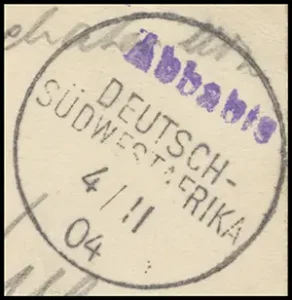
In addition to a far larger number of towns that had postmarks, a special type of cancel known as a “Wanderstempel” (right) was used at a number of locations only in GSWA. The Wanderstempel were metal cancel devices without a town name. The town name was then inserted by hand, either as a rubber handstamp or by being handwritten by the postal clerk. Wanderstempel were used at towns that were newly established, in some cases, those which had been founded as stops on the German built railroads. Some would eventually become established towns and were issued proper postmark devices. Some became towns, but their names were changed from the names that appear in Wanderstempel cancellations. Some were temporary camps for the railroad crews, and their Wanderstempel are the only philatelic proof of their existence.
GSWA was one of three African colonies which issued stamp booklets. Some panes from these booklets have se-tenant pairs of the 5 Pf and 10 Pf values, or se-tenant pairs with a stamp and an ad label. Se-tenant pairs come only from booklets issued in Berlin during the war, so genuine postal use is unknown.
Areas unique to this colonial outpost:
Mail with military cancels from the 1904-1906 period is known and is collected for that reason. As German control of the colony continued in areas for a year or so, “war date” mail is known and is highly collectable.
In addition to a far larger number of towns that had postmarks, a special type of cancel known as a “Wanderstempel” (below) was used at a number of locations only in GSWA. The Wanderstempel were metal cancel devices without a town name. The town name was then inserted by hand, either as a rubber handstamp or by being handwritten by the postal clerk. Wanderstempel were used at towns that were newly established, in some cases, those which had been founded as stops on the German built railroads. Some would eventually become established towns and were issued proper postmark devices. Some became towns, but their names were changed from the names that appear in Wanderstempel cancellations. Some were temporary camps for the railroad crews, and their Wanderstempel are the only philatelic proof of their existence.
GSWA was one of three African colonies which issued stamp booklets. Some panes from these booklets have se-tenant pairs of the 5 Pf and 10 Pf values, or se-tenant pairs with a stamp and an ad label. Se-tenant pairs come only from booklets issued in Berlin during the war, so genuine postal use is unknown.
Kamerun (Cameroon)

The earliest German colonial possession, Kamerun, was officially founded on 14 July 1884. Kamerun was also the first German colony to open post offices, beginning operations on 1 February 1887. Kamerun issued the usual range of stamps, beginning with diagonal overprints on the 1889 definitive series, and continuing with “Yacht” stamps printed on unwatermarked paper starting in November 1900. Kamerun would be divided between the British and the French at the end of the war. Modern Camero0n was formed largely from the area mandated to France, as well as a small part of the area mandated to Britain. About one third of the area formerly part of German Kamerun is now part of Nigeria, Gabon, and other neighboring African states.
Vorläufer period: 1887-1897
Kriegsdruck: Actual postal use of Friedensdruck printings of stamps on watermarked paper occurred for the 5 Pf, 10 Pf, 20 Pf, and 5 M values. Such uses of the 20 Pf and 5 M values are extremely scarce and command significant premiums over equivalent stamps printed on unwatermarked paper. Kreigsdruck printings were made of the 3 Pf, 5 Pf, 20 Pf, 1 M and 5 M values.
Postal Stationery: Postal cards, including paid reply cards.
Final loss of control: Kamerun was taken over by the Allies in stages between September 1914 and January 1916.
Kamerun
Areas unique to this colonial outpost:
Kamerun officially issued bisected stamps. The Longji post office used bisected 20 Pf stamps as 10 Pf stamps in May 1911.
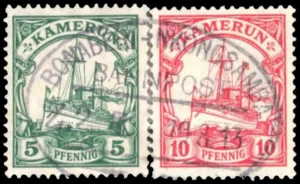
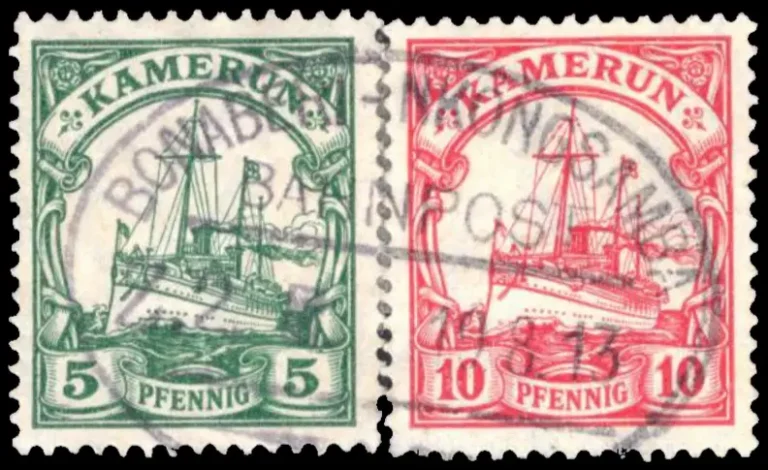
Kamerun also had railway postal facilities with the distinctive oval Bahnpost cancels (right).
Cancel devices captured from the Germans by the Allies, particularly in the French zones of occupation, are known to have been used without alteration for some time after the war ended.
Kamerun was one of three African colonies which had stamp booklets. Some panes from these booklets have se-tenant pairs of the 5 Pf and 10 Pf values, or se-tenant pairs with a stamp and an ad label. The se-tenant pairs come only from booklets produced during the war, so genuine postal use of a se-tenant pair is impossible.
Areas unique to this colonial outpost:
Kamerun officially issued bisected stamps. The Longji post office used bisected 20 Pf stamps as 10 Pf stamps in May 1911.
Kamerun also had railway postal facilities with the distinctive oval Bahnpost cancels (below).
Cancel devices captured from the Germans by the Allies, particularly in the French zones of occupation, are known to have been used without alteration for some time after the war ended.
Kamerun was one of three African colonies which had stamp booklets. Some panes from these booklets have se-tenant pairs of the 5 Pf and 10 Pf values, or se-tenant pairs with a stamp and an ad label. The se-tenant pairs come only from booklets produced during the war, so genuine postal use of a se-tenant pair is impossible.
Karolinen (Caroline Islands)

The Caroline Islands colony (“Karolinen”) was originally part of the Spanish East Indies. Once Spain lost control of the Philippines and Guam to the United States in 1898, the remaining Spanish possessions in the Pacific were quickly sold to Germany. German control commenced on 12 October 1899.
The first issues of the German Carolines were 1889 series stamps overprinted diagonally with the word “Karolinen”. This first issue had the overprint at an angle of 48° across the face of the stamp. A subsequent issue was issued in May 1900, but with the overprint set to a steeper angle of 56°. Genuine examples of the earlier issue can command significant premiums.
As with the other colonies, “Yacht” issues appeared in late 1900, and remained valid until the end of German control.
Vorläufer period: n/a. German issues prepared for use in the Carolines were available on the first day of German administration.
Kriegsdruck: Kriegsdruck issues were created for the 3 Pf, 5 Pf, and 5 M values. According to Michel, the 5 Pf issue was created in 1923, nearly 4 years after the colonial issues were supposed to have been withdrawn from sale in Germany proper, and is the last German colonial stamp produced. No watermarked stamps were available in the colony during the period of German control.
Postal Stationery: Postal cards, including paid reply cards.
Final loss of control: The Carolines were occupied by the Japanese in October 1914.
Karolinen
Areas unique to this colonial outpost:
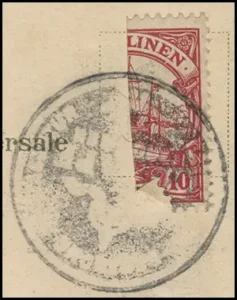
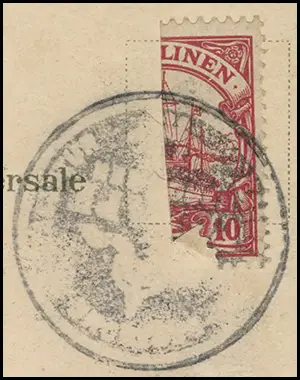
A 1905 typhoon destroyed most of the stock of 5 Pf stamps as well as the cancel device from the main post office at Ponape. For a period from April to July, 1905, vertically bisected 10 Pf stamps were used instead of 5 Pf stamps, cancelled with the Official Seal instead of a postmark device. (Other stamps used at Ponape in this period also show this seal used as a cancel.) This is the most easily obtained of any German colonial bisect (right) .
When a 1910 visit of a two German warships exhausted the supply of 5 Pf and 10 Pf stamps, provisional issues were again used. Approximately 500 of the 3 Pf stamps were hand stamped “5 Pf” and placed in use. 20 Pf stamps were also bisected to provide 10 Pf values.
Along with the Marshalls and the Marianas, the Carolines were administered by the United States as part of the UN Trust Territory of the Pacific. While this political entity was in existence (1947-1984, to 1994 for Palau) US stamps were used.
Areas unique to this colonial outpost:
A 1905 typhoon destroyed most of the stock of 5 Pf stamps as well as the cancel device from the main post office at Ponape. For a period from April to July, 1905, vertically bisected 10 Pf stamps were used instead of 5 Pf stamps, cancelled with the Official Seal instead of a postmark device. (Other stamps used at Ponape in this period also show this seal used as a cancel.) This is the most easily obtained of any German colonial bisect (below).
When a 1910 visit of a two German warships exhausted the supply of 5 Pf and 10 Pf stamps, provisional issues were again used. Approximately 500 of the 3 Pf stamps were hand stamped “5 Pf” and placed in use. 20 Pf stamps were also bisected to provide 10 Pf values.
Along with the Marshalls and the Marianas, the Carolines were administered by the United States as part of the UN Trust Territory of the Pacific. While this political entity was in existence (1947-1984, to 1994 for Palau) US stamps were used.
Kiautschou (Kiauchau)

Officially a “Pachtgebeit” (ceded territory under German control), Kiautschou was under German colonial administration from 1897. Postal service commenced on 26 January 1898, but as the post office of a naval military facility. Germany and China quickly signed for a 99-year lease on the territory, which also gave Germany rights in a “neutral zone” around the colony—one of which was establishing a railroad which would have on-board postal services.
Until “Yacht” stamps were issued in early 1901, Kiautschou used German Offices in China stamps. Yacht stamps were initially denominated in German Marks and Pfennigs, but this currency was never in widespread acceptance in Kiautschou. To reflect this, new stamps were issued in denominations of (Chinese) dollars and cents in October of 1905. Printings with dollar / cent denominations on unwatermarked paper were available for a short time before being replaced with watermarked paper printings beginning in 1905.
Vorläufer period: 1898-1900 Most Vorläufer from Kiautschou are stamps prepared for the German Offices in China. A smaller number of Vorläufer are unoverprinted stamps from Germany proper.
Kriegsdruck: Kriegsdruck issues were created for the 1¢, $1/2, $1, $1 ½ , and $2 ½ values. Freidensdruck printings on watermarked paper exist for all values that were available at Kiautschou post offices before the war.
Postal Stationery: Postal cards, including paid reply cards.
Final loss of control: Kiautschou was overrun in stages by Japanese armed forces between September and 7 November 1914.
Kiautschou
Areas unique to this colonial outpost:
This colony was the only one which never received 1889 series stamps overprinted diagonally with the name of the colony.
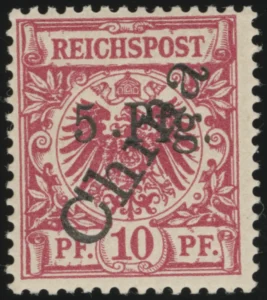
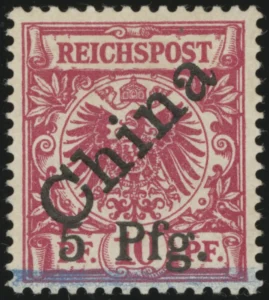
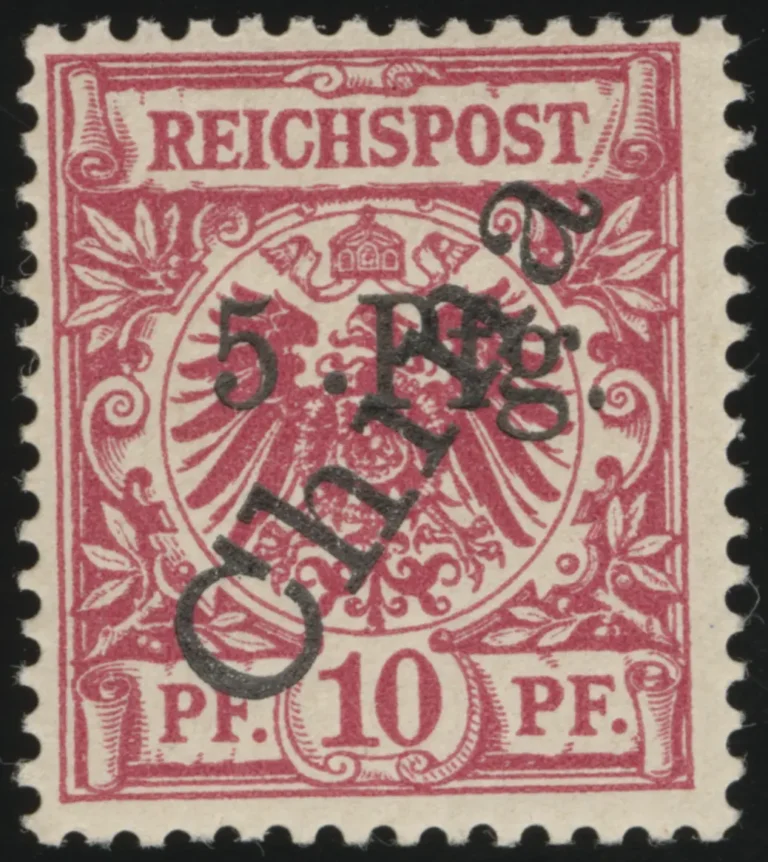
The first Kiautschou stamp was a 5 Pf stamp, produced by locally overprinting 10 Pf German Offices in China stamps with the inscription “5 Pfg.” Due to issues with the readability of this overprint on some stamps from the sheet, a “5 Pf.” handstamp was later used on some of these stamps to apply a second overprint. As a result, these issues are commonly confused with the “5 Pf”-overprinted provisional issues of the Futschau post office of the German PO in China, but can be distinguished by the overprint – “5 Pfg.” (Kiautschou), “5 Pf.” (Kiautschou), and “5 pf” (China). Numerous varieties of this overprint exist. This stamp was issued on the first day of issue (9 May 1900) without a blue pencil line “cancelling” the original value (right) .
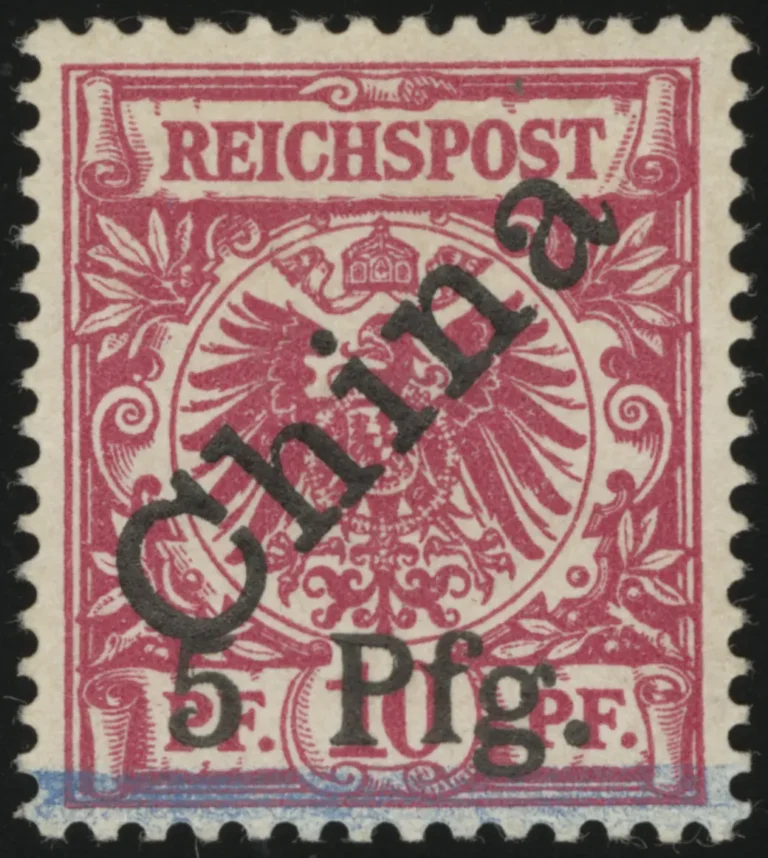
After that date, a blue or purple pencil line was drawn across the stamp’s original face value (right) .
Kiautschou stamps of the “Yacht” issue were sold at the German Office in Peking (Beijing) during the Boxer Rebellion (1900-1902). These are included with the “Petschili” uses of the German Offices in China.
Tsingtau was the terminus of the Shandong Railroad, which eventually provided rail service from Tsingtau all the way to Berlin via Russia and China. Cancellations from this railroad are known on all Kiautschou issues in addition to German Offices in China issues.
Areas unique to this colonial outpost:
This colony was the only one which never received 1889 series stamps overprinted diagonally with the name of the colony.
The first Kiautschou stamp was a 5 Pf stamp, produced by locally overprinting 10 Pf German Offices in China stamps with the inscription “5 Pfg.” Due to issues with the readability of this overprint on some stamps from the sheet, a “5 Pf.” handstamp was later used on some of these stamps to apply a second overprint. As a result, these issues are commonly confused with the “5 Pf”-overprinted provisional issues of the Futschau post office of the German PO in China, but can be distinguished by the overprint – “5 Pfg.” (Kiautschou), “5 Pf.” (Kiautschou), and “5 pf” (China). Numerous varieties of this overprint exist. This stamp was issued on the first day of issue (9 May 1900) without a blue pencil line “cancelling” the original value (below).
After that date, a blue or purple pencil line was drawn across the stamp’s original face value (below).
Kiautschou stamps of the “Yacht” issue were sold at the German Office in Peking (Beijing) during the Boxer Rebellion (1900-1902). These are included with the “Petschili” uses of the German Offices in China.
Tsingtau was the terminus of the Shandong Railroad, which eventually provided rail service from Tsingtau all the way to Berlin via Russia and China. Cancellations from this railroad are known on all Kiautschou issues in addition to German Offices in China issues.
Marianen (Mariana Islands)

Also a part of the Spanish East Indies, the Mariana Islands were sold to Germany in 1899. German postal control began on 18 November 1899. As was the case in the nearby Carolines, stamps for the Marianas were produced in two settings. The earlier, more valuable setting has the overprint at an angle of 48°. The later setting has the overprint at 56°.
“Yacht” series stamps appeared in January 1901.
Vorläufer period: n/a. German issues prepared for use in the Marianas were available on the first day of German postal administration.
Kriegsdruck: Kriegsdruck issues were created for the 3 Pf and 5 M values. No watermarked stamps were available in the colony during the period of German control.
Postal Stationery: Postal cards, including paid reply cards.
Final loss of control: The Marianas were occupied by Japan on 14 October 1914.
Marianen
Areas unique to this colonial outpost:
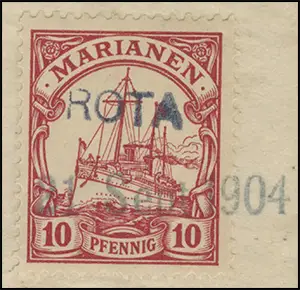
Saipan was the only post office in the colony and used one cancel device for the entire period. A post office at Rota was planned, and handwritten or handstamped cancellations exist (right) , but were legitimate only for a very short period.
Postally used examples of the “Marianen” overprinted stamps of 1899 and 1900 are known to have been extensively cancelled with a backdated canceller. Some of these are known to have been cancelled in this fashion as late as 1907, long after the stamps themselves were invalid. These are worth significantly less than stamps with cancels correctly applied on the date shown in the cancel device.
The Marianas, as the Commonwealth of the Northern Mariana Islands, are the only part of the German colonial empire to have been incorporated into the United States. The CNMI voted to become part of the US as an American Commonwealth, a status also held by Puerto Rico. Northern Marianas residents were made US citizens in 1986.
Areas unique to this colonial outpost:
Saipan was the only post office in the colony and used one cancel device for the entire period. A post office at Rota was planned, and handwritten or handstamped cancellations exist (below), but were legitimate only for a very short period.
Postally used examples of the “Marianen” overprinted stamps of 1899 and 1900 are known to have been extensively cancelled with a backdated canceller. Some of these are known to have been cancelled in this fashion as late as 1907, long after the stamps themselves were invalid. These are worth significantly less than stamps with cancels correctly applied on the date shown in the cancel device.
The Marianas, as the Commonwealth of the Northern Mariana Islands, are the only part of the German colonial empire to have been incorporated into the United States. The CNMI voted to become part of the US as an American Commonwealth, a status also held by Puerto Rico. Northern Marianas residents were made US citizens in 1986.
Marshall-Inseln (Marshall Islands)

The Marshall Islands were the first German island colony in the Pacific. German control began in 1885, with establishment of a post office four years later. The post office of the colonial seat, Jaluit atoll, would be the only post office in the colony until a second office opened on the island of Nauru in 1908. No other official post offices would open in the colony during the colonial period, but “Atollpost” (i.e. mail with handwritten cancellations for mail to/from some of the outlying islands) is known between 1902 and 1906.
Vorläufer period: 1889-1897
Kriegsdruck: Kriegsdruck issues were created only for the 3 Pf and 5 M values. The Marshallese 5 M Kriegsdruck issue exists in two forms, one of which was created by mistakenly printing the Type I frame with the Type II vignette. Although this variety was created in error, it is actually more common than the intended printing where both frame and vignette are Type I.
Postal Stationery: Postal cards, including paid reply cards.
Final loss of control: The colony was conquered by both the Japanese and the Australians early in the war. Most of the colony, i.e. the part above the Equator, was occupied by Japan by the end of September 1914. The island of Nauru held out until the arrival of the Australians on 6 November.
Marshall-In.
Areas unique to this colonial outpost:
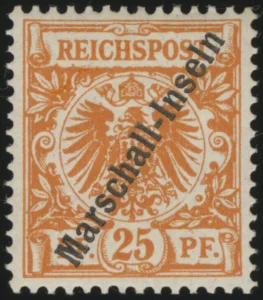
The Marshalls are the one colony where the name of the colony was officially changed, resulting in two different stamp issues. The earliest set of Marshallese stamps shows the name of the colony as “MARSCHALL-INSELN” (right) , diagonally overprinted on the 1889 definitive series. Subsequent issues show the name of the colony as “MARSHALL-INSELN”.
Marshallese occupation issues, created by overprinting German stamps on hand in the colony, were issued in December 1914. These consist of overprints reading “G.R.I. / (new value)” applied to Marshallese “Yacht” stamps, and these were used largely on Nauru.
Along with the Carolines and the Marianas, the Marshall Islands were administered by the United States as part of the UN Trust Territory of the Pacific. While this political entity was in existence (1947-1984, to 1994 for Palau) US stamps were used.
For collectors of new issues, the Marshall Islands are one of four colonies which continue to issue stamps under the same name as that used during the German colonial period. The others are Cameroon, Togo, and Samoa.
Areas unique to this colonial outpost:
The Marshalls are the one colony where the name of the colony was officially changed, resulting in two different stamp issues. The earliest set of Marshallese stamps shows the name of the colony as “MARSCHALL-INSELN” (below), diagonally overprinted on the 1889 definitive series. Subsequent issues show the name of the colony as “MARSHALL-INSELN”.
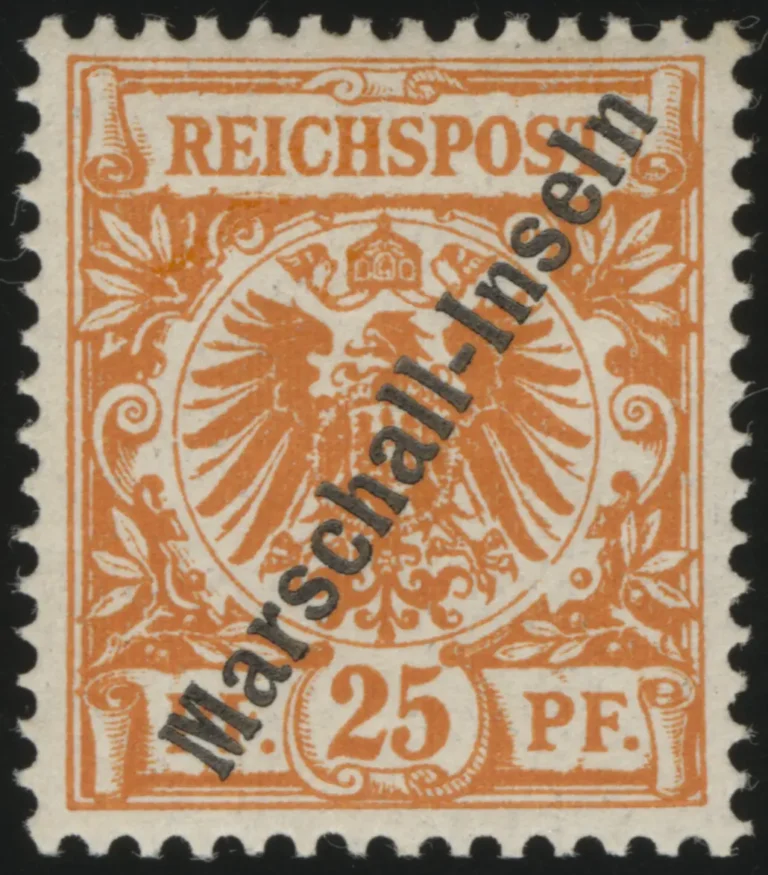
Marshallese occupation issues, created by overprinting German stamps on hand in the colony, were issued in December 1914. These consist of overprints reading “G.R.I. / (new value)” applied to Marshallese “Yacht” stamps, and these were used largely on Nauru.
Along with the Carolines and the Marianas, the Marshall Islands were administered by the United States as part of the UN Trust Territory of the Pacific. While this political entity was in existence (1947-1984, to 1994 for Palau) US stamps were used.
For collectors of new issues, the Marshall Islands are one of four colonies which continue to issue stamps under the same name as that used during the German colonial period. The others are Cameroon, Togo, and Samoa.
Samoa

The final colony established by Imperial Germany, the German postal presence predated the founding of the colony by nearly a generation. The German post office at Apia opened on 21 September 1886 as a post office abroad, while the official colonization of Samoa did not occur until 1 March 1900. Cancels for the German Post Office at Apia used prior to 1901 were also inscribed as for use at a German Office Abroad; nearly all carry the inscription “Kaiserl. Deutsche Postagentur” as do the similar period cancels from the offices in Turkey and China. Diagonal overprints reading “Samoa” were applied in one setting to 1889 series stamps, which were replaced after about six months with “Yacht” series stamps.
Vorläufer period: 1886-1900, longer than any other German colony and almost as long as the Vorläufer period for the German Offices in Turkey.
Kriegsdruck: Kriegsdruck issues were created for the 3 Pf, 5 Pf, 10 Pf, and 5 M values. No watermarked stamps were available in the colony during the period of German control.
Postal Stationery: Postal cards, including paid reply cards.
Final loss of control: Samoa was occupied by New Zealand, with the help of Australian, British, and French forces. New Zealand occupation commenced on 29 August 1914.
Samoa
Areas unique to this colonial outpost:
Samoa had a postal system with stamps issued in British currency before German colonization in 1900.
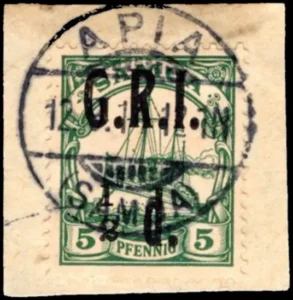
Unused German colonial stamps still in Samoa when the colony was occupied by New Zealand troops in 1914 were overprinted with values in British currency and were used as occupation issues (right) .
Samoa, along with the Marshall Islands, Togo, and Cameroon, are the only German colonial entities which continue to issue stamps under the same names they had as German colonies—although the other three countries have different borders than they did when they were German colonies.
Areas unique to this colonial outpost:
Samoa had a postal system with stamps issued in British currency before German colonization in 1900.
Unused German colonial stamps still in Samoa when the colony was occupied by New Zealand troops in 1914 were overprinted with values in British currency and were used as occupation issues (below).
Samoa, along with the Marshall Islands, Togo, and Cameroon, are the only German colonial entities which continue to issue stamps under the same names they had as German colonies—although the other three countries have different borders than they did when they were German colonies.
Togo

The colony of Togo was one of the first settled, so has one of the longest postal histories among the German colonies. Despite its small size, Togo generated a lot of postal traffic, largely due to successful German commercial enterprises there. Only Samoa and Togo were eventually commercially successful enough to be economically self-sufficient. All of the other colonies were supported by regular cash payments from the Imperial Treasury.
The stamps issued by German Togo were fairly typical. Six values of diagonal overprints were printed beginning in 1897, and the normal range of values of “Yacht” stamps appeared in late 1900.
Vorläufer period: 1888-1897
Kriegsdruck: Kriegsdruck printings were made of the 3 Pf and 5 M values. Friedensdruck printings on watermarked paper were made for the 5 Pf and 10 Pf values and were used in the colony.
Postal Stationery: Postal cards, including paid reply cards.
Final loss of control: 26 August 1914. Togo was the first colony to be occupied by the Allies, less than a month into the war.
Togo
Areas unique to this colonial outpost:
The watermarked 10 Pf exists in fairly large quantities in mint condition, but few saw genuine postal use. These command prices higher than that of any of the used Togo stamps without watermark, excepting only the unwatermarked 5 M and sometimes the 3 M stamps.
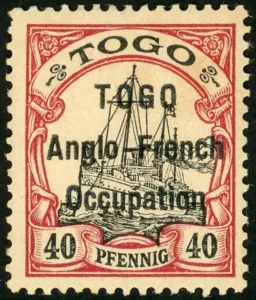
German Togo stamps were overprinted by both the French and the British (right) as occupation issues, and these have numerous settings and varieties for the specialist to pursue.
Cancel collectors may also search for examples of the German cancel devices used on French Togo stamps, as the cancel devices remained in use during and after the occupation. Unlike in other colonies, these were used unaltered, and their appearance only changes over time and due to wear.
Areas unique to this colonial outpost:
The watermarked 10 Pf exists in fairly large quantities in mint condition, but few saw genuine postal use. These command prices higher than that of any of the used Togo stamps without watermark, excepting only the unwatermarked 5 M and sometimes the 3 M stamps.
German Togo stamps were overprinted by both the French and the British (below) as occupation issues, and these have numerous settings and varieties for the specialist to pursue.
Cancel collectors may also search for examples of the German cancel devices used on French Togo stamps, as the cancel devices remained in use during and after the occupation. Unlike in other colonies, these were used unaltered, and their appearance only changes over time and due to wear.
Vorläufer & Mitläufer
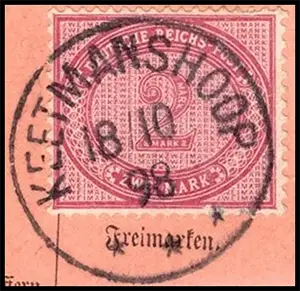
In the case of the majority of the colonies and offices abroad, Vorläufer are typically stamps of the German Empire that were placed in use before distinctive colonial stamps were issued. A few exceptions do exist. The colonies in the Mariana and Caroline Islands, as well as the post offices in Morocco, had distinctive issues from the first day of postal operations, so there are no Vorläufer known for these areas. Kiautschou Vorläufer are usually stamps of the German Offices in China, but can also be stamps of Germany proper. An example of a Vorläufer from German Southwest Africa (right) shows an otherwise ordinary German 2 Mark stamp from the 1890’s with a cancel applied at the GSWA post office at Keetmanshoop.
The term “Mitläufer” has no direct translation in English, but means approximately “concurrent use” or “tolerated franking.” In the German colonial context, it refers to a stamp of Germany proper accepted as valid at a colonial post office or an office abroad, despite the availability of a local issue. The colonies accepted any stamp valid in Germany as a proper franking, in small quantities, for as long as Berlin remained in control of that colony. Some were created when someone happened to bring German stamps with them to a colony, particularly in the case when a German military vessel happened to call on a port in a German colony. Most were likely to have been created when German stamps purchased before distinctive issues appeared were used up in the course of ordinary postal business. Whatever their origin, Mitläufer are typically encountered in smaller quantities than Vorläufer.
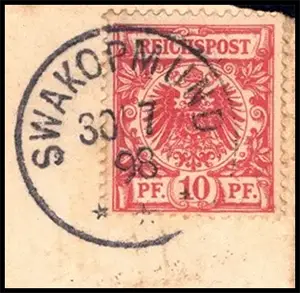
Collecting both Vorläufer and Mitläufer requires obtaining used stamps and knowledge of dates of use. A stamp may have been purchased at a colonial office or a post office abroad, but unless it was also used there, there is no way to absolutely determine this fact. Additionally, determining whether a stamp is a Vorläufer or a Mitläufer requires a clear postmark date to determine whether it was used before or after a colonial replacement was issued. The image of a Mitläufer (right) shows a clear cancel from Swakopmund, GSWA, applied on 30 July 1898. This stamp was used in GSWA nearly a year after a distinctive stamp with overprint was issued in July 1897, making the 1898 usage a Mitläufer.
This can be somewhat complicated for colonies that issued different stamps issues at different times. For example, Kiautschou issued a 5 Pf stamp on 9 May 1900, but issued no other denominations of stamps until January 1901. Thus, during the period from 9 May 1900 until January 1901, use in Kiautschou of 5 Pf stamps from the German Offices in China or German Empire would be considered Mitläufer, but use of any other denomination would still be a Vorläufer, as no Kiautschou stamps of the other denominations were available during that period.
In the case of the majority of the colonies and offices abroad, Vorläufer are typically stamps of the German Empire that were placed in use before distinctive colonial stamps were issued. A few exceptions do exist. The colonies in the Mariana and Caroline Islands, as well as the post offices in Morocco, had distinctive issues from the first day of postal operations, so there are no Vorläufer known for these areas. Kiautschou Vorläufer are usually stamps of the German Offices in China, but can also be stamps of Germany proper. An example of a Vorläufer from German Southwest Africa (below) shows an otherwise ordinary German 2 Mark stamp from the 1890’s with a cancel applied at the GSWA post office at Keetmanshoop.
The term “Mitläufer” has no direct translation in English, but means approximately “concurrent use” or “tolerated franking.” In the German colonial context, it refers to a stamp of Germany proper accepted as valid at a colonial post office or an office abroad, despite the availability of a local issue. The colonies accepted any stamp valid in Germany as a proper franking, in small quantities, for as long as Berlin remained in control of that colony. Some were created when someone happened to bring German stamps with them to a colony, particularly in the case when a German military vessel happened to call on a port in a German colony. Most were likely to have been created when German stamps purchased before distinctive issues appeared were used up in the course of ordinary postal business. Whatever their origin, Mitläufer are typically encountered in smaller quantities than Vorläufer.
Collecting both Vorläufer and Mitläufer requires obtaining used stamps and knowledge of dates of use. A stamp may have been purchased at a colonial office or a post office abroad, but unless it was also used there, there is no way to absolutely determine this fact. Additionally, determining whether a stamp is a Vorläufer or a Mitläufer requires a clear postmark date to determine whether it was used before or after a colonial replacement was issued. The image of a Mitläufer (below) shows a clear cancel from Swakopmund, GSWA, applied on 30 July 1898. This stamp was used in GSWA nearly a year after a distinctive stamp with overprint was issued in July 1897, making the 1898 usage a Mitläufer.
This can be somewhat complicated for colonies that issued different stamps issues at different times. For example, Kiautschou issued a 5 Pf stamp on 9 May 1900, but issued no other denominations of stamps until January 1901. Thus, during the period from 9 May 1900 until January 1901, use in Kiautschou of 5 Pf stamps from the German Offices in China or German Empire would be considered Mitläufer, but use of any other denomination would still be a Vorläufer, as no Kiautschou stamps of the other denominations were available during that period.
Overprints
Many of the colonial and offices abroad stamps were created by overprinting contemporary German stamps. This was done by running sheets of stamps through a printing press which changed a stamp’s denomination, added an additional inscription, or both.
In the case of colonial issues, there was typically one overprinted issue where the name of the colony was overprinted diagonally over the face of the stamp. All of the stamps to which this overprint were applied are examples of the 1889 “Krone / Adler” (Crown / Eagle) definitive series.
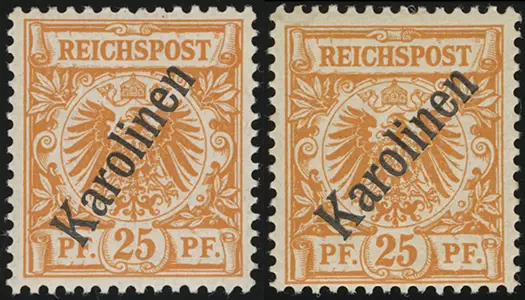
For those colonies with a second such issue, the differences were either one of spelling – “Marschall-Inseln” versus “Marshall-Inseln“, “Deutsch-Südwest-Afrika” versus “Deutsch-Südwestafrika” – or angle of the overprint – for example, 48° / 56° (top right) in Karolinen and Marianen. All of these overprints are in black.
In the case of issues for the offices abroad, three major types of overprint occur. For China and Morocco, diagonal overprints on the 1889 issue were created. On issues for Turkey, horizontal overprints were issued at the same time, but which were slightly different in ways which will be discussed in a description of that area. All of these overprints were in black.
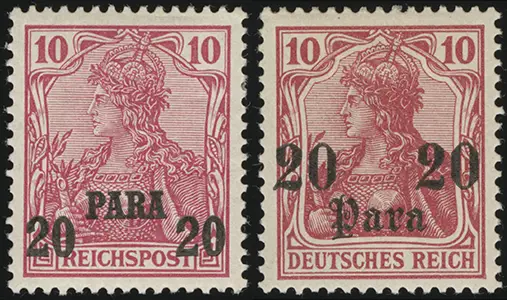
Once the 1900 “Germania” series appeared, new overprints appeared for all offices, all of which were horizontal and were also in black. An exception to this was the overprint applied to the 3 Mark stamp, which was vertical, on both sides of the stamp, and in red ink. Stamps issued prior to 1905 had overprints in “Lateinschrift“, a Latin font (left in image at middle right). Issues for 1905 and after were overprinted in “Frakturschrift”, an ornate Gothic font associated with German printing until the 1940s (right in image at middle right).
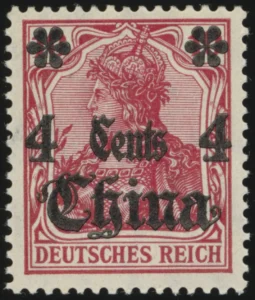
Additionally, the Frakturschrift overprints for China included small additional ornaments, called “rosettes” which were placed so as to cover up the stamp’s original denomination (lower right).
Handstamp overprints are encountered, but only as provisional or emergency issues. Stamps with handstamped overprints were issued in the Carolines, China, and Kiautschou.
Many of the colonial and offices abroad stamps were created by overprinting contemporary German stamps. This was done by running sheets of stamps through a printing press which changed a stamp’s denomination, added an additional inscription, or both.
In the case of colonial issues, there was typically one overprinted issue where the name of the colony was overprinted diagonally over the face of the stamp. All of the stamps to which this overprint were applied are examples of the 1889 “Krone / Adler” (Crown / Eagle) definitive series.
For those colonies with a second such issue, the differences were either one of spelling – “Marschall-Inseln” versus “Marshall-Inseln“, “Deutsch-Südwest-Afrika” versus “Deutsch-Südwestafrika” – or angle of the overprint – for example, 48° / 56° (below) in Karolinen and Marianen. All of these overprints are in black.
In the case of issues for the offices abroad, three major types of overprint occur. For China and Morocco, diagonal overprints on the 1889 issue were created. On issues for Turkey, horizontal overprints were issued at the same time, but which were slightly different in ways which will be discussed in a description of that area. All of these overprints were in black.
Once the 1900 “Germania” series appeared, new overprints appeared for all offices, all of which were horizontal and were also in black. An exception to this was the overprint applied to the 3 Mark stamp, which was vertical, on both sides of the stamp, and in red ink. Stamps issued prior to 1905 had overprints in “Lateinschrift“, a Latin font (left in image below). Issues for 1905 and after were overprinted in “Frakturschrift”, an ornate Gothic font associated with German printing until the 1940s (right in image below).
Additionally, the Frakturschrift overprints for China included small additional ornaments, called “rosettes” which were placed so as to cover up the stamp’s original denomination (below).
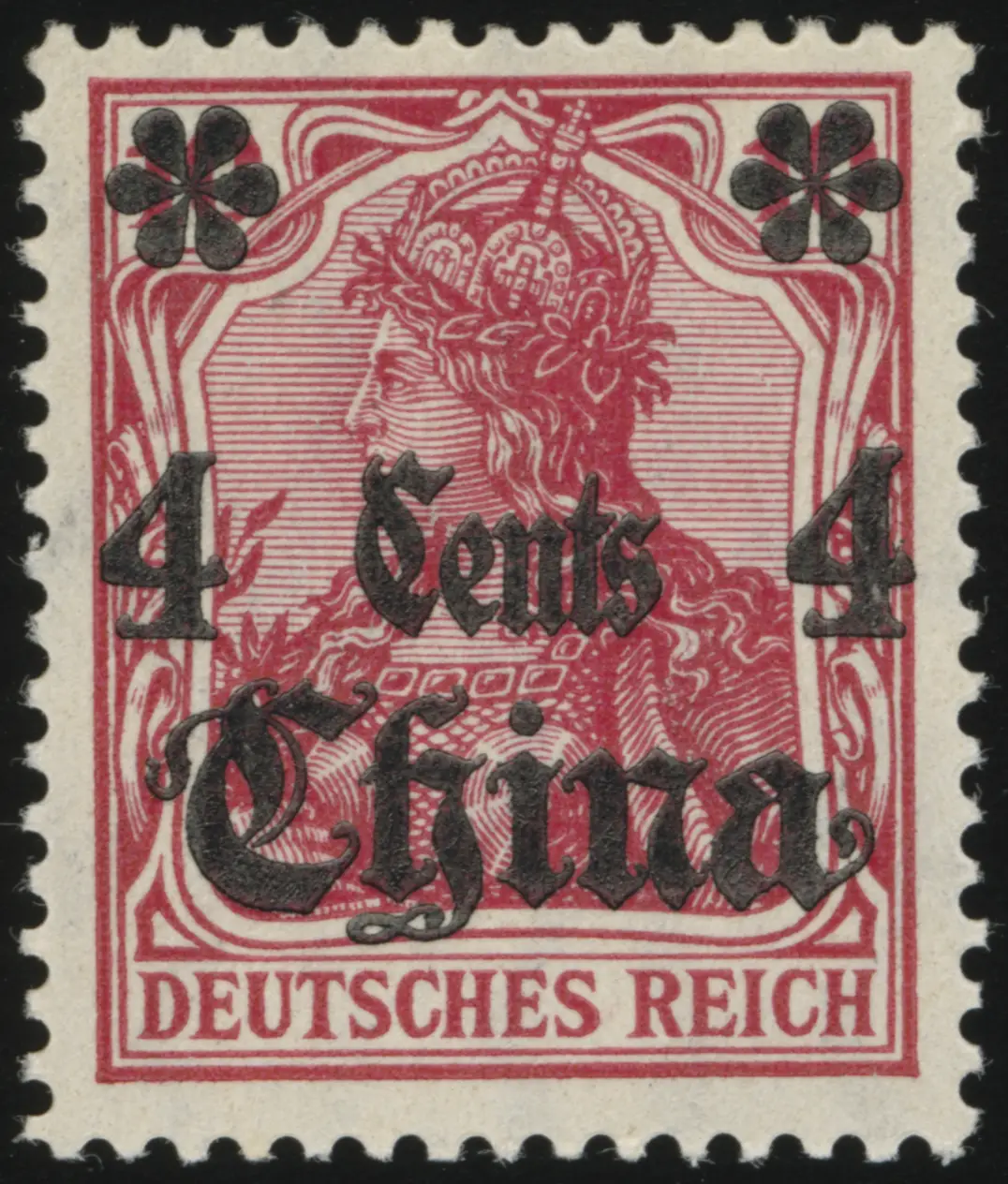
Handstamp overprints are encountered, but only as provisional or emergency issues. Stamps with handstamped overprints were issued in the Carolines, China, and Kiautschou.
The “Yacht” Issues
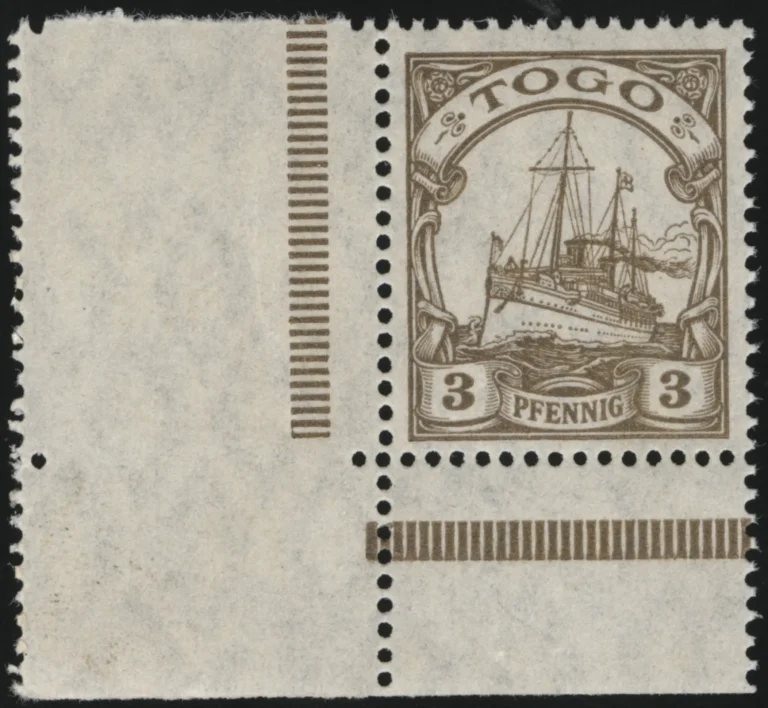
The “’Yacht” series was the first (and only) stamp design specifically produced for use in the colonies but not at the offices abroad. Stamps of this series all show an engraved image of the SMJ Neue Hohenzollern, the Kaiser’s Imperial Yacht, and are generally thought of as a keytype series. Printed in Berlin, they match the colors and face values found on contemporary German stamps of the “Germania” series, excepting that some denominations were never issued for the colonies.
Stamps were issued in two sizes, identical to those in Germany. Those with a face value of less than 1 Mark are smaller than those of 1 Mark and greater, and these two sizes are sometimes referred to as “Small Yachts” and “Large Yachts” respectively.
Small Yachts with face values up to 20 Pfennig are single color (left in image at right), while those from 25 Pf to 80 Pf have the ship vignette and the frame of the stamp printed in different colors (right in image at right), some on tinted paper of a third color, and with the colony name and denomination printed in black.
Large Yachts are single color except for the high value of the series, which was had one color for the frame and another for the vignette.
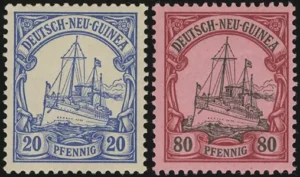
The “’Yacht” series was the first (and only) stamp design specifically produced for use in the colonies but not at the offices abroad. Stamps of this series all show an engraved image of the SMJ Neue Hohenzollern, the Kaiser’s Imperial Yacht, and are generally thought of as a keytype series. Printed in Berlin, they match the colors and face values found on contemporary German stamps of the “Germania” series, excepting that some denominations were never issued for the colonies.
Stamps were issued in two sizes, identical to those in Germany. Those with a face value of less than 1 Mark are smaller than those of 1 Mark and greater, and these two sizes are sometimes referred to as “Small Yachts” and “Large Yachts” respectively.
Small Yachts with face values up to 20 Pfennig are single color (top right), while those from 25 Pf to 80 Pf have the ship vignette and the frame of the stamp printed in different colors (bottom right), some on tinted paper of a third color, and with the colony name and denomination printed in black.
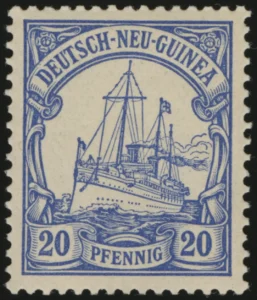
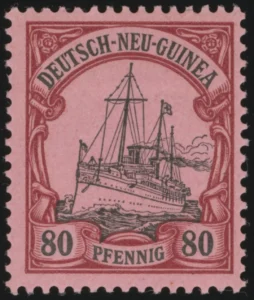
Large Yachts are single color except for the high value of the series, which was had one color for the frame and another for the vignette.
Seepost / Seapost
In German philately, special terms exist for postmarks and facilities that could travel. Seepost facilities were those which existed aboard ships. These facilities had distinctive postmarks associated with them, and are highly collectable in their own right.
Seepost cancels can be found on nearly all German colonial issues. All of the German colonies had a sea coast, and most relied on ships to transport mail between the colonies and to / from Germany at one point or another. Most Seepost cancels show the name of the ship line on which they were applied. This was particularly true in the Pacific; these shipping lines could be the primary link between the colonies and the outside world.
Among the most commonly encountered Seepost postmarks among the Africa colonies are those of the Hamburg-Westafrika Linie (right) and the various forms of the Ost-Afrika lines.
Among the most commonly encountered Seepost postmarks among the Pacific colonies are those of the various New Guinea lines, the Jaluit line, and the lines servicing China and Kiautschou. Although individual colonies did not have their own Seepost markings, the German Offices in China operated Seepost facilities between Shanghai and Tientsin to speed up mail deliveries between different parts of China.
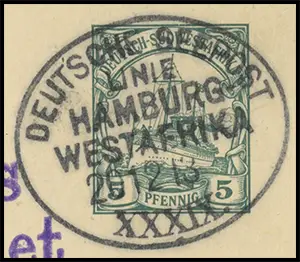
In German philately, special terms exist for postmarks and facilities that could travel. Seepost facilities were those which existed aboard ships. These facilities had distinctive postmarks associated with them, and are highly collectable in their own right.
Seepost cancels can be found on nearly all German colonial issues. All of the German colonies had a sea coast, and most relied on ships to transport mail between the colonies and to / from Germany at one point or another. Most Seepost cancels show the name of the ship line on which they were applied. This was particularly true in the Pacific; these shipping lines could be the primary link between the colonies and the outside world.
Among the most commonly encountered Seepost postmarks among the Africa colonies are those of the Hamburg-Westafrika Linie (below) and the various forms of the Ost-Afrika lines.
Among the most commonly encountered Seepost postmarks among the Pacific colonies are those of the various New Guinea lines, the Jaluit line, and the lines servicing China and Kiautschou. Although individual colonies did not have their own Seepost markings, the German Offices in China operated Seepost facilities between Shanghai and Tientsin to speed up mail deliveries between different parts of China.
Marine-Schiffspost / Naval Ship Post
Another type of postmark that can be found used in the colonies is the Marine-Schiffspost (Naval Ship Post), or MSP cancel. Most German naval vessels of the period had on-board postal facilities, and were assigned numbered postmarks for use on mail processed by those facilities.
During the colonial period, Germany had naval vessels assigned to several stations around the world (West African Station, East African Station, East Asia Station, etc.), including several in the colonies, for the purpose of protecting German interests worldwide. The ships assigned to these stations frequent patrolled throughout the German colonies and to the countries with PO Abroad. As a result, MSP postmarks (right) are known used on postage from all of the German Colonies and PO Abroad.
Additionally, during periods in which Germany was moving large numbers of troops to and from the colonies, these postmarks were also used on-board civilian steamers chartered by the German Navy for troop transport.
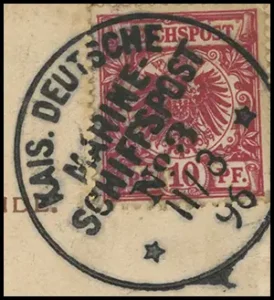
Another type of postmark that can be found used in the colonies is the Marine-Schiffspost (Naval Ship Post), or MSP cancel. Most German naval vessels of the period had on-board postal facilities, and were assigned numbered postmarks for use on mail processed by those facilities.
During the colonial period, Germany had naval vessels assigned to several stations around the world (West African Station, East African Station, East Asia Station, etc.), including several in the colonies, for the purpose of protecting German interests worldwide. The ships assigned to these stations frequent patrolled throughout the German colonies and to the countries with PO Abroad. As a result, MSP postmarks (below) are known used on postage from all of the German Colonies and PO Abroad.
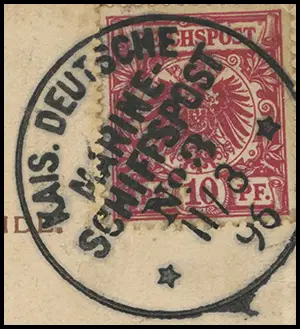
Additionally, during periods in which Germany was moving large numbers of troops to and from the colonies, these postmarks were also used on-board civilian steamers chartered by the German Navy for troop transport.
Bahnpost / Railway Post
Bahnpost facilities were those postal facilities that existed aboard trains. Bahnpost was a bit more limited than Seepost in is prevalence.
The most extensive German-built railroads were installed in German Southwest Africa, German East Africa, and Kamerun.
The other colonies did not have any rail facilities except for Kiautschou. The Germans built a railroad in China’s Shandong (formerly Shantung) province connecting the city of Weihsien in China with the Kiautschou colonial capitol at Tsingtau, which would eventually provide rail connections between Kiautschou and Germany via Russia’s Trans-Siberian Railway.
All of these used oval cancel devices (right) similar to those used on board trains in Germany proper for the length of colonial administration, except in German Southwest Africa where the use of such cancels ended in 1903.
In addition, in German Southwest Africa, numerous provisional Bahnpost markings are known. These manuscript cancels and cancels made with handstamped station marks are the result of provisional requirements as the railway was being constructed and philatelic creations by interested parties along the railway.
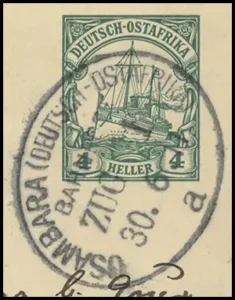
Bahnpost facilities were those postal facilities that existed aboard trains. Bahnpost was a bit more limited than Seepost in is prevalence.
The most extensive German-built railroads were installed in German Southwest Africa, German East Africa, and Kamerun.
The other colonies did not have any rail facilities except for Kiautschou. The Germans built a railroad in China’s Shandong (formerly Shantung) province connecting the city of Weihsien in China with the Kiautschou colonial capitol at Tsingtau, which would eventually provide rail connections between Kiautschou and Germany via Russia’s Trans-Siberian Railway.
All of these used oval cancel devices (below) similar to those used on board trains in Germany proper for the length of colonial administration, except in German Southwest Africa where the use of such cancels ended in 1903.
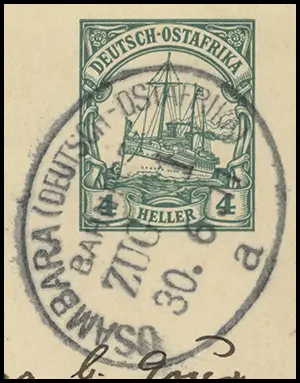
In addition, in German Southwest Africa, numerous provisional Bahnpost markings are known. These manuscript cancels and cancels made with handstamped station marks are the result of provisional requirements as the railway was being constructed and philatelic creations by interested parties along the railway.
Feldpost / Military Mail
Feldpost, or military field mail, is also a facet of German colonial philately.
Military mail facilities were in place in northern China during 1900 and 1902, during and shortly after the “Boxer Rebellion.” Initial Feldpost service was provisional, with non-standard postmarks and temporary or mobile Feldpost stations. Postmarks from this period are primarily from locally made cancellers or cancellers assigned to the Expedition sent from Germany.
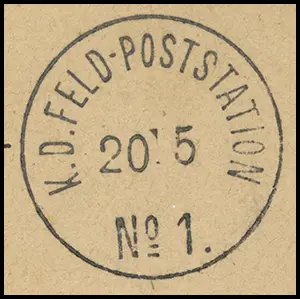
Eventually, ten military post offices (Feldpoststation) were established (right), some of which became civilian post offices after combat was over.
Military mail in China during this period also led to some unique aspects of German colonial philately, particularly provisional cancels and provisional cancels applied on trains.
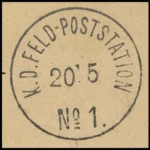
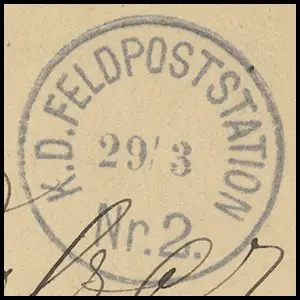
One other colony, German Southwest Africa, had military post offices. Four of these facilities (right) were created in the period 1904-1906 during the “Ovaherero Uprising” in this colony, and numerous civilian post offices cancelled Feldpost mail as troops passed through the area.
Most of the Feldpost examples are stampless, as the military could use the post for free—but the cancels are known to have been applied to stamps and postal stationery as well. These items also often carry markings of the sender’s unit, either handwritten or with a unit handstamp, as it was a requirement that the sender include his name and unit on all items sent free of charge.
A large amount of Feldpost from German Southwest Africa is also known from German naval vessels participating in the conflicts or from German military personnel being transported to and from German Southwest Africa aboard steamers chartered for that purpose.
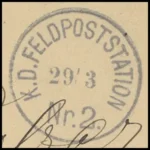
With regard to the First World War, fewer explicitly military related topics exist. Feldpost facilities did exist in German East Africa, and cancels associated with the town of Taveta—in British East Africa, but occupied by the Germans—are documented.
But as most of the colonies were occupied by the Allies within months of the start of the War, the Germans had few opportunities to establish such facilities. Most of the military mail associated with the First World War is associated with specific ships which happened to be in a colony rather than with the colony itself.
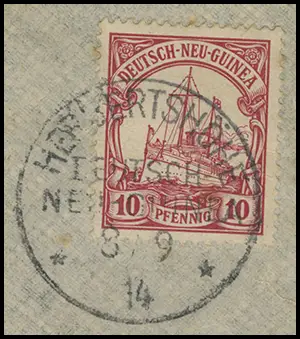
Instead of collecting military-related mail from the colonies, most German colonial collectors focus instead on “War Date” mail or censored mail, i.e. mail which clearly shows a date of posting after the start of the war on 28 July 1914 (right). For some colonies, (Togo and all of the Pacific colonies) War Date cancels are exceedingly scarce as Germany lost control of these between August and November of 1914. Collectors of such material usually look to German East Africa and German Southwest Africa, where German control lasted until 1915 or later, or the German Offices in China (1917) and Morocco (1919).
Feldpost, or military field mail, is also a facet of German colonial philately.
Military mail facilities were in place in northern China during 1900 and 1902, during and shortly after the “Boxer Rebellion.” Initial Feldpost service was provisional, with non-standard postmarks and temporary or mobile Feldpost stations. Postmarks from this period are primarily from locally made cancellers or cancellers assigned to the Expedition sent from Germany.
Eventually, ten military post offices (Feldpoststation) were established (below), some of which became civilian post offices after combat was over.
Military mail in China during this period also led to some unique aspects of German colonial philately, particularly provisional cancels and provisional cancels applied on trains.
One other colony, German Southwest Africa, had military post offices. Four of these facilities (below) were created in the period 1904-1906 during the “Ovaherero Uprising” in this colony, and numerous civilian post offices cancelled Feldpost mail as troops passed through the area.
Most of the Feldpost examples are stampless, as the military could use the post for free—but the cancels are known to have been applied to stamps and postal stationery as well. These items also often carry markings of the sender’s unit, either handwritten or with a unit handstamp, as it was a requirement that the sender include his name and unit on all items sent free of charge.
A large amount of Feldpost from German Southwest Africa is also known from German naval vessels participating in the conflicts or from German military personnel being transported to and from German Southwest Africa aboard steamers chartered for that purpose.
With regard to the First World War, fewer explicitly military related topics exist. Feldpost facilities did exist in German East Africa, and cancels associated with the town of Taveta—in British East Africa, but occupied by the Germans—are documented.
But as most of the colonies were occupied by the Allies within months of the start of the War, the Germans had few opportunities to establish such facilities. Most of the military mail associated with the First World War is associated with specific ships which happened to be in a colony rather than with the colony itself.
Instead of collecting military-related mail from the colonies, most German colonial collectors focus instead on “War Date” mail or censored mail, i.e. mail which clearly shows a date of posting after the start of the war on 28 July 1914 (below). For some colonies, (Togo and all of the Pacific colonies) War Date cancels are exceedingly scarce as Germany lost control of these between August and November of 1914. Collectors of such material usually look to German East Africa and German Southwest Africa, where German control lasted until 1915 or later, or the German Offices in China (1917) and Morocco (1919).
Stamp Paper & Ink
The majority of German colonial stamps were printed on ordinary paper. Once distinct stamps were produced for the colonies and offices, stamp colors and printing features matched those of the stamps with the same denominations from Germany proper, as well as equivalent stamps from the other colonies that used the German Mark as their currency. This included stamps which were printed on tinted papers, a feature that first appeared in 1900.
For those colonies that did not use the Mark, stamp colors and papers matched as closely as possible whichever German stamp was closest in value to the colonial issue. For example, the $1/2 stamp issued by Kiautschou is the same shade of carmine as a German 1 Mark stamp, as both were equal in value. By contrast, the high values of German East Africa do not match the shades of any current German stamps, as there was no obviously equivalent value (1 Rupie = 1,33 Mark).
Beginning in 1905, stamps began to be printed on watermarked paper. German colonial stamps that were not printed on ordinary paper were printed only on paper watermarked with a series of diamond lozenges.
This watermark is “Wz. 1 (Wasserzeichen 1) in the Michel catalogue and “Watermark 125” in Scott (right).
The majority of German colonial stamps were printed on ordinary paper. Once distinct stamps were produced for the colonies and offices, stamp colors and printing features matched those of the stamps with the same denominations from Germany proper, as well as equivalent stamps from the other colonies that used the German Mark as their currency. This included stamps which were printed on tinted papers, a feature that first appeared in 1900.
For those colonies that did not use the Mark, stamp colors and papers matched as closely as possible whichever German stamp was closest in value to the colonial issue. For example, the $1/2 stamp issued by Kiautschou is the same shade of carmine as a German 1 Mark stamp, as both were equal in value. By contrast, the high values of German East Africa do not match the shades of any current German stamps, as there was no obviously equivalent value (1 Rupie = 1,33 Mark).
Beginning in 1905, stamps began to be printed on watermarked paper. German colonial stamps that were not printed on ordinary paper were printed only on paper watermarked with a series of diamond lozenges.
This watermark is “Wz. 1 (Wasserzeichen 1) in the Michel catalogue and “Watermark 125” in Scott (below).
Peace & War Printings
The terms Kriegsdruck (war printing) and Friedensdruck (peace printing) are routinely used for stamps issued around the time of the First World War. All German colonial stamps printed on ordinary wove paper are Friedensdruck. For the smaller colonies, the ordinary paper printing of 1900 was large enough that watermarked issues were never issued before the First World War. For the larger colonies, watermarked Friedensdruck printings were made of some denominations, typically the ones which saw the most use. Watermarked Friedensdruck printings of 5 Pf and 10 Pf stamps were made for every colony that issued any watermarked stamps before the war, for instance.
Kriegsdruck issues, by comparison, exist only on watermarked paper. Most were created in 1916 or later, and at a point when Germany had lost control of the colony in question. These stamps were presumably printed under the assumption that German colonial administration would resume once the war was over. As this never happened, genuine postal use of Kriegsdruck issues is typically impossible. The Allied blockade prevented the Germans from sending such stamps to their colonies, even in the event that they retained control. For nearly all colonies, Kriegsdruck issues were created for the high and low values of the series, i.e. the 3 Pf and 5 M values. For the smaller colonies, these were the only Kriegsdruck stamps printed. Larger colonies may have had other values produced, based on projected, post-war demand.
Distinguishing Kriegsdruck from Friedensdruck can be more of an art than a science. Few absolute statements can be made regarding their differences. In general, Friedensdruck stamps (left in image at right) have clean, clear impressions, are well printed, and have brighter colors. The watermarks are always clear, and the gum (for mint issues) is whiter and has a more matte finish. Kriegsdruck stamps (right in image at right) have darker, more drab colors, and were printed with blurry, unclear, or broken impressions from plates that were wearing down. The paper is typically rougher, and the watermark may also be blurry. For unused stamps, the gum is typically more yellow and has a high gloss. In the case of higher values (especially the 5 M value) there are specific printing and perforation varieties that occur only with Kriegsdruck and can sometimes increase their value.
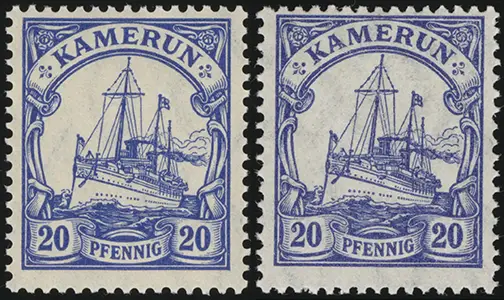
The terms Kriegsdruck (war printing) and Friedensdruck (peace printing) are routinely used for stamps issued around the time of the First World War. All German colonial stamps printed on ordinary wove paper are Friedensdruck. For the smaller colonies, the ordinary paper printing of 1900 was large enough that watermarked issues were never issued before the First World War. For the larger colonies, watermarked Friedensdruck printings were made of some denominations, typically the ones which saw the most use. Watermarked Friedensdruck printings of 5 Pf and 10 Pf stamps were made for every colony that issued any watermarked stamps before the war, for instance.
Kriegsdruck issues, by comparison, exist only on watermarked paper. Most were created in 1916 or later, and at a point when Germany had lost control of the colony in question. These stamps were presumably printed under the assumption that German colonial administration would resume once the war was over. As this never happened, genuine postal use of Kriegsdruck issues is typically impossible. The Allied blockade prevented the Germans from sending such stamps to their colonies, even in the event that they retained control. For nearly all colonies, Kriegsdruck issues were created for the high and low values of the series, i.e. the 3 Pf and 5 M values. For the smaller colonies, these were the only Kriegsdruck stamps printed. Larger colonies may have had other values produced, based on projected, post-war demand.
Distinguishing Kriegsdruck from Friedensdruck can be more of an art than a science. Few absolute statements can be made regarding their differences. In general, Friedensdruck stamps (below left) have clean, clear impressions, are well printed, and have brighter colors. The watermarks are always clear, and the gum (for mint issues) is whiter and has a more matte finish. Kriegsdruck stamps (below right) have darker, more drab colors, and were printed with blurry, unclear, or broken impressions from plates that were wearing down. The paper is typically rougher, and the watermark may also be blurry. For unused stamps, the gum is typically more yellow and has a high gloss. In the case of higher values (especially the 5 M value) there are specific printing and perforation varieties that occur only with Kriegsdruck and can sometimes increase their value.
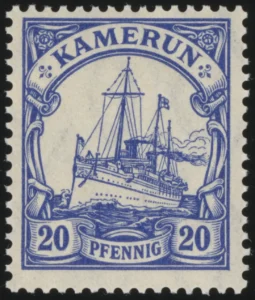
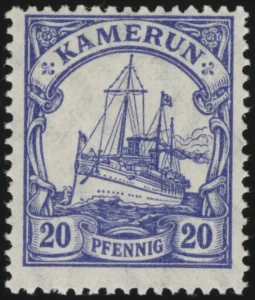
Perforation Varieties
Generally speaking, most Kriegsdruck high values (1 Mark and higher, or equivalent) occur with Michel type B perforations, while most Friedensdruck have Michel type A perforations. There are a few exceptions for each – Kriegsdruck with A perforations, Friedensdruck with Type B. These exceptions are typically the later Kriegsdruck Yacht Issues with A perforations and Friedensdruck Germania issues with B perforations that were overprinted for use in the PO Abroad. The difference is very small, but can also be very valuable for some varieties.
While technically of the same gauge, type A perforations have 26 perforation holes across the top and bottom of the stamp and 17 perforation holes at left and right. These are also referred to as “26:17” perforations (top).

Type B, in contrast, has 25 perforation holes across the top and bottom instead of 26 perforation holes, and are also known as “25:17” or “25:16” perforations (bottom).
Most colonial Kriegsdruck of the higher values that were produced exist with both types of perforations, and this leads to a relatively small difference in value between them, with Type A perfs valued between €5 and €15 more than type B for hinged 5 Mark stamps. But for some colonies, some issues with Type A perfs can be worth significantly more than Type B perfs, particularly for never hinged examples. The German East Africa 3 Rupien with 26:17 perfs (Michel 39 II A) has a CV of between €400 and €700 for a never hinged example based on shade. The same stamp with 25:17 perfs (Michel 39 II B) is valued at €160 in never hinged condition.
Frame & Vignette Differences
The high value of the “Yacht” series was always printed in two colors, with one color for the frame and the other for the vignette.
There were three types of frame and vignette used for printing this value. The main differences between the various types of vignette and frame can be found in the scroll at the top which shows the colony’s name, as well as the shells in the lower corners showing the denomination.
The scroll at the top of the frame shows a single, unbroken arc for the colony name, and was used for colonies with longer names. The upper arc of the vignette for Type I is also unbroken, and lines up with the bottom of the scroll. Three colonies (German New Guinea, German Southwest Africa, and the Marshall Islands) had 5 Mark stamps with Type I frames and vignettes (right).
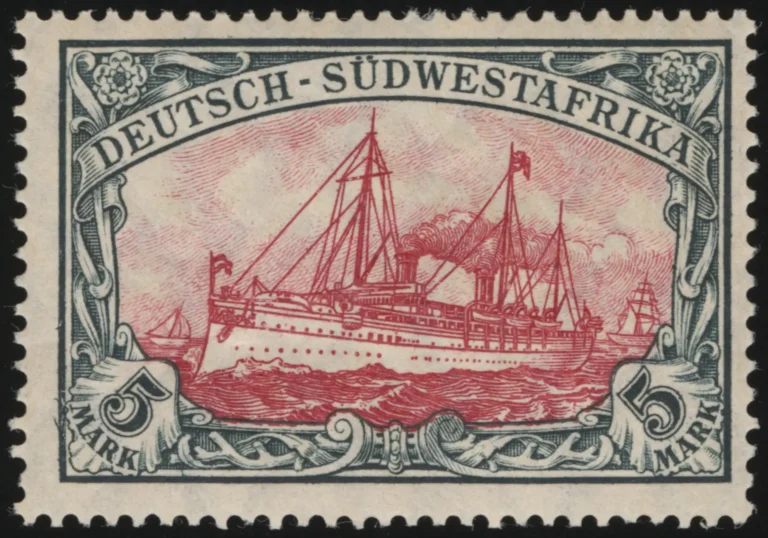
Type II frames and vignettes (right) were used for colonies with shorter names. The scroll at the top of the stamp that shows a name shows an additional “fold” in the scroll at both left and right, with these folds projecting down into the vignette. In order to allow for this, the Type II vignette has two “bites” where the engraved lines of the clouds were removed, to keep the scroll work and the engraving illustrating the clouds from overlapping.
The high values of the “Yacht” issue were issued with Type II vignettes and frames for all colonies except for German East Africa and the three that issued Type I stamps for this value.
Type III vignettes and frames were prepared only for the 3 Rupien stamps of German East Africa. Type III is essentially identical to Type I, except that the shells showing the denominations on Type III are slightly larger than on Type I. This was necessary as the value “3 Rupien” took up more space than the corresponding value “5 Mark” on the Type I issues, requiring the larger shells.
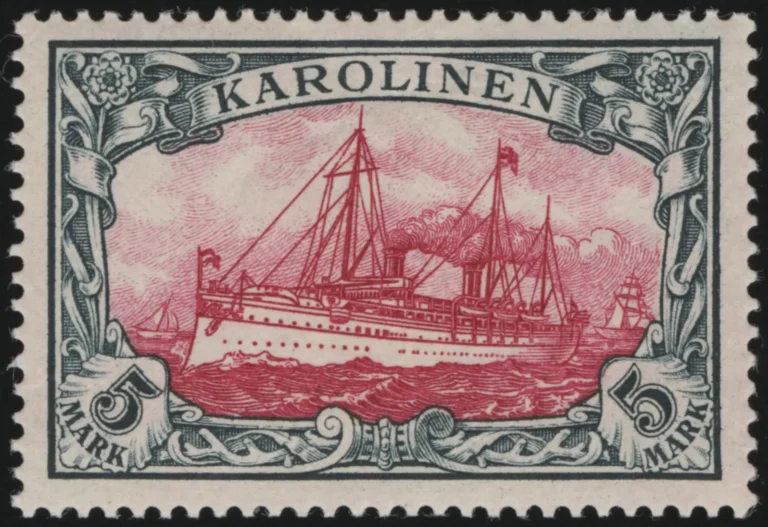
For all pre-war printings, the frame and vignette types were properly matched for each colony. But for some of the printings produced during the war, the stamps were produced so quickly that some 5 Mark stamps for German New Guinea, German Southwest Africa, and the Marshall Islands were printed with mismatched frames and vignettes. German New Guinea was the only colony where all three types of vignettes were used for different print runs, and of these, the combination of a Type I frame with a Type III vignette is the most valuable. The CV of the Type I frame with a Type I vignette is €180 versus €140 with a Type II vignette and €2200 for a Type III vignette (all in never hinged condition; significantly less in hinged).
German Southwest Africa and the Marshall Islands both had the combination of Type I frames with Type II vignettes in addition to Type I vignettes and frames. This created two “bites” in the clouds below the band with the colony’s name on it, which appears as two small, white spaces amid the red clouds (right).
For additional examples and guides, see the GCCG’s Guide to Colonial Frame & Center Types.
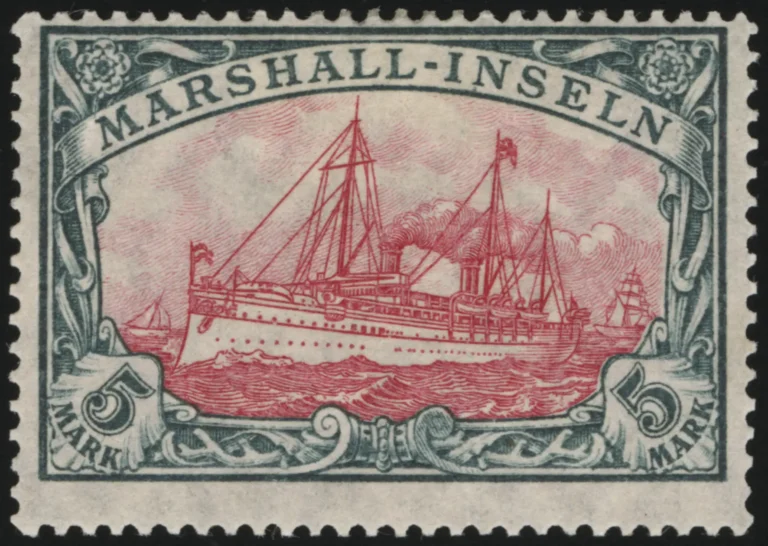
The high value of the “Yacht” series was always printed in two colors, with one color for the frame and the other for the vignette.
There were three types of frame and vignette used for printing this value. The main differences between the various types of vignette and frame can be found in the scroll at the top which shows the colony’s name, as well as the shells in the lower corners showing the denomination.
The scroll at the top of the frame shows a single, unbroken arc for the colony name, and was used for colonies with longer names. The upper arc of the vignette for Type I is also unbroken, and lines up with the bottom of the scroll. Three colonies (German New Guinea, German Southwest Africa, and the Marshall Islands) had 5 Mark stamps with Type I frames and vignettes (below).
Type II frames and vignettes (below) were used for colonies with shorter names. The scroll at the top of the stamp that shows a name shows an additional “fold” in the scroll at both left and right, with these folds projecting down into the vignette. In order to allow for this, the Type II vignette has two “bites” where the engraved lines of the clouds were removed, to keep the scroll work and the engraving illustrating the clouds from overlapping.
The high values of the “Yacht” issue were issued with Type II vignettes and frames for all colonies except for German East Africa and the three that issued Type I stamps for this value.
Type III vignettes and frames were prepared only for the 3 Rupien stamps of German East Africa. Type III is essentially identical to Type I, except that the shells showing the denominations on Type III are slightly larger than on Type I. This was necessary as the value “3 Rupien” took up more space than the corresponding value “5 Mark” on the Type I issues, requiring the larger shells.
For all pre-war printings, the frame and vignette types were properly matched for each colony. But for some of the printings produced during the war, the stamps were produced so quickly that some 5 Mark stamps for German New Guinea, German Southwest Africa, and the Marshall Islands were printed with mismatched frames and vignettes. German New Guinea was the only colony where all three types of vignettes were used for different print runs, and of these, the combination of a Type I frame with a Type III vignette is the most valuable. The CV of the Type I frame with a Type I vignette is €180 versus €140 with a Type II vignette and €2200 for a Type III vignette (all in never hinged condition; significantly less in hinged).
German Southwest Africa and the Marshall Islands both had the combination of Type I frames with Type II vignettes in addition to Type I vignettes and frames. This created two “bites” in the clouds below the band with the colony’s name on it, which appears as two small, white spaces amid the red clouds (below).
For additional examples and guides, see the GCCG’s Guide to Colonial Frame & Center Types.
References
Friedemann, A. (1980). The Stamps and Cancels of the German Colonies and the German Post Offices Abroad, Section XI Marshall Islands. Translated by Alfred K. Walter. Wilmington, DE: German Colonies Collector Group.
Michel Redaktion (ed.) (2025). Michel Germany Specialized Catalog 2025 (Part 1). Bobingen, Germany: Schwaneberger Verlag Gmbh.
Nössig, T. (ed.) (2019). Catalog of the Postmarks of the German Colonies & Post Offices Abroad (1st English ed). Berlin, Germany: Arbeitsgemeinschaft der Sammler deutscher Kolonialpostwertzeichen.
Illustrations courtesy of Jerry Miller, Jochen Vogenbeck, Oliver Wyrtki, Gannon Sugimura, & Jed Dorman.