
Beginners Guide
Post Offices in China
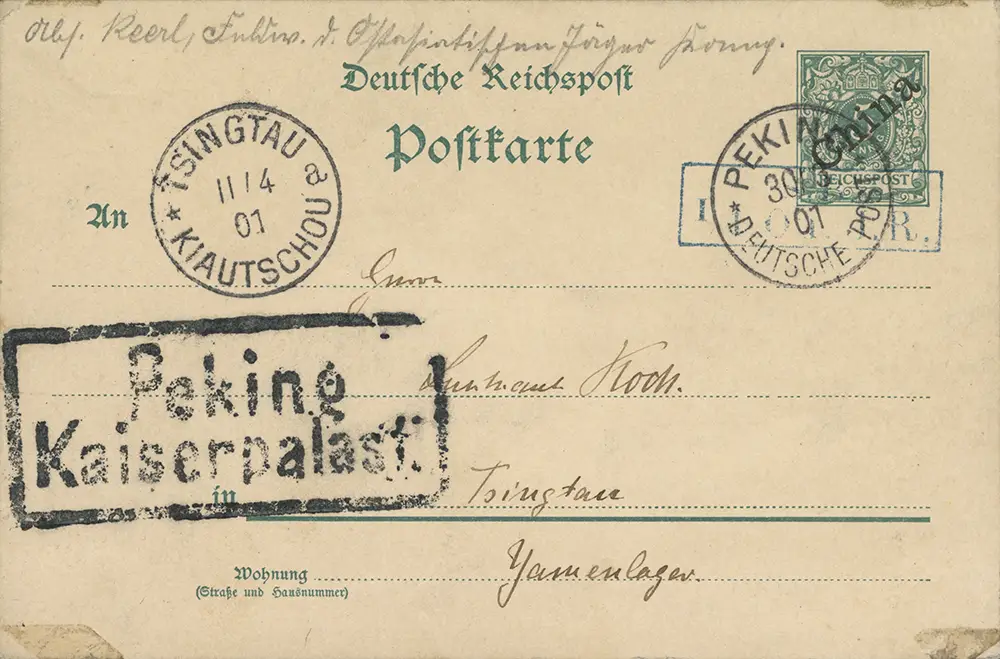
Postcard from Imperial Palace in Peking to Tsingtau, Kiautschou, 20 March 1901
General

PO China
PO Morocco

PO Turkey
D-NG

D-OA

D-SWA

Kamerun

Karolinen

Kiautschou

Marianen

Marshall-In.
Samoa
Togo
German Post Offices in China
By Gannon Sugimura
Introduction

This guide will deal with the historical aspects of how Germany’s postal network in China evolved, and why the Germans placed their post offices where they did. Over the course of its existence, Germany opened offices in multiple places, and some closed after just a short time. One factor that has not apparently been explored is why Germany chose to open an office in a particular location, and what factors led to closing it if it closed earlier than others. In particular, competition from other nations’ postal facilities appears to have been a factor-but not necessarily in the way that most would expect.
But first, what is a Post Office Abroad (POA)? Ordinarily, a country’s post office has a monopoly on postal services only within the borders of that country. When a country opens a post office that is located in another country, that would then be considered a POA. Were this to happen today, it would be as if the US Post Office were to open branches in Canada, France, or anywhere else in the world that is not part of the US.
Post Offices Abroad of the 19th century were officially opened when Country A had business or other connections in Country B, which required communication between the two nations. In an era with no telephones, internet, or even telegraph lines, that meant a postal service. A POA was typically opened because the postal service in Country B was deemed inadequate for whatever reason.
In the case of China, a series of municipal and local posts had agreements with each other to transfer mail around the country. While some of these local posts were efficient, others were not. Areas not served by one of the municipal posts could be denied postal services completely. There was no national-level postal service until the Imperial Chinese Post was established in 1898.
Once the Imperial Chinese Post was established, it still took more time to get international service. In order for any country’s stamps to be accepted in the international mails, that country must be a member of the Universal Postal Union (UPU). China did not join the UPU until 1914; prior to that, it was impossible to mail a letter to foreign destinations without the involvement of a German or other foreign POA whose mother country was a UPU member. In order to do this, foreign posts had to accept and postmark a piece of mail from China-and for this service, they often required payment of whatever postage they deemed fit, even if Chinese stamps were affixed to it.
One additional reason for a customer to use a POA was that most such offices charged domestic rates for items posted to the home country. In the case of Germany, Berlin subsidized mail to and from the German offices in China by charging domestic rates for letters, starting in 1908. Postal customers thus paid less than half the postage they would otherwise have been charged-but only for letters. Heavier items like parcels were never subsidized in this manner.
Unofficially, however, a POA was also a sign of imperialism. Most countries that did open such offices did so because they could-not just because there was a need. No country worthy of being called a world power failed to open a postal presence in China by the end of the 19th century. This was not limited to postal affairs. With the exception of the United States, each of the major powers also carved out “spheres of influence” within China in which it was the dominant foreign power and in which its laws applied to its citizens, to the exclusion of any conflicts the foreign power’s law had with Chinese law.
All the countries that had offices in China could have closed them in 1914 once China joined the UPU, but none of them actually did so at that time. Italy even waited until 1917 to open its POAs there – even though there was no need for such facilities by then. For the duration of their existence, the foreign posts were at best an irritation to China. The foreign posts clearly infringed on Chinese sovereignty, as they routinely handled mail delivery within China, not just facilitating the exchange of mail sent overseas.
Do POAs still exist? The short answer is yes, but not in the same manner as before. Most countries have the option of handing the mail for their embassies and (if applicable) their military facilities in other countries. The difference is that all ordinary mail to and from such facilities is now subject to the customs controls of the country where the embassy or military base is located.
As was the case with colonial activity in general, Germany arrived late in China. Britain had had more than a dozen post offices in China open for nearly 50 years by the time the first German office opened, for example. Except for Italy, Germany was the last foreign power to open offices in China. Although Germany opened two offices at Shanghai and Tientsin prior to 1900, Germany did not open offices anywhere in China until after the 1899-1901 Boxer Rebellion. There are several reasons for this. In part , POAs were not opened by Germany sooner for the simple reason that Germany as a unified nation did not exist prior to 1871. Additionally, foreign powers that already had postal operations in China did not welcome German competition with open arms. Yet whether stated or not, it was only after Germany had proved her worth as an ally of the other imperial powers during the Boxer Rebellion – and had pushed the case for being an equal partner of the other imperial powers – did Germany expand postal operations beyond the two offices it first opened.
Germany’s postal network in China would ultimately consist of offices in about 30 locations, half of which closed for good before the First World War. One area that this article will examine is why a post office in any specific location was closed early, and the presence of other nations’ POAs or lack thereof seems to be a good reflection of the reasons for this.
Note: For reasons of consistency , the German spellings of place names for this era will be used for anything relating to the German postal presence in China. For example, Germany had a post office in Peking rather than Beijing. The modern names of the cities, as well as how their names are written in Chinese, are provided as a heading for each location (e .g., Tientsin (Tianjin), 天津).
And now, on to the historical aspects of Germany’s posts in China.
Shanghai (spelled “Shanghai to 1905 and “Schanghai” thereafter), 上海


The first German POA opened inside the German consulate at Shanghai on 16 August 1887. Initially, this office was an “Imperial German Postal Agency” (Kaiserlich Deutsche Post Agentur) as can be seen in an image of the cancel used at this time (top right).
At the time, a postal agency was a rung or two lower in status than a full post office. Typically, the difference lay in the types of transactions that could be handled. It is the understanding of the author that a postal agency only handled mail; a post office in this period would also have been able to handle nonpostal financial transactions.
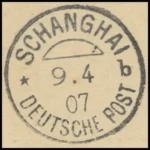
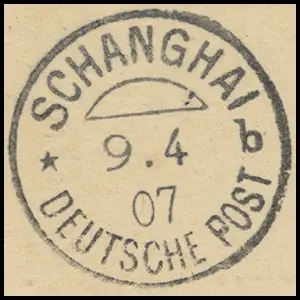
As was the case with several of Germany’s post offices in China, the names of the office in the cancel devices used were changed to reflect German orthography. In the case of Shanghai, new cancel devices pressed into service in 1905 changed the name of the office from “Shanghai” to “Schanghai”, a spelling that remained current for the remainder of the office’s existence (bottom right).
The choice of Shanghai for Germany’s first POA in China was not a coincidence. Once China’s doors were forced open in the 19th century, Shanghai quickly became its principal window to the outside world. Shanghai was so important for trade that every country that had POAs in China opened one there. Germany’s post office competed with counterparts from France, Great Britain, Japan, Russia, and the US. Austria offered intermittent postal service from ships that were in port at Shanghai, and Belgium prepared stamps for use in China, but never actually opened any post offices there. Only Italy never opened an office there, possibly due to the intense competition. With the exception of mail to and from the US, which was the only kind of mail the US Postal Agency at Shanghai handled, anyone who wanted to use a post office in Shanghai had the choice of five foreign nations’ competing offices in addition to the Imperial Chinese Post. The choice of which post to use was largely one of which office was perceived to have better rates or better service.
Once Germany opened additional offices in other parts of China, the postal agency in Shanghai was elevated to the status of a post office, and it also became the headquarters of German postal operations in China and Kiautschou. The first German POA in China was also one of the last. As the War progressed, the German postal HQ in China resorted to selling off its property and used increasingly circuitous routings to avoid areas of active military operations. Mail to Germany, for instance, was eventually routed via the United States.
The Shanghai POA would remain open until 16 March 1917, the date on which the now-Republic of China declared war on Germany. This resulted in the closure of all German POs in China that were still in operation in 1917. Germany continued to print stamps for use in China until the end of the war, much as was done for the colonies, in the expectation that both the colonies and foreign POs would be returned to German control when the war ended. This never occurred, and the German office in Shanghai became a casualty of war.
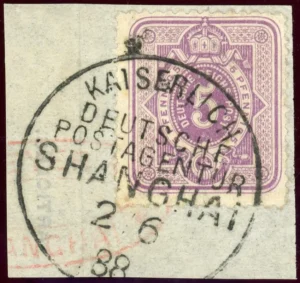
The first German POA opened inside the German consulate at Shanghai on 16 August 1887. Initially, this office was an “Imperial German Postal Agency” (Kaiserlich Deutsche Post Agentur) as can be seen in an image of the cancel used at this time (below).
At the time, a postal agency was a rung or two lower in status than a full post office. Typically, the difference lay in the types of transactions that could be handled. It is the understanding of the author that a postal agency only handled mail; a post office in this period would also have been able to handle nonpostal financial transactions.
As was the case with several of Germany’s post offices in China, the names of the office in the cancel devices used were changed to reflect German orthography. In the case of Shanghai, new cancel devices pressed into service in 1905 changed the name of the office from “Shanghai” to “Schanghai”, a spelling that remained current for the remainder of the office’s existence (below).
The choice of Shanghai for Germany’s first POA in China was not a coincidence. Once China’s doors were forced open in the 19th century, Shanghai quickly became its principal window to the outside world. Shanghai was so important for trade that every country that had POAs in China opened one there. Germany’s post office competed with counterparts from France, Great Britain, Japan, Russia, and the US. Austria offered intermittent postal service from ships that were in port at Shanghai, and Belgium prepared stamps for use in China, but never actually opened any post offices there. Only Italy never opened an office there, possibly due to the intense competition. With the exception of mail to and from the US, which was the only kind of mail the US Postal Agency at Shanghai handled, anyone who wanted to use a post office in Shanghai had the choice of five foreign nations’ competing offices in addition to the Imperial Chinese Post. The choice of which post to use was largely one of which office was perceived to have better rates or better service.
Once Germany opened additional offices in other parts of China, the postal agency in Shanghai was elevated to the status of a post office, and it also became the headquarters of German postal operations in China and Kiautschou. The first German POA in China was also one of the last. As the War progressed, the German postal HQ in China resorted to selling off its property and used increasingly circuitous routings to avoid areas of active military operations. Mail to Germany, for instance, was eventually routed via the United States.
The Shanghai POA would remain open until 16 March 1917, the date on which the now-Republic of China declared war on Germany. This resulted in the closure of all German POs in China that were still in operation in 1917. Germany continued to print stamps for use in China until the end of the war, much as was done for the colonies, in the expectation that both the colonies and foreign POs would be returned to German control when the war ended. This never occurred, and the German office in Shanghai became a casualty of war.
Tientsin (Tianjin), 天津

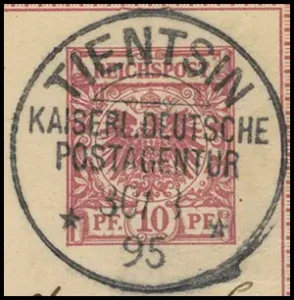
The second German POA in China opened its doors in Tientsin on 1 April 1893. Tianjin was also a very appropriate choice for a post office. Located on the coast 70 miles/110 km from Peking, Tianjin has served as the port for the Chinese capital since its founding. The name “Tientsin” literally means “Heaven’s Ferry,” with “Heaven” being a reference to the “Son of Heaven” (i.e., the Emperor of China). As was the case with Shanghai, the office at Tientsin was originally a postal agency (top right); it was also elevated to post office status once the German network was more fully established.
Prior to the opening of a German office in Peking, the Tientsin office handled double duty, handling all mail generated by German interests in the port of Tianjin, as well as mail heading to and from the Peking office.
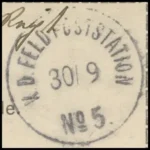
Alone among German POs in China, Tientsin hosted every type of postal facility Germany operated abroad prior to the First World War. In addition to starting off as a postal agency before transitioning into a full post office, Tientsin also hosted a military Feldpoststation that operated during the Boxer Rebellion (1900-1901). Cancels from this military facility are circular date stamps reading “K.D. Feld Post Station / No. 5” with a day and month, but no year (bottom right).
Tientsin proved to be such a useful place to open a post office that the German office competed with counterparts from four other nations-Great Britain, France, Japan, and Russia. Although a fifth nation, Italy, did eventually open an office at Tientsin, the Italian office never competed with the German office as their periods of operation did not overlap; the Italian office opened only after the German office had already closed.
Collectors of postmarks will find that the postmarks of this office are easily found, if not quite as numerous as those of Shanghai. The “Tientsin / Deutsche Post” CDS is routinely clear and well struck, with many examples being SON.
Prior to the opening of a German office in Peking, the Tientsin office handled double duty, handling all mail generated by German interests in the port of Tianjin, as well as mail heading to and from the Peking office.
Alone among German POs in China, Tientsin hosted every type of postal facility Germany operated abroad prior to the First World War. In addition to starting off as a postal agency before transitioning into a full post office, Tientsin also hosted a military Feldpoststation that operated during the Boxer Rebellion (1900-1901). Cancels from this military facility are circular date stamps reading “K.D. Feld Post Station / No. 5” with a day and month, but no year (below).
Tientsin proved to be such a useful place to open a post office that the German office competed with counterparts from four other nations-Great Britain, France, Japan, and Russia. Although a fifth nation, Italy, did eventually open an office at Tientsin, the Italian office never competed with the German office as their periods of operation did not overlap; the Italian office opened only after the German office had already closed.
Collectors of postmarks will find that the postmarks of this office are easily found, if not quite as numerous as those of Shanghai. The “Tientsin / Deutsche Post” CDS is routinely clear and well struck, with many examples being SON.
Northern China

Germany would eventually open a number of post offices in Northern China. Just over a third of all the German post offices in China were opened in the north, ten of which were initially opened as military post offices. All of these military offices were directly connected with the Boxer Rebellion, a violent, anti-foreign, and anti-Christian uprising aimed at removing foreign interests in China. Although not officially supported by the Chinese government, the actions of the Boxers were unofficially supported by Peking and tolerated by the Imperial court. An eight-nation coalition, which included the major Western powers and Japan, ended up invading China and forcing numerous concessions from China. In the case of Germany, this included the opportunity to open many more post offices in parts of China other than Shanghai and Tientsin.
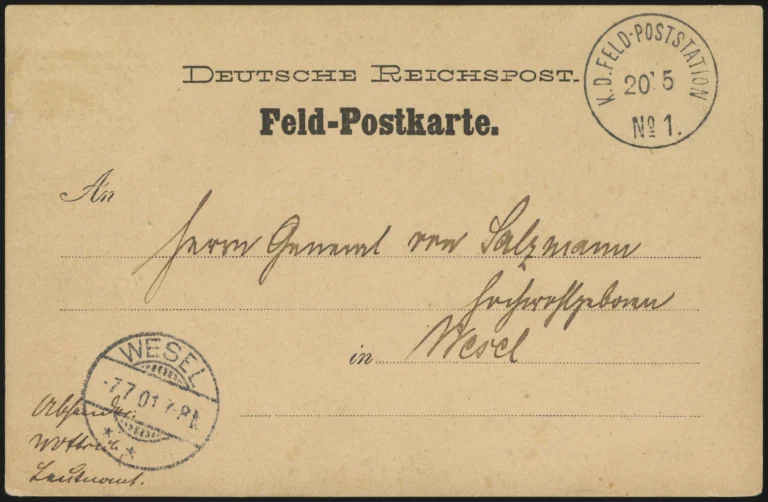
All of the German military POs first opened at this time used similar circular cancel devices. These cancels, which are small enough to almost completely fit on a small sized German definitive stamp, read “K.D. Feld-Poststation” across the top of the device. The center of the device has a date consisting of a day and a month but lacking a year. At the bottom, a number (“No. 1”, “No. 2,” etc.), identifies the exact military office. Unlike other period cancels, these devices only show a day and a month without a year.
These cancels can appear on German Offices in China issues, as well as issues of Germany proper (right) and of colonial Kiautschou. The latter two uses are collectively referred to as “Petschili” issues, and hold a special place in German colonial philately.

The primary reason for opening military facility in China was to serve the needs of the army in the field. As would be the case in both World Wars, German soldiers could send letters and postcard through the Feldpost system free of charge. For this reason, the cancels of these offices most typically appears on stampless Feldpost mail (below). Examples of these cancels appearing on stamps and postal stationery is most typically explained as being either a philatelic souvenir or a usage of the office by a civilian who was required to pay postage.
Germany would eventually open a number of post offices in Northern China. Just over a third of all the German post offices in China were opened in the north, ten of which were initially opened as military post offices. All of these military offices were directly connected with the Boxer Rebellion, a violent, anti-foreign, and anti-Christian uprising aimed at removing foreign interests in China. Although not officially supported by the Chinese government, the actions of the Boxers were unofficially supported by Peking and tolerated by the Imperial court. An eight-nation coalition, which included the major Western powers and Japan, ended up invading China and forcing numerous concessions from China. In the case of Germany, this included the opportunity to open many more post offices in parts of China other than Shanghai and Tientsin.
All of the German military POs first opened at this time used similar circular cancel devices. These cancels, which are small enough to almost completely fit on a small sized German definitive stamp, read “K.D. Feld-Poststation” across the top of the device. The center of the device has a date consisting of a day and a month but lacking a year. At the bottom, a number (“No. 1”, “No. 2,” etc.), identifies the exact military office. Unlike other period cancels, these devices only show a day and a month without a year.
These cancels can appear on German Offices in China issues, as well as issues of Germany proper (below) and of colonial Kiautschou. The latter two uses are collectively referred to as “Petschili” issues, and hold a special place in German colonial philately.
The primary reason for opening military facility in China was to serve the needs of the army in the field. As would be the case in both World Wars, German soldiers could send letters and postcard through the Feldpost system free of charge. For this reason, the cancels of these offices most typically appears on stampless Feldpost mail (below). Examples of these cancels appearing on stamps and postal stationery is most typically explained as being either a philatelic souvenir or a usage of the office by a civilian who was required to pay postage.
Peking (Beijing), 北京

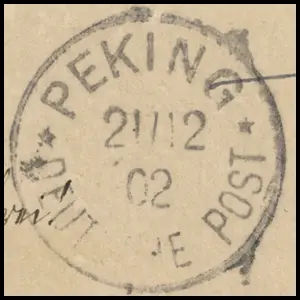
The German PO in the Chinese capital opened first as a military post office in the middle of the Boxer Rebellion-related military actions in the city of Peking (Beijing). The civilian office opened in September 1900 and was joined by a military counterpart in November of that year as “Feld-Poststation No. 2.” This was one of the more successful German POs in northern China and remained open until the final closure of Germany’s Offices in China. Peking opened so quickly that it was one of a few offices that used undated provisional cancels, which appear to have been hand-cut from wood. These are circular marks read “Peking / Deutsche Post” but without a date (top right). In such cases, the cancel was used for only a few weeks until a metal circular date stamp arrived (middle right).
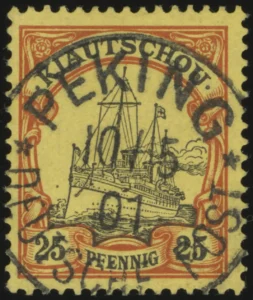
The Peking office is noted for its use of stamps issued for use in the German colony of Kiautschou (bottom right). At the height of the Boxer Rebellion, stamp supplies for the Peking office ran low and replacement stamps could not be obtained from Berlin in a timely fashion. The German colony at Kiautschou, however, had stamps and was relatively nearby. So as a matter of expediency, Peking obtained stamps from Kiautschou and issued them. Kiautschou stamps used at Peking are listed separately in Michel and command significant premiums for this reason.
The Peking office’s success is explained in part because it was located in the Chinese capital. Administrative cities typically generate a lot of correspondence, and Peking was no exception. As was typical for successful German POs, this one did have competition in the form of offices run by France, Japan, and Russia. (Italy eventually ran a post office at Peking-but as in the case of Tientsin, only after the German office had closed.) Of all the major powers, only Great Britain had no Peking office, probably because the northern part of China was significantly outside the British sphere of influence.
Having said this, however, Peking was smaller in comparison to the others run by Germany. In terms of surviving cancel examples, fewer strikes from Peking are known compared to Shanghai or Tientsin.
Additionally, excepting the Feldpost cancel device, Peking used only one cancel device that contained a date for the length of its existence. This is a measure of mail volume, as cancel devices were replaced very regularly at higher volume offices. The 8 cancel devices used at Shanghai, for comparison purposes, had an average life of 3 ½ years. Peking’s lone dated cancel device lasted for nearly 17 years, and returned to Germany after the War. It is on currently display at the Museum fur Kommunikation Berlin, located in what used to be Berlin’s Central Post Office.

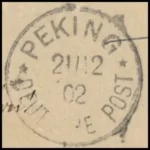
The German PO in the Chinese capital opened first as a military post office in the middle of the Boxer Rebellion-related military actions in the city of Peking (Beijing). The civilian office opened in September 1900 and was joined by a military counterpart in November of that year as “Feld-Poststation No. 2.” This was one of the more successful German POs in northern China and remained open until the final closure of Germany’s Offices in China. Peking opened so quickly that it was one of a few offices that used undated provisional cancels, which appear to have been hand-cut from wood. These are circular marks read “Peking / Deutsche Post” but without a date (below).
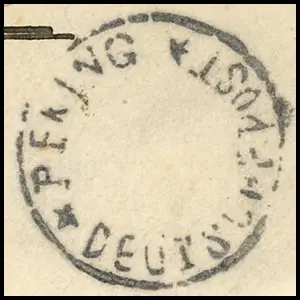
In such cases, the cancel was used for only a few weeks until a metal circular date stamp arrived (below).
The Peking office is noted for its use of stamps issued for use in the German colony of Kiautschou (below). At the height of the Boxer Rebellion, stamp supplies for the Peking office ran low and replacement stamps could not be obtained from Berlin in a timely fashion. The German colony at Kiautschou, however, had stamps and was relatively nearby. So as a matter of expediency, Peking obtained stamps from Kiautschou and issued them. Kiautschou stamps used at Peking are listed separately in Michel and command significant premiums for this reason.
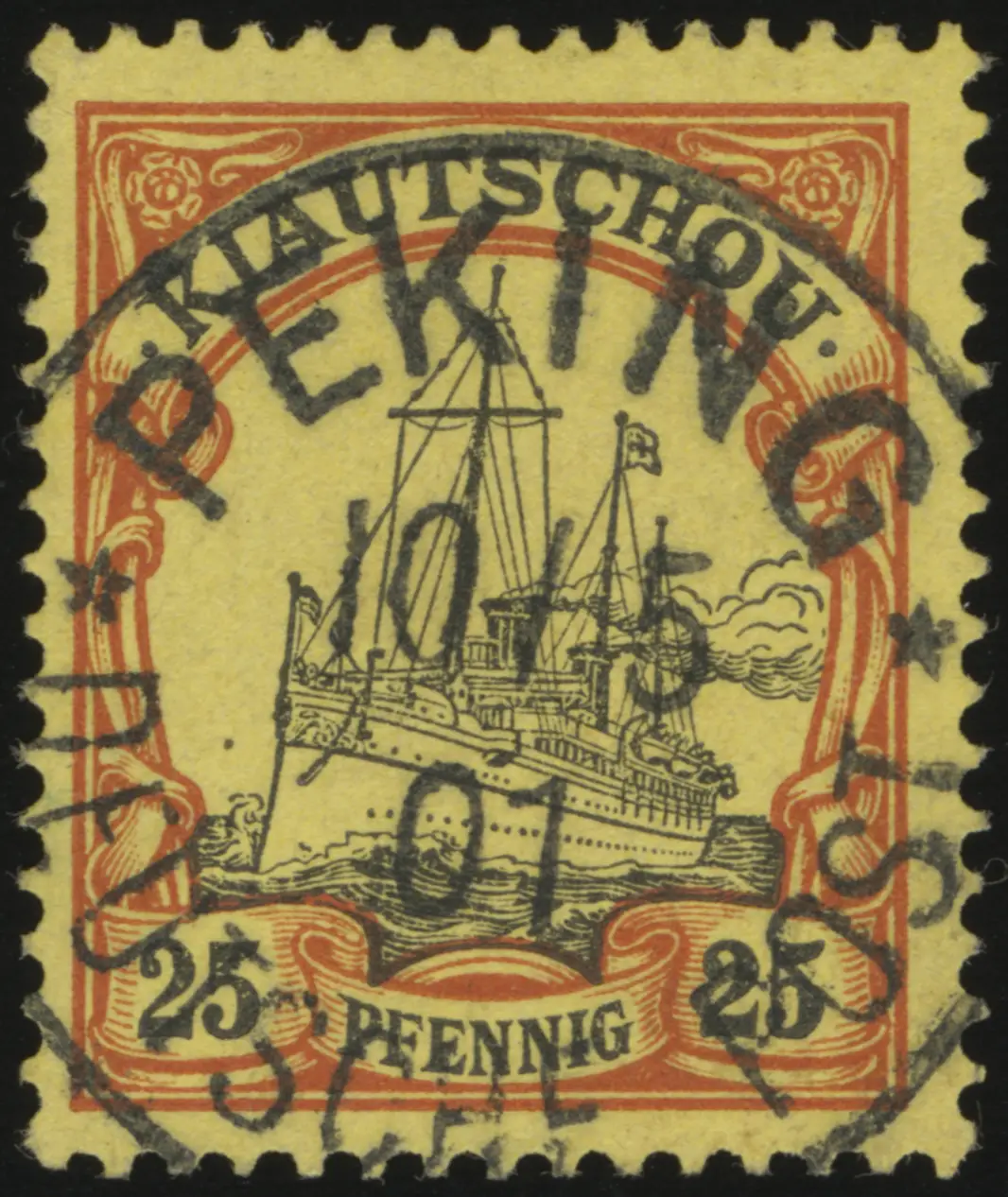
The Peking office’s success is explained in part because it was located in the Chinese capital. Administrative cities typically generate a lot of correspondence, and Peking was no exception. As was typical for successful German POs, this one did have competition in the form of offices run by France, Japan, and Russia. (Italy eventually ran a post office at Peking-but as in the case of Tientsin, only after the German office had closed.) Of all the major powers, only Great Britain had no Peking office, probably because the northern part of China was significantly outside the British sphere of influence.
Having said this, however, Peking was smaller in comparison to the others run by Germany. In terms of surviving cancel examples, fewer strikes from Peking are known compared to Shanghai or Tientsin.
Additionally, excepting the Feldpost cancel device, Peking used only one cancel device that contained a date for the length of its existence. This is a measure of mail volume, as cancel devices were replaced very regularly at higher volume offices. The 8 cancel devices used at Shanghai, for comparison purposes, had an average life of 3 ½ years. Peking’s lone dated cancel device lasted for nearly 17 years, and returned to Germany after the War. It is on currently display at the Museum fur Kommunikation Berlin, located in what used to be Berlin’s Central Post Office.
Tongku (Tanggu), 塘沽

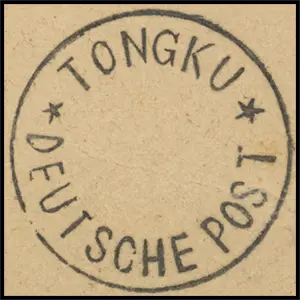
Tongku opened in September of 1900 as “Feldpost Station No. 4.” In addition to the Feldpost cancel, Tongku used an undated provisional cancel in the same manner as Peking (right).
Unlike Peking, this office did not last very long. Closing in April of 1906, the Tongku office was open for roughly 5 ½ years. Tongku was very typical in that the primary competition for a very provincial office came from the Japanese. Of all the foreign powers, it was Japan that operated the largest and most comprehensive network in China. In many instances, Japan operated the only foreign office in a city or continued to operate such a facility once all the rest had closed.
The likely reason for Tongku’s eventual closure was that it outlived its usefulness too quickly. Now essentially an outlying district of Tianjin, the Tongku office had a location convenient for foreign troop landings during the Boxer Rebellion. But once military operations ceased, such locations had little need for foreign post offices. This was doubly true of Tongku, which was close to the multiple foreign PO’s at Tientsin. Tongku did close later than most former military offices, so it appears that Tongku maintained some use as troops were being pulled out just as it had when they landed, and also as the office to which the functions of offices that had closed prior to this were transferred. But any such usefulness was at an end by the end of 1905, leading to this office’s closure.
Tongku opened in September of 1900 as “Feldpost Station No. 4.” In addition to the Feldpost cancel, Tongku used an undated provisional cancel in the same manner as Peking (below).
Unlike Peking, this office did not last very long. Closing in April of 1906, the Tongku office was open for roughly 5 ½ years. Tongku was very typical in that the primary competition for a very provincial office came from the Japanese. Of all the foreign powers, it was Japan that operated the largest and most comprehensive network in China. In many instances, Japan operated the only foreign office in a city or continued to operate such a facility once all the rest had closed.
The likely reason for Tongku’s eventual closure was that it outlived its usefulness too quickly. Now essentially an outlying district of Tianjin, the Tongku office had a location convenient for foreign troop landings during the Boxer Rebellion. But once military operations ceased, such locations had little need for foreign post offices. This was doubly true of Tongku, which was close to the multiple foreign PO’s at Tientsin. Tongku did close later than most former military offices, so it appears that Tongku maintained some use as troops were being pulled out just as it had when they landed, and also as the office to which the functions of offices that had closed prior to this were transferred. But any such usefulness was at an end by the end of 1905, leading to this office’s closure.
Shanhaikwan (Shanhaiguan), 山海关

Shanhaikwan was another office that opened as a military Feldpost Office (No. 8) in November 1900. From that point until early 1902, Shanhaikwan remained a military facility before transitioning to civilian control.
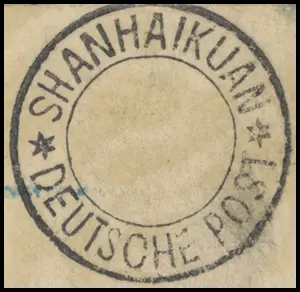
Shanhaikwan was the first of the German Offices in China to go through a name change. The first cancel device used at this office, a dateless circular stamp reading “Shanhaikwan * Deutsche Post*”, was used between 1 September and 30 November 1901, (top right) after which only the Feldpost No. 8 cancel was in use.
When the office transitioned to civilian use, a new “Schanhaikwan / Deutsche Post” cancel was used (bottom right), but only between 1 March and 31 October 1902. Examples of either cancel bearing the Shanhaikwan / Schanhaikwan cancel command premiums due to the short period of use.
Foreign competition for this office was likewise limited to a single Japanese post office, which also saw little in the way of actual usage of postal facilities. Not only did Germany have few nonmilitary interests in this area of China, it was also too close to another German facility at nearby Tschinwangtau and reasonably close to others at Tientsin and Tongku.
The German presence at Shanhaikwan continued for several more years after the post office closed, as the ArGe catalogue notes and values mail with Shanhaikwan return addresses for the period of November 1902-1906. But such mail was handled by other German offices in the area, as not enough of a German presence was there to justify reopening an office at Shanhaikwan.
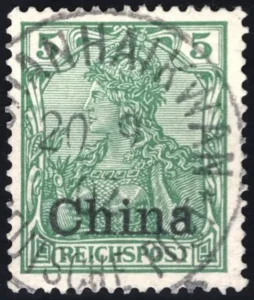
Shanhaikwan was another office that opened as a military Feldpost Office (No. 8) in November 1900. From that point until early 1902, Shanhaikwan remained a military facility before transitioning to civilian control.
Shanhaikwan was the first of the German Offices in China to go through a name change. The first cancel device used at this office, a dateless circular stamp reading “Shanhaikwan * Deutsche Post*”, was used between 1 September and 30 November 1901, (below) after which only the Feldpost No. 8 cancel was in use.
When the office transitioned to civilian use, a new “Schanhaikwan / Deutsche Post” cancel was used (below), but only between 1 March and 31 October 1902.
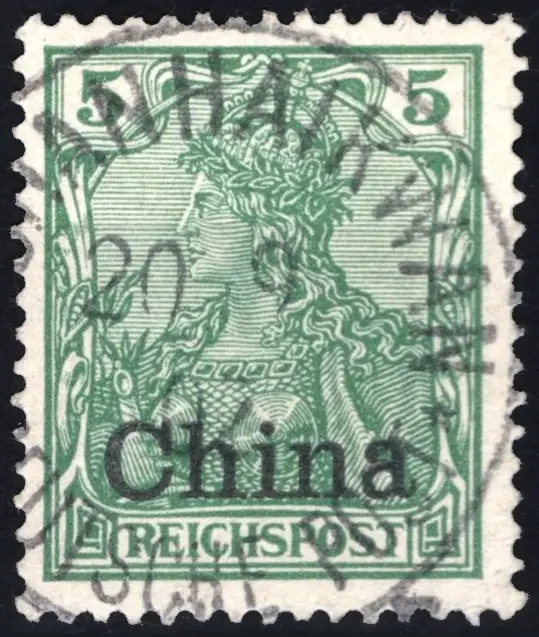
Examples of either cancel bearing the Shanhaikwan / Schanhaikwan cancel command premiums due to the short period of use.
Foreign competition for this office was likewise limited to a single Japanese post office, which also saw little in the way of actual usage of postal facilities. Not only did Germany have few nonmilitary interests in this area of China, it was also too close to another German facility at nearby Tschinwangtau and reasonably close to others at Tientsin and Tongku.
The German presence at Shanhaikwan continued for several more years after the post office closed, as the ArGe catalogue notes and values mail with Shanhaikwan return addresses for the period of November 1902-1906. But such mail was handled by other German offices in the area, as not enough of a German presence was there to justify reopening an office at Shanhaikwan.
Tschinwangtau (Qinhuangdao), 秦皇岛

The Tschinwangtau post office opened in December 1901 as part of the general increase in post operations in China.
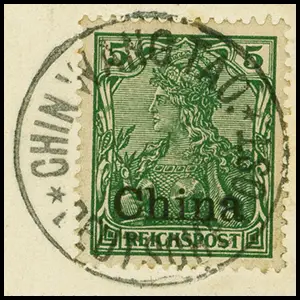
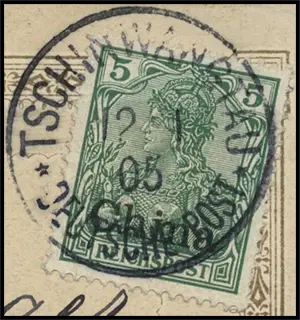
It used a “Chin Wang Tao” postmark without date (top right) for the first two months of its operation.
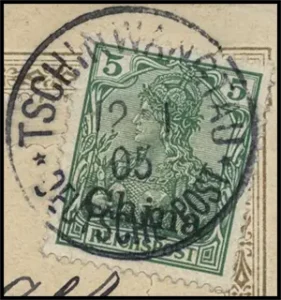
Beginning in mid-January 1902, it used a normal dated Deutsche Post canceller (bottom right) for the remainder of the brief period it was open.
Like the offices at Shanhaikwan and Tongku, it would not last very long. Like Tongku, this office closed at the end of April 1906.
In general, this office was also a victim of its own limitations and geography. Like Tongku, Tschinwangtau was located just outside the city limits of Tientsin, and as such is extremely close to the German offices there and at Tongku and Shanhaikwan. Once the troops left, not enough business remained for that many postal facilities, and all closed except Tientsin. Tschinwangtau appears to have had no foreign competition at all-another indication of a lack of adequate mail traffic.
The closures of Shanhaikwan, Tongku, and Tschinwangtau left only Peking and Tientsin as operational German offices in northern China between 1906 and 1917.
The Tschinwangtau post office opened in December 1901 as part of the general increase in post operations in China.
It used a “Chin Wang Tao” postmark without date (below) for the first two months of its operation.
Beginning in mid-January 1902, it used a normal dated Deutsche Post canceller (below) for the remainder of the brief period it was open.
Like the offices at Shanhaikwan and Tongku, it would not last very long. Like Tongku, this office closed at the end of April 1906.
In general, this office was also a victim of its own limitations and geography. Like Tongku, Tschinwangtau was located just outside the city limits of Tientsin, and as such is extremely close to the German offices there and at Tongku and Shanhaikwan. Once the troops left, not enough business remained for that many postal facilities, and all closed except Tientsin. Tschinwangtau appears to have had no foreign competition at all-another indication of a lack of adequate mail traffic.
The closures of Shanhaikwan, Tongku, and Tschinwangtau left only Peking and Tientsin as operational German offices in northern China between 1906 and 1917.
The Coastal Offices
Arguably the most successful grouping of post offices was those opened in the Treaty Ports along the southern and eastern coasts of China. In the context of China, the term “Treaty Ports” applies to those cities that were forced to open to trade by one foreign power or another, usually as the result of military action. Foreign citizens generally enjoyed extraterritorial rights, such as immunity from Chinese laws within the boundaries of the Treaty Port in question. Foreign powers had the right to apply their sovereignty-including operating postal systems-in Treaty Ports as well. These treaties have been called unequal, as their terms were dictated to China; China did not have the option of changing the terms, nor did Chinese citizens enjoy reciprocal rights in the territories of the other nations.
The first 12 Treaty Ports were forced open by Great Britain as a result of the First Opium War (1840), which also saw the island of Hong Kong ceded to London “in perpetuity.” Once Britain had extracted these rights from China, other nations lined up to do the same, and more Treaty Ports opened for business. All of the foreign powers who operated post offices in China eventually did so on the basis of these treaties, on land called “concessions” which China was required to cede to them.
Futschau (Fuzhou), 福州

One of the first German offices to open in southern China, Futschau opened as a civilian office before the start of military action related to the Boxer Rebellion. As the capital of Fujian province, Futschau benefited from being a regional trading center even before it opened as a Treaty Port. In addition to being located on the coast, Futschau is conveniently located roughly halfway between Canton and Shanghai and is more or less directly across the Taiwan Strait from Taipei on the island of Taiwan. As Taiwan was a colonial possession of Japan from 1895 to 1945, Futschau provided easy access to a city under Japanese control as well as to port facilities in a populous part of China. Alternatively, the German presence in Futschau (and nearby Amoy) may also have been an attempt to check the influence of Japan, as Fujian province was in the Japanese sphere of influence.
But as Taiwan was a Japanese possession, the Japanese office here provided a lot of competition for the German post office, as well as for similar facilities run by Britain, France, and Russia. Or so it would seem. Sources indicate that the Japanese post offices in China were numerous but were viewed by contemporary Westerners as inefficient and slow. Whether this was reality or perception is a matter of conjecture. At the time, Asians and Westerners each viewed their opposites as ethnically and culturally inferior. The actual amount of competition may have been less than it would otherwise seem.
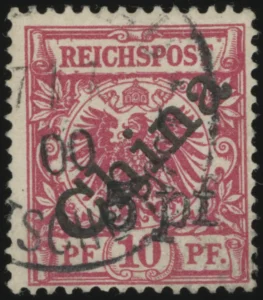
The German office at Futschau would become famous for producing Scott and Michel-listed provisional stamps (top right). The advent of the Boxer Rebellion so soon after the office’s opening increased traffic in 1900, but the disruptions of war prevented additional stocks of stamps from being sent easily to Futschau. By July of 1900, supplies of 5 Pf stamps had run out. A similar situation in Peking led to the issue of Kiautschou stamps there, but Futschau was far enough away to prevent Kiautschou stamps from easily being sent there. The solution was that the Futschau postmaster applied a handstamped “5 pf” overprint to 10 Pf stamps with “China” overprints. The overprint was applied to both varieties of 10 Pf stamps, i.e. to stamps with “China” overprinted at 45° and 56°. These provisional stamps can easily be confused with the first issues of Kiautschou, which also have a handstamp overprint of this value. The difference is that the Futschau overprint reads “5 pf” (no period) where one of the Kiautschou overprints reads “5 Pfg.”, while a second reads “5 Pf.” (with period), both in a smaller font size.
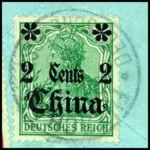
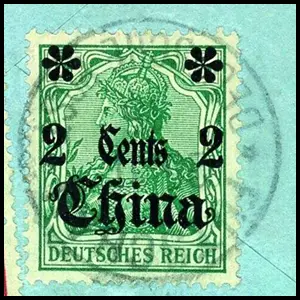
Futschau would remain open until 16 March 1917, and carried a healthy amount of traffic. Yet ArGe catalogue values for this cancel suggest the opposite. It is likely that the higher value placed on a Futschau cancel is the result of a lack of good examples of it. Most examples of the Futschau cancel are light and/or partial, with fewer legible examples (bottom right). Fewer still are SON.
One of the first German offices to open in southern China, Futschau opened as a civilian office before the start of military action related to the Boxer Rebellion. As the capital of Fujian province, Futschau benefited from being a regional trading center even before it opened as a Treaty Port. In addition to being located on the coast, Futschau is conveniently located roughly halfway between Canton and Shanghai and is more or less directly across the Taiwan Strait from Taipei on the island of Taiwan. As Taiwan was a colonial possession of Japan from 1895 to 1945, Futschau provided easy access to a city under Japanese control as well as to port facilities in a populous part of China. Alternatively, the German presence in Futschau (and nearby Amoy) may also have been an attempt to check the influence of Japan, as Fujian province was in the Japanese sphere of influence.
But as Taiwan was a Japanese possession, the Japanese office here provided a lot of competition for the German post office, as well as for similar facilities run by Britain, France, and Russia. Or so it would seem. Sources indicate that the Japanese post offices in China were numerous but were viewed by contemporary Westerners as inefficient and slow. Whether this was reality or perception is a matter of conjecture. At the time, Asians and Westerners each viewed their opposites as ethnically and culturally inferior. The actual amount of competition may have been less than it would otherwise seem.
The German office at Futschau would become famous for producing Scott and Michel-listed provisional stamps (below).
The advent of the Boxer Rebellion so soon after the office’s opening increased traffic in 1900, but the disruptions of war prevented additional stocks of stamps from being sent easily to Futschau. By July of 1900, supplies of 5 Pf stamps had run out. A similar situation in Peking led to the issue of Kiautschou stamps there, but Futschau was far enough away to prevent Kiautschou stamps from easily being sent there. The solution was that the Futschau postmaster applied a handstamped “5 pf” overprint to 10 Pf stamps with “China” overprints. The overprint was applied to both varieties of 10 Pf stamps, i.e. to stamps with “China” overprinted at 45° and 56°. These provisional stamps can easily be confused with the first issues of Kiautschou, which also have a handstamp overprint of this value. The difference is that the Futschau overprint reads “5 pf” (no period) where one of the Kiautschou overprints reads “5 Pfg.”, while a second reads “5 Pf.” (with period), both in a smaller font size.
Futschau would remain open until 16 March 1917, and carried a healthy amount of traffic. Yet ArGe catalogue values for this cancel suggest the opposite. It is likely that the higher value placed on a Futschau cancel is the result of a lack of good examples of it. Most examples of the Futschau cancel are light and/or partial, with fewer legible examples (below). Fewer still are SON.
Canton (Guangzhou), 广州

If Shanghai was the most important port in China for the foreign powers during the Treaty Port years, Canton was arguably the second most important. Situated at the mouth of the Pearl River Delta, Canton is the capital of Guangdong province as well as the de facto regional capital of the southern third of China. Prior to 1841 and the First Opium War, Canton was also the only port at which China allowed commerce with the West. Its relative importance as a port declined when other ports were allowed to open to trade, but Canton remained important until the People’s Republic closed all its borders again after the 1949 revolution.
Culturally speaking, Guangdong province was ultimately the source of the majority of emigrants bound for the Americas prior to 1949 and the point of primary connection between China and the Chinese communities of Southeast Asia in the same time period. Older Chinese-Americans who grew up speaking Chinese almost universally speak Cantonese; most of these say that they eschewed learning Mandarin (the official dialect), as this was associated very strongly with the People’s Republic.
The German office in Canton opened for business on 2 June 1902, as part of a wave of offices opened in China following the peace at the end of the Boxer Rebellion. It had competition from a number of other nations’ offices, including those of Great Britain, France, and Japan. Russia did not open an office here, as Canton was outside its sphere of influence.
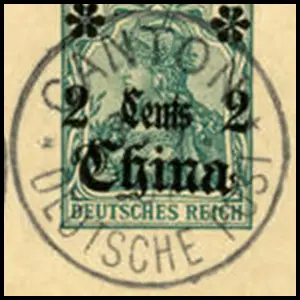
Canton was one of four post offices, along with Amoy, Shanghai, and Shanhaikwan, whose name was changed during the period of its opening to conform to German orthography. Until the middle of 1913, the office was named “Canton” (top right). Thereafter, the office name was spelled “Kanton” (bottom right), which remained the official spelling until 1917. For cancel collectors, the one cancel used with the spelling “Canton” is relatively common and inexpensive, but the other cancel with the spelling “Kanton” is much less common and commands more of a premium. The Canton office had enough business to remain open until 16 March 1917, when all German post offices in China were closed down.
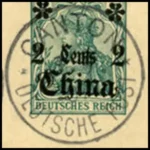
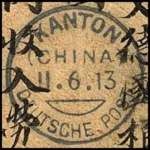
If Shanghai was the most important port in China for the foreign powers during the Treaty Port years, Canton was arguably the second most important. Situated at the mouth of the Pearl River Delta, Canton is the capital of Guangdong province as well as the de facto regional capital of the southern third of China. Prior to 1841 and the First Opium War, Canton was also the only port at which China allowed commerce with the West. Its relative importance as a port declined when other ports were allowed to open to trade, but Canton remained important until the People’s Republic closed all its borders again after the 1949 revolution.
Culturally speaking, Guangdong province was ultimately the source of the majority of emigrants bound for the Americas prior to 1949 and the point of primary connection between China and the Chinese communities of Southeast Asia in the same time period. Older Chinese-Americans who grew up speaking Chinese almost universally speak Cantonese; most of these say that they eschewed learning Mandarin (the official dialect), as this was associated very strongly with the People’s Republic.
The German office in Canton opened for business on 2 June 1902, as part of a wave of offices opened in China following the peace at the end of the Boxer Rebellion. It had competition from a number of other nations’ offices, including those of Great Britain, France, and Japan. Russia did not open an office here, as Canton was outside its sphere of influence.
Canton was one of four post offices, along with Amoy, Shanghai, and Shanhaikwan, whose name was changed during the period of its opening to conform to German orthography.
Until the middle of 1913, the office was named “Canton” (below).
Thereafter, the office name was spelled “Kanton” (below), which remained the official spelling until 1917.
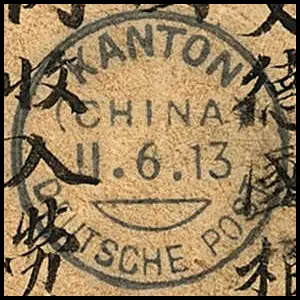
For cancel collectors, the one cancel used with the spelling “Canton” is relatively common and inexpensive, but the other cancel with the spelling “Kanton” is much less common and commands more of a premium. The Canton office had enough business to remain open until 16 March 1917, when all German post offices in China were closed down.
Amoy (Xiamen), 厦门

The city of Amoy (modern Xiamen) was opened as a Treaty Port in part because the original city was built on an island on the coast of China. Opening island cities as Treaty Ports was one way that China attempted to control foreigners’ access to China, as well as interactions between Chinese and foreign nationals. An island is clearly bounded by the water that separates it from the mainland, and it is difficult to leave or to go to an island without using ferries or bridges – which could continue to be controlled by China. China would then be able to prohibit its own nationals from going to the island without permission and likewise keep foreigners from leaving it.
Amoy was also chosen as a Treaty Port, as it is roughly halfway between Canton and Shanghai and is more or less directly across the Taiwan Strait from Tainan and Kaohsiung on the southern end of the island of Taiwan. As Taiwan was a colonial possession of Japan from 1895 to 1945, Amoy also provided easier access to Japan, as well as to port facilities in a populous part of China.
As was the case with Canton, the German office at Amoy changed the spelling of its name towards the end of its existence to conform to German orthography. From its opening on 12 June 1902 until the middle of 1913, the town name was spelled “Amoy” (top right). From mid-1913 until March of 1917, the town name was “Amoi.” (bottom right). This cancel is the only one where a period actually appears at the end of the town name. Regardless of its spelling, it appears to have had significantly less traffic than other offices. Based on ArGe catalogue values, the Amoy cancel is roughly at the middle of the values for circular date stamps, with a value of €18. Of the 30 CDS cancels Germany used in China, only nine have a higher catalogue value than Amoy. The “Amoi.” cancel has a value of €200 on piece, higher than any other CV for a regular use cancel. (ArGe does list higher values for on-cover examples of cancels in special inks, uses of cancel devices with altered date slugs, provisional cancels used for short periods, or special uses.)
One of the reasons for the smaller amount of traffic for Amoy was fierce competition from offices run by Britain, France, and Japan. Amoy was also more of a second-tier Treaty Port, overshadowed to an extent by Shanghai and Canton.
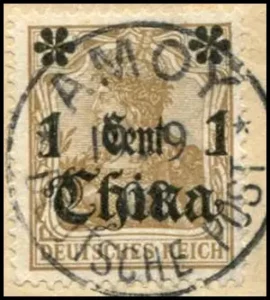
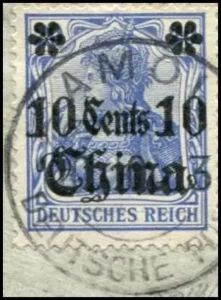
The city of Amoy (modern Xiamen) was opened as a Treaty Port in part because the original city was built on an island on the coast of China. Opening island cities as Treaty Ports was one way that China attempted to control foreigners’ access to China, as well as interactions between Chinese and foreign nationals. An island is clearly bounded by the water that separates it from the mainland, and it is difficult to leave or to go to an island without using ferries or bridges – which could continue to be controlled by China. China would then be able to prohibit its own nationals from going to the island without permission and likewise keep foreigners from leaving it.
Amoy was also chosen as a Treaty Port, as it is roughly halfway between Canton and Shanghai and is more or less directly across the Taiwan Strait from Tainan and Kaohsiung on the southern end of the island of Taiwan. As Taiwan was a colonial possession of Japan from 1895 to 1945, Amoy also provided easier access to Japan, as well as to port facilities in a populous part of China.
As was the case with Canton, the German office at Amoy changed the spelling of its name towards the end of its existence to conform to German orthography. From its opening on 12 June 1902 until the middle of 1913, the town name was spelled “Amoy” (below).
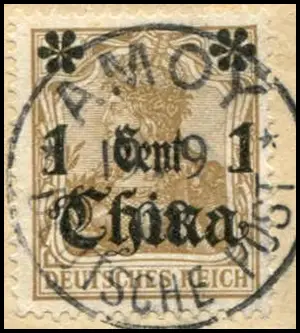
From mid-1913 until March of 1917, the town name was “Amoi.” (below).
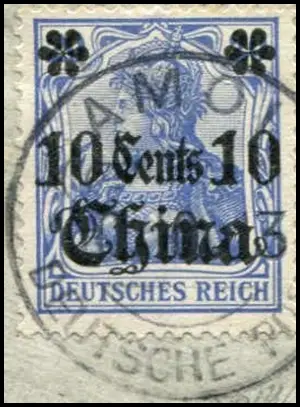
This cancel is the only one where a period actually appears at the end of the town name. Regardless of its spelling, it appears to have had significantly less traffic than other offices. Based on ArGe catalogue values, the Amoy cancel is roughly at the middle of the values for circular date stamps, with a value of €18. Of the 30 CDS cancels Germany used in China, only nine have a higher catalogue value than Amoy. The “Amoi.” cancel has a value of €200 on piece, higher than any other CV for a regular use cancel. (ArGe does list higher values for on-cover examples of cancels in special inks, uses of cancel devices with altered date slugs, provisional cancels used for short periods, or special uses.)
One of the reasons for the smaller amount of traffic for Amoy was fierce competition from offices run by Britain, France, and Japan. Amoy was also more of a second-tier Treaty Port, overshadowed to an extent by Shanghai and Canton.
Swatau (Shantou), 汕头

The final coastal Treaty Port to have a German Post Office was Swatau (Shantou), a coastal city on the borders of the provinces of Guangdong and Fujian. Although it was and remains a regional center for the eastern part of Guangdong, Swatau never achieved the heights of greatness that Shanghai or Canton did. The German office here opened on 17 May 1904 and remained open until the final closure of all German offices on 16 March 1917.
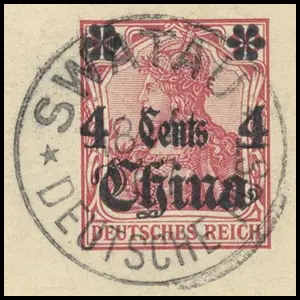
Swatau did not handle as much mail volume as the other German offices; as a result, strikes of the one cancel device used there are scarcer than similar cancels from other offices. But enough commercial opportunities did exist for competition from the British and Japanese. The British office at Swatow was one of the first foreign facilities open in China from the early 1840s, and it likely continued to take the lion’s share of mail bound for Europe even after the Germans opened their competing office here. Cancel strikes are also typically lighter in the date area (right).
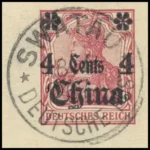
The final coastal Treaty Port to have a German Post Office was Swatau (Shantou), a coastal city on the borders of the provinces of Guangdong and Fujian. Although it was and remains a regional center for the eastern part of Guangdong, Swatau never achieved the heights of greatness that Shanghai or Canton did. The German office here opened on 17 May 1904 and remained open until the final closure of all German offices on 16 March 1917.
Swatau did not handle as much mail volume as the other German offices; as a result, strikes of the one cancel device used there are scarcer than similar cancels from other offices. But enough commercial opportunities did exist for competition from the British and Japanese. The British office at Swatow was one of the first foreign facilities open in China from the early 1840s, and it likely continued to take the lion’s share of mail bound for Europe even after the Germans opened their competing office here. Cancel strikes are also typically lighter in the date area (below).
Shandong Province
The German presence in Shandong province began in late 1897. The murder of two German missionaries in southern Shandong provided Germany with a reason to launch a military invasion of that area of China. German military adventures in Shandong ended with a Sino-German treaty granting a 99-year lease on the German “treaty territory” of Kiautschou, which Germany treated as a colonial possession. This treaty led to similar leases with Russia, France, and the UK-the last of which many can still remember. (The British lease was for 90% of the territory of Hong Kong; the end of the lease in 1997 led to the return of Hong Kong to Chinese rule.)
Most of the German postal presence in Shandong also hinges on this treaty. One other provision of the treaty created a “neutral zone” around the German colony in which Germany could prospect for minerals, and also the right to create a railroad. Many of Germany’s post offices in Shandong started life as stops on this railroad.
Tsingtau (Qingdao), 青岛

The city that would become the colonial capital city started life as a small fishing village. Its postal history as part of colonial Kiautschou is explored more in the Kiautschou section of this guide. It is mentioned here as the German PO at Tsingtau began life as a German Office in China.
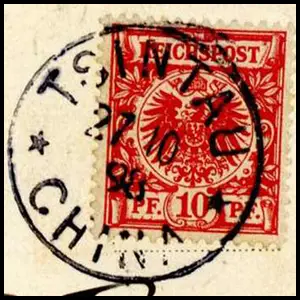
From January 1898 until January 1901, all of Kiautschou was essentially treated as part of the German postal network in China, and was provided by Berlin with German Offices in China stamps. For this reason, Kiautschou was the only colony never to have 1889-series stamps diagonally overprinted with the name of the colony, and German Offices in China issues with Kiautschou postmarks are listed separately as Kiautschou Vorläufer and Mitläufer. Unoverprinted German definitives (top right) can also be Vorläufer and Mitläufer.
By the time it was decided to create distinctive Kiautschou issues, the Germans were already printing “Yacht” series stamps for the colonies. These were placed on sale in Kiautschou in January 1901.
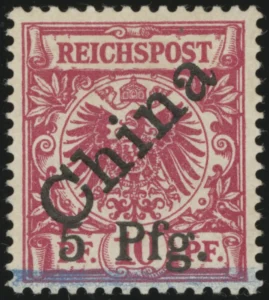
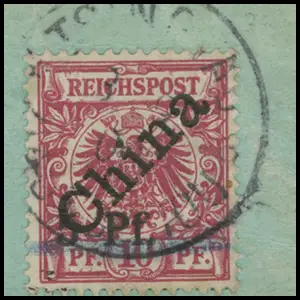
The first issues distinctive to Kiautschou, however, were locally produced “5 Pfg.” overprints on German Offices in China 10 Pf stamps with both 56° and 45° overprints. Created to fill the need for 5 Pf stamps after stamps of that value ran low during the Boxer Rebellion, three styles of the “5 Pfg.” overprint exist. Most examples have lines in blue or violet colored pencil horizontally across the face of the stamp. The colored pencil was applied to “cancel” the stamps’ original face value (middle right), but examples exist without this line.
Michel notes that stamps of this issue without the colored pencil line were sold on the first day of issue, while Scott notes that some of their listed varieties only exist without the colored line. Stamps of this first Kiautschou issue can be confused with similar but generally more valuable stamps issued by the Futschau post office, also in 1900.
Additionally, later overprints were produced with “5 Pf.” handstamped overprints (bottom right), with some of these having additional “5” or “5 Pf.” handstamps applied.
Tsingtau was also the terminus of the German-built Shandong railway. Once fully in operation, it was possible to travel by rail from Tsingtau all the way to Berlin via Russia and the Trans-Siberian Railway.
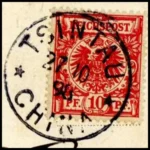
The city that would become the colonial capital city started life as a small fishing village. Its postal history as part of colonial Kiautschou is explored more in the Kiautschou section of this guide. It is mentioned here as the German PO at Tsingtau began life as a German Office in China. From January 1898 until January 1901, all of Kiautschou was essentially treated as part of the German postal network in China, and was provided by Berlin with German Offices in China stamps. For this reason, Kiautschou was the only colony never to have 1889-series stamps diagonally overprinted with the name of the colony, and German Offices in China issues with Kiautschou postmarks are listed separately as Kiautschou Vorläufer and Mitläufer. Unoverprinted German definitives (below) can also be Vorläufer and Mitläufer.
By the time it was decided to create distinctive Kiautschou issues, the Germans were already printing “Yacht” series stamps for the colonies. These were placed on sale in Kiautschou in January 1901.
The first issues distinctive to Kiautschou, however, were locally produced “5 Pfg.” overprints on German Offices in China 10 Pf stamps with both 56° and 45° overprints. Created to fill the need for 5 Pf stamps after stamps of that value ran low during the Boxer Rebellion, three styles of the “5 Pfg.” overprint exist. Most examples have lines in blue or violet colored pencil horizontally across the face of the stamp. The colored pencil was applied to “cancel” the stamps’ original face value (below), but examples exist without this line. Michel notes that stamps of this issue without the colored pencil line were sold on the first day of issue, while Scott notes that some of their listed varieties only exist without the colored line. Stamps of this first Kiautschou issue can be confused with similar but generally more valuable stamps issued by the Futschau post office, also in 1900.
Additionally, later overprints were produced with “5 Pf.” handstamped overprints (below), with some of these having additional “5” or “5 Pf.” handstamps applied.
Tsingtau was also the terminus of the German-built Shandong railway. Once fully in operation, it was possible to travel by rail from Tsingtau all the way to Berlin via Russia and the Trans-Siberian Railway.
Tschifu (Zhifu), 芝罘

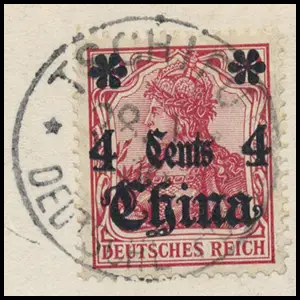
The German PO at Tschifu opened on New Year’s Day, 1900. It is notable that this was the only German post office in Shandong which was not related either to the colony of Kiautschou or to the railroad. Tschifu is located directly across the Bohai Strait from Port Arthur (part of the modern city of Dalian, which was a territory leased to Russia. Following the Sino-German treaty that gave Kiautschou to Berlin, the other foreign powers also wanted a piece of Shandong. The British used the existence of Kiautschou and Port Arthur to force China to lease a territory called Wei Hai Wei, which was also across the bay from Port Arthur. The British leased this territory for the purpose of keeping an eye on the competition; to this end, the British had the lease written so that their territory would exist so long as any foreign power maintained a presence at Port Arthur.
Although Tschifu was opened as a Treaty Port to allow foreign trade; it is conveniently located next door to Wei Hai Wei. This allowed the other Western powers to keep an eye on both the British and the Russians. Tschifu also allowed trading access to Shandong along the northern coast of the province, as opposed to Kiautschou on the southern coast of the province, so it legitimately needed a foreign postal presence as much as anywhere else. At Tschifu, more foreign competition existed than in any other city save Shanghai and Tientsin. In addition to the German post office, offices operated by Great Britain, France, Japan, and Russia also existed.
Tschifu remained open until the final closure of all German offices in March 1917.
The German PO at Tschifu opened on New Year’s Day, 1900. It is notable that this was the only German post office in Shandong which was not related either to the colony of Kiautschou or to the railroad. Tschifu is located directly across the Bohai Strait from Port Arthur (part of the modern city of Dalian, which was a territory leased to Russia. Following the Sino-German treaty that gave Kiautschou to Berlin, the other foreign powers also wanted a piece of Shandong. The British used the existence of Kiautschou and Port Arthur to force China to lease a territory called Wei Hai Wei, which was also across the bay from Port Arthur. The British leased this territory for the purpose of keeping an eye on the competition; to this end, the British had the lease written so that their territory would exist so long as any foreign power maintained a presence at Port Arthur.
Although Tschifu was opened as a Treaty Port to allow foreign trade; it is conveniently located next door to Wei Hai Wei. This allowed the other Western powers to keep an eye on both the British and the Russians. Tschifu also allowed trading access to Shandong along the northern coast of the province, as opposed to Kiautschou on the southern coast of the province, so it legitimately needed a foreign postal presence as much as anywhere else. At Tschifu, more foreign competition existed than in any other city save Shanghai and Tientsin. In addition to the German post office, offices operated by Great Britain, France, Japan, and Russia also existed.
Tschifu remained open until the final closure of all German offices in March 1917.
Shandong Railway Offices
As was the case in other German colonial spheres (notably but not exclusively German Southwest Africa), Germany’s decision to build a railroad influenced postal operations. As in German Southwest Africa, post offices opened once the railroad reached settlements of a given size. A number of the German offices along the route of the railroad would close not long after the railroad moved on, while others would remain open.
Tschingtschoufu (Qingzhou), 青州
& Tschoutsun (Zhoucun), 周村

These two post offices were located at cities in the middle of the Shandong Railroad and each opened once the railroad arrived at their respective locations. The railroad reached Tschingtschoufu first, as “Bahnpost” cancels with this city’s name appearing in June 1903, followed six months later by Bahnpost cancels reading “Tschoutsun.”
Clearly following the example of railroads in German Southwest Africa, both of these offices appear to have opened primarily because of railroad construction, and reached the height of their importance during the period when workers were actively building the railroad itself. Although each has a station on the railroad, the German need for postal facilities at both dropped off significantly once the area of active construction moved on. Additionally, no other country chose to open foreign offices at either location; this is a good indicator of a lack of the economic activity present in places like Shanghai or Tientsin. All recorded cancel devices from both towns, which include dateless “provisional” cancels (top right) and dated metal circular date stamps (bottom right), command premiums.
Although no census is readily available, if ArGe catalogue values are an indication of rarity, strikes of the cancels of these two offices are scarcer than ordinary strikes from all but one or two of the other cancels used in German China.
Both offices closed on 31 December 1905.

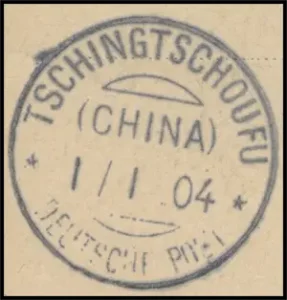
These two post offices were located at cities in the middle of the Shandong Railroad and each opened once the railroad arrived at their respective locations. The railroad reached Tschingtschoufu first, as “Bahnpost” cancels with this city’s name appearing in June 1903, followed six months later by Bahnpost cancels reading “Tschoutsun.”
Clearly following the example of railroads in German Southwest Africa, both of these offices appear to have opened primarily because of railroad construction, and reached the height of their importance during the period when workers were actively building the railroad itself. Although each has a station on the railroad, the German need for postal facilities at both dropped off significantly once the area of active construction moved on. Additionally, no other country chose to open foreign offices at either location; this is a good indicator of a lack of the economic activity present in places like Shanghai or Tientsin. All recorded cancel devices from both towns, which include dateless “provisional” cancels (below left) and dated metal circular date stamps (below right), command premiums.

Although no census is readily available, if ArGe catalogue values are an indication of rarity, strikes of the cancels of these two offices are scarcer than ordinary strikes from all but one or two of the other cancels used in German China.
Both offices closed on 31 December 1905.
Weihsien (Weifang), 青州

The German Post Office at Weihsien opened in June of 1902. Unlike the other offices, the opening of this facility preceded the arrival of the railroad by about 18 months. Also unlike the other offices in the area, it stayed open until 1914, well after the railroad had moved on. It is unclear why this was the case. Weihsien holds the distinction of being one of two offices in China that managed to stay open for more than 10 years in the absence of any significant competition for postal facilities provided by other countries; the only other postal facilities in Weihsien were those operated by China itself. Only one cancel device reading “Weihsien” was ever placed in use (right), and well-struck examples are not uncommon.
Part of the reason for the longevity of the Weihsien office can be explained by its location deep in Shandong province. While only the colony of Kiautschou was officially ceded to Germany, the entire province was seen by Germany as its sphere of influence. As such, Germany would have been in a position to discourage or to prevent other nations from opening postal facilities here.
The ultimate closure of the office on 1 September 1914 was likely due to a number of factors. China had joined the UPU precisely six months before, on 1 March 1914. Once China’s Weihsien postal facilities were able to accept international mail, the importance of Germany’s Weihsien office would have decreased particularly for non-German foreign nationals, who would no longer have to use the German facilities. Additionally, the First World War had begun in late July of the same year. Any citizens of nations with which Germany was now at war would have stopped using the German post office both for nationalistic and practical reasons. Quite simply, they would not have paid the enemy for the privilege of handling (and censoring) their outgoing mail. Even had they done so, the Germans would have been unable to get that mail to a country with which they were at war.
On top of everything else, Japan was in the process of invading Kiautschou, which would eventually fall in early November 1914. Once these military operations commenced, the amount of mail being sent in both directions via Weihsien would have been significantly reduced. Germany continued to need the facilities at nearby Tsinanfu for other reasons, but those at Weihsien became superfluous fairly quickly. All of this led to the office’s closure, which would end up being permanent regardless of any reasoning to the contrary that may have been going on at the time.
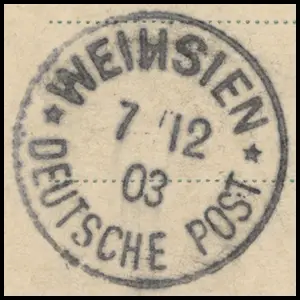
The German Post Office at Weihsien opened in June of 1902. Unlike the other offices, the opening of this facility preceded the arrival of the railroad by about 18 months. Also unlike the other offices in the area, it stayed open until 1914, well after the railroad had moved on. It is unclear why this was the case. Weihsien holds the distinction of being one of two offices in China that managed to stay open for more than 10 years in the absence of any significant competition for postal facilities provided by other countries; the only other postal facilities in Weihsien were those operated by China itself. Only one cancel device reading “Weihsien” was ever placed in use (below), and well-struck examples are not uncommon.
Part of the reason for the longevity of the Weihsien office can be explained by its location deep in Shandong province. While only the colony of Kiautschou was officially ceded to Germany, the entire province was seen by Germany as its sphere of influence. As such, Germany would have been in a position to discourage or to prevent other nations from opening postal facilities here.
The ultimate closure of the office on 1 September 1914 was likely due to a number of factors. China had joined the UPU precisely six months before, on 1 March 1914. Once China’s Weihsien postal facilities were able to accept international mail, the importance of Germany’s Weihsien office would have decreased particularly for non-German foreign nationals, who would no longer have to use the German facilities. Additionally, the First World War had begun in late July of the same year. Any citizens of nations with which Germany was now at war would have stopped using the German post office both for nationalistic and practical reasons. Quite simply, they would not have paid the enemy for the privilege of handling (and censoring) their outgoing mail. Even had they done so, the Germans would have been unable to get that mail to a country with which they were at war.
On top of everything else, Japan was in the process of invading Kiautschou, which would eventually fall in early November 1914. Once these military operations commenced, the amount of mail being sent in both directions via Weihsien would have been significantly reduced. Germany continued to need the facilities at nearby Tsinanfu for other reasons, but those at Weihsien became superfluous fairly quickly. All of this led to the office’s closure, which would end up being permanent regardless of any reasoning to the contrary that may have been going on at the time.
Tsinanfu (Jinan), 济南

Of all the German offices along the Shandong Railroad, the Tsinanfu office became the most important. Tsinanfu was the western terminus of the railroad itself and was the junction with the China Eastern Railroad run principally by Russia. Once the railroad reached Tsinanfu, travel of mail and passengers to Europe exclusively by rail became possible using the Trans-Siberian Railroad through Russia. Tsinanfu opened in 1904 and remained open until all German offices closed in March of 1917. Although Tsinanfu had no direct foreign competition, in this case, it appeared not to need any.
The fastest mail service between Europe and China from 1903 on was via the Trans-Siberian Railway. Tsinanfu was the nexus where several branches of the rail lines came together, and as such, Tsinanfu was in an ideal position to act as a sort of “routing office” for the German postal network. Aside from the Shandong Railway connecting Tsinanfu to Kiautschou, branches of China’s rail network ran south to Nanking and Shanghai, as well as north to Peking and the Russian border. Tsinanfu was also conveniently located as a transfer point for mail handled by German facilities in northern China not directly served by the main rail lines (e.g. Tschifu). Further need for postal facilities existed as Tsinanfu is the capital of a province firmly within the German sphere of influence.
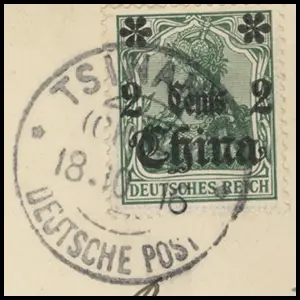
The volume of mail passing through this office is attested by the large number of examples of its cancel device (right). It is the most common of all the offices in Shandong outside of Kiautschou.
Of all the German offices along the Shandong Railroad, the Tsinanfu office became the most important. Tsinanfu was the western terminus of the railroad itself and was the junction with the China Eastern Railroad run principally by Russia. Once the railroad reached Tsinanfu, travel of mail and passengers to Europe exclusively by rail became possible using the Trans-Siberian Railroad through Russia. Tsinanfu opened in 1904 and remained open until all German offices closed in March of 1917. Although Tsinanfu had no direct foreign competition, in this case, it appeared not to need any.
The fastest mail service between Europe and China from 1903 on was via the Trans-Siberian Railway. Tsinanfu was the nexus where several branches of the rail lines came together, and as such, Tsinanfu was in an ideal position to act as a sort of “routing office” for the German postal network. Aside from the Shandong Railway connecting Tsinanfu to Kiautschou, branches of China’s rail network ran south to Nanking and Shanghai, as well as north to Peking and the Russian border. Tsinanfu was also conveniently located as a transfer point for mail handled by German facilities in northern China not directly served by the main rail lines (e.g. Tschifu). Further need for postal facilities existed as Tsinanfu is the capital of a province firmly within the German sphere of influence.
The volume of mail passing through this office is attested by the large number of examples of its cancel device (below). It is the most common of all the offices in Shandong outside of Kiautschou.
The River Posts
Hankau (Hankou, now part of Wuhan), 汉口

The Treaty Port system grew to include a number of cities that were not typical Treaty Ports. Among these, the Treaty Port of Hankau was probably the most important. This city is located on the Yangtze River about 500 miles / 800 km inland from Shanghai, which also has access to the Yangtze. Hankau is located at a confluence of two major rivers, the Han and the Yangtze; other smaller rivers meet the Yangtze at points nearby. Due to this, the port of Hankau facilitated trade far inland from the coast, at a place where the rivers provided water transport in three main directions-more, if the smaller rivers in the area are included. For this reason, virtually everyone who operated a foreign Post Office in China in 1900 had one here. The German office competed directly with other offices run by France, Great Britain, Japan, and Russia due to the numerous business opportunities and other national interests present in the city.
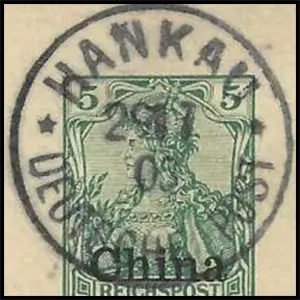
The German office in Hankau opened its doors on 25 April 1900 and stayed open until 16 March 1917. Enough mail traffic passed through this office that the Hankau cancel device left numerous strikes on a variety of mail; examples of the cancel device (right) do not command a premium, except for blue ink strikes known on the first day of operations and for early January 1901 strikes where the year is written in manuscript.
The establishment of a German presence at Hankau proved to be pivotal in a number of areas. Once Germany had a foothold at this location, it supported other post offices and business interests at other locations along the Yangtze. While the other powers had a presence in Hankau proper, only Germany attempted to establish a presence at other locations along the river. With the exception of Nanking, most of these functioned without competition from other powers. It is also likely that German actions in this area were calculated in part to annoy the British, who regarded the Yangtze River valley as firmly within their sphere of influence.
This was of importance as Europe in 1900 was very different than it is today. The major European rivalries revolved around the interactions between a well-established and powerful British Empire and a newly unified and ambitious German Empire. While other countries played their roles on this stage, it was largely the interactions of these two powers and their allies which shaped European politics in Asia and ultimately set the stage for later conflicts like the First World War. It is worth noting that Germany did not establish a notable presence in any of the other nations’ spheres of influence, except in larger Treaty Port cities where multiple nations enjoyed concessions from China.
The Treaty Port system grew to include a number of cities that were not typical Treaty Ports. Among these, the Treaty Port of Hankau was probably the most important. This city is located on the Yangtze River about 500 miles / 800 km inland from Shanghai, which also has access to the Yangtze. Hankau is located at a confluence of two major rivers, the Han and the Yangtze; other smaller rivers meet the Yangtze at points nearby. Due to this, the port of Hankau facilitated trade far inland from the coast, at a place where the rivers provided water transport in three main directions-more, if the smaller rivers in the area are included. For this reason, virtually everyone who operated a foreign Post Office in China in 1900 had one here. The German office competed directly with other offices run by France, Great Britain, Japan, and Russia due to the numerous business opportunities and other national interests present in the city.
The German office in Hankau opened its doors on 25 April 1900 and stayed open until 16 March 1917. Enough mail traffic passed through this office that the Hankau cancel device left numerous strikes on a variety of mail; examples of the cancel device (below) do not command a premium, except for blue ink strikes known on the first day of operations and for early January 1901 strikes where the year is written in manuscript.
The establishment of a German presence at Hankau proved to be pivotal in a number of areas. Once Germany had a foothold at this location, it supported other post offices and business interests at other locations along the Yangtze. While the other powers had a presence in Hankau proper, only Germany attempted to establish a presence at other locations along the river. With the exception of Nanking, most of these functioned without competition from other powers. It is also likely that German actions in this area were calculated in part to annoy the British, who regarded the Yangtze River valley as firmly within their sphere of influence.
This was of importance as Europe in 1900 was very different than it is today. The major European rivalries revolved around the interactions between a well-established and powerful British Empire and a newly unified and ambitious German Empire. While other countries played their roles on this stage, it was largely the interactions of these two powers and their allies which shaped European politics in Asia and ultimately set the stage for later conflicts like the First World War. It is worth noting that Germany did not establish a notable presence in any of the other nations’ spheres of influence, except in larger Treaty Port cities where multiple nations enjoyed concessions from China.
Tschinkiang (Zhenjiang), 镇江

The first city on the Yangtze river to receive the honor of hosting a German post office after Hankau, Tschinkiang is about 150 miles / 240 km inland from Shanghai. This post office would have served a city lying very close to the point where the Grand Canal connects to the Yangtze. Although its Venetian counterpart may be more well known in the West, the Grand Canal of China is the longest canal in the world at over 1,100 miles / 1,800 km. The canal is on the order of 1,400 years old and is now a UNESCO World Heritage Site. It was built to provide an inland water connection from Peking to numerous places in Eastern China. For this reason, the Germans would clearly have wanted a foothold in an area close to it in order to access the Grand Canal.
To this end, Germany opened a post office in Tschinkiang. The German office here joins the office at Weihsien as being the only two German offices opened in China that managed to stay open for over 10 years in areas that lacked significant competition from other nations’ post offices. Only China also had a post office here. Opened on the 28 October 1901, this German office stayed open until the final closure of all German offices on 16 March 1917. Mail volume here seems to be intermediate. ArGe values strikes of this office’s one cancel device (right) at €30, which is mid-level for such values. Strikes of this cancel are typically light and not as clear as other offices’ cancel devices.
The first city on the Yangtze river to receive the honor of hosting a German post office after Hankau, Tschinkiang is about 150 miles / 240 km inland from Shanghai. This post office would have served a city lying very close to the point where the Grand Canal connects to the Yangtze. Although its Venetian counterpart may be more well known in the West, the Grand Canal of China is the longest canal in the world at over 1,100 miles / 1,800 km. The canal is on the order of 1,400 years old and is now a UNESCO World Heritage Site. It was built to provide an inland water connection from Peking to numerous places in Eastern China. For this reason, the Germans would clearly have wanted a foothold in an area close to it in order to access the Grand Canal.
To this end, Germany opened a post office in Tschinkiang. The German office here joins the office at Weihsien as being the only two German offices opened in China that managed to stay open for over 10 years in areas that lacked significant competition from other nations’ post offices. Only China also had a post office here. Opened on the 28 October 1901, this German office stayed open until the final closure of all German offices on 16 March 1917. Mail volume here seems to be intermediate. ArGe values strikes of this office’s one cancel device (below) at 30€, which is mid-level for such values. Strikes of this cancel are typically light and not as clear as other offices’ cancel devices.
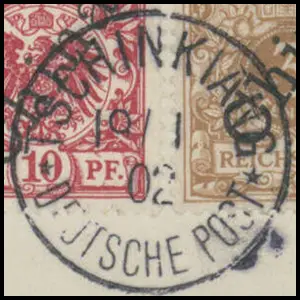
Nanking (Nanjing), 南京

The city of Nanking was arguably one of the more important places Germany could have established a presence for reasons other than trade. “Nanjing,” literally “Southern Capital,” has been the Chinese capital city off and on until 1949. In 1912, when the Nanking office was still open, the city was declared the capital of the newly formed Republic of China. Although the Republic of China now controls only Taiwan, it still regards Nanjing as its de jure capital city.
Despite this, the German Nanking post office did not gain that much importance. Only the Japanese maintained a rival facility here. Nanking opened on 1 January 1903 and remained open until 16 March 1917, but generated only enough mail volume to avoid being a highly priced postmark (right) in the ArGe catalogue-even though it remains one that commands a premium.
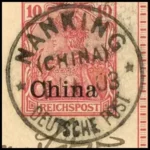
The city of Nanking was arguably one of the more important places Germany could have established a presence for reasons other than trade. “Nanjing,” literally “Southern Capital,” has been the Chinese capital city off and on until 1949. In 1912, when the Nanking office was still open, the city was declared the capital of the newly formed Republic of China. Although the Republic of China now controls only Taiwan, it still regards Nanjing as its de jure capital city.
Despite this, the German Nanking post office did not gain that much importance. Only the Japanese maintained a rival facility here. Nanking opened on 1 January 1903 and remained open until 16 March 1917, but generated only enough mail volume to avoid being a highly priced postmark (below) in the ArGe catalogue-even though it remains one that commands a premium.
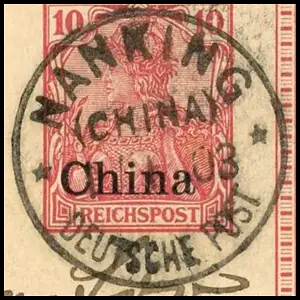
Itschang (Yichang), 宜昌

The final post office Germany opened along the Yangtze River is one of the biggest mysteries of this era. The post office here seemed to serve little purpose, and why it was opened in the first place is unclear. Located 180 miles / 220 km upriver from Hankau / Wuhan, modern Yichang is now a large and important city. But in 1903, Itschang was much more of a provincial backwater with a volume of trade just a fraction of Hankau’s. Itschang was also not sufficiently far enough away from Hankau to have produced a trade environment noticeably different from that of Hankau. Germany may have decided to establish a presence here to try to go upriver to corral trade coming down the Yangtze from further upstream before the competition could get to it. If that was the case, the effort did not succeed.
The German office at Itschang opened on 21 February 1903 and closed on 1 September 1908. Only three other German offices in China were open for a shorter period of time than Itschang. The volume of mail processed here was light enough that strikes of its cancel device (right) command higher premiums than most. Even though other cancel devices command higher premiums in the catalogue, strikes of the Itschang cancel device seem to be less common than a number of the higher priced (and presumably rarer) cancels. This is true despite an official lack of competition from other offices.
This did not mean that Germany had no competition from other foreign post offices. Itschang was one location where sources suggest unofficial competition in the form of a “secret” post office run by Japan. It is known that a small number of Japanese postal facilities operated in China, leaving behind signs their existence in the form of postmarks and other markings. But these facilities also did not leave behind any paper trail or other historic evidence of their functions. Other Japanese post offices, for example, would have at least filed regular financial reports, placed orders for stamps and postal stationery, and filed logs of registered letters with the relevant ministries in Tokyo; many of these records still exist. But for the “secret” facilities, not only is there no paper trail, it also appears that there never was one. Itschang was one of the locations where a “secret” post office is believed to have functioned. Why Japan would choose to operate post offices in this fashion is unclear, but any loss of postal business to Japan at a lightly used facility like Itschang would have sealed its fate all the sooner.
The final post office Germany opened along the Yangtze River is one of the biggest mysteries of this era. The post office here seemed to serve little purpose, and why it was opened in the first place is unclear. Located 180 miles / 220 km upriver from Hankau / Wuhan, modern Yichang is now a large and important city. But in 1903, Itschang was much more of a provincial backwater with a volume of trade just a fraction of Hankau’s. Itschang was also not sufficiently far enough away from Hankau to have produced a trade environment noticeably different from that of Hankau. Germany may have decided to establish a presence here to try to go upriver to corral trade coming down the Yangtze from further upstream before the competition could get to it. If that was the case, the effort did not succeed.
The German office at Itschang opened on 21 February 1903 and closed on 1 September 1908. Only three other German offices in China were open for a shorter period of time than Itschang. The volume of mail processed here was light enough that strikes of its cancel device (below) command higher premiums than most
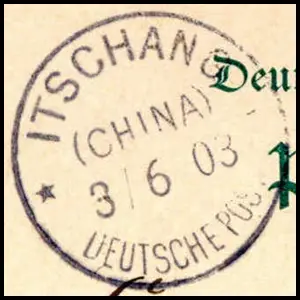
Even though other cancel devices command higher premiums in the catalogue, strikes of the Itschang cancel device seem to be less common than a number of the higher priced (and presumably rarer) cancels. This is true despite an official lack of competition from other offices.
This did not mean that Germany had no competition from other foreign post offices. Itschang was one location where sources suggest unofficial competition in the form of a “secret” post office run by Japan. It is known that a small number of Japanese postal facilities operated in China, leaving behind signs their existence in the form of postmarks and other markings. But these facilities also did not leave behind any paper trail or other historic evidence of their functions. Other Japanese post offices, for example, would have at least filed regular financial reports, placed orders for stamps and postal stationery, and filed logs of registered letters with the relevant ministries in Tokyo; many of these records still exist. But for the “secret” facilities, not only is there no paper trail, it also appears that there never was one. Itschang was one of the locations where a “secret” post office is believed to have functioned. Why Japan would choose to operate post offices in this fashion is unclear, but any loss of postal business to Japan at a lightly used facility like Itschang would have sealed its fate all the sooner.
The ultimate end of the foreign posts in China came in fits and starts. As has been previously mentioned, Germany was “overtaken by events,” first by losing Kiautschou in 1914, and the entire German postal presence in China in stages by early 1917. The only echo of this that remained would be found in Kiautschou, in the sense that postal facilities there continued to be provided as part of a POA network; the former German colony was occupied by Japan, which operated postal facilities there as Japanese POAs until 1922. Germany would continue to print stamps for its POAs in China until 1919, in the expectation that the end of the First World War would simply reset the world to how it had been before 1914. Instead, Germany was required by the Treaty of Versailles not only to give up her colonies but also to give up any right to run POAs anywhere they had existed before. By 1919, the entire German POA network consisted of just four post offices in the western part of the Spanish zone of Morocco.
During the run-up to the signing of the Treaty of Versailles, these last four German post offices closed in June of 1919, marking the end of all of Germany’s postal adventures abroad.
References
Friedemann, A. (1980). The Stamps and Cancels of the German Colonies and the German Post Offices Abroad, Section XI Marshall Islands. Translated by Alfred K. Walter. Wilmington, DE: German Colonies Collector Group.
Michel Redaktion (ed.) (2025). Michel Germany Specialized Catalog 2025 (Part 1). Bobingen, Germany: Schwaneberger Verlag Gmbh.
Nössig, T. (ed.) (2019). Catalog of the Postmarks of the German Colonies & Post Offices Abroad (1st English ed). Berlin, Germany: Arbeitsgemeinschaft der Sammler deutscher Kolonialpostwertzeichen.
Miller, J. (2010). The Evolution of ‘via Siberia‘ Mail 1899-1945, Part 1 of 3. The German Postal Specialist, LXI No. 4 (Whole Number 659), 141–153.
Mosher, J. (1978). Japanese post offices in China and Manchuria. Lawrence, MA: Quarteraan Publications.
Steinmetz, G. (2007). The Devil’s Handwriting; Precoloniality and the German Colonial State in Qingdao, Samoa, and Southwest Africa. Chicago, IL: The University of Chicago Press.
Universal Postal Union. China. (2016, October 22) Retrieved from http://www.upu.int/nc/en/the-upu/member-countries/southem-asia-and-oceania/chinapeoples-rep.html ?sword list[0]=china
Wikipedia. Grand Canal (China). (2016, December 24). Retrieved from https://en.wikipedia.org/wiki/Grand_Canal_(China)
Yale Law School. The Versailles Treaty June 28 1919. (2016, December 24). Retrieved from http://avalon.law.yale.edu/subject_ menus/versailles menu.asp
Illustrations courtesy of Gannon Sugimura & Jed Dorman.