
Beginners Guide
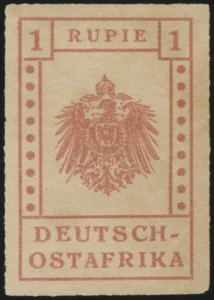
Deutsch-Ostafrika
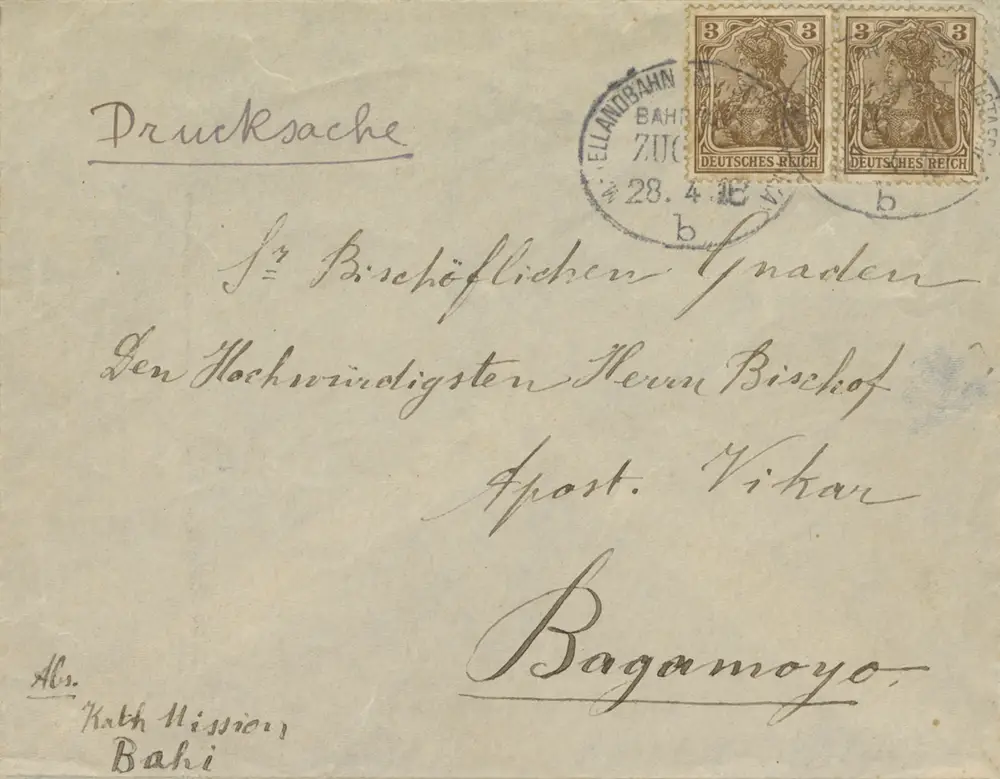
Königsberg-Möwe Provisionals used on train of the Mittellandbahn, 28 April 1916
General

PO China

PO Morocco

PO Turkey
D-NG
D-OA

D-SWA

Kamerun

Karolinen

Kiautschou

Marianen

Marshall-In.
Samoa
Togo
Deutsch-Ostafrika (German EastAfrica)
By Gannon Sugimura
Historical Background

Welcome to the largest corner of the German colonial empire! For the stamp collector and the historian in each of us, this one colony could easily be considered the most unusual of them all in many respects. Among the reasons why would include the following:
- German East Africa was gigantic. With a territory of approximately 995,000 km² / 385,000 mi², GEA was nearly three times the size of the modern Federal Republic. All of the modern nations of Rwanda, Burundi, and the mainland portion of Tanzania were carved out of the former German colony; additionally, small pieces of GEA are now part of neighboring nations like Mozambique.
- German East Africa was the only colony to never use the German Mark as its currency, instead using the Rupie for its entire existence. Only one other colony, Kiautschou would follow suit in a way. Kiautschou started off using the Mark, but eventually the Chinese dollar in 1905. The GEA Rupie was also the only non-decimal currency in the German Empire, with 1 Rupie = 64 Pesa, a detail which will become important c. 1905.
- In the area of philately, GEA issued stamps in unique colors that would appear in no other German colonial stamp issue.
- GEA also issued, in 1893, the only colonial issues which consisted of a currency overprint on German definitives without a colony name. In the other nine colonies, stamps always either included the colony name in their design or included it in the overprint applied to German definitives.
Note: The name of the colony is abbreviated as “GEA,” as it would be in English, throughout the article. However, the GEA currency will be referred to as “Rupie” (singular) and “Rupien”(plural) as in German, so as to correspond to the inscriptions on the stamps with face values of 1 R or higher.
And now, on to Africa!
The beginnings of all German colonial establishments in general, and German East Africa in particular, can be traced to the founding of the German Colonial Society (Gesellschaft für Deutsche Kolonisation, GfdK) which was founded in March of 1884. The Imperial charter granted to this society was exercised the following year with the establishment of German East Africa on 27 February 1885, after the company signed “treaties” with several African societies on the African mainland in the area of modern Tanzania directly across from the island of Zanzibar. The Sultan of Zanzibar, who claimed the coast of East Africa sought by the European powers, had objected to their colonial advances – but the British and the Germans joined forces to press their claims militarily. The end result of this was the acceptance of the Sultan to the presence of the Europeans, who agreed to divide this portion of East Africa between them.
At this point, “German East Africa” was not technically a colony, but was rather the territory controlled by the GfdK for its own commercial activities. Eventually, the company realized it did not have the resources to govern the territory properly, at which point Berlin stepped in and set up a formal colonial administration. German East Africa was far from alone in following this path. Not only did other German colonies start off as commercial settlements of a company, nearly all the other European colonial empires would “inherit” at least one colony in this manner. The Belgian government even took over the Belgian Congo (now the Democratic Republic of Congo) which had initially been regarded as the personal property of the Belgian king.
The first German commercial presence on the coast of East Africa consisted of settlements at the coastal towns of Lamu, Dar-Es-Salaam, and Bagamoyo. The first German postal operations would not begin until December of 1888, with a post office at Lamu (below), followed by similar offices opened in October 1890 at the other two locations.

Having succeeded militarily in quelling opposition on the island of Zanzibar, the Germans also opened a post office there in 1890.
All four German postal facilities in East Africa began operations as a “Kaiserlich Deutsch Postagentur” or “Imperial German Postal Agency”. This designation also applied to all German post offices abroad established after 1884, but in 1890 the only other such offices operated at Constantinople (Istanbul), Shanghai, and Apia (Samoa). The wording “Kaiserlich Deutsch Postagentur”, either in full or in abbreviation, is shown in the cancellation devices used at all of these offices except that at Lamu, which included only the inscription “Ostafrika.”
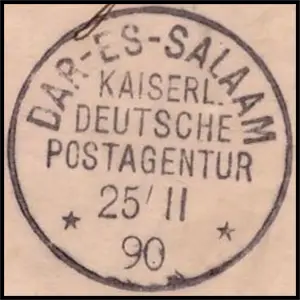
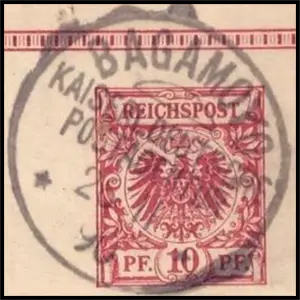
The German Offices in East Africa would never issue distinctive postage stamps the way that the Offices in China, Turkey, and Morocco did. All would only ever use contemporary German stamps without overprint. As such, usage of these stamps is limited to stamps classified as Vorläufer – although, as we will see, for some of them no other type of usage would ever exist.
Although the British and the Germans had united to overcome Zanzibari opposition to their colonization of East Africa in 1885, they did not actually decide between themselves which areas would be colonized by each power. Even Germany’s take-over of the territory of the GfdK did not actually address this. As a result, both Berlin and London would exercise overlapping colonial claims on the African mainland as well as in the now reduced Sultanate of Zanzibar. This was left unanswered for several years, until the conclusion of the Heligoland-Zanzibar Treaty, signed on 1 July 1890.
By signing this treaty, Germany agreed to give up all her claims to Zanzibar proper, as well as to an area called “Wituland” on the African mainland which would become part of British East Africa (i.e. Kenya.) This area included the town of Lamu, so the Germans had to close the Lamu post office. This occurred in March of 1891.
As part of the Heligoland-Zanzibar Treaty, Germany promised not to interfere with British actions on the island of Zanzibar, the British were not willing to accept the operation of a German post office there, even though they tolerated a French post office on Zanzibar until 1904. As a result, the German office on Zanzibar (right) permanently closed in July 1891. For her part, Germany gained undisputed control of the coastal areas south of Tanga which would become the coast of German East Africa. The towns of Dar-Es-Salaam and Bagamoyo are located in this area, so their post offices remained open.
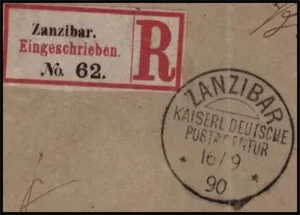
As part of the Heligoland-Zanzibar Treaty, Germany promised not to interfere with British actions on the island of Zanzibar, the British were not willing to accept the operation of a German post office there, even though they tolerated a French post office on Zanzibar until 1904. As a result, the German office on Zanzibar (below) permanently closed in July 1891.
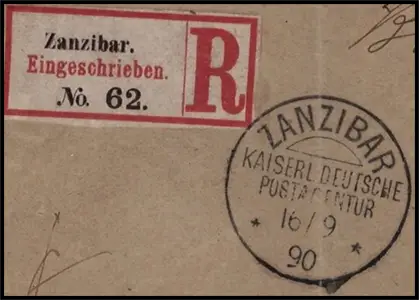
For her part, Germany gained undisputed control of the coastal areas south of Tanga which would become the coast of German East Africa. The towns of Dar-Es-Salaam and Bagamoyo are located in this area, so their post offices remained open.
Vorläufer & Mitläufer

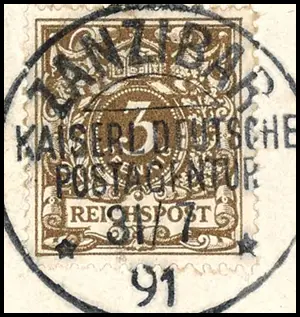
In the area of stamp collecting, the Michel catalogue values the Vorläufer usages at Lamu and Zanzibar separately, and uses different prefixes to note at which office the usage occurred. Stamps listed with the prefix “VL” for those used at Lamu, while “VZ” is the prefix used to denote Zanzibar usage. The prefix used for GEA usages, is similarly “VO” instead of the otherwise typical “V”.
With regard to value, although the Michel catalogue does not note this, the ArGe catalogue does make a distinction between those VO usages which have a clear date showing a usage before the colonial government was established on 1 January 1891. Stamps showing a date of 31 December 1890 or earlier are typically valued around 4-5 times the value of those dated in the period 1 January 1891 – 30 June 1893, the period during which only Vorläufer are encountered. Mitläufer are also noted for usages dated 1 July 1893 or later, with the 2 Mark value known as a Vorläufer as late as 1901.
First Overprint Issues

Philatelically speaking, German East Africa is regarded as beginning on 1 January 1891, when the Imperial government took over the operation of German East Africa and turned it into a formal colony. Distinct issues would not appear until 1 July 1893, when the first GEA specific stamps were placed on sale at post offices.
As is the case with most such colonial issues, these stamps were overprints of ordinary “Krone / Adler” (Crown / Eagle) series of 1889 definitives, which were current at the time of issue. Unlike all other colonies’ issues, these first issues’ overprint included only a currency equivalent of the German stamp’s face value; no colony name appears here. This detail, showing only a currency equivalent, is a feature shared only with the German Post Offices in Turkey, which also consisted only of a local currency value.
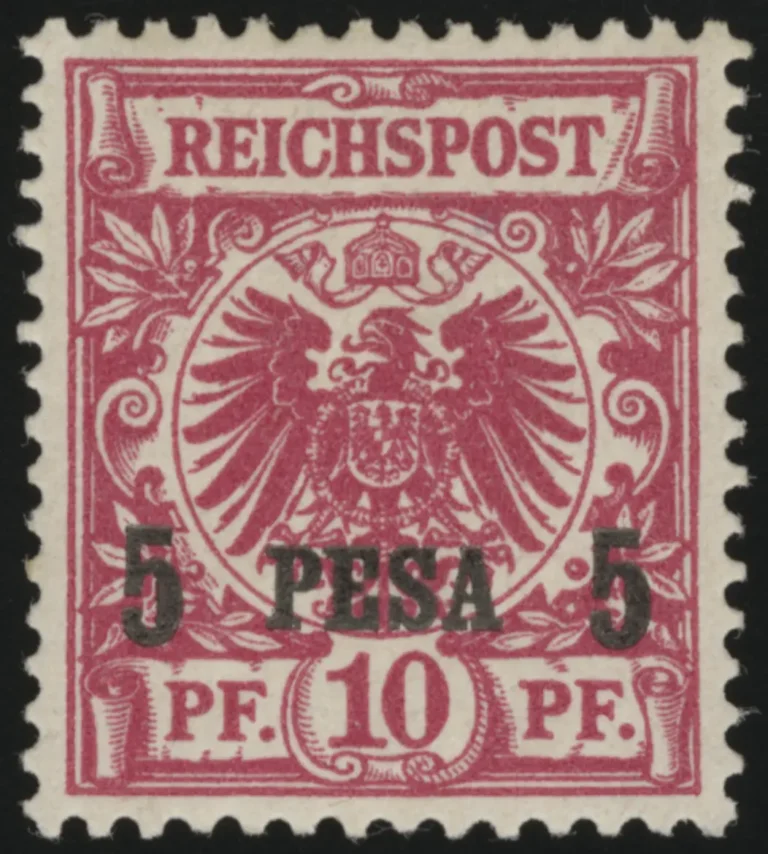
In both Turkey and GEA, the main reason for needing an overprint in the first place was to provide postal services while simultaneously denying currency speculators the opportunity to make a profit from the Reichspost. In both cases, German stamps were sold for local currency with the intent being that they would be used in the territory where they were sold. But because of exchange rate differences, it was possible to make a profit by purchasing quantities of German stamps for local currency in either Turkey or East Africa, and shipping them back to Germany where they would either be sold back to the post office for face value, or sold to the public for use as postage.
Overprinting solved this problem, since German stamps without overprint were still valid in GEA, but overprinted GEA stamps were invalid in Germany and could not be sold to anyone there except on the philatelic market. At this point in time, it should be noted, the overprint did not represent a currency equivalent but was instead a sales price. The franking value remained the face value of the underlying stamp; for this reason, the pesa denominated overprint was applied so that it would not cover up the pfennig value shown on the stamp
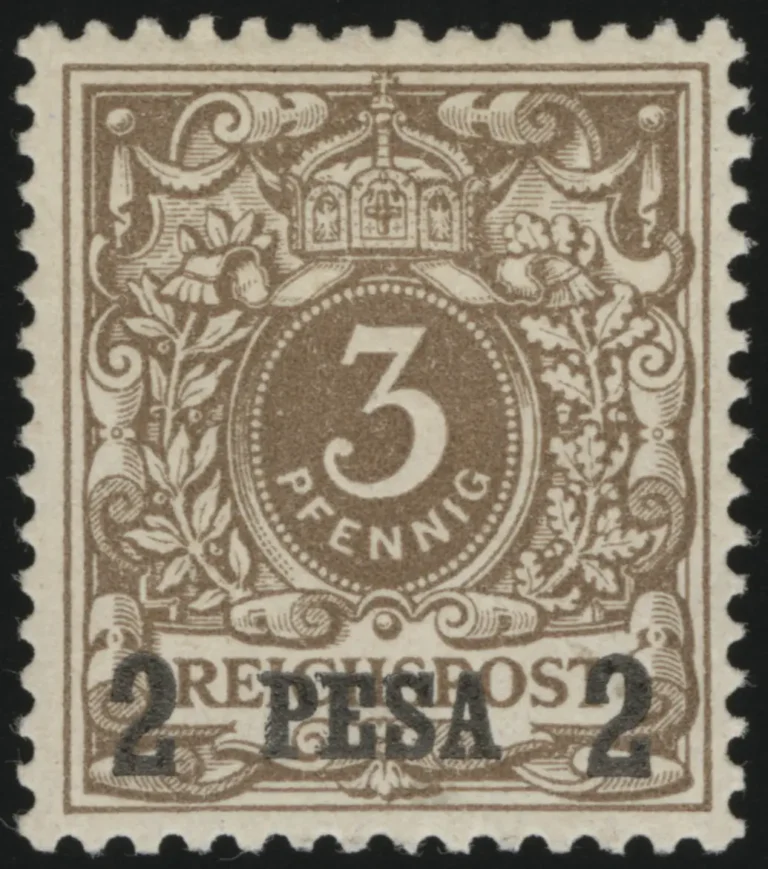
Prior to 1904, one GEA Rupie was divided in to 64 sub-units called “pesa.” This made the currency similar to the Indian rupee, which could also be divided into the same sub-unit, but which is spelled “pies” or “paisa”, or “paise” in English. The Indian rupee, however, differed in that it had a sub-unit called the “anna” which would never be used by the German colonial government in East Africa.
For both overprinted issues of German East Africa, five of the six denominations from the German 1889 series definitives received overprints with values expressed in pesa. These were 2 Pesa-on-3 Pf, 3 Pesa-on-5 Pf, 5 Pesa-on-10 Pf, 10 Pesa-on-20 Pf, and 25 Pesa-on-50 Pf. (Only the 25 Pf value was not created with any sort of overprint.) In each case, the overprinted value was a sales price, but was relatively close to the equivalent value in denominations that could be expressed in whole (i.e. not fractions of) pesa. Each overprint was horizontal, and lay across the bottom of the stamp, typically above the German face value.
Collectors of plate or overprint varieties will be happy to note that this issue does abound with both. In the area of plate flaws for the underlying stamps, all the ones that exist in the 1889 Reichspost series also exist in the GEA 1893 series. The 2 Pesa-on-3 Pf value, for example, exists with the “break in the lower right band” variety just at it does for the unoverprinted stamp of the same period.
The same extends to the shade varieties found in the German series, with shades noted for the 5 Pesa-on-10 Pf and 25 Pesa-on-50 Pf, with multiple shades noted for the 5 Pesa-on-10 Pf value.
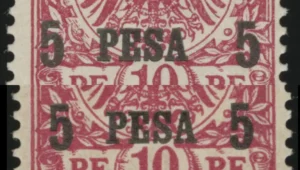
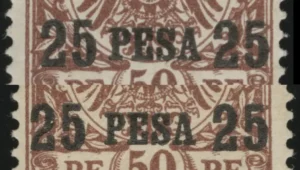
As for overprint varieties, these typically consist of overprints of different widths and are noted for all values except for the 10 Pesa-on-20 Pf value. In the case of the three lower values, Michel notes that the different overprints come from specific positions in the printing plate. For the high value (25 Pesa-on-50 Pf), different overprint widths are listed but without any notation that such varieties come from specific positions on the printing plate. For those inclined to search for these varieties, it will be necessary to use a millimeter ruler, as the difference in overprints can be as low as 1.0 mm smaller or larger than the “normal” overprint. As can be seen in the scan at right, there are subtle differences in spacing (left and right of the word “PESA”) (right) as well as the font size of the word “PESA” in these overprint varieties.
Collectors of plate or overprint varieties will be happy to note that this issue does abound with both. In the area of plate flaws for the underlying stamps, all the ones that exist in the 1889 Reichspost series also exist in the GEA 1893 series. The 2 Pesa-on-3 Pf value, for example, exists with the “break in the lower right band” variety just at it does for the unoverprinted stamp of the same period.
The same extends to the shade varieties found in the German series, with shades noted for the 5 Pesa-on-10 Pf and 25 Pesa-on-50 Pf, with multiple shades noted for the 5 Pesa-on-10 Pf value.
As for overprint varieties, these typically consist of overprints of different widths and are noted for all values except for the 10 Pesa-on-20 Pf value. In the case of the three lower values, Michel notes that the different overprints come from specific positions in the printing plate. For the high value (25 Pesa-on-50 Pf), different overprint widths are listed but without any notation that such varieties come from specific positions on the printing plate. For those inclined to search for these varieties, it will be necessary to use a millimeter ruler, as the difference in overprints can be as low as 1.0 mm smaller or larger than the “normal” overprint. As can be seen in the scan at right, there are subtle differences in spacing (left and right of the word “PESA”) (below) as well as the font size of the word “PESA” in these overprint varieties.
Second Overprint Issues

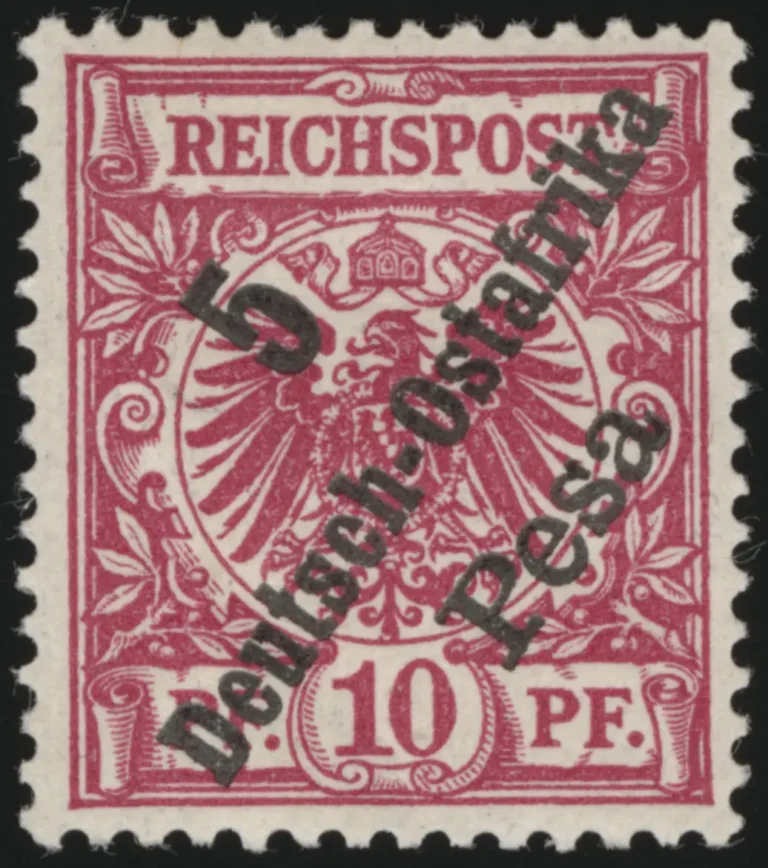
A second series of overprints was issued starting in April 1896. As was the case in the other colonial issues of the later 1890’s, the overprint was applied diagonally across the face of the stamp. This overprint also included the name of the colony.
In several of the other colonies, the overprint was applied at different angles in different printings, but in the case of GEA, there is only one such setting angle. In other words, the angle of the overprint does not need to be measured; it can only occur at one specific angle.
The three-line overprint for each stamp (as shown at right) reads as “(NUMBER) / Deutsch-Ostafrika / Pesa” and consisted of the same five face values as the 1893 issue.
For the 1896 issue, though, the main area of collectible varieties is limited to the shades of the underlying stamp, as well as the plate flaws associated with those shades.
For the low value, 2 Pesa-on-3 Pf, there are six Michel noted shades; Scott notes four different shades for this value. While Scott does not note shades for the other values, Michel notes five shades for the 5 Pesa-on-10 Pf value.
Unlike the prior issue, plate flaws involving the overprint (such as overprint length, broken letters etc.) are neither noted nor listed in Michel.
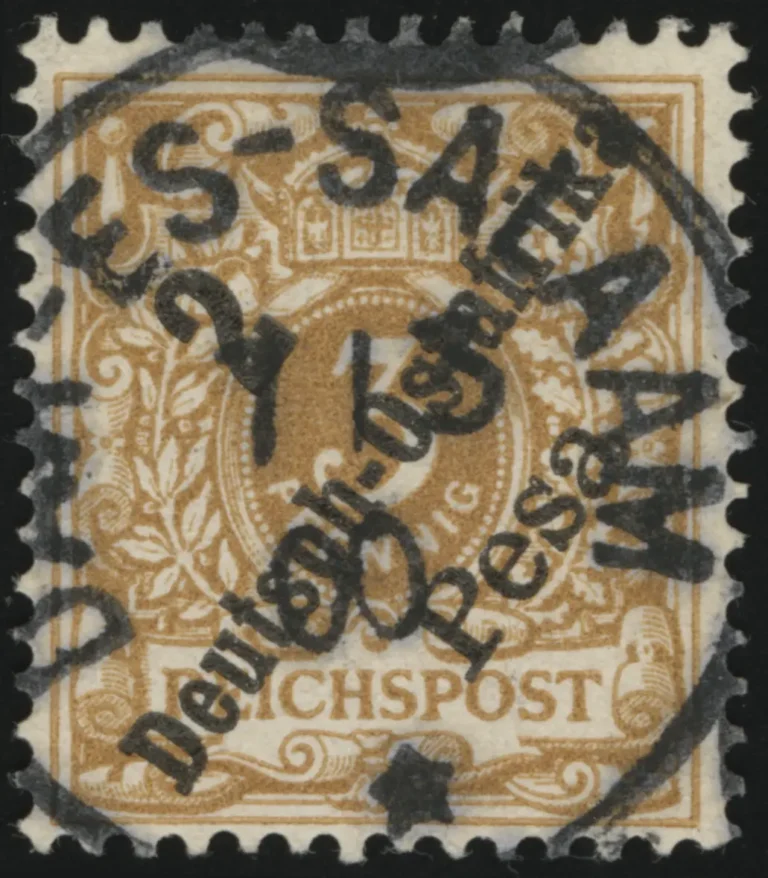
After the introduction of the Yacht stamps, all stamps from the overprinted issues remained valid until 30 September 1901 for their face values in pesa.
Unlike in some of the other German colonial possessions, German stamps without overprint used after 1901 were no longer valid. Any examples of such stamps used in German East Africa are examples of tolerated frankings or were accepted in error – although examples of unoverprinted stamps used in GEA in connection with naval personnel connected with German ships in GEA waters during the First World War are known and highly valued.
The First Yacht Series

Similar with what would later happen in Kiautschou – and for the same reason – German East Africa would end up with two different series of “Yacht” stamps printed on paper without watermark. The first issue consisted of 11 values, which included all of five of the pesa-denominated values of the prior two series, as well as six new values. Issued on 1 January 1901, there are significant small varieties between the issues of German East Africa and Germany proper, or between GEA and any other colony.
A total of eight (8) stamps were printed and issued in the Yacht series which approximate the shades and paper tints of the 1900 “Germania” series of Germany proper. As was the case with the prior issues, the face values of these stamps were as close as could be approximated, rounded to the nearest whole pesa.
The colors chosen for several denominations were determined by the 1897 UPU Congress, which decided that member nations’ stamps which paid specific rates needed to be printed in specific colors. In the case of Germany, few changes needed to be made since the Reichspost had already been printing stamps in these shades beginning with the 1875 “Number/Eagle” series. For this reason, the 3 Pesa/5 Pf domestic-rate postcard stamps had been printed in shades of green for several decades prior to the issuance of the first Yacht series. Similarly, the 5 Pesa/10 Pf international postcard / domestic letter stamp was printed in some shade of carmine, while the 10 Pesa/20 Pf international letter rate stamp was printed in ultramarine.
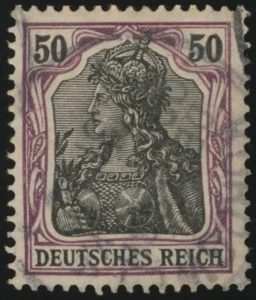
For all the other values, however, the new series represented a major change. The 25 Pesa stamp (right), which had been issued in various shades of reddish brown prior to 1901 was now a bi-color stamp with the frame printed in purple, the name of the colony and the denomination printed in black; additionally, the stamp was printed on paper tinted an orangish-rose shade described in Scott as “Salmon.” This description also describes the equivalent 50 Pf stamp issued in Germany proper, as well as the 50 Pf stamps issued in the other colonies at approximately the same time.
A total of eight (8) stamps were printed and issued in the Yacht series which approximate the shades and paper tints of the 1900 “Germania” series of Germany proper. As was the case with the prior issues, the face values of these stamps were as close as could be approximated, rounded to the nearest whole pesa.
The colors chosen for several denominations were determined by the 1897 UPU Congress, which decided that member nations’ stamps which paid specific rates needed to be printed in specific colors. In the case of Germany, few changes needed to be made since the Reichspost had already been printing stamps in these shades beginning with the 1875 “Number/Eagle” series. For this reason, the 3 Pesa/5 Pf domestic-rate postcard stamps had been printed in shades of green for several decades prior to the issuance of the first Yacht series. Similarly, the 5 Pesa/10 Pf international postcard / domestic letter stamp was printed in some shade of carmine, while the 10 Pesa/20 Pf international letter rate stamp was printed in ultramarine.
For all the other values, however, the new series represented a major change. The 25 Pesa stamp (below), which had been issued in various shades of reddish brown prior to 1901 was now a bi-color stamp with the frame printed in purple, the name of the colony and the denomination printed in black; additionally, the stamp was printed on paper tinted an orangish-rose shade described in Scott as “Salmon.” This description also describes the equivalent 50 Pf stamp issued in Germany proper, as well as the 50 Pf stamps issued in the other colonies at approximately the same time.
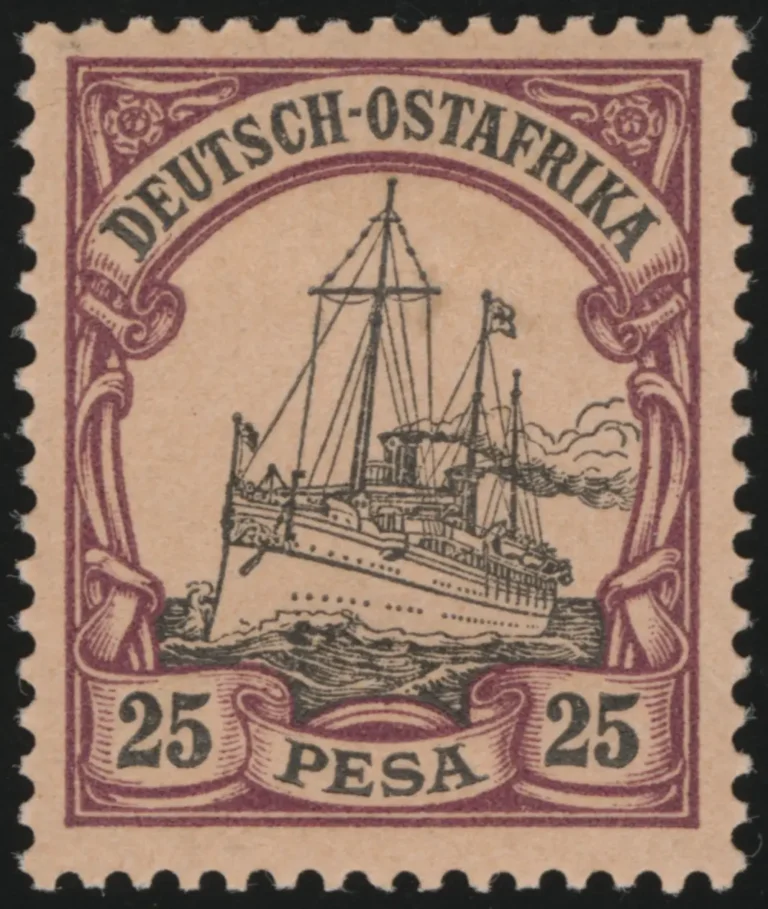
This description also describes the equivalent 50 Pf stamp issued in Germany proper, as well as the 50 Pf stamps issued in the other colonies at approximately the same time.
One difference between the Germania stamps of 1900 and the GEA Yacht stamps of 1901 was the number of denominations. Two denominations from the 1900 Germania series, 2 Pf and 25 Pf, did not see equivalents issued in GEA. That the equivalent of a 2 Pf stamp was not issued did not pose a huge problem, as this stamp paid a local postcard rate that was only truly useful in cities with larger populations than existed in the colonies. As a result, no colony would ever issue a 2 Pf stamp, although 2 Pf proofs for some colonies were produced and are known in collector hands.
As for the 25 Pf stamp, the GEA equivalent would have been 12 Pesa – but this value did not in any way correspond to a postage rate. With the exception of two printed matter rates and one postcard rate, all GEA postal rates for GEA were in multiples of 5 Pesa rather than 2 or 3. The only way this author can think of where a 12 Pesa stamp could theoretically have been needed was for 50 g printed matter mailings sent by registered mail – a rate that is incredibly odd and not likely to see much if any use. (The 25 Pf rate in Germany proper was also for an Express mail rate not offered in GEA.) For all these reasons, there was no need for such a stamp.
The Small Yachts of the first series remained valid until 31 March 1906, one year after the second series was issued.
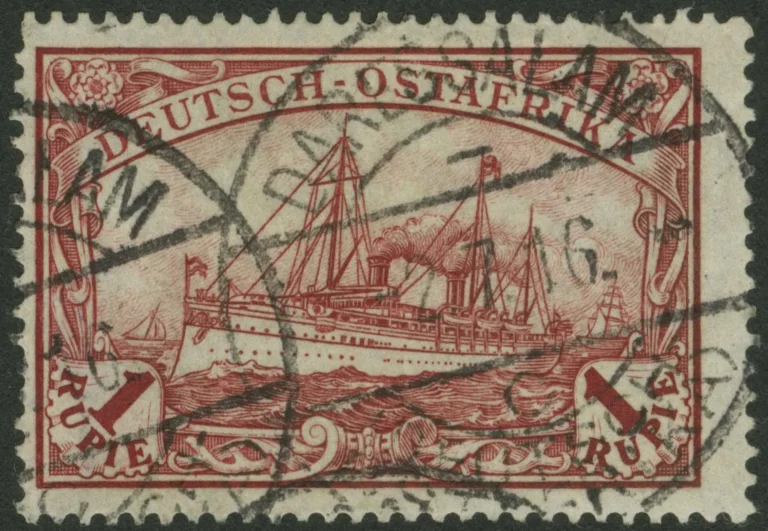
In many ways, the “Large Yachts” of German East Africa are unique in German colonial philately. Throughout the German Empire, the high values of the definitive set consisted of a carmine 1 M, dark blue 2 M, blackish-violet 3 M, and a bicolor 5 M with a carmine center and a greenish frame usually called “slate.” In those colonies and offices that did not use the Mark, equivalent values were issued for all four of these values and in the same colors.
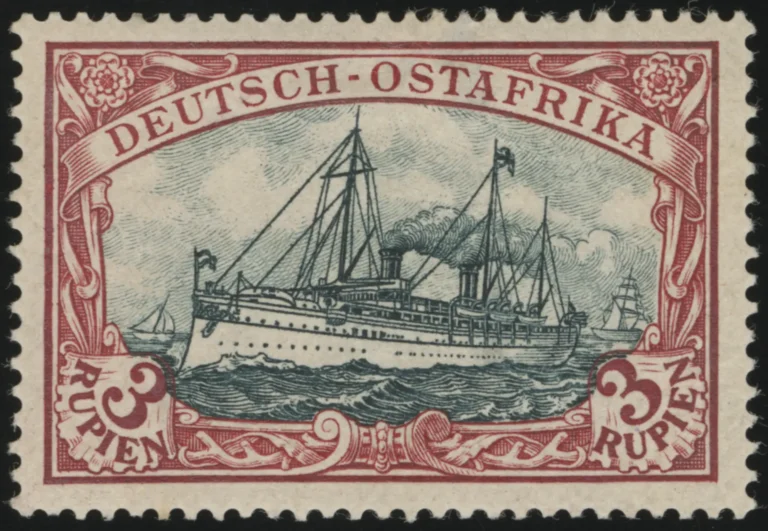
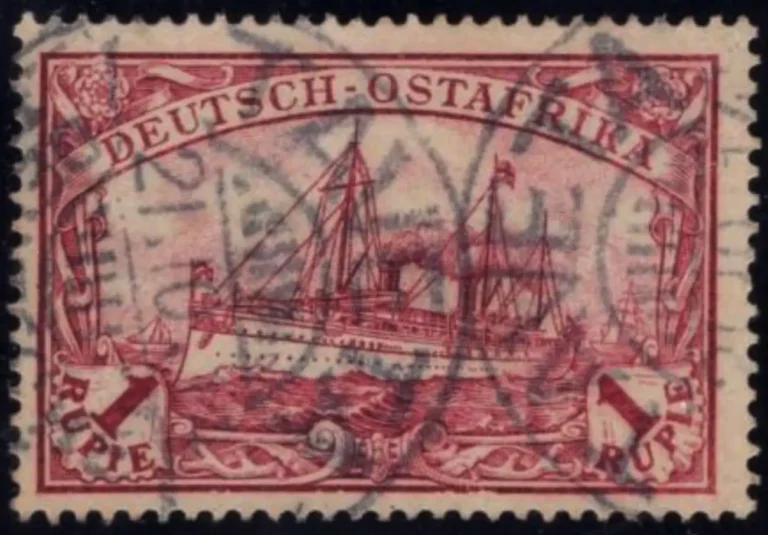
German East Africa, by contrast, issued only three such stamps. These were a 1 Rupie stamp in a shade of red darker than the 1 Mark stamp (which is called “claret” in Scott and “dark lilac red” in Michel), a 2 Rupien stamp issued in yellow-green, and a 3 Rupien stamp issued with a blackish green vignette and a carmine-dark red frame (i.e. roughly the opposite of the 5 Mark stamp) (right).
In many ways, the “Large Yachts” of German East Africa are unique in German colonial philately. Throughout the German Empire, the high values of the definitive set consisted of a carmine 1 M, dark blue 2 M, blackish-violet 3 M, and a bicolor 5 M with a carmine center and a greenish frame usually called “slate.” In those colonies and offices that did not use the Mark, equivalent values were issued for all four of these values and in the same colors.
German East Africa, by contrast, issued only three such stamps. These were a 1 Rupie stamp in a shade of red darker than the 1 Mark stamp (which is called “claret” in Scott and “dark lilac red” in Michel), a 2 Rupien stamp issued in yellow-green, and a 3 Rupien stamp issued with a blackish green vignette and a carmine-dark red frame (i.e. roughly the opposite of the 5 Mark stamp) (below).
The reason for this obvious difference in colors lay in the use of the Rupie rather than the Mark. Firstly, the exchange rate was not 1:1, as 1 Rupie = 1.33 Marks. Secondly, the Rupie was not a decimal currency when the first Yacht stamps were issued. This combination of factors mean that only one stamp could be issued with a useful value in Rupien that corresponded exactly to one of the high values stamps issued in the rest of the Empire. This stamp would have been a 1,50 Rupien stamp issued in blue, which would have exactly equaled 2 Marks . But in 1901, it would have had to have been either a 1 Rupie 32 Pesa or a 96 Pesa stamp. Such a stamp did not pay any actual rate, so was not needed for any postal purpose.
It should be noted that the 3 Rupien value of the issue of 1901 presents the only shade differences to be found in the First Yacht Series. The frame of this issue comes in two Michel and Scott listed shades, with one being dark red and the other being dark carmine-red. Overall, these are not easy to distinguish.
The reason for issuing stamps of equivalent value in the same colors across the Empire had to do largely with postal operations. Since stamps issued in UPU-required colors were the same around the world, postal clerks in any country could tell if letters, postcards, and printed matter were correctly franked no matter where they originated or where they ended up. The same applied to the other stamps issued in the German colonies, since most of these would end up being used on mail sent between points in the Empire. Identical colors on the same value of stamp would allow German postal clerks to determine if an item were correctly paid on items sent to the homeland, regardless of currency, and even during those time periods when international rates applied on mail sent from the colonies to Germany proper.
Even so, German East Africa’s use of the Rupie posed problems which required changes – though regardless of the changes, all of the Large Yachts from the first issue remained valid until the end of 1917 in areas where Germany retained control of the colony.
Currency Reform

The entire coast of East Africa, from Somalia to Natal, used the silver Rupee as a regional currency. Attempts to introduce other currencies, such as the German Mark, did not find great success. The Rupee held such great importance that it crossed international boundaries, similar to the way the Euro does today in Europe. In the German Empire, the Mark had been a decimal currency since its introduction in 1875, so by the early 20th century, Germans were no longer used to dealing with non-decimal currencies.
The impasse was resolved in 1904, when the GEA Rupie was “decimalized.” While the Rupie itself was left unchanged, the pesa was demonetized, and 1 Rupie was divided into 100 decimal units called the “heller”. The exchange rate between the Mark and the Rupie was also fixed at 15 Rupien = 20 Mark.
This exchange rate ensured that it would be easy to maintain the use of the Mark as the Empire-wide currency of account, with a relatively simple calculation to convert between Rupien and Marks. At the actual exchange rate between the Indian Rupee and the German Mark, the accounting would have become far more difficult. Additionally, making the GEA Rupie worth slightly less than its Indian counterpart ensured that GEA silver coins remained inside the colony rather than being circulated further afield, a situation which could have resulted in some denominations eventually being in short supply – a situation occasionally encountered in the Eurozone and in other parts of the world with similar currency unions.
The Second Yacht Series

Having undergone decimalization, it quickly became necessary to replace the Pesa-denominated Small Yachts with new ones denominated in Heller. This new series was issued on 1 April 1905, and consisted of eight values: 2½, 4, 7½, 15, 20, 30, 45, and 60 Heller. Since the Rupie itself was unchanged by decimalization, no new denominations of “Large Yachts” were needed.
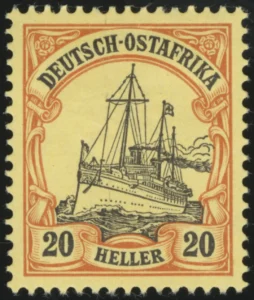
Once again, the colors and paper tints used corresponded with those of the Germania series, although since the 20 Heller stamp equated more closely to the 25 Pf stamp than the 30 Pf, this stamp (right) was printed in orange and black on yellow paper like the 25 Pf stamp. No separate replacement for the 30 Pf stamp was ever issued.
Having undergone decimalization, it quickly became necessary to replace the Pesa-denominated Small Yachts with new ones denominated in Heller. This new series was issued on 1 April 1905, and consisted of eight values: 2½, 4, 7½, 15, 20, 30, 45, and 60 Heller. Since the Rupie itself was unchanged by decimalization, no new denominations of “Large Yachts” were needed.
Once again, the colors and paper tints used corresponded with those of the Germania series, although since the 20 H stamp equated more closely to the 25 Pf stamp than the 30 Pf, this stamp (below) was printed in orange and black on yellow paper like the 25 Pf stamp.
No separate replacement for the 30 Pf stamp was ever issued.
In addition to the benefits of a decimal currency, postal clerks in Germany had a simpler time dealing with GEA mail. Several highly used rates, including the domestic letter/international postcard, international letter, and registered international letter rates were paid by the 7½ Heller, 15 Heller, and 30 Heller stamps. These three stamps, as well as the 60 Heller stamp, converted exactly to their German equivalent values of 10 Pf, 20 Pf, 40 Pf, and 80 Pf. Only the printed matter and domestic postcard rate stamps remained with face values larger than their equivalents in Marks, but these were used primarily within the colony. The other two stamps, 20 Heller and 45 Heller, did not exactly equal their values in Marks, but each paid a specific rate that did not involve a large number of mailings.
The Small Yachts denominated in heller and printed on unwatermarked paper represent the first Small Yacht stamps for which shade differences start to be an issue. Michel notes two shades each for the 15 Heller and 45 Heller denominations, and three for the 4 Heller. As is typical, Scott notes fewer shades – although in this case, that means only that the 45 Heller is not recognized as having shade differences. Scott recognizes the same number of shades for the other two values.
The Third Yacht Series
The primary difference between the Second and Third series lies only in the paper, which is watermarked with diamond lozenges. The watermark is described as “Watermark 125” by Scott and “Wasserzeichen 1” in Michel, and appears in the paper of all pre-war German stamps.
The Third Yacht series included all the same heller denominations as the Second series, as well as the three Rupien denominations from 1901. The first stamps from the Third series were issued in 1906 for the more highly used Small Yacht denominations, with others becoming available as supplies of older stamps ran out.
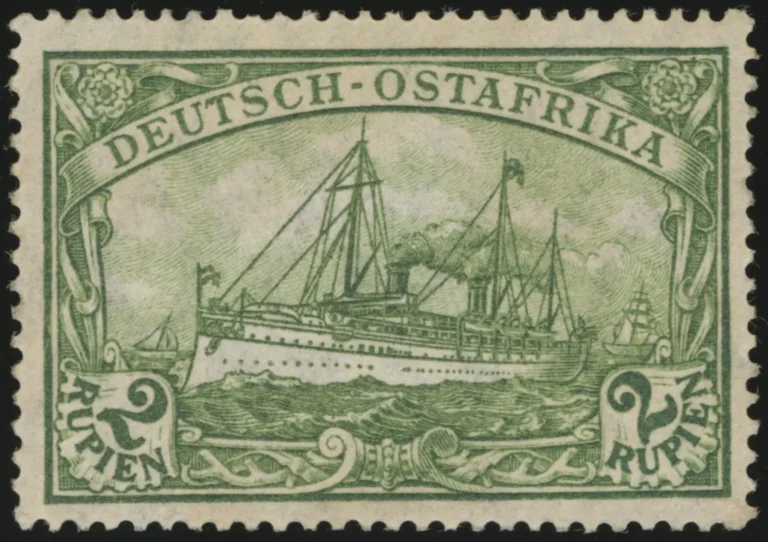
As this was the final issue of the Yacht series, Peace and War printings were also created. Peace printings were created for all denominations, with recognized shades for the 7½ Heller and 15 Heller values. War printings were created only for the 2 ½ Heller, 1 Rupie, and 3 Rupien denominations. While not specified as such, the 2 Rupien value on watermarked paper (right) has the appearance of a Peace printing, but as this stamp was never placed in use before the War’s end, it is usually classed among the War printings.
The primary difference between the Second and Third series lies only in the paper, which is watermarked with diamond lozenges. The watermark is described as “Watermark 125” by Scott and “Wasserzeichen 1” in Michel, and appears in the paper of all pre-war German stamps.
The Third Yacht series included all the same heller denominations as the Second series, as well as the three Rupien denominations from 1901. The first stamps from the Third series were issued in 1906 for the more highly used Small Yacht denominations, with others becoming available as supplies of older stamps ran out.
As this was the final issue of the Yacht series, Peace and War printings were also created. Peace printings were created for all denominations, with recognized shades for the 7½ Heller and 15 Heller values. War printings were created only for the 2 ½ Heller, 1 Rupie, and 3 Rupien denominations. While not specified as such, the 2 Rupien value on watermarked paper (below) has the appearance of a Peace printing, but as this stamp was never placed in use before the War’s end, it is usually classed among the War printings.
One detail worth noting about stamps of the Third Series involves the 60 Heller stamp (right). This particular denomination was apparently of very little use, and all 60 Heller stamps were officially demonetized on 31 March 1912. At this point in time, the Reichspost only ever demonetized stamps when new issues supplanted older ones, when a currency conversion made older stamps obsolete, or (during the War) when German control of a colony was lost. None of these situations applied to the 60 Heller stamp.
It presents a good example of how simply having a colonial stamp available that exactly equaled the value and color to a domestic German stamp would serve no purpose unless it had a rate to pay. It would end up being the only stamp from any German colony demonetized prior to World War I for this reason.
One detail worth noting about stamps of the Third Series involves the 60 Heller stamp (below).
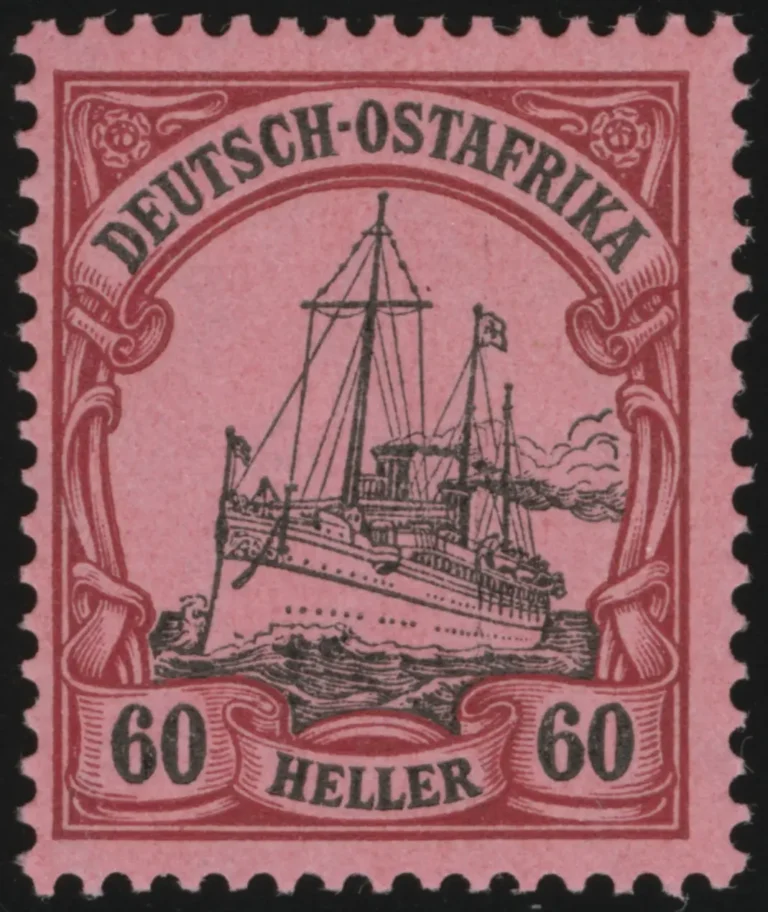
This particular denomination was apparently of very little use, and all 60 Heller stamps were officially demonetized on 31 March 1912. At this point in time, the Reichspost only ever demonetized stamps when new issues supplanted older ones, when a currency conversion made older stamps obsolete, or (during the War) when German control of a colony was lost. None of these situations applied to the 60 Heller stamp. It presents a good example of how simply having a colonial stamp available that exactly equaled the value and color to a domestic German stamp would serve no purpose unless it had a rate to pay. It would end up being the only stamp from any German colony demonetized prior to World War I for this reason.
Postal Stationery

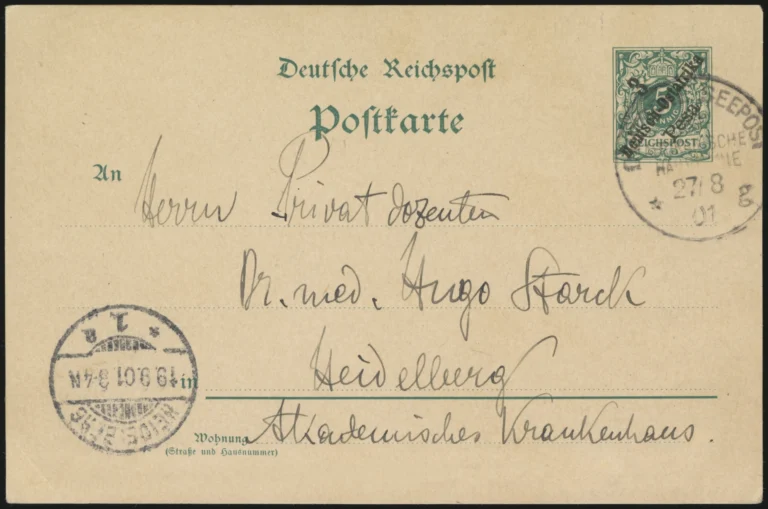
Postal stationery issued for use in GEA generally follows the pattern from other colonies, and is limited to postal cards. (No postal envelopes, other than First World War related emergency issues) would be created.
Vorläufer usages of otherwise typical German postal cards came first, followed by overprinted German cards and finally cards with imprinted stamps of the correct values. These were created in both domestic (green) and international (red) versions, with stamps of the proper denominations imprinted on the cards.
Booklets

German East Africa was one of three colonies which would be provided with stamps in booklet form, the other two being German Southwest Africa and Kamerun. These booklets resemble contemporary booklets from Germany proper in that all were printed with just the “red and green” stamps paying postal card and domestic letter rates, and all sold for 2 Marks, or the rough GEA equivalent of 1 Rupie 55 Heller or 1 Rupie 60 Heller.
All three colonial stamp booklets followed roughly the same timeline as that which will now be described for German East Africa.
It is important to note that Michel lists two varieties of each type of booklet pane.
Type “A” panes (below left) are those for which the perforations between the top and bottom rows of stamps extends all the way through the selvage at the left edge of the pane.
Type “B” panes (below right) have the perforations stopping short, and they do not extend all the way through the selvage.
Of the two, Type “B” perforations appear to have been issued in smaller quantities; values for any type “B” pane or se-tenant pair is higher than for any type “A” equivalent.
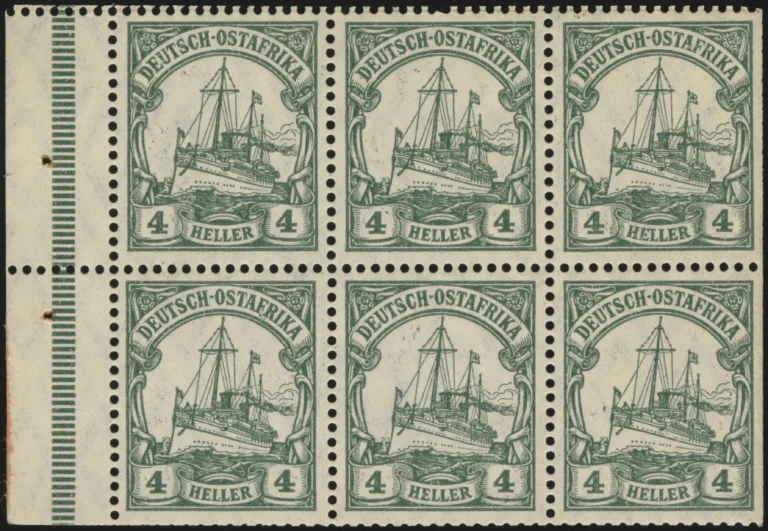
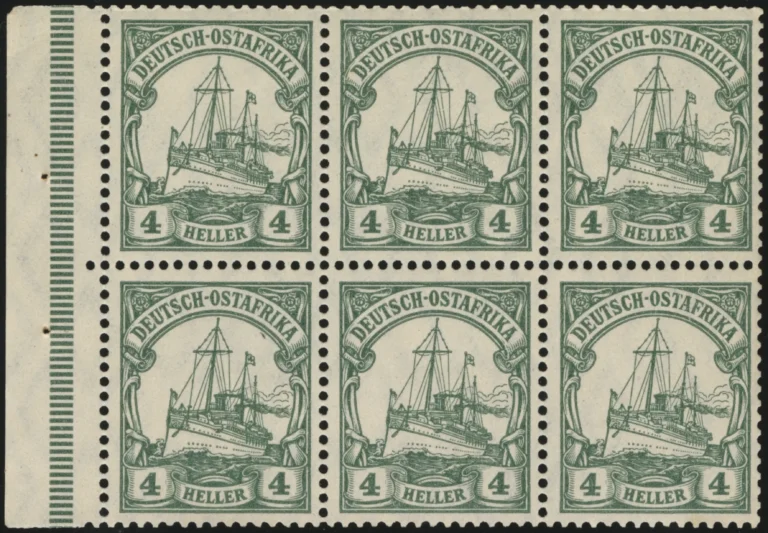
“Booklet A” was issued in late 1911, when 5,000 booklets were sent to the GEA post office. This first booklet, named due to the letter printed at the bottom right of the front cover, consisted of 20 postcard rate (4 Heller) stamps and 10 letter rate (7½ Heller) stamps, which gave it stamps with a total face value of R 1,55.
A complete booklet would include four (4) panes of the 4 Heller stamp, each in panes of 6 subjects. Of the six subjects, 5 were 4 Heller stamps, while the sixth was one of four different se-tenant ad labels. The label is always found in position 1, which is the upper left corner of the booklet pane. Each booklet also included two (2) panes of 7½ Heller stamps with ad labels that differed from the ones found on the panes of 4 Heller stamps. Additional advertising was found on the dividers placed between booklet panes, and which were added to keep the stamps from sticking to each other.
The stamps by themselves, when separated from the booklet, fit the description of Peace printing stamps issued on watermarked paper. Once removed from a pane, most of the stamps become indistinguishable from regular stamps issued in panes of 100 for ordinary postal use – although the pair created when one of the stamps is left attached to the ad label is instantly identifiable. Such a pair can only have come from a booklet since such ad labels were not printed in the regular pane stamps.
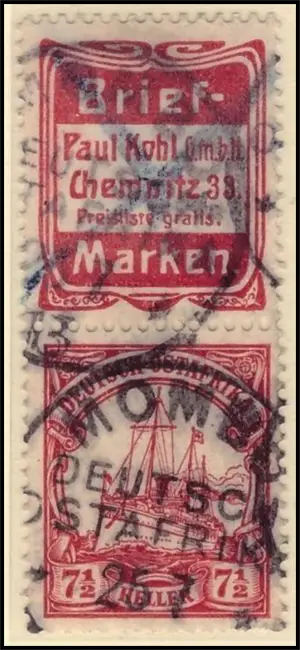
The above description applies both to Booklet A as well as to “Booklet B”, which was issued in April 1912. The primary difference between the two, other than the serial letter on the front cover, lies in the se-tenant ad labels.
When Booklet B was printed, only the ad label from pane #2 of Booklet A was reprinted and so can also be found in Booklet B. A second ad label, originally printed in red and found on one of the 7½ Heller panes from Booklet A, became a green ad on a 4 Heller booklet pane in Booklet B. All of the other ad labels from Booklet A were replaced with new ad labels which can only be found in panes from Booklet B.
Intact, complete booklets from either printing command high prices. Booklets A and B were sold only in the colonies; collectors who did not themselves live in the colony would have had to have known someone who did. The vast majority of these booklets were purchased by non-collectors, who used the stamps inside as postage. In terms of value, the se-tenant pair from each pane holds most of the value. The price for a mint, hinged, se-tenant pair from Booklet A Pane #1 has a catalogue value of €450, while the intact pane of 5 stamps and label is €480. (The same pair in used condition is valued at €2,200, while the used pane is €2,500.) It should be noted that the CV for entire, used panes are viewed as theoretical values by specialists, as used panes are never actually encountered in the marketplace. Specialists who wish to have used examples must typically content themselves with used se-tenant pairs.
A third booklet, “Booklet C” was printed in 1913 but were never sent to GEA. Michel notes that these reached collector hands after being sold at auction in September 1921.
For GEA, Booklet C was a little different than its predecessors. This booklet contained 10 examples of the 4 Heller stamp, and 16 of the 7½ Heller stamp, which gave its stamps a face value of R1,60 rather than R1,55.
The panes from this booklet did not have any se-tenant ad labels as did the prior two, but it did have se-tenant labels printed with a large “X” in the same color as the stamps on the rest of the pane as follows:
- one pane of six (6) 4-Heller stamps
- one pane of four (4) 4-Heller stamps and two “X” labels
- two panes of six (6) 7½-Heller stamps
- one pane of four (4) 7½-Heller stamps and two “X” labels
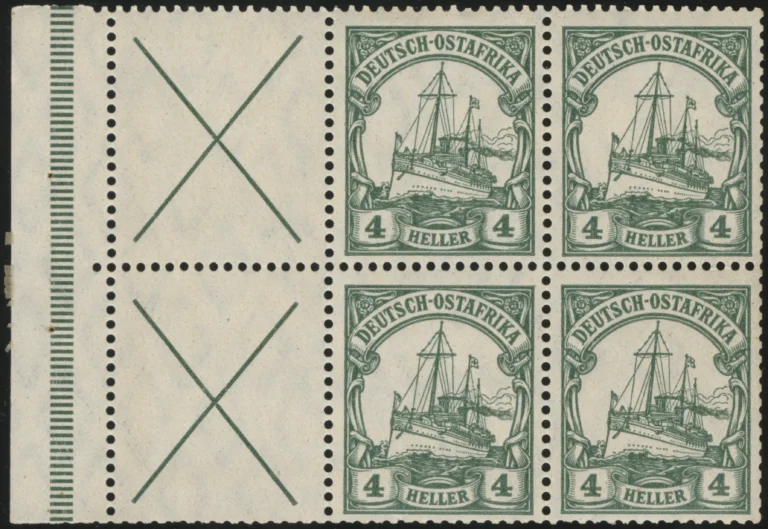
Additionally, the other two “C” colonial booklets (for German Southwest Africa and Kamerun) included at least one se-tenant pane with both denominations present in the booklet, and as such is in two colors. Each pane from a GEA booklet includes stamps of only one denomination and is printed in one color only.
In terms of value, intact booklets and panes from Booklet “C” command the lowest prices, as this booklet appears to have been printed in larger quantities than the prior two booklets. Additionally, the stamps inside could never have been used for postage, and were sold only to collectors.
Intact “C” booklets from GEA are presently valued at €380 with “A” type perforations, and €450 with “B” type perforations. (The value of a hinged, se-tenant pair of either value is just €15.) “C” booklets from GEA, however, have higher catalogue values than their counterparts from either German Southwest Africa or Kamerun.
Bahnpost

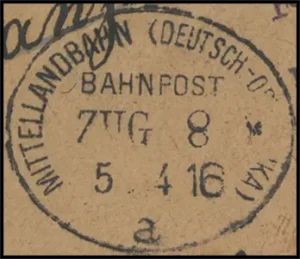
German East Africa provides one area for collecting that would appeal to specialists in its Bahnpost usages. The Bahnpost, or “railway post” in the German context applies to usages that are shown to have a connection to the railways. Oval cancels were also used to cancel mail on board trains, and these resemble marks used in Germany proper in that they have Zug (Train) numbers, and wording in the cancels to show on which train line they were used.
The first line that the Germans built in East Africa was the Usambarabahn, which began at the port of Tanga (on the Indian Ocean coast, near the border with Kenya) before going inland. This line was first planned to go as far as Korogwe when it was planned in 1891, but it only reached that town in 1902. It would continue to be extended until it terminated after a total length of about 220 mi / 350 km at the town of Moschi. This gives it a track that roughly follows a path parallel to the border with Kenya. A branch line to the northern town of Arusha, while planned by the Germans, was only completed by the British administration after the War’s end.
The second line, the Mittlelandbahn, cuts across the middle of the country starting at Dar-Es-Salaam on the Indian Ocean in the East and terminating at Kigoma on the shores of Lake Tangyanika in the West, passing through a number of towns with post offices during the German colonial period such as Dodoma (now the capital city of Tanzania), Morogoro, Tabora, and Kilossa. A branch line to Muanza (now Mwanza) on the shores of Lake Victoria attaches to the main line at Tabora.
The Mittellandbahn was designed to connect the Indian Ocean ports, primarily Dar-Es-Salaam, with the areas far inland and Lake Tangyanika, where ferries could provide further transport to the Belgian, British, and Portugeuse colonies in East Africa. It was generally envisioned that this transportation system would eventually connect with railroads being built in the Belgian Congo and via the Zambezi River to German Southwest Africa. This interconnection would allow transport of goods and people to/from the African interior, as well as over land between the Atlantic and Indian Ocean coasts of central Africa. The final station of this line, Kigoma, only opened in 1914 just prior to the outbreak of the war. As such, the Mittellandbahn never provided the Germans with the economic benefits originally envisioned.
Between the two lines, most of the economically important inland areas coast were connected by rail to the ports on both the Indian Ocean and Lakes Tanganyika and Victoria. Both lines, while in dire need of upgrading, remain in use today in modern Tanzania – as do many of the German-built station buildings. The kindest descriptions of this situation center on the excellence of German engineering; it is difficult to imagine, however, that early 20th century engineering is up to the tasks created by a 21st century world no matter how good it was 100 years ago.
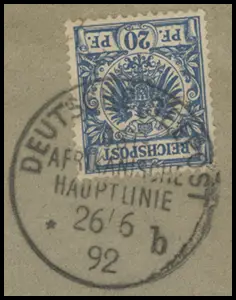
With regard to philately, certain cancels from the railway post command significant premiums compared to others. For example, cancels from the Mittellandbahn Zug (Train) #9 is only noted in literature with Kennbuchstabe “a” (The Kennbuchstabe is the index letter – a, b, or c – which appears at the bottom of the cancel below the month in the date.) This cancel has the highest noted CV of any such cancel at €200, on piece, or €500 on cover. The same cancel with Zug 2 instead of Zug 9, on the other hand, has a catalog value of €15 on piece and €50 on cover.
In general, cancels from the Mittellandbahn command higher prices than those from the Usamabarabahn. Many more German residents, and therefore more need for postal services, were located in the towns served by the Usamabarabahn as compared to the towns served by the Mittellandbahn. Additionally, the Usamabarabahn was placed in service first, so there is a longer period of usage for cancels from this line.
Botenpost

The towns with a German post office which were neither situated on a coast nor had a station on one of the railroads were connected to the postal network by the Botenpost, i.e., a network of overland postal couriers. The Botenpost lines connected similarly situated inland towns both with each other and with either the railroad or a coastal port.
The Botenpost connections were as follows:
- A roughly circular Botenpost route began in Kilossa (on the Mittellandbahn) and was approximately as follows: Kilossa –Iringa – Neu Langenburg – Muaja (Lake Malawi port) – Wiedhafen (Lake Malawi port) – Songea – Mahenge – Kilossa
Muaja and Wiedhafen were linked by lake ferry rather than overland, and mail could also be placed on a ferry in either town for ferry transport to a British or Portuguese port on the shore of the Lake.
Mail bound for post offices outside of the Northwest corner of GEA could go via a “branch line” between Ruanda and Bukoba on Lake Victoria. A similar branch routed mail to/from the Urundi post office via a Botenpost connection to Usumbura.
- Kilimatinde (Mittellandbahn station) – Mkalama – Umbulu – Aruscha – Leganga – Moschi (Usambarabahn station). Mail could eventually be transferred to the Usambarabahn at Aruscha once the railroad station there opened.
- Dodoma (Mittellandbahn station) – Kondoa-Irangi
Seepost

German Seepost, or “Sea Post” was an analogous service to the Bahnpost excepting that it involved ships rather than trains. Unlike the Bahnpost, there were no specifically GEA based ships even though several Seepost lines included this colony in the areas they served. These included the Ost-Afrika-Linie, the Ost-Afrikanische Zwieglinie, and the Bombay Linie, all of which are known to have cancelled the stamps of German East Africa as well as the stamps of Germany proper and the stamps of other countries under the rules in effect for “paquetbot” cancels.
The port towns, particularly on the Indian Ocean, were also connected to each other by ships. Mail was transported up and down the coast of East Africa, with connections to Zanzibar City, on a regular schedule.
Feldpost / Military Mail

There were several military post offices in GEA during the First World War. Most of these were similar to the ordinary Feldpost in that they had cancels with numbers and dates, e.g., “Feldpost Station No. 1” etc. Those which have numbers tend to be stampless, since Feldpost did not have to be stamped. Having said that, however, there is a cancel unique to German colonial philately which does have a Feldpost cancel with the name of a town.
The town of Taveta, where this cancel was used, is located outside GEA in the southern part of what is now Kenya. This town was occupied by the Germans for several years during the war, during which time this cancel was created.
GEA Philately during World War I
When the First World War began, German East Africa found itself surrounded by the colonies of Allied nations. This was generally true for all of the German colonies, although Kamerun did have a land border with Rio Muni, which was at the time a colony of neutral Spain. For Togo and Kamerun, this geography would mean that those two colonies fell in a matter of weeks. Portions of German Southwest Africa, which had a larger German population, managed to hold out until mid-1915. One would have expected that German East Africa, with a smaller German population and also a larger area to defend, would have also fallen to the Allies quite quickly. In reality, the reverse was true. World War I technically lasted longer in East Africa than in Europe.
To make a long story short, Allied forces took over German East Africa piecemeal, following numerous conflicts with German troops. Yet the Germans were able to hold out for much longer here than they were in their other colonies. Several urban areas, including Dar-Es-Salaam, Morogoro, and Tanga, remained under German rule until mid-1916, with more rural areas able to hold out until 1917. When most settlements were lost, German forces numbering just a few thousand in total carried out guerilla-style military operations in German East Africa as well as in Allied colonies such as Portuguese Mozambique, British East Africa (Kenya), and British Northern Rhodesia (Zambia). The final battle of World War I took place on 13 November 1918 – two days after the armistice in Europe – when German forces under the command of Paul von Lettow-Vorbeck took the town of Kasama in the northern-most district of British Northern Rhodesia. The Germans would eventually surrender two weeks later once news of the armistice in Europe reached Africa.
Postally speaking, this period of German East Africa is probably the most interesting of all. That “necessity is the mother of invention” is exceedingly true here. Because this colony was cut off from the rest of the German colonial empire due to the British blockade, it had to be self-sufficient in many areas. Stamps in particular were sometimes hard to come by. This led to several provisional means being used to keep the mail running.
Cash Pre-Payment Frankings

The first provisional method used to alleviate shortages of postage was the use of cash payment frankings.
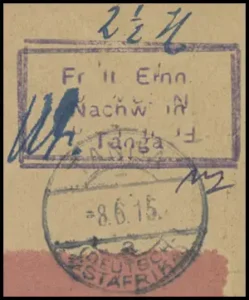
Beginning in May 1915, these “cash frankings” or “postage paid” marks were applied by postal employees when a customer brought in article(s) to be mailed and paid cash for the services provided by the post office at that time. In prior times, the customer could have purchased stamps and affixed them to their own mailings prior to being mailed, but once the supply of stamps of the correct value(s) had been exhausted, this was no longer an option and the post office created these markings to show that postage had actually been paid.
These markings are known from 10 post offices – 8 using handstamps (Daressalam, Kigoma, Morogoro, Moschi, Muansa, Tabora, Tanga, Wilhelmstal) and 2 using adhesive labels (Amani, Mombo).
Multiple forms exist, but most state some version of “Frei laut Einnahme Nachweis” and the name of the post office, with the amount paid either handstamped or handwritten.
The 2½ Heller rate for printed matter in particular was applied to wrappers made paper obtained from numerous sources. Known in English as “Adversity” covers, examples are known made from newspaper, printed flyers, foolscap, ledger book pages etc., and provide a lot of opportunities for the collector of the unusual.
Königsberg / Möwe Provisionals

The next method used to alleviate the shortage of postage was an unusual one – the salvage of German postage from the sunken German ships SMS Königsberg and SMS Möwe.
On 20 September 1914, the German survey ship SMS Möwe was scuttled in Daressalam to avoid being captured or sunk by the British. The German cruiser SMS Königsberg retreated to the Rufiji Delta, where she was inaccessible to British forces. Following extensive efforts by the British to sink her, she was scuttled by her crew on 11 July 1915.
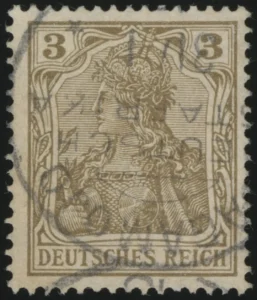
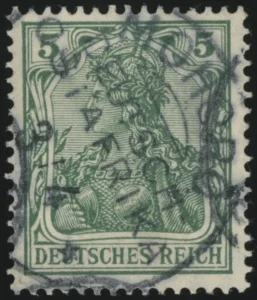
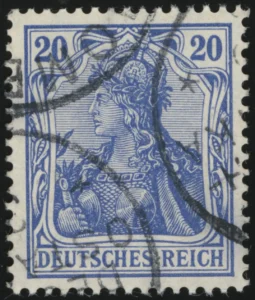
On-board these ships was a supply of Germania stamps. In December 1915, these stamps were salvaged and distributed to several post offices, with the Pfennig denominations used according to the corresponding Heller value.
The quantities salvaged were:
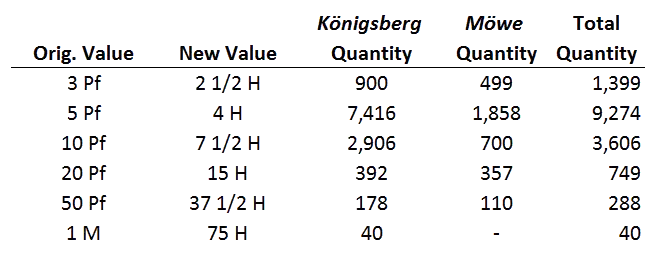
Which were distributed as follows:
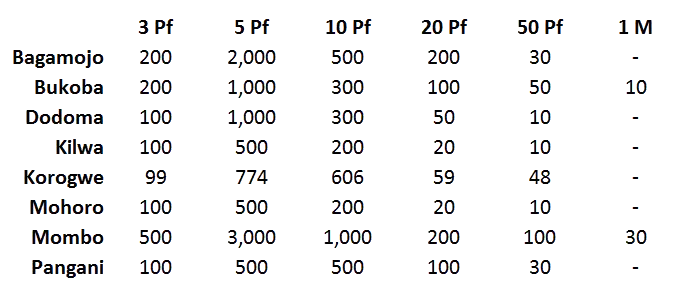
Copies of all values have survived except for the 1 M value. One copy was known to still exist – cancelled in Mombo on 4 January 1916 – at the outbreak of WWII, but it has not been seen since and is presumed lost.
These issues can only be distinguished from normal German postage by the use of GEA postmarks.
Pre-Paid Envelopes

In January 1916, another procedure was introduced to alleviate the postage shortage – pre-paid franking envelopes.
The post offices at Daressalam, Morogoro, and Tanga accepted envelopes from customers to which a handstamp reading “Frankiert mit 7 ½ H” and the official seal of the post office were applied. Once so marked, these envelopes were accepted for mailing at any post office in the colony, not just the one that issued the franking.
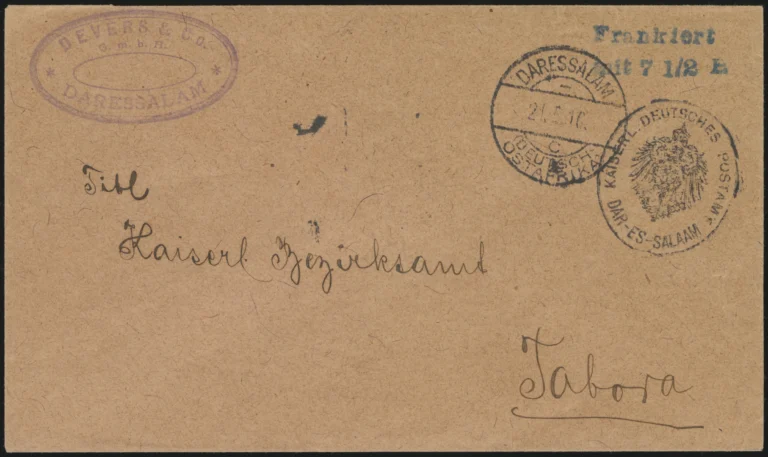
For a variety of reasons, both logistical and postal, these envelopes were valid only on mailings within the colony. Customers who wished to obtain these envelopes had to submit them in multiples of 10, and they paid 75 Heller for the postage value.
Wuga Provisionals

The final attempt at provisional postage was the printing of the Wuga Provisionals in March 1916.
By early 1916, stamp stocks of the 2 ½ Heller, 7 ½ Heller, and 1 Rupie values were essentially exhausted. Provisional stamps were printed on a printing press at the Evangelical Mission in Wuga (part of Wilhelmsthal during the German period, now Lushoto, Tanzania) but these were never placed in use as new stamps arrived from Germany just in time. The stamps were buried to keep the British from taking them, and were not recovered and returned to Germany until 1921.
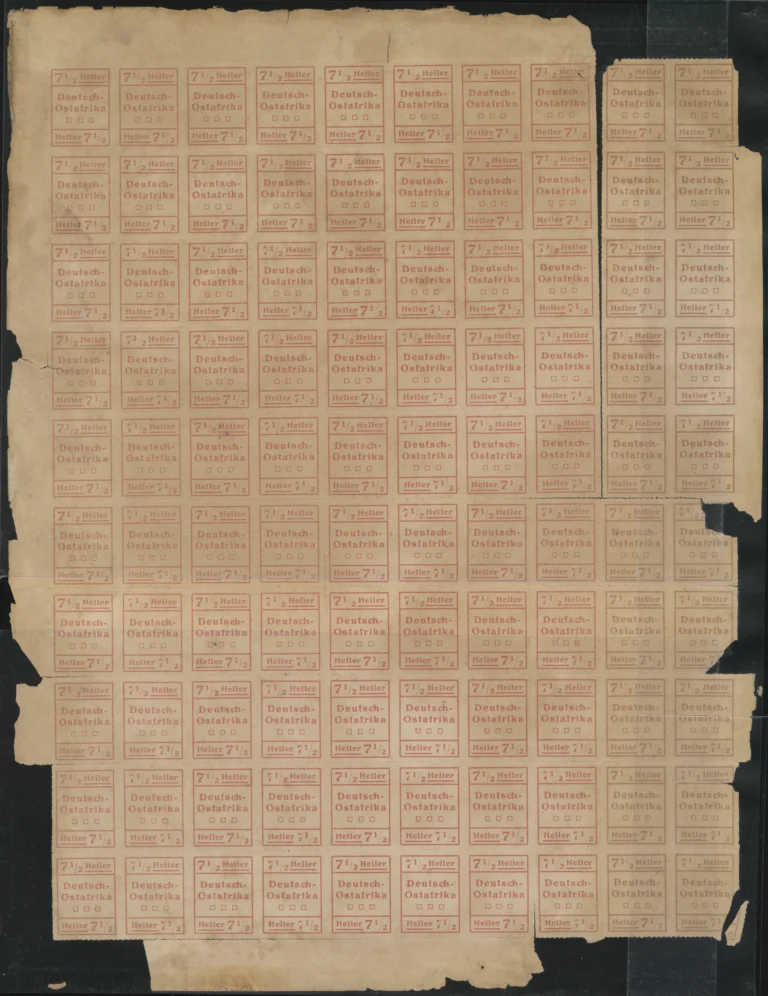
The first examples would reach the stamp market in 1922. Time had not already been kind to these stamps. The paper on which they were printed was not the best quality to begin with, and after being buried for several years in the damp soil of eastern Africa, many of the stamps were too damaged to be collectible. Scott notes that 90-95% of the print run was ruined, while most of the remainder usually bears stains or other damage, as can be seen on this full sheet of the 7 ½ Heller value (below).
The final attempt at provisional postage was the printing of the Wuga Provisionals in March 1916.
By early 1916, stamp stocks of the 2 ½ Heller, 7 ½ Heller, and 1 Rupie values were essentially exhausted. Provisional stamps were printed on a printing press at the Evangelical Mission in Wuga (part of Wilhelmsthal during the German period, now Lushoto, Tanzania) but these were never placed in use as new stamps arrived from Germany just in time. The stamps were buried to keep the British from taking them, and were not recovered and returned to Germany until 1921.
The first examples would reach the stamp market in 1922. Time had not already been kind to these stamps. The paper on which they were printed was not the best quality to begin with, and after being buried for several years in the damp soil of eastern Africa, many of the stamps were too damaged to be collectible. Scott notes that 90-95% of the print run was ruined, while most of the remainder usually bears stains or other damage, as can be seen on this full sheet of the 7 ½ Heller value (below).
Due to a shortage of typeface, each of the two lower values exist in two different types (below – Type I’s are on the left, Type II’s on the right).
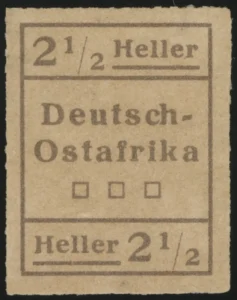
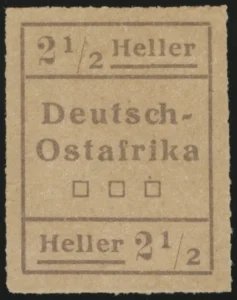
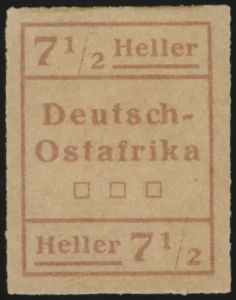
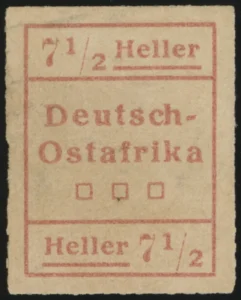
The more common Type I stamp can be most easily determined by the width of the number in the stamp’s face value, which is noticeably wider than in the less common Type II.
The reason for having two different types of the same value lies in the fact that the printing press used to create these stamps lacked enough of either type of font to create the entire issue with just the one width of numerals – so the printers improvised. This situation is frequently encountered with provisional stamp issues the world over, particularly those created in times of crisis.
Se-tenant pairs of the two types of both lower values command a premium over a single of each type. Michel also values the arrangement of the stamps in the pair specifically, and due to the sheet arrangement, some are rarer (and therefore more valuable) than others.
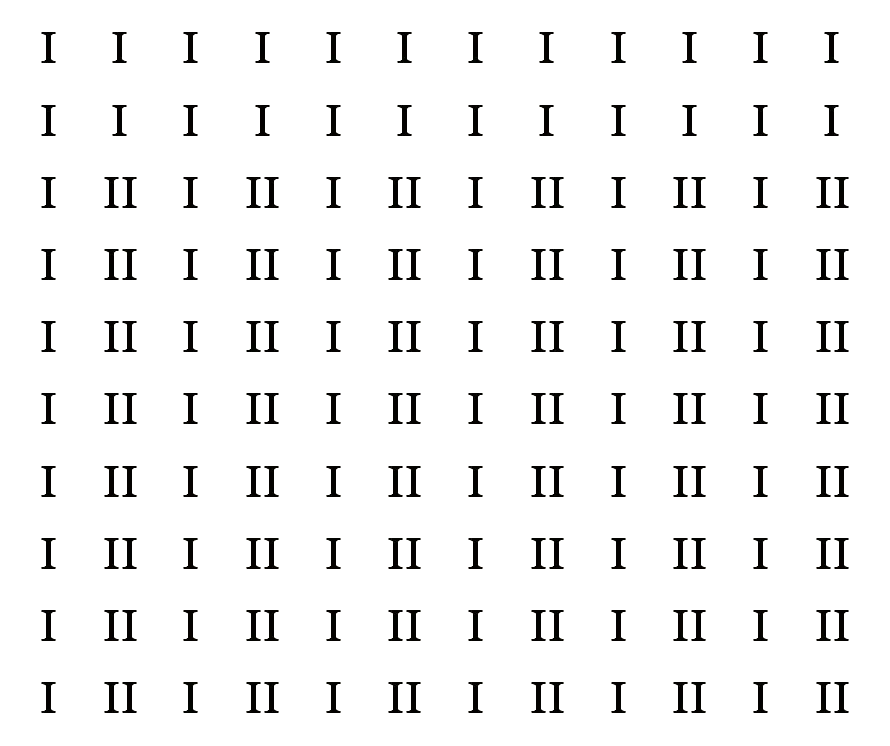
Vertical pairs are valued much more highly than horizontal pairs, while horizontal pairs consisting of a Type II stamp as the left stamp are valued higher than horizontal pairs with a Type I stamp on the left.
The Watermarked 1 Rupie

In March 1916, the German steamer Marie managed to run the British blockade and deliver her cargo to German East Africa. Among the items she carried was a small supply of the 1 Rupie Large Yacht (Mi. 38 I A b). This stamp was otherwise unavailable for use in the colony, and the only used copies are those that were aboard Marie.
This stamp in mint condition is a relatively inexpensive stamp at €35 (Michel) or $13 (Scott) – but only in mint. A genuinely used example of this stamp catalogues at €30,000 off cover (€65,000 on cover) in Michel and $25,000 off / $55,000 on cover in Scott – if one can be found at those prices. The last time an off-cover example was auctioned in Germany, its hammer price was €46,000.
The GCCG maintains a census of these issues (for members only!), which currently stands at 52 known copies. This is one of the rarest German colonial issues in existence, and it exists only because the stamp shipment which arrived in early 1916 included a few 1 Rupie stamps.
Post Offices & Postmarks
Locations on the Usambarabahn are noted with (UB). Locations on the Mittellandbahn are noted with (MB). Locations with Botenpost are noted with (BP).
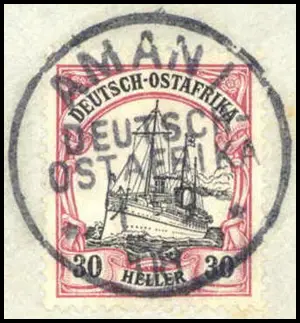
Amani


The Amani post office served villages in the border area in eastern Tanzania near the border with Kenya.
Amani, “Peace” in Swahili, now refers to a nature reserve in that area.
Aruscha

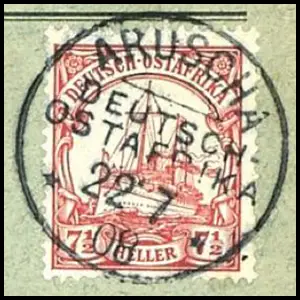
Now Arusha, fell under German control in 1896. The Germans took the town following the murder of two German missionaries in the area nearby, and the Germans would eventually build a fort there.
Arusha is presently known for hosting the “Arusha Accords,” the peace talks intended to end the civil wars in Rwanda (1993) and Burundi (2000).
Arusha has been nominated to become the capital city of the East African Federation, a political and economic union between Burundi, Kenya, Rwanda, South Sudan, Tanzania, and Uganda which would be somewhat similar to the European Union if it is ever launched. (UB)
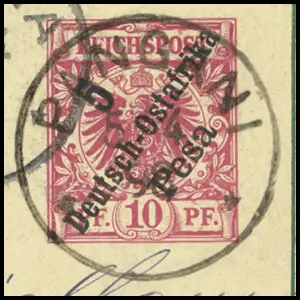
Bagamoyo / Bagamojo

A town on the Indian Ocean coast of GEA. It served as the first capital of GEA when it was run by the German East Africa Company, from 1885 to 1890. When the Imperial government took over control of the colony in 1891, the capital was moved to Dar-es-Salaam.
Both cities’ post offices opened as “Imperial German Postal Agencies” (i.e., a post offices abroad), the only two such offices in what would later become German East Africa. The reason behind this status was that these post offices were initially operating in territory belonging to the Sultanate of Zanzibar. This post office’s status as an “Office Abroad” would only last for a few weeks until the end of 1890. This is the reason for the much higher ArGe values for cancels dated before 1 January 1891, reflecting the change in political status of the area and the short period of when it truly was an Office Abroad.
The spelling of the town’s name was changed to “Bagamojo” in 1909 during a revision of spellings throughout the Empire which better confirmed to German orthography than had prior spellings. The spelling reverted to “Bagamoyo” under the British and has remained as such to the present day.
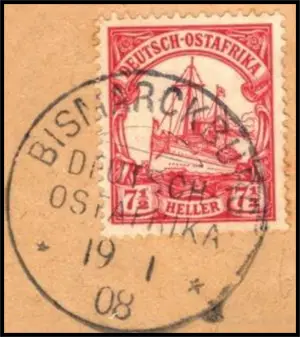
Bismarckburg

Site of a research station on the shores of Lake Tanganyika, the German colonial town around the research station was named in honor of the “Iron Chancellor” Otto von Bismarck (1815-1898).
Bismarckburg functioned as a lake port connecting the south-western part of GEA with the Belgian Congo (now the D.R. of Congo) and Northern Rhodesia (now Zambia).
Under the British occupation after World War I, the town was renamed “Kasanga.” (BP)
Buiko
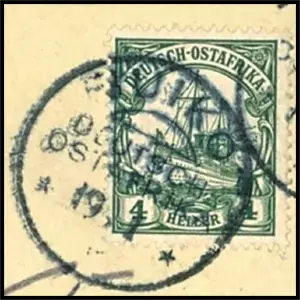
A small town on the Usambarabahn, about 75 km northwest of Korogwe. (UB)
Bukoba

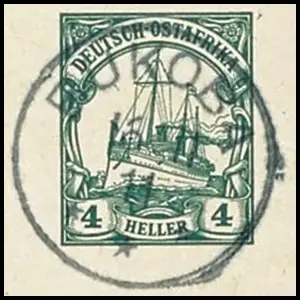
Under the Germans, this town became a ports and border towns on the western shore of Lake Victoria.
The modern port of Bukoba has ferry links with other Lake Victoria ports in Tanzania, Uganda, and Kenya. The city of Bukoba is also the major town on the land border with Uganda.
Dar-es-Salaam / Daressalam

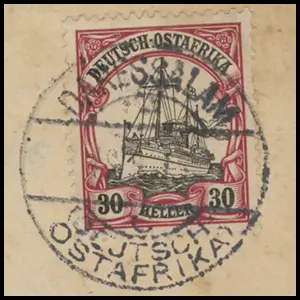
The city of Dar-es-Salaam was originally founded by the Sultan of Zanzibar, whose realm then included the coast of what would later become German East Africa. (Dar-es-Salaam means “House of Peace” in Arabic.) During the 1909 spelling reforms, the city’s name would become “Daressalaam.”
Dar-es-Salaam retained central importance during the entire German colonial period, being the headquarters of all colonial government operations including the post office. The city would actually be the last colonial capitol to fall to the Allies, and the German post office there remained operational until 1 September 1916. Many of the provisional and interim postal issues were printed in Dar-es-Salaam, as were interim issues of banknotes.
The capital city of German East Africa moved to Dar-es-Salaam from Bagamoyo in 1891, when the German colonial government took over the operations of the German East Africa company. The city remained the capitol through the British period, and through independence until the decision was made to move the capitol to Dodoma in 1974. Dar-es-Salaam is now the 5th largest city in Africa with a population of about 7 million and remains Tanzania’s financial hub. (MB)
Dodoma

This town was one of those founded by the Germans in 1907 during the construction of the Mittellandbahn through central Tanzania, although there was apparently a small market town in the area prior to this. The German population only grew to the point where a post office was warranted in 1911.
Dodoma was named as the site to which Tanzania’s national capital would move in 1974, but the move ended up taking over 20 years to complete. Dodoma has officially been Tanzania’s federal capital since 1996. (MB)
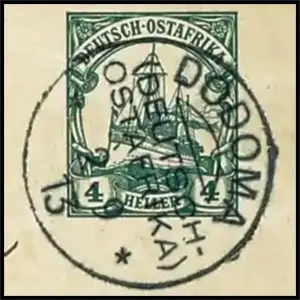
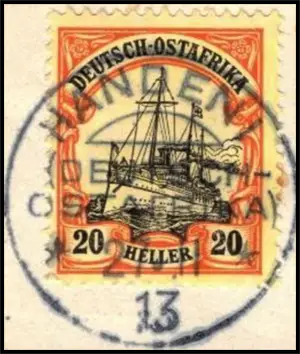
Handeni
A smaller city located in the “plantation belt” of eastern Tanzania. The area of GEA in the north and east was the site of many small German towns and plantations founded by German settlers who came to GEA. (BP)
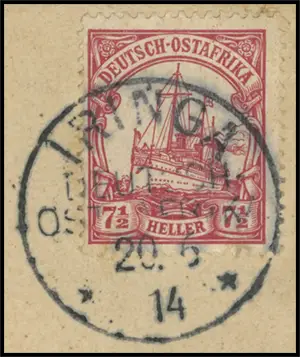
Iringa

Now a medium sized city in central Tanzania, the name “Iringa” comes from a word for “Fort.” It was a center of regional importance before the German colonial period began, a status it maintains today. (BP)
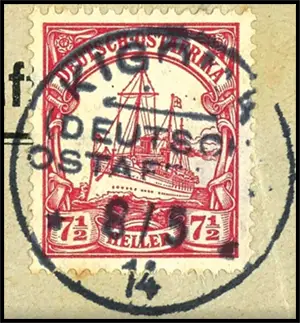
Kigoma

Now a medium-sized city located in the northern part of the western shore of Lake Tanganyika, near DRC and the southern tip of Burundi. Kigoma is the western terminus of the German-built Mittlelandbahn, with trains providing a direct connection to Dar-es-Salaam and the Indian Ocean.
Although it was a busy port before the train station opened in 1915, access to the rail network would make it one of the busiest ports on Lake Tanganyika. Because of its importance as a port and rail terminus, Kigoma was one of the last cities in GEA to fall to the Allies, with the Germans maintaining control until July of 1916. (MB)
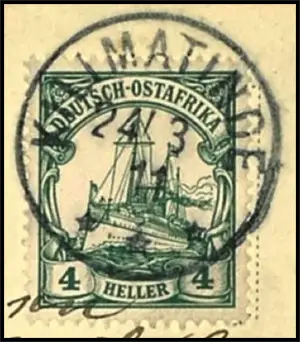
Kilimatinde

A village in central Tanzania, founded as a German colonial fortress.
It remains a small place, with under 6,000 inhabitants in the 21st century. While there is no train station in Kilimatinde proper at present, there is one in Manyoni, which is essentially part of the same urban area. (MB)
Kilossa

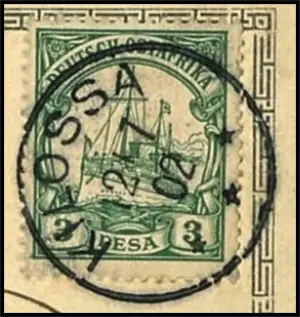
Now Kilosa, is small city in central Tanzania.
It gained importance after a train station opened there during the German colonial period. It was (and remains) the primary urban area in the middle of what is otherwise farmland. Kilossa is also known as the site of a German victory at what was later known as “the Battle of Kilossa” in 1916. (MB)
Kilwa

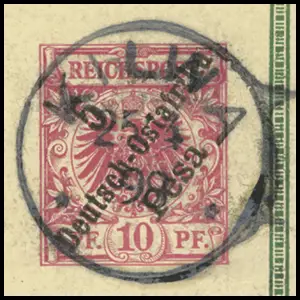
Now Kilwa Kivinje, this is a small town in the southern portion of Tanzania’s Indian Ocean coast.
The nearby island of Kilwa Kisiwani was historically the center of the Kilwa sultanate, an important state in the area in the Middle Ages.
Kisaki

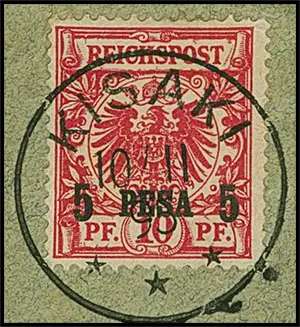
This is a small town in eastern Tanzania, relatively close to the city of Morogoro. Kisaki has a station on the TAZARA railway, which was built by Tanzania, Zambia, and the People’s Republic of China in 1975.
It did not have access to the rails during the German period, and was of relatively little importance to Germany, which explains the short period of postal services.
Kissenji

This is a border town situated in the northwest corner of GEA and on the shores of Lake Kivu.
Now known as Gisenyi, Rwanda, the town remains an important border crossing with the city of Goma in the Democratic Republic of Congo (formerly the Belgian Congo). (BP)
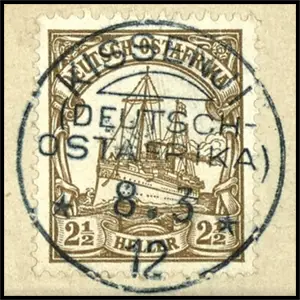
Kondoa-Irangi

A district in north-central Tanzania, to the north of Dodoma.
The district is the location of the UNESCO World Heritage Site known as the Kondoa-Irangi Rock Art Paintings. Also site of a major battle in 1916. (BP)
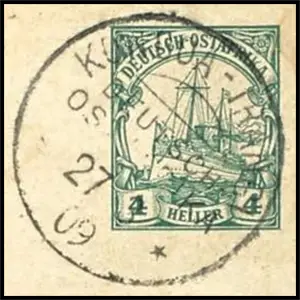
Korogwe

A town in eastern Tanzania, close to Pangani and Tanga.
It was one of the first stations on the Usambarabahn, and sits at the crossroads where connecting Dar-es-Salaam with Arusha, Moschi, and Tanga. (UB)
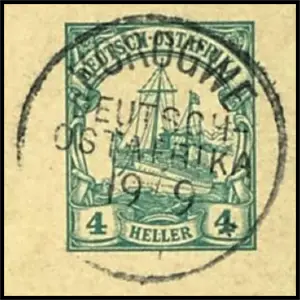
Langenburg

The German presence in the region began in the early 1890’s with the arrival of Christian missionaries. A town to cement the German administration was soon to follow at the northern tip of Lake Nyasa (also known as Lake Malawi). The original site of the town called “Langenburg”, was established a few kilometers to the south of the town’s present location in 1893.
The original site of Langenburg had to be abandoned as it proved unsuitably low; it was being inundated by waters from Lake Nyasa. As a consequence, the town was moved to its present location in 1900. At this point, the town became known as “Neu-Langenburg”, while the abandoned site became known as “Alt-Langenburg.” (BP)
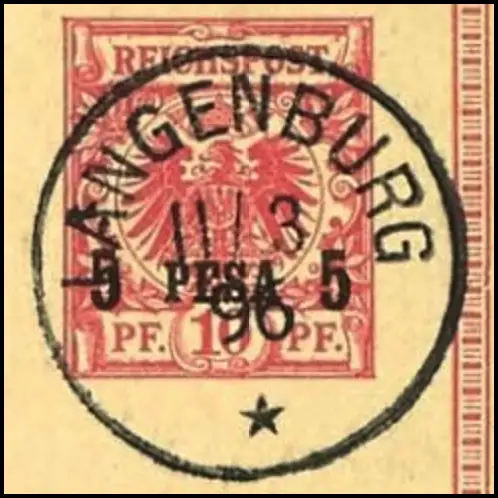
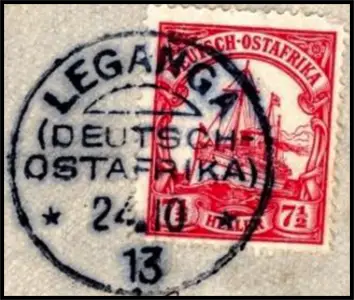
Leganga

This is a village in eastern Tanzania, in roughly the same area as Dodoma and Mpapua.
The village was also known as “Leudorf” during the colonial period. This is an instance where the indigenous place name appeared in the postmark operated by the German colonial authorities rather than the German colonial name by which it was also known. While indigenous place names appeared more frequently in other colonies, this happened much less frequently in GEA. (BP)
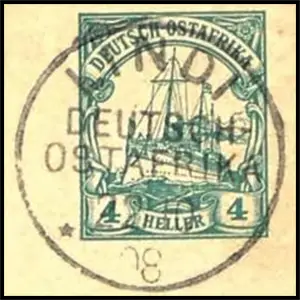
Lindi

Lindi is a settlement founded over 1,000 years ago by Swahili speaking peoples in what is now Tanzania. The name “Lindi” was actually given to the town by the Omani Arabs, who colonized this part of the coast in the 17th century. (“Lindi” in Arabic means “deep channel.”)
Lindi is located on the southern end of Tanzania’s Indian Ocean coast, approximately 100 km / 60 miles north of the Tanzania-Mozambique border. Due to its location on the coast, Lindi was important to German (and later British) colonial administration in the region in an era without air travel, and before roads were built to other populated areas.
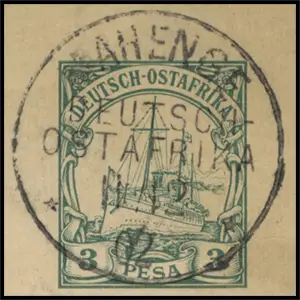
Mahenge

A small town near Morogoro, located in a small mountain range of the same name.
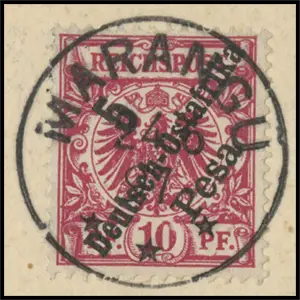
Marangu

A town close to both Mount Kilimanjaro and the border with Kenya. The name means “too many waters”, a reference to the numerous streams and waterfalls in the area.
It is essentially a market town, and is one of the principal towns from which visitors access Kilimanjaro.
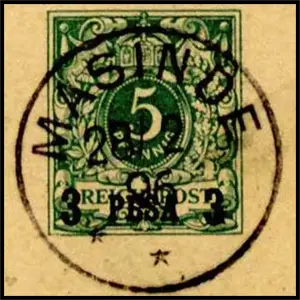
Masinde
A small town now on the Nyumba ya Mungu Reservoir, close to the Kenyan border, near Taveta.
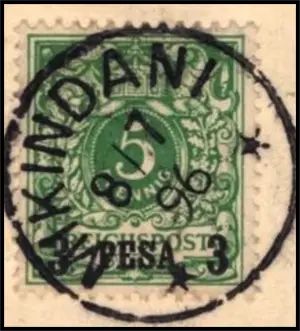
Mikindani

Mikindani is a small town on the Indian Ocean coast of Tanzania, very close to the border with Mozambique. It has a long history, being founded in the 9th century.
It was a regional trading center in the 1800’s prior to German colonization, and retained significance throughout the German colonial period. During this time, Mikindani had a German boma (fort), prison, and a slave market.
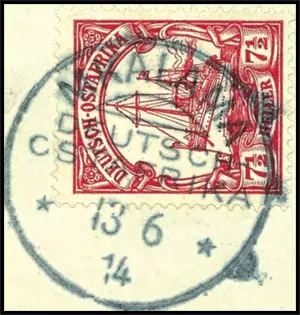
Mkalama

The name “Mkalama” in modern Tanzania applies to a district, which is roughly equivalent to a county in the English-speaking world, or a Kreis / Landkreis in Germany. Mkalama consists of fourteen “wards” or municipalities. The Mkalama district is located on the northern border of its region, and it is relatively close to Arusha.
The village of Mkalama was in the central part of the Mkalama District, and is unnamed on modern maps. The remains of the German Boma are still visible there, and the German Lutheran Church is still in operation. (BP)
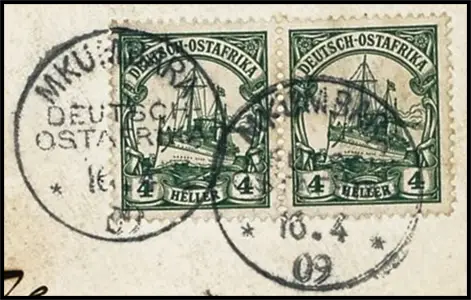
Mkumbara
A small town along the Usambarabahn in the Usambara mountains of northeastern Tanzania.
This town is also one of the few in GEA whose indigenous name appears in the postmark; the town was also known as “Neu Hornow” during the colonial period.
The town is also known to have had an aerial cablecar system transporting wood to a local sawmill built by the firm “Adolf Bleichert & Co.” (UB)
Mnyussi
While Mnyussi used to be a separate village, it is now a ward of Korogwe rural district; essentially, it is part of the rural district that forms the suburbs of Korogwe.
Mnyussi also was a stop on the Usambarabahn. (UB)
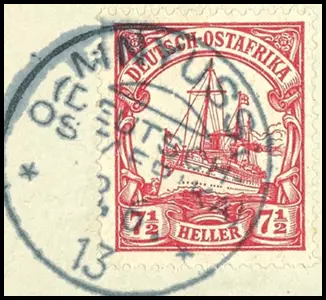
Mohorro / Mohoro

The town of Mohorro is a town inland from, but close to, the Indian Ocean coast. It is between Dar-es-Salaam and Kilwa, near the mouth of the Rufiji River. It is roughly on the coast opposite Mafia Island.
The spelling “Mohorro” was in use at the beginning of the German colonial period, until the spelling reform of 1909. At this point, the town name became “Mohoro.” The revised spelling has been retained to the present.
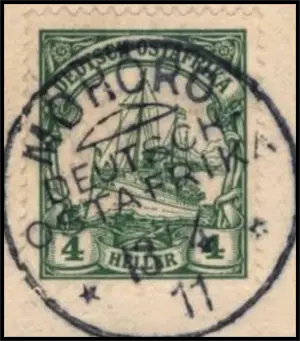
Mombo

Mombo is now a ward of the Tanga Region, in the Northeastern part of Tanzania.
The town appears to have had a stop on the Usambarabahn in the past, but it is unclear if that station is still open today. (UB)
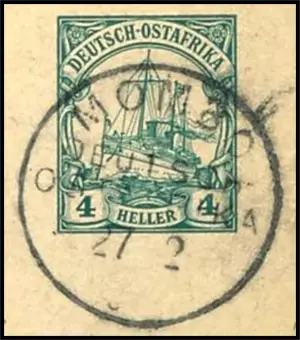
Morogoro

Morogoro is a city in eastern Tanzania. It became a bezirksamt (district office) of the German colonial government in 1904, at which time there were approximately 800 residents.
The Mittlelandbahn passes through the city, and the town would grow rapidly once the station opened in 1907. The city was and remains a center of agriculture. (MB)
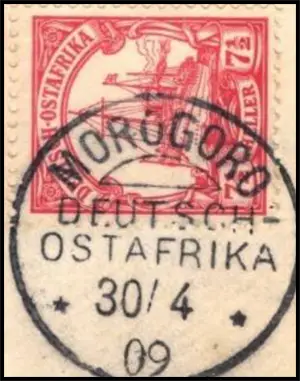
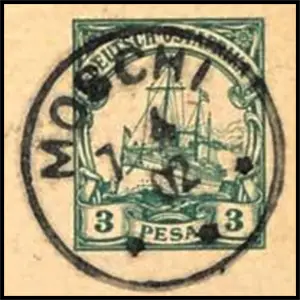
Moschi

Moschi was likely a very important town under the Germans, as evidenced by the large number of cancel examples on GEA stamps. The town is very close to the south flank of Kilimanjaro, and is also very close to the border with Kenya.
The modern town holds the distinction of being the smallest municipality in the country, covering just 23 mi² / 59 km².
The spelling of the town name was changed to “Moshi” after the British took over control of the area. The town has a station on the Usambarabahn, but this station only opened in 1912. (UB)
Mpapua

Mpapua was one of the first areas under firm enough German control to have a fort (boma) built there in the 1890’s.
The town is located in the Dodoma region in north-central Tanzania. The town name is now spelled “Mpwapwa.”

Muaja
The town known as Muaja under the Germans is situated very close to both Lake Nyasa/ Lake Malawi and the Tanzania-Malawi border.
Muaja remains a small town, whose name is now spelled “Mwaya” in modern Tanzania.
Muanza / Muansa

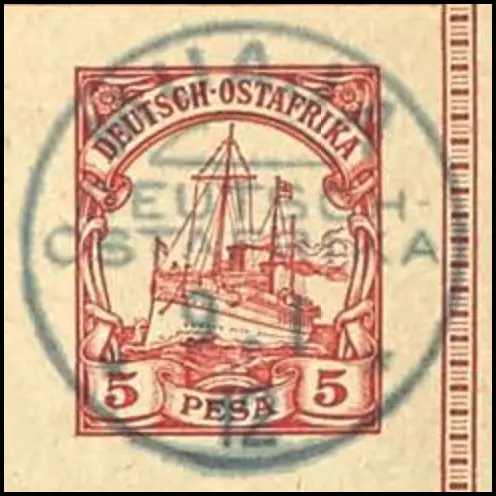
This is a major port city just about in the middle of the southern shore of Lake Victoria today, as it was in the German colonial period. It is the largest port town situated on the shores of Lake Victoria, and is the second largest city in modern Tanzania after Dar-es-Salaam.
The Germans had planned to connect Muanza to the rail network with a branch of the Mittlelandbahn that would have joined the main line at Tabora; however, the branch line was not yet begun when World War I broke out. The German plans would eventually be implemented by the British.
The town’s name was changed to “Muansa” in the 1909 spelling reforms, and was changed again in later years to the spelling that is now used: “Mwanza.”
Muhesa

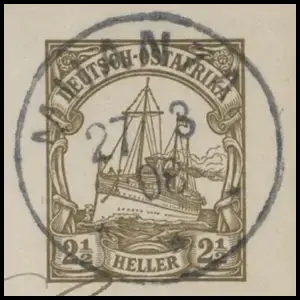
This town is located in the eastern portion of the former GEA, and had a stop on the Usambarabahn.
It is located close to Tanga. It is now located on the map as the “Muheza” district. (UB)
Musoma
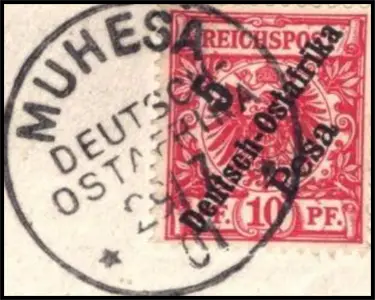
The post office in this town served the port facilities located on south shore of Lake Victoria.
Located half-way between the primary Lake Victoria port (Muanza) and the border outpost at Schirati, it aided in shipping and postal transit around the lake by ferry, which aided the many smaller communities on the shore of the lake that were not connected to the rail network.
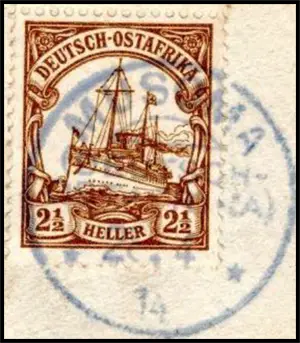
Neu-Langenburg

The German presence in the region began in the early 1890’s with the arrival of Christian missionaries. A town to cement the German administration was soon to follow at the northern tip of Lake Nyasa (also known as Lake Malawi). The original site of the town called “Langenburg”, was established a few kilometers to the south of the town’s present location in 1893.
The original site of Langenburg had to be abandoned as it proved unsuitably low; it was being inundated by waters from Lake Nyasa. As a consequence, the town was moved to its present location in 1900. At this point, the town became known as “Neu-Langenburg”, while the abandoned site became known as “Alt-Langenburg.”
It is now known as Tukuyu. (BP)
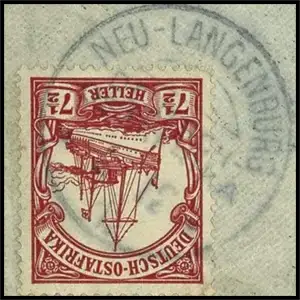
Ngerengere

Formerly a small town with a stop on the Mittellandbahn, Ngeregere was absorbed by, and is now a ward of, Morogoro. (MB)
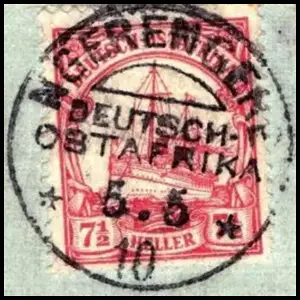
Ngomeni

A small town to the west of Tanga, which had a stop on the Usambarabahn.
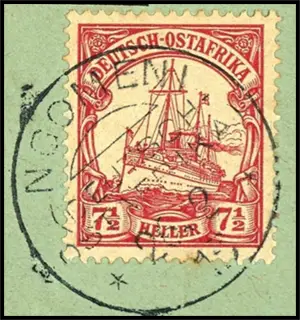
Pangani

A fairly large port city 45 km south of Tanga.
While it still exists, its importance as a port has been largely superseded by the port facilities at Dar-es-Salaam. It has a stop on the Usambarabahn. (UB)
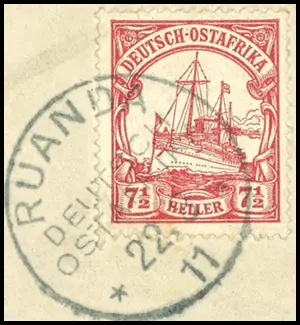
Ruanda

This post office was established in 1907 when Germany, which had administered the northeast of GEA as one administrative district / province, created separate administrations for the northern half (Ruanda) and the southern half (Urundi).
The town of “Ruanda” is now Kigali, the capital city of Rwanda. (BP)
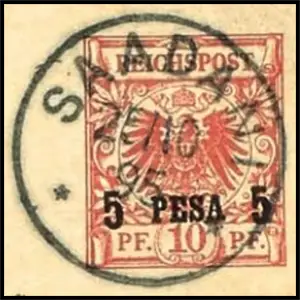
Saadani / Sadani

The importance of the town of Saadani during the colonial period primarily lay in its location as an Indian Ocean coastal port directly across the Zanzibar channel from Zanzibar City, the seat of the Sultan of Zanzibar.
During the 1909 spelling reform, the town’s name was changed to “Sadani.” This area is no longer as important as it once was. The name “Saadani” also applies to a national park in the area in modern times.
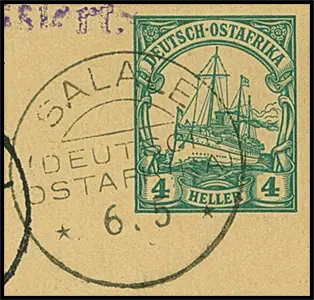
Salale
A small town in the delta of the Rufiji River. It can be seen on maps near Mohoro.
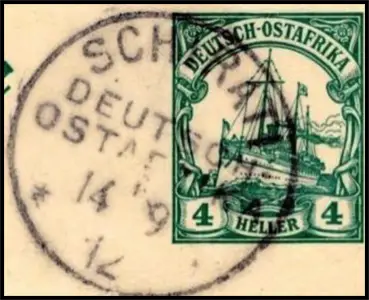
Schirati

A border town / port on Lake Victoria approximately 10 mi / 16 km from the border with Kenya.
Its importance as a port has since been eclipsed by Mwanza, but retains some importance due to its location on the border. The name of the town was changed in the British period to “Shirati.”
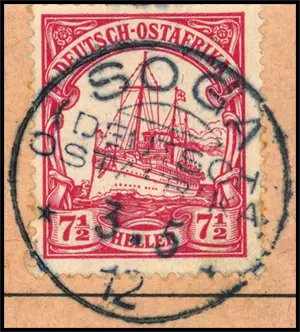
Soga

A village with a Mittellandbahn railway station located in what is now the outer suburbs of Dar-es-Salaam.
In the colonial period, it was an important stopping point between the coast and the interior. (MB)
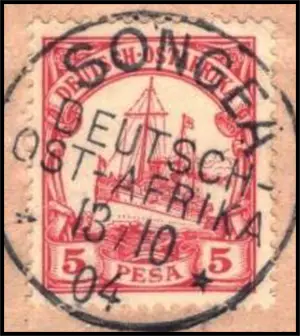
Songea / Ssongea
A city in the Southwest of the former GEA. The town would end up becoming a center of the Maji Rebellion, an armed war pitting the German colonial authorities against indigenous Muslim and Animist Africans. This uprising lasted from 1905 until 1907, and is believed to have killed approximately 300,000 people.
The name of the town was changed to “Ssongea” in the 1909 spelling reforms.
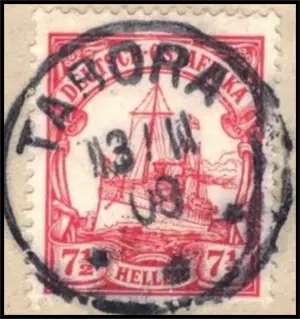
Tabora

A “Wild West” / lawless town in the early days of colonization, the city became an important station on the Mittellandbahn. The Germans had planned a branch of the Mittellandbahn from Tabora to Muanza, which was to connect towns in northern GEA to the rail network. The branch line was eventually built after World War I ended during the British period.
Tabora remained under German control until September of 1916, and also produced the only coins minted in any German colony. These were emergency issues of 5 Heller coins struck in brass, 20 Heller coins struck in either brass or copper, and 15 Rupien coins struck in gold. (MB)
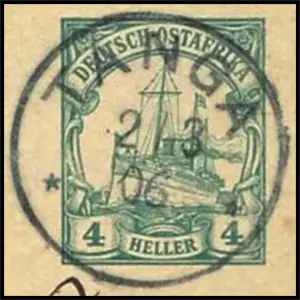
Tanga

A port city on the Indian Ocean coast. Tanga was the site of a Portugeuse trading post which was founded there c. 1500, and remained an important slave trading market until slavery was banned by the European powers in the 19th century, prior to the German colonial period. The name “Tanga” is said to mean “Sail” in Arabic.
Tanga is the northern-most port on the coast of the former GEA, and was the closest port to the Usambara mountain towns where most of the Germans lived and established plantations. Tanga was, therefore, a logical place to place the coastal terminus of the Usambarabahn, the first of the two railroads built by the Germans. (UB)
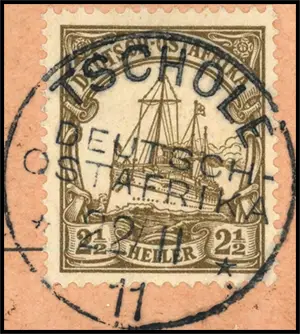
Tschole
This post office was located on Chole Island, an islet just off the coast of Mafia Island in the Indian Ocean (central coast, became German in 1890 due to Zanzibar treaty).
Chole Island was very important trading link.
Ujiji / Udjidji

This is a market town on Lake Tangyanika. In the German period, it had a station of the Mittlelandbahn, and is the oldest town in Western Tanzania. It is known to have already had a population of approximately 10,000 by 1900, and is located near what would become the border with Burundi.
Ujiji is the site of one of the most famous meetings in history between two European explorers in Africa. It was here on 27 October 1871 that Henry Stanley posed the now immortal question “Dr. Livingstone, I presume?” (Dr. David Livingstone had been missing in Africa for a period of six years at the time, which is a story for another time.)
The name of the town was changed to “Udjidji” during the spelling reform of 1909, but has since been changed back. (MB)
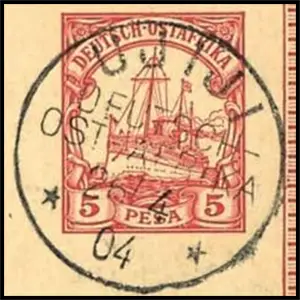
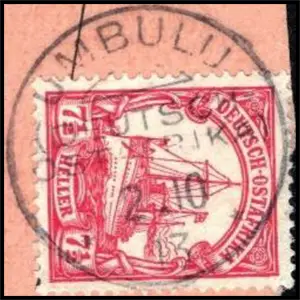
Umbulu

Now Mbulu. This town is located in north/west Tanzania somewhat near Arusha.
Urundi

This post office was located in Gitega (alternately spelled “Kitega”), in the center of the southern part of GEA that Belgium would take over as “Ruanda-Urundi” in the settlement that ended World War I. Gitega was the site of the royal court of the Mwami (King) of Burundi prior to colonization, and as such, was the administrative center of Urundi when the Germans decided to create separate administrations in Ruanda and Urundi in 1907.
More recently, the Parliament of Burundi voted to return the capitol to Gitega, with all branches of the national government required to move there no later than 2022. (BP)
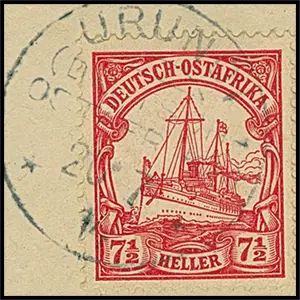
Usumbura

A port located at the northern end of Lake Tangyanika, Usumubura was originally a small settlement until the Belgians made it the administrative center of their Ruanda-Urundi colony after World War I. Having been renamed “Bujumbura”, it would remain the capital city of the Kingdom of Burundi following independence from Belgium in 1962.
The city is now the largest city, and largest port, in the country. Although political power is due to transfer to Gitega before the end of 2022, Bujumbura remains the economic capitol of the country. (BP)
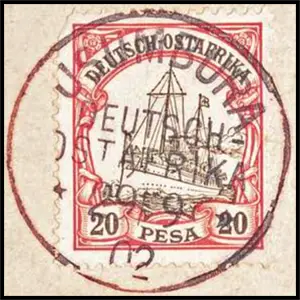
Utete
A wide space in the road on the Rufiji River, inland from Salale. It remains a small village today.
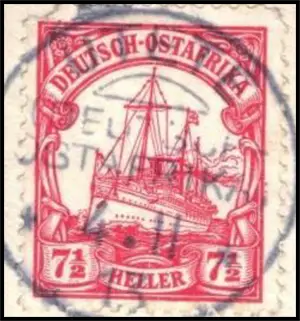
Wiedhafen
A small town settled by the Germans on shore of Lake Malawi, about half-way between the northern tip of the lake and the Mozambique border. The town name is now “Manda.”
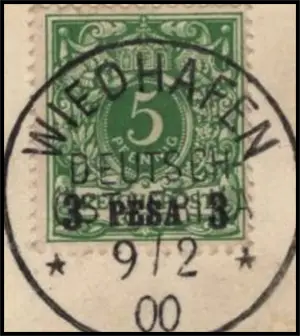
Wilhelmsthal

A town in the Usambara mountains of eastern Tanzania. The town’s name has since been changed to “Lushoto” in modern Tanzania.
This town’s main claim to fame – from the German colonial perspective – is that it was the birthplace of Kai-Uwe von Hassel, a politician from the CDU who held offices between 1954 and 1972. Among others, he held the posts of Minister-President of Schleswig-Holstein and President of the Bundestag.
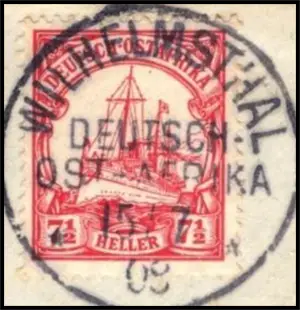
Wuigiri
This post office might be unique in the German colonial empire. Most German post offices in the colonies served the needs of the inhabitants of a town, the colonial administration of the colony, or the locally based German military.
In contrast, the Wugiri post office appears to have existed solely to support an overseas station of the German Weather Service (Deutscher Wetterdienst). One such station called “Wugiri” existed in the Usambara Mountains near the border with Kenya, but was closed down by 1909. No town in Tanzania presently exists with this name.
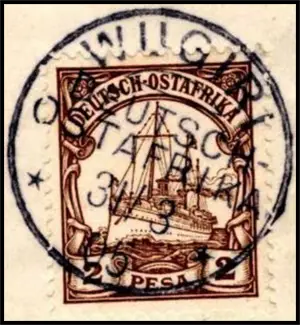
References
Friedemann, A. (1980). The Stamps and Cancels of the German Colonies and the German Post Offices Abroad, Section XI Marshall Islands. Translated by Alfred K. Walter. Wilmington, DE: German Colonies Collector Group.
Michel Redaktion (ed.) (2025). Michel Germany Specialized Catalog 2025 (Part 1). Bobingen, Germany: Schwaneberger Verlag Gmbh.
Nössig, T. (ed.) (2019). Catalog of the Postmarks of the German Colonies & Post Offices Abroad (1st English ed). Berlin, Germany: Arbeitsgemeinschaft der Sammler deutscher Kolonialpostwertzeichen.
Deutscher Wetterdienst. (2020, June 23). List of Overseas Stations.
https://www.dwd.de/EN/ourservices/overseas_stations/overseas_documentation/list_overseas_20200623_pdf.pdf?__blob=publicationFile&v=3
German East African Rupie. (2021, November 12). In Wikipedia. https://en.wikipedia.org/wiki/German_East_African_rupie
Holschauer, G. Images from the Colonial Stamp Company reference collection. Retrieved 22 October 2021.
Krieg, H. Personal Communication. 23 September 2021.
Sandrock, J.E. (n.d.) A Monetary History of German East Africa.
http://www.thecurrencycollector.com/pdfs/A_MONETARY_HISTORY_OF_GERMAN_EAST_AFRICA.pdf
Illustrations courtesy of Reinhard Fischer, Jerry Miller, Jochen Vogenbeck, Oliver Wyrtki, Gannon Sugimura, & Jed Dorman.