
Beginners Guide
Post Offices in Turkey
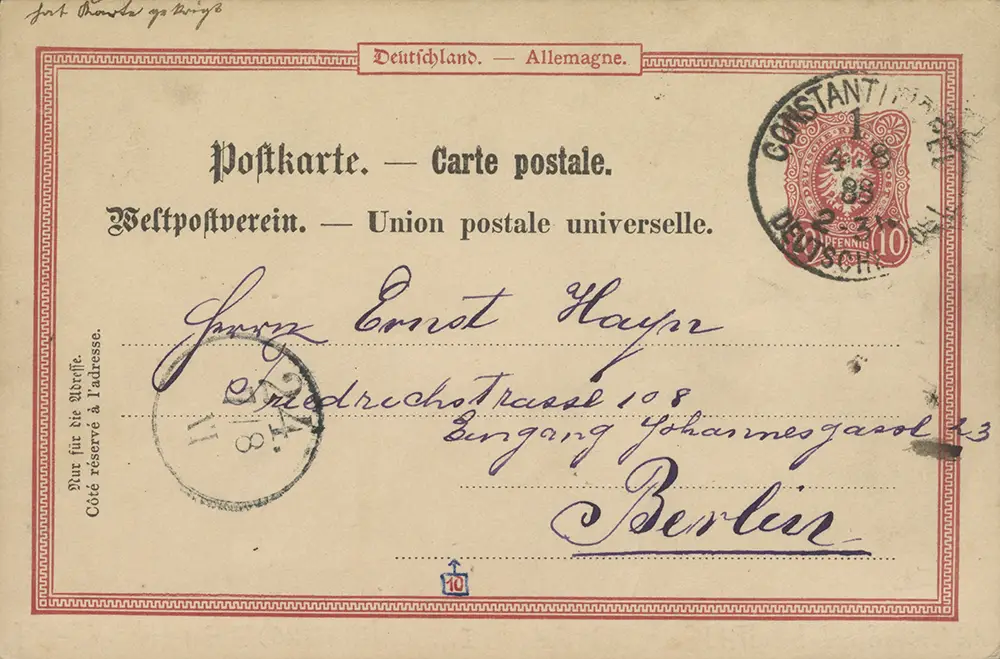
Vorläufer postcard from Constantinopel 1 to Berlin, 4 August 1888
General

PO China
PO Morocco
PO Turkey
D-NG
D-OA

D-SWA

Kamerun

Karolinen

Kiautschou

Marianen

Marshall-In.
Samoa
Togo
German Post Offices in Turkey (Ottoman Empire)
By Gannon Sugimura
Introduction

All fans of Germany’s colonial stamps should really take a moment to consider collecting the stamps of the German Offices in Turkey. Why? Because this was Germany’s first colonial endeavor, even though it was colonialism that didn’t control a territory. It occurred so far back in time that the German Offices in Turkey predate the establishment of Germany itself.
Opened on 1 March 1870, the first German office at Constantinople (now Istanbul) opened as a postal agency of the North German Confederation (NGC; Norddeutscher Bund) and issued North German Confederation stamps denominated in Groschen. Stamps used in Turkey would not have any distinct overprint until 1884. Operations as an office of the NGC lasted as long as the Confederation did. From 1 January 1872, the stamps of the German Reichspost replaced those of the NGC.
Also during the transition, the German post transitioned from a Postagentur office to a Postamt office. The difference is fairly significant. An Agentur is a step down from a full post office, and the name indicates a role in facilitating mail handling. An Agentur might not have been able to handle certain transactions, particularly financial ones. A Postamt, on the other hand, is a full post office handling all the functions that such an office in Germany proper would have. More importantly, a Postamt was a clear expression of German sovereignty, with all the implications that entails. This would become a factor again and again as time progressed in the Ottoman Empire.
But why bother at all? There are all kinds of expenses involved in running a post office, particularly from a distance. Was it really necessary? The short answer is that it was-and wasn’t-at the same time.
The official reason for operating this kind of system was that the local postal facilities were inefficient. In the 19th century, the post was the only way to communicate across any sort of distance, and trade between the Ottoman Empire and Europe was very brisk. While the Ottomans did have a postal service by the time that Germany opened its first office in 1870, contemporary descriptions state that it was slow and unreliable, not to mention hard to reach. In 1863, just 63 post offices existed in the entire Ottoman Empire – a nation which, at the time, had about 35 million residents. Additionally, there was no mechanism to send and receive mail across international borders, which meant that merchants would have had difficulty communicating with their customers in Europe or anywhere outside the Empire if not for the operations of the foreign post offices.
For these reasons, a number of European countries opened post offices in the Ottoman Empire. Initially consular courier services which were used by diplomats to communicate with relevant ministries back home, the consular posts quickly became popular once they started to serve the general public. Germany was one of the last European powers to provide postal service in this fashion. Russia and Austria had both opened post offices before 1800, with France, Great Britain, and Greece opening offices between 1800 and 1870. For a brief period in 1896 when there was a Romanian Constantinople office, a postal customer could choose from among the services of eight competing administrations.
Yet ultimately, the unwritten reason that any country operated offices abroad was that it could do so. While Germany and all the rest may have been able to justify their postal presence in Ottoman territory on the grounds of the inefficiency of the Ottoman post, the Ottomans improved the situation fairly rapidly. Germany and the Ottoman Empire were both founding members of the UPU, with the membership of both countries beginning on the same date – 1 July 1875. The old argument about there being no mechanism for transport of mail across borders no longer applied. The inefficiency of the Ottoman post may have been a factor earlier in the 19th century, but the Ottoman post met the UPU standard when it joined.
Another point of view can be found in the way the Ottomans reacted to the foreign posts. In 1881, the Ottoman post tried discounting by as much as 50% the postage rates required by the UPU. Had this worked, the foreign posts would have been driven out of business. The UPU responded to this by declaring that if the discounting continued, Ottoman stamps would no longer be accepted in the UPU as valid. Yet the idea of discounting postage would not go away. Beginning in 1906, the Ottoman post overprinted some issues with the Arabic letter “Beh” (for Behie or “discount”), which were again sold at a discount to encourage the use of the Ottoman post. Such overprints were issued periodically until the First World War.
Other Ottoman actions to impede the foreign posts included denying them the option of using their railroads to transport mail by land. While most of the German post offices were located in port cities, the Germans had to resort to using postilions (mail coaches) to transport mail to and from Jerusalem. Although the post offices themselves were essentially extensions of the consulates in the cities where they operated, the general public ran some risks in using them. In 1900, for example, the Ottoman sultan decreed that it would be illegal for his subjects to use the foreign posts. Anyone who held stocks of German stamps outside of the post office facilities could have them confiscated by government agents, which seems to have occurred with some regularity. Yet these countermeasures do not appear to have been very successful. Statistics exist for the German Post Office at Jerusalem for the year 1909, showing that nine years after opening, the German P.O. there had taken in 60,000 French francs’ worth of business. For comparison purposes, the Austrian post office in Jerusalem had 250,000 francs’ worth of business in the same year, but the Turkish office there had just 20,000 francs’ worth.
Overprint Stamps & Currency Issues

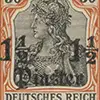
For the first 14 years of operation, the Germans sold ordinary German stamps from their post offices. But beginning in 1884, the German Offices in Turkey had their own distinctive issues, which were unique in German colonial philately. Overprints were applied to then-current German stamps, restating their value in Ottoman currency (right). The stamps of the German Offices in Turkey were the only German colonial issues that always lacked the name of the country in which they were intended to be used, although the first five stamps of German East Africa also did not state the name of that colony. This would be true for the rest of the time these offices were open.
The usual rationale for this type of overprint was that it allowed local customers to pay in local currency rather than German marks, but the underlying stamp was still identifiable by postal clerks who needed to assess if the correct postage had been paid. This would be true even for postal clerks working in Germany proper who received items posted in the Ottoman Empire. It also had the added benefit of allowing companies in Germany to account for any expenditures they had for postage between their offices in Germany and in Turkey, and to do so in either currency.
But all of this begs the question as to why any of this was necessary. The forerunner period at Germany’s Ottoman offices had already lasted 14 years, during which time Ottoman currency had been perfectly acceptable. Why then did there need to be any change at all? Although I have been unable to find documentation about the specific German situation, documentation is readily available for the situation at Britain’s post offices. British sources note that in 1883, the Ottoman piaster was officially devalued. This had two immediate effects.
Firstly, the devaluation made all the European post offices more expensive than the Ottoman post. The Europeans would have had to either charge more in piasters than the Ottomans for the same services or provide the same services with a smaller revenue stream. The Europeans decided to keep their rates unchanged, so as to preserve their share of the market.
Secondly, the decision not to raise rates had the effect of encouraging speculation in stamps of a type not seen before. The British had determined that speculators were making a profit buying British stamps in Turkey with devalued Ottoman currency, then shipping them back to Britain where they were sold for more valuable British pounds. British postal regulations required the post office to buy back mint stamps, so the post office was effectively subsidizing a profit-making scheme for the speculators. The overprints created stamps that could not be sold anywhere except in the Ottoman Empire. This method of overprinting was undertaken by all the foreign posts in Turkey at roughly this time, excepting only the Russians who were already issuing distinctive stamps.
Whatever the reason for issuing overprinted stamps, it should be noted that while post offices in Germany would not accept stamps overprinted for use abroad, Germany’s Ottoman offices would accept postally valid German stamps. Just how often someone showed up in Turkey with ordinary German stamps is subject to debate, but Mitläufer such as these can command significant premiums.
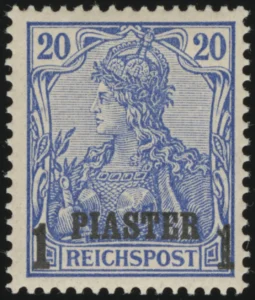
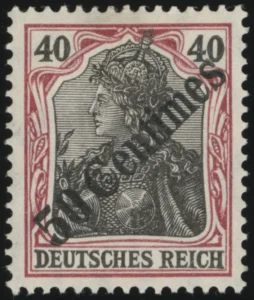
One unusual feature of the overprinted stamps issued by Germany was a set of five stamps issued in 1908, listed in Scott as 55-59 and in Michel as 48-52 (right). These stamps were overprinted diagonally with a new value in French Centimes. Overprinting stamps issued by one country for use in a second country but valued in the currency of a third country not in local use was something unique to Germany’s Turkish offices – Germany’s Morocco offices did issue stamps overprinted with a value in Spanish pesetas, but the Spanish peseta was legal tender in Morocco at that time. The reason for the French currency overprints in Turkey is not explained in Scott. vMichel, however, does note that currency conversion rates made certain classes of mail more expensive when posted at Germany’s offices. This probably seems illogical to the modern collector, but it was understandable at the time.
First, it must be understood that 19th century currencies were mostly on the gold standard, meaning that the currency’s value was defined as a specific weight of gold. For today’s fiat currencies, exchange rates can fluctuate noticeably even over the course of a single day. But two gold standard currencies could not do so, due to the link to gold. Additionally, an organization called the Latin Monetary Union (LMU) already existed, whose members had currencies designed to be exchangeable at a 1:1 ratio. Gold coins of any one LMU member could theoretically circulate in the others, similar to the way Euro coins circulate today.
For these reasons, members of the 19th century UPU were able to agree to charge exactly the same postage rates. Single-weight letters, for example, were rated at 25 French Centimes for all members, with printed rates in multiples of 5 Centimes and international post cards rated at 10 centimes. UPU members were required to charge the equivalent of these amounts in their currency for these rates. The UPU rates were defined in terms of the French Franc – an LMU currency – in part because several important UPU members used LMU currencies, so they did not have to actually convert anything.
Germany did not issue an LMU currency; the exchange rate of the time was 20 German Marks to 25 French Francs. So for letters, the 20 Pf stamps issued by Germany exactly equaled the 25 Centime UPU letter rate. But for postcards, Germany was charging 10 Pf (12.5 Centimes), and for printed matter 5 Pf (7.25 Centimes). Exactly why Germany was able to charge different rates for these UPU mailings is unclear, but therein lay the problem. While the difference was not all that large for individual items, it would add up to considerable sums over time or for customers with larger volume mailings.
For the first 14 years of operation, the Germans sold ordinary German stamps from their post offices. But beginning in 1884, the German Offices in Turkey had their own distinctive issues, which were unique in German colonial philately. Overprints were applied to then-current German stamps, restating their value in Ottoman currency (below).
The stamps of the German Offices in Turkey were the only German colonial issues that always lacked the name of the country in which they were intended to be used, although the first five stamps of German East Africa also did not state the name of that colony. This would be true for the rest of the time these offices were open.
The usual rationale for this type of overprint was that it allowed local customers to pay in local currency rather than German marks, but the underlying stamp was still identifiable by postal clerks who needed to assess if the correct postage had been paid. This would be true even for postal clerks working in Germany proper who received items posted in the Ottoman Empire. It also had the added benefit of allowing companies in Germany to account for any expenditures they had for postage between their offices in Germany and in Turkey, and to do so in either currency.
But all of this begs the question as to why any of this was necessary. The forerunner period at Germany’s Ottoman offices had already lasted 14 years, during which time Ottoman currency had been perfectly acceptable. Why then did there need to be any change at all? Although I have been unable to find documentation about the specific German situation, documentation is readily available for the situation at Britain’s post offices. British sources note that in 1883, the Ottoman piaster was officially devalued. This had two immediate effects.
Firstly, the devaluation made all the European post offices more expensive than the Ottoman post. The Europeans would have had to either charge more in piasters than the Ottomans for the same services or provide the same services with a smaller revenue stream. The Europeans decided to keep their rates unchanged, so as to preserve their share of the market.
Secondly, the decision not to raise rates had the effect of encouraging speculation in stamps of a type not seen before. The British had determined that speculators were making a profit buying British stamps in Turkey with devalued Ottoman currency, then shipping them back to Britain where they were sold for more valuable British pounds. British postal regulations required the post office to buy back mint stamps, so the post office was effectively subsidizing a profit-making scheme for the speculators. The overprints created stamps that could not be sold anywhere except in the Ottoman Empire. This method of overprinting was undertaken by all the foreign posts in Turkey at roughly this time, excepting only the Russians who were already issuing distinctive stamps.
Whatever the reason for issuing overprinted stamps, it should be noted that while post offices in Germany would not accept stamps overprinted for use abroad, Germany’s Ottoman offices would accept postally valid German stamps. Just how often someone showed up in Turkey with ordinary German stamps is subject to debate, but Mitläufer such as these can command significant premiums.
One unusual feature of the overprinted stamps issued by Germany was a set of five stamps issued in 1908, listed in Scott as 55-59 and in Michel as 48-52 (below).
These stamps were overprinted diagonally with a new value in French Centimes. Overprinting stamps issued by one country for use in a second country but valued in the currency of a third country not in local use was something unique to Germany’s Turkish offices – Germany’s Morocco offices did issue stamps overprinted with a value in Spanish pesetas, but the Spanish peseta was legal tender in Morocco at that time. The reason for the French currency overprints in Turkey is not explained in Scott. vMichel, however, does note that currency conversion rates made certain classes of mail more expensive when posted at Germany’s offices. This probably seems illogical to the modern collector, but it was understandable at the time.
First, it must be understood that 19th century currencies were mostly on the gold standard, meaning that the currency’s value was defined as a specific weight of gold. For today’s fiat currencies, exchange rates can fluctuate noticeably even over the course of a single day. But two gold standard currencies could not do so, due to the link to gold. Additionally, an organization called the Latin Monetary Union (LMU) already existed, whose members had currencies designed to be exchangeable at a 1:1 ratio. Gold coins of any one LMU member could theoretically circulate in the others, similar to the way Euro coins circulate today.
For these reasons, members of the 19th century UPU were able to agree to charge exactly the same postage rates. Single-weight letters, for example, were rated at 25 French Centimes for all members, with printed rates in multiples of 5 Centimes and international post cards rated at 10 centimes. UPU members were required to charge the equivalent of these amounts in their currency for these rates. The UPU rates were defined in terms of the French Franc – an LMU currency – in part because several important UPU members used LMU currencies, so they did not have to actually convert anything.
Germany did not issue an LMU currency; the exchange rate of the time was 20 German Marks to 25 French Francs. So for letters, the 20 Pf stamps issued by Germany exactly equaled the 25 Centime UPU letter rate. But for postcards, Germany was charging 10 Pf (12.5 Centimes), and for printed matter 5 Pf (7.25 Centimes). Exactly why Germany was able to charge different rates for these UPU mailings is unclear, but therein lay the problem. While the difference was not all that large for individual items, it would add up to considerable sums over time or for customers with larger volume mailings.
The Post Offices
By the time the system came to an end, Germany would eventually open seven post offices in the Ottoman Empire. Three of these were located in Constantinople, while four others were located in other places. The evolution of the German postal network, as well as why an office was located where it was will be explained in the rest of this guide.
Constantinople


At the time of the foreign offices in Turkey, the one place that all foreign powers had a post office was Istanbul, known to Westerners at the time as Constantinople (spelled “Constantinopel” in period cancels used in the German Offices in Turkey.) The Constantinople of the 19th century was the capital city of the Ottoman Empire, located on two continents simultaneously. The city controls access between the Mediterranean and the Black Seas, as well as the primary bridges between Europe and Asia for land crossings. As such, it was uniquely situated for the purposes of trade and exchange between East and West.
The first German office opened in the Beyoglu district, which was known to Germans as the Pera district. In the 19th century, Pera was home to most of the European residents of the city, and it also hosted the majority of the foreign embassies to the Ottoman court. The Pera district was also home to a number of merchants involved in what we would now call the import-export business. For both governmental reasons and commerce, it proved to be an ideal place to open a German post office.
Cancels from the period of the NGC read “Constantinople N.P.A.” with a place for the time at the bottom of the cancel, e.g. “3-4 N” (below left). The abbreviation “N.P.A.” stood for Norddeutscher Post Agentur. The time “3-4 N” corresponds to the 15:00 hour (i.e., between 3 and 4 PM). As was typical for German cancels of the period, the letter V (for Vor) appeared in the time for AM hours, while N (Nach) appears for PM hours. In preparation for the establishment of the Reichspost on 1 January 1872, the Constantinople office used the N.P.A. cancel only until 14 August 1871. A new cancel of the same type reading “CONSTANTINOPLE D.R.P.A.” (Deutsch Reichs Post Agentur) was pressed into use on 18 August 1871 (below right). This cancel is one of the least seen cancels of the German Post. It was replaced barely a month later with a series of cancels that are much more familiar to collectors, all of which read “Kaiserl. Deutsch. P.A. Constantinopel” (Imperial German Post Office Constantinople). Three similar cancels of this type, in use between 22 September 1871 and 1 December 1883, are distinguished by the lack of or presence of a symbol above the date.
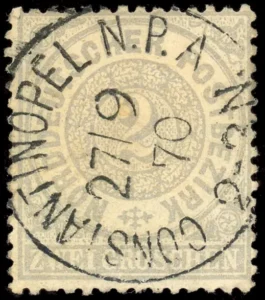
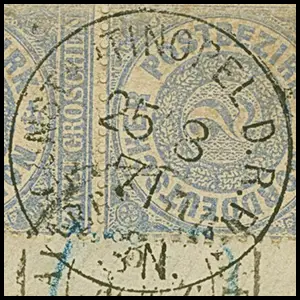
The second German office opened in 1876 in the Stamboul district. Located across a narrow strait from Pera, “Stamboul” was an alternative name for all of Istanbul, but was applied by the West only to the district that included the ancient Byzantine part of the city. With two German offices in the city, the Stamboul office was now officially known as “Constantinople 2,” while the original office in Pera was “Constantinople 1.” The Stamboul office used a cancel with a star index above the date (below left), while the Pera office used a device with no index (below middle) or with a small circle index (below right).
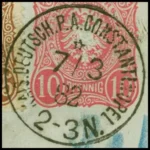
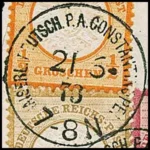
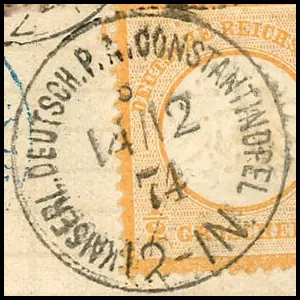
Cancel devices stating “Constantinople 1” or “2” would be in use from 1883 (below), in several forms each.
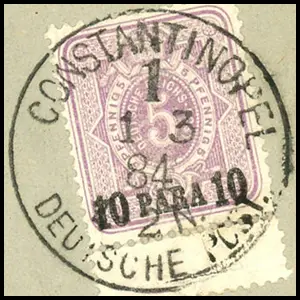
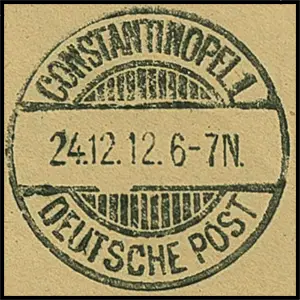
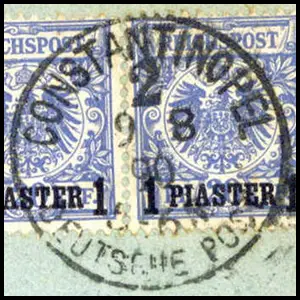
For a variety of reasons, the Pera office was closed in 1877 and transferred to the adjoining Karaköy district. Known as “Galata” in the West, this office appears to have opened as the merchant quarter of the city expanded in that direction from the Pera district. This office would hold the designation “Constantinople 1” until 1914. But increasing mail volume at the end of the century meant that two German offices were not enough. The Pera office was reopened as “Constantinople 3” on 1 March 1900, and would used numbered cancellers like the “1” and “2” above, but with number “3”. All three offices remained open until the system closed permanently on 30 September 1914.
Jaffa

The first German office outside of Constantinople opened in the southern city of Jaffa on 1 October 1898. Now the “Yafo” section of the Israeli city of Tel Aviv-Yafo, Jaffa is an ancient city and was the primary capital in the Ottoman province known as the “Sandjak of Jerusalem” which includes most of modern Israel. Jaffa’s importance increased in 1892 once a railroad opened between Jaffa and interior portions of the province, including Jerusalem. This provided visitors with a much shorter land route to religious sites in and around Jerusalem; earlier journeys required land transport between Jerusalem and Beirut.
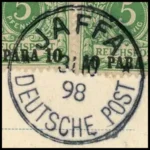
The Jaffa office originally opened with one cancel device generally described in Steuer as a “DP” cancel (top right). These are typical, single ring circular date stamps with the name of the town at the top of the circle, the date in the middle, and the words Deutsche Post across the bottom. The “DP” has two stars in the cancel device, one between the town name and Deutsche Post at roughly 9 o’clock and 3 o’clock.
A similar type of cancel, the “DPa” cancel replaces the right hand star with the letter “a” at 3 o’clock – as can be seen in the Beirut example below. Whatever symbol is located in this position is sometimes referred to as the cancel’s “index.” Similar cancel devices were used in Germany’s other foreign offices, as well as the colonies of the Caroline Islands, Kamerun, Kiautschou, the Marshall Islands, the Marianas, and Togo.
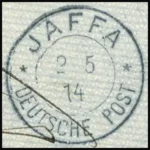
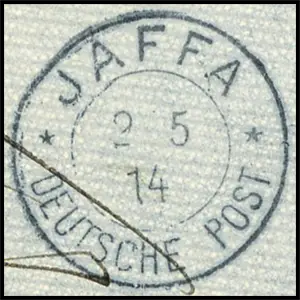
The second Jaffa cancel device was obtained from Berlin in 1906. The 1898 Jaffa cancel is a typical example of the DP cancel type. The device pressed into use in 1906 also fits this general description, except that it has a second circle around the date (bottom right). The 1906 Jaffa cancel appears to be the only one used in the German colonial sphere with this particular feature.
The first German office outside of Constantinople opened in the southern city of Jaffa on 1 October 1898. Now the “Yafo” section of the Israeli city of Tel Aviv-Yafo, Jaffa is an ancient city and was the primary capital in the Ottoman province known as the “Sandjak of Jerusalem” which includes most of modern Israel. Jaffa’s importance increased in 1892 once a railroad opened between Jaffa and interior portions of the province, including Jerusalem. This provided visitors with a much shorter land route to religious sites in and around Jerusalem; earlier journeys required land transport between Jerusalem and Beirut.
The Jaffa office originally opened with one cancel device generally described in Steuer as a “DP” cancel (below).
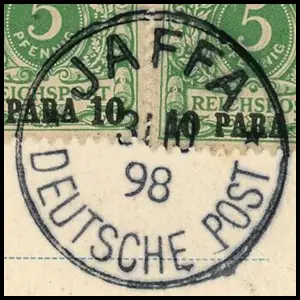
These are typical, single ring circular date stamps with the name of the town at the top of the circle, the date in the middle, and the words Deutsche Post across the bottom. The “DP” has two stars in the cancel device, one between the town name and Deutsche Post at roughly 9 o’clock and 3 o’clock.
A similar type of cancel, the “DPa” cancel replaces the right hand star with the letter “a” at 3 o’clock – as can be seen in the Beirut example below. Whatever symbol is located in this position is sometimes referred to as the cancel’s “index.” Similar cancel devices were used in Germany’s other foreign offices, as well as the colonies of the Caroline Islands, Kamerun, Kiautschou, the Marshall Islands, the Marianas, and Togo.
The second Jaffa cancel device was obtained from Berlin in 1906. The 1898 Jaffa cancel is a typical example of the DP cancel type. The device pressed into use in 1906 also fits this general description, except that it has a second circle around the date (below). The 1906 Jaffa cancel appears to be the only one used in the German colonial sphere with this particular feature.
Beirut

The German P.O. in the city that would become Lebanon’s capital was the first of the three offices that the Germans opened outside of Constantinople on 1 March 1900. Beirut was a perfect choice for a foreign power opening a post office. Beirut was the primary port city in the Arabic-speaking Ottoman provinces of the eastern Mediterranean between Turkish-speaking Asia Minor and Egypt. Prior to 1892, Beirut was actually the primary point of access to the Judea-Christian and Islamic religious sites in the Sandjak of Jerusalem. It continued to be an alternate point of access to those sites after this, as well as to other inland areas like Damascus.
The Beirut office was predicted to be busy enough that it opened with two cancel devices generally described in Steuer as “DP” (top right) and “DPa” (bottom right) cancels. In the German ArGe catalogue, both Beirut cancel devices have minimum catalogue values, which also serve as an indicator to the amount of business this office had. But cancel collectors will be pleased to know that this office tended to produce fairly well struck examples of the cancels.

The German P.O. in the city that would become Lebanon’s capital was the first of the three offices that the Germans opened outside of Constantinople on 1 March 1900. Beirut was a perfect choice for a foreign power opening a post office. Beirut was the primary port city in the Arabic-speaking Ottoman provinces of the eastern Mediterranean between Turkish-speaking Asia Minor and Egypt. Prior to 1892, Beirut was actually the primary point of access to the Judea-Christian and Islamic religious sites in the Sandjak of Jerusalem. It continued to be an alternate point of access to those sites after this, as well as to other inland areas like Damascus.
The Beirut office was predicted to be busy enough that it opened with two cancel devices generally described in Steuer as “DP” (bottom left) and “DPa” (bottom right) cancels.
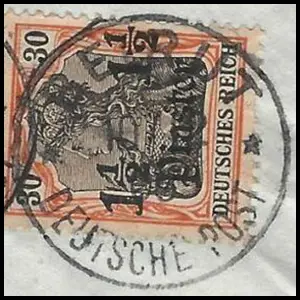
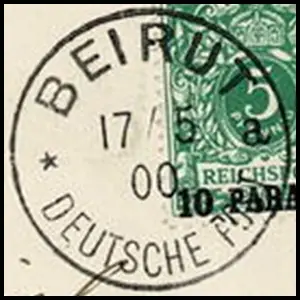
In the German ArGe catalogue, both Beirut cancel devices have minimum catalogue values, which also serve as an indicator to the amount of business this office had. But cancel collectors will be pleased to know that this office tended to produce fairly well struck examples of the cancels.
Jerusalem

Following the successful opening of the Jaffa post office, an office at Jerusalem also opened on 1 March 1900. As has been the case for several thousand years, Jerusalem is a site of supreme religious importance for Judaism, Christianity, and Islam. As such, it was and continues to be a place of pilgrimage for the faithful. Tourists, and the commercial interests that support and surround tourism, needed postal services. Foreign postal services had been established here by the Austrians as far back as 1849 and grew to include the post offices of five nations.
That Germany wished to take some business away from the Austrians in particular is clear enough from the types and numbers of postal souvenirs generated in Jerusalem. Show below, for example, is a commemorative card postmarked on 31 October 1898 and produced by a German firm headquartered in Berlin.
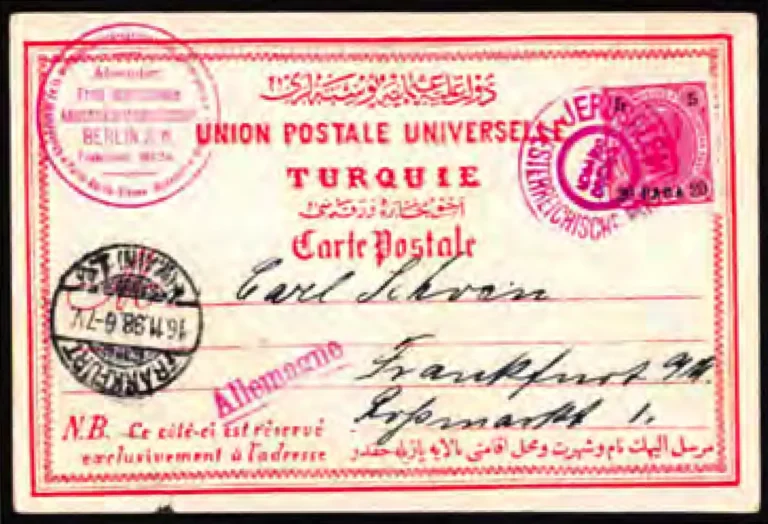

The event being commemorated was the visit to Jerusalem of the German Kaiser, Wilhelm II, who had made the trip to Jerusalem to personally dedicate the Church of Christ the Redeemer. This firm, the First International Postcard Company (Erste Internationale Ansichtskartengesellschaft), seems to have been in the business of printing multicolored postcards to be sent to Europe from exotic locales or to commemorate special events. Broadly similar postcards were created to mark the last Christmas of the 19th century in 1899, for instance. But since there was no German post office in Jerusalem at this time, the cards had to be mailed using the Austrian post office-which was obliging enough to apply its postmark in a special magenta ink for the occasion.
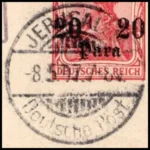
Jerusalem was busy enough that, like Beirut, it opened with two cancel devices in use from day one. Like Beirut, Jerusalem opened with a “DP” cancel as well as a “DPa” cancel (top right). Unlike Beirut, Jerusalem had enough business to obtain a third cancel device in early 1907-this one of a type referred to as a “Swiss cancel” (bottom right). This cancel indicated the time it was used between February 1907 and February 1908, and had no indication of the time after that. Swiss cancels were only used in a handful of locations in the German colonial Empire, and all appear to have been ordered in 1906 or 1907. The only other one used in Turkey appeared at Constantinople 1 (see above).

Following the successful opening of the Jaffa post office, an office at Jerusalem also opened on 1 March 1900. As has been the case for several thousand years, Jerusalem is a site of supreme religious importance for Judaism, Christianity, and Islam. As such, it was and continues to be a place of pilgrimage for the faithful. Tourists, and the commercial interests that support and surround tourism, needed postal services. Foreign postal services had been established here by the Austrians as far back as 1849 and grew to include the post offices of five nations.
That Germany wished to take some business away from the Austrians in particular is clear enough from the types and numbers of postal souvenirs generated in Jerusalem. Show below, for example, is a commemorative card postmarked on 31 October 1898 and produced by a German firm headquartered in Berlin.
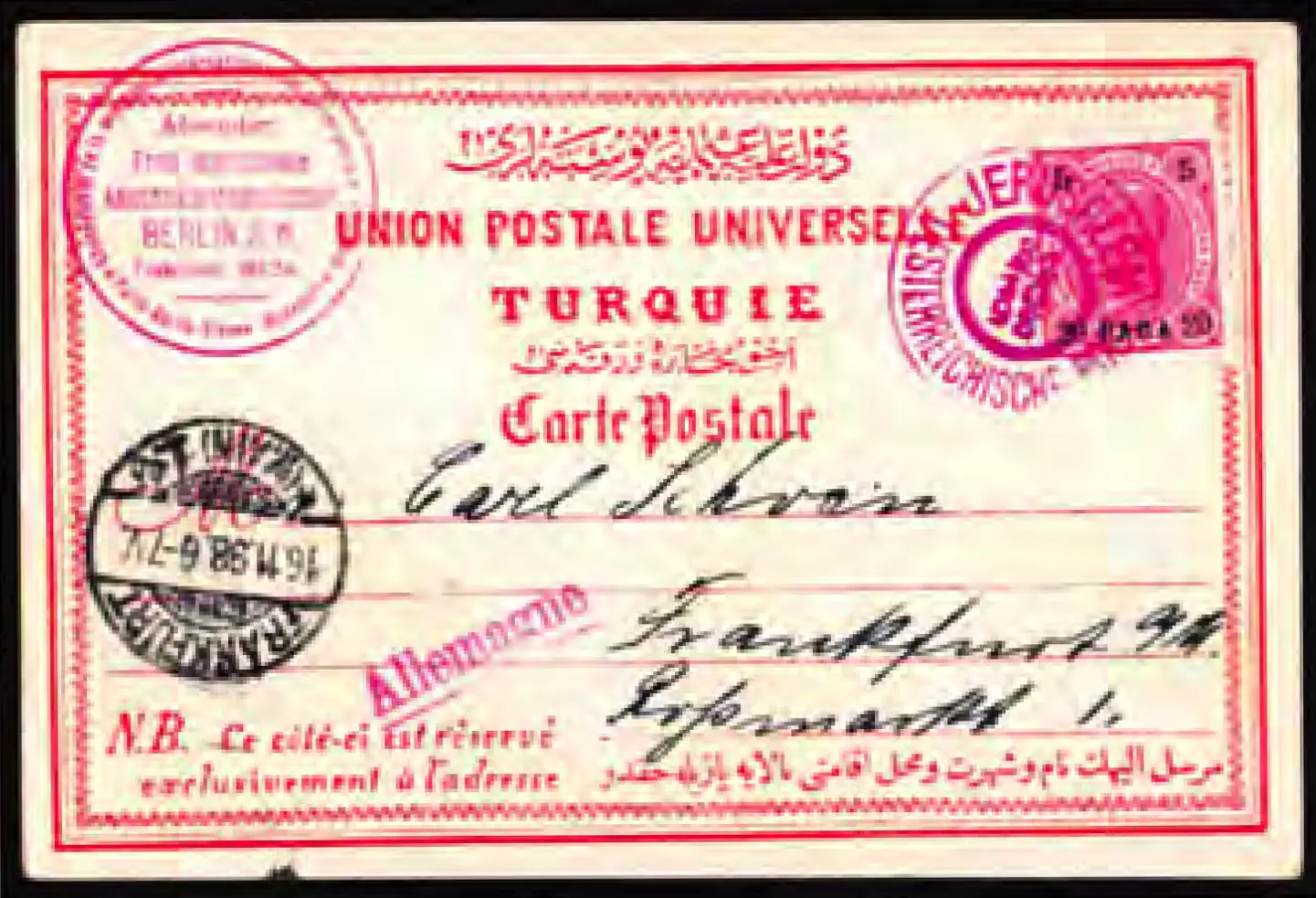
The event being commemorated was the visit to Jerusalem of the German Kaiser, Wilhelm II, who had made the trip to Jerusalem to personally dedicate the Church of Christ the Redeemer. This firm, the First International Postcard Company (Erste Internationale Ansichtskartengesellschaft), seems to have been in the business of printing multicolored postcards to be sent to Europe from exotic locales or to commemorate special events. Broadly similar postcards were created to mark the last Christmas of the 19th century in 1899, for instance. But since there was no German post office in Jerusalem at this time, the cards had to be mailed using the Austrian post office-which was obliging enough to apply its postmark in a special magenta ink for the occasion.
Jerusalem was busy enough that, like Beirut, it opened with two cancel devices in use from day one. Like Beirut, Jerusalem opened with a “DP” cancel as well as a “DPa” cancel (below).
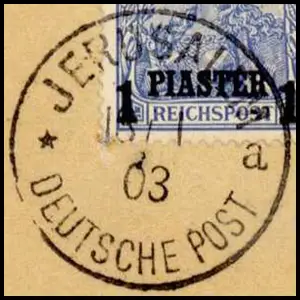
Unlike Beirut, Jerusalem had enough business to obtain a third cancel device in early 1907-this one of a type referred to as a “Swiss cancel” (below).
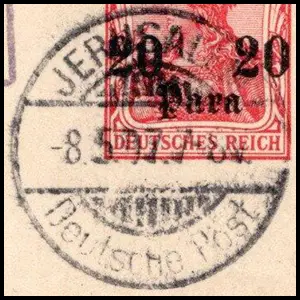
This cancel indicated the time it was used between February 1907 and February 1908, and had no indication of the time after that. Swiss cancels were only used in a handful of locations in the German colonial Empire, and all appear to have been ordered in 1906 or 1907. The only other one used in Turkey appeared at Constantinople 1 (see above).
The German P.O. in the city that would become Lebanon’s capital was the first of the three offices that the Germans opened outside of Constantinople on 1 March 1900. Beirut was a perfect choice for a foreign power opening a post office. Beirut was the primary port city in the Arabic-speaking Ottoman provinces of the eastern Mediterranean between Turkish-speaking Asia Minor and Egypt. Prior to 1892, Beirut was actually the primary point of access to the Judea-Christian and Islamic religious sites in the Sandjak of Jerusalem. It continued to be an alternate point of access to those sites after this, as well as to other inland areas like Damascus.
The Beirut office was predicted to be busy enough that it opened with two cancel devices generally described in Steuer as “DP” (bottom left) and “DPa” (bottom right) cancels.
In the German ArGe catalogue, both Beirut cancel devices have minimum catalogue values, which also serve as an indicator to the amount of business this office had. But cancel collectors will be pleased to know that this office tended to produce fairly well struck examples of the cancels.
Smyrna

The final German post office opened on 1 March 1900 at Smyrna (now Izmir), located in western Anatolia. It has been an important commercial port for much of its 4,000-year history and has easy access to the Aegean islands, southern Italy, and the island of Cyprus. The demographics of the Smyrna region also favored western commercial interests in a way other ports did not-namely, Smyrna had a large population of members of the Ottoman Empire’s Greek minority.
The Ottoman Greeks by this time formed a mercantile and investor class that had a great deal of interest in promoting trade with Europe. They also served as middlemen between European customers and Turkish suppliers further inland. As such, they were ideal clients for the German P.O. in Smyrna. The Greek influence in this area was so strong that after the war, Smyrna and the area around it were initially given to Greece in the same way that Syria was mandated to France, and Palestine to Britain-although Smyrna did not remain Greek territory.
The German Office in Smyrna had enough business that Smyrna opened in 1900 with one DP cancel device and one DPa cancel device (top right). There was so much business that Smyrna was the only German Office in Turkey to obtain a “b” index DP cancel (bottom right), which it started to use in 1903. Additionally, the original “DP” cancel device appears to have worn out in mid-1909, and it was replaced by a different cancel device matching the same description. Excepting the Jerusalem office, all the other German offices in Turkey only had enough business to require two cancel devices at any given time, including the three in Constantinople.
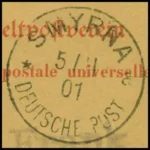
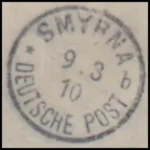
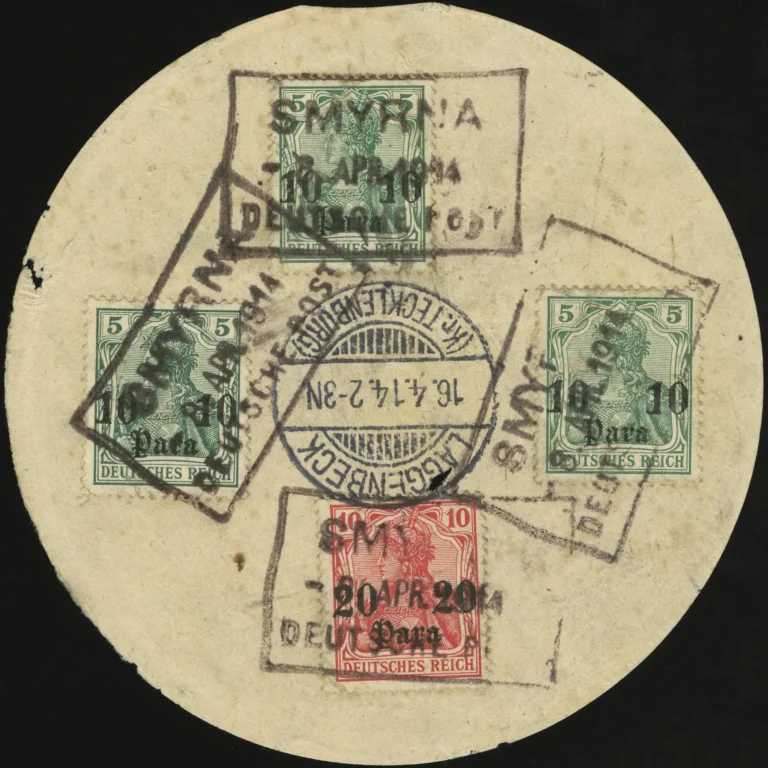
Smyrna is also known to have used a boxed dated cancel, which commonly appears on the French currency overprinted issues of 1908. This postmark was created because Symrna was a major exporter of raisins, and merchants would send containers of raisins through the mail. The normal cancellers would damage the containers, so two rubber handstamp cancellers (now known as “rosinenstempel,” or raisin postmarks) were created – one with stars in the design and one without – to cancel the stamps attached to raisin containers without damaging them. It can be found on loose stamps and on intact lids from the raisin container (below).
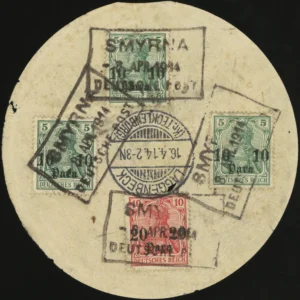
The final German post office opened on 1 March 1900 at Smyrna (now Izmir), located in western Anatolia. It has been an important commercial port for much of its 4,000-year history and has easy access to the Aegean islands, southern Italy, and the island of Cyprus. The demographics of the Smyrna region also favored western commercial interests in a way other ports did not-namely, Smyrna had a large population of members of the Ottoman Empire’s Greek minority.
The Ottoman Greeks by this time formed a mercantile and investor class that had a great deal of interest in promoting trade with Europe. They also served as middlemen between European customers and Turkish suppliers further inland. As such, they were ideal clients for the German P.O. in Smyrna. The Greek influence in this area was so strong that after the war, Smyrna and the area around it were initially given to Greece in the same way that Syria was mandated to France, and Palestine to Britain-although Smyrna did not remain Greek territory.
The German Office in Smyrna had enough business that Smyrna opened in 1900 with one DP cancel device and one DPa cancel device (below left). There was so much business that Smyrna was the only German Office in Turkey to obtain a “b” index DP cancel (below right), which it started to use in 1903.

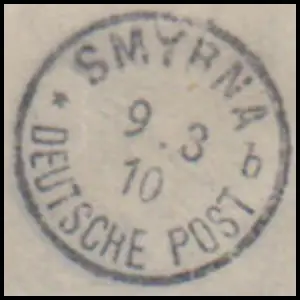
Additionally, the original “DP” cancel device appears to have worn out in mid-1909, and it was replaced by a different cancel device matching the same description. Excepting the Jerusalem office, all the other German offices in Turkey only had enough business to require two cancel devices at any given time, including the three in Constantinople.
Smyrna is also known to have used a boxed dated cancel, which commonly appears on the French currency overprinted issues of 1908. This postmark was created because Symrna was a major exporter of raisins, and merchants would send containers of raisins through the mail. The normal cancellers would damage the containers, so two rubber handstamp cancellers (now known as “rosinenstempel,” or raisin postmarks) were created – one with stars in the design and one without – to cancel the stamps attached to raisin containers without damaging them. It can be found on loose stamps and on intact lids from the raisin container (below).
Nebenstempel (Secondary Markings)

One additional facet of German postal operations in this part of the world dealt with secondary markings (Nebenstempel) applied to some mail (below). At this time, mail coaches transported mail between Jaffa and Jerusalem, since the Germans were denied use of the rails. A small quantity of mail was collected at mailboxes or other collection points along the route by the driver of the mail coach, which was not postmarked until the coach arrived at Jaffa or Jerusalem, depending on the direction of travel. Such mail received a strike of a boxed “Aus [pickup location] / Deutsche Post” marking to indicate where it was actually posted.
The ArGe catalogs 8 different Nebenstempel from 7 different locations – Jaffa, Jerusalem, Ramleh, Sarona, Tempel-Kolonie Hamidije-Wilhelma in Jaffa, Rischon-le-Zion bei Jaffa, and Emmaus. Collectors of Judaica might wish to look for markings showing the mail was related to specifically Jewish communities along the Jaffa-Jerusalem route.
One additional facet of German postal operations in this part of the world dealt with secondary markings (Nebenstempel) applied to some mail (below). At this time, mail coaches transported mail between Jaffa and Jerusalem, since the Germans were denied use of the rails. A small quantity of mail was collected at mailboxes or other collection points along the route by the driver of the mail coach, which was not postmarked until the coach arrived at Jaffa or Jerusalem, depending on the direction of travel. Such mail received a strike of a boxed “Aus [pickup location] / Deutsche Post” marking to indicate where it was actually posted.
The ArGe catalogs 8 different Nebenstempel from 7 different locations – Jaffa, Jerusalem, Ramleh, Sarona, Tempel-Kolonie Hamidije-Wilhelma in Jaffa, Rischon-le-Zion bei Jaffa, and Emmaus. Collectors of Judaica might wish to look for markings showing the mail was related to specifically Jewish communities along the Jaffa-Jerusalem route.
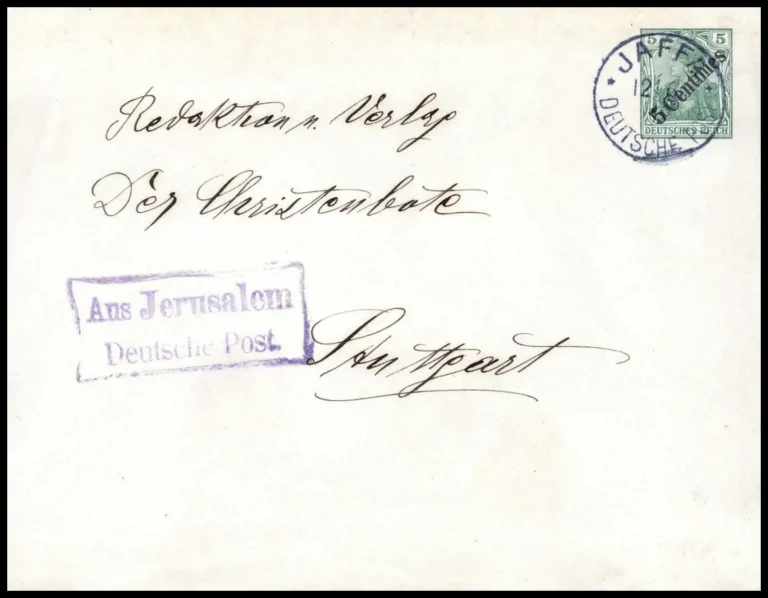
The ArGe catalogs 8 different Nebenstempel from 7 different locations – Jaffa, Jerusalem, Ramleh, Sarona, Tempel-Kolonie Hamidije-Wilhelma in Jaffa, Rischon-le-Zion bei Jaffa, and Emmaus. Collectors of Judaica might wish to look for markings showing the mail was related to specifically Jewish communities along the Jaffa-Jerusalem route.
The existence of the German postal network in the Ottoman Empire would prove useful only until the beginning of the First World War. The Ottoman desire to close the foreign posts was realized once the Ottomans allied themselves with the Central Powers. Part of the price of the alliance with the Ottomans was that Germany closed all its Turkish post offices, which occurred on 30 September 1914. Germany thereafter continued postal operations only as military Feldpost, which is beyond the scope of this guide.
Regardless of how the war would end, Germany did not have plans to ever re-open its Turkish offices. War-time or Kriegsdruck printings of stamps were created for all German colonies and the offices in China and Morocco, with the expectation the pre-war status quo would eventually resume. No such printings were ever created for the Turkish offices. As such, collectors may find the stamps of the Turkish offices useful as examples of Friedensdruck stamps when trying to determine if another stamp is actually Friedensdruck or Kriegsdruck.
References
Great Britain Overprint Society. (2013, Feb 2) . Levant (Turkish Currency). Retrieved from http://www.gbos.org. uk/index. php /Country _ List /23
Friedemann, A. (1980). The Stamps and Cancels of the German Colonies and the German Post Offices Abroad, Section XI Marshall Islands. Translated by Alfred K. Walter. Wilmington, DE: German Colonies Collector Group.
Michel Redaktion (ed.) (2025). Michel Germany Specialized Catalog 2025 (Part 1). Bobingen, Germany: Schwaneberger Verlag Gmbh.
Nössig, T. (ed.) (2019). Catalog of the Postmarks of the German Colonies & Post Offices Abroad (1st English ed). Berlin, Germany: Arbeitsgemeinschaft der Sammler deutscher Kolonialpostwertzeichen.
Tchilinghirian, S .D., Stephen, W.S.E., & Tranmer, K. (1981). Austrian Post Offices Abroad, Part Eight: Austrian Lloyd, Liechtenstein, Cyprus, Egypt, Palestine, Syria-Lebanon, Asia Minor. Abelour, United Kingdom. Austrian Stamp Club of Great Britain.
Universal Postal Union. Germany. (2017, September 3). Retrieved from http://www.upu.int/nc/en/the-upu/member-countries/western-europe/germany.html?sword_ list[0]=germany
Universal Postal Union. Turkey. (2017, September 3). Retrieved from http://www.upu.int/nc/en/the-upu/member-countries/western-europe/turkey.html?sword _list[0]=turkey
Illustrations courtesy of Gannon Sugimura & Jed Dorman.