
Beginners Guide
Marianen
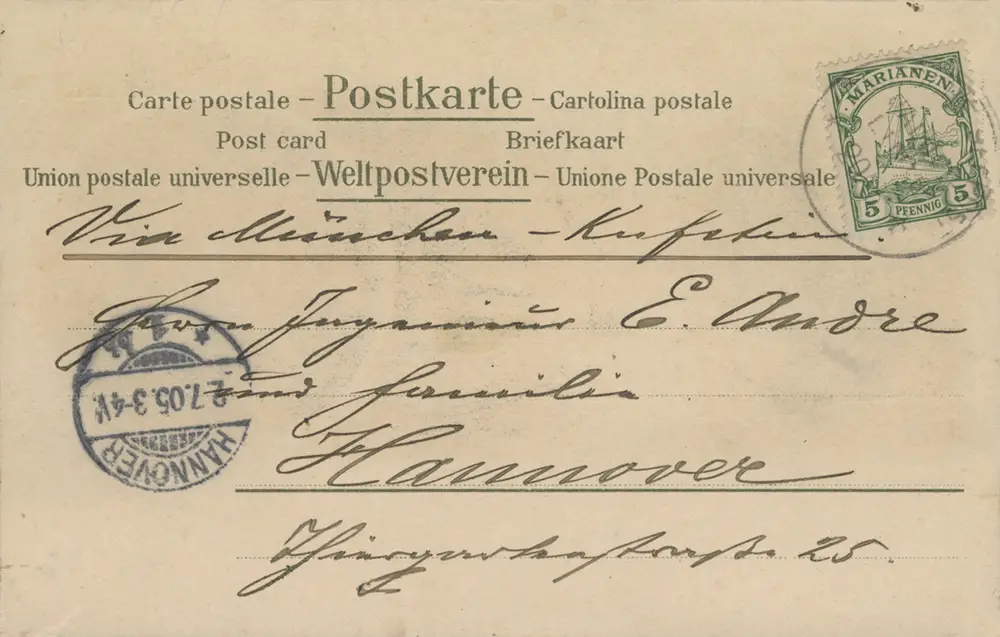
Postcard sent from Marianen to Hannover aboard steamer Germania of the Jaluit Linie, 20 May 1905
General

PO China
PO Morocco
PO Turkey
D-NG
D-OA
D-SWA

Kamerun

Karolinen

Kiautschou

Marianen

Marshall-In.
Samoa
Togo
Marianen (Mariana Islands)
By Gannon Sugimura
Introduction

In many ways, the German Marianen colony existed because it was a colony Germany could establish. By the time the German Empire was established in 1871 as a unified state, the only places available for colonization were locations deemed too remote or economically unattractive for the purposes of colonization. In other words, other countries had already colonized most of the world, and Germany was left with choices only from what little remained untouched. In the case of the Marianas, it was more along the lines of what Germany was able to buy instead of conquer.
By 1899, the Spanish Empire was in major decline after more than four centuries in existence. Having lost all her continental Latin American colonies in the early part of the 19th century, Spain’s colonial empire in 1899 consisted only of a few islands in the Pacific and the Caribbean, as well as a few relatively small possessions in Africa. Losses resulting from the 1898 Spanish-American War ended Spanish control of the most important non-African parts of what remained. In the Pacific, the Philippine Islands and Guam were separated from the colony then known as the “Spanish East Indies” and ceded to the US. Madrid very quickly decided that what remained of the Spanish East Indies was no longer viable as a colony and sought to sell it. Enter Germany, which purchased all of Spain’s remaining Pacific possessions for 25 million Spanish pesetas (worth approximately US $5 million at the time), and established separate colonies in the Carolines (Karolinen) and the Marianas (Marianen).
During the Spanish period, the Marianas were geographically a northern extension of the Carolines and were a district of the Spanish East Indies. But with Guam, the largest of the Mariana Islands, now under US control, the remaining islands of the Marianas to the north were physically separated from the Carolines by both foreign territory and several hundred miles of open ocean. For whatever reason, the Mariana Islands were created as a separate colony from the Carolines when German colonial influence began, and as a result would need distinctive stamps.
Overprint Issues

The beginning of German postal operations in the Marianas occurred on 18 November 1899, with the opening of the German post office on Saipan, where Germany also established its colonial capital.
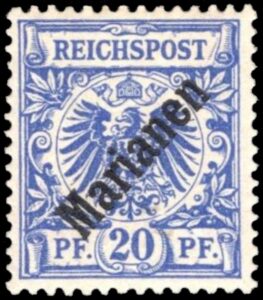
Initial issues were the “diagonal” version of the “MARIANEN” overprint on the “Crown/Eagle” 1889 Imperial German definitive series, placed at 48° across the face of the stamp (top right). This would be the only stamp issue available for the better part of six months.
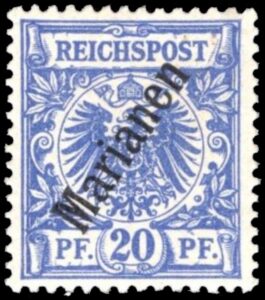
New stamps would be issued in May of 1900, as stamps with the “sloping” overprint were issued (bottom right). The overprint on this issue was placed at 56° instead of 48°, and these stamps were issued in larger quantities than the prior issue.
For the 1899 48° diagonal issue, it is known that 5,000 each of the 10 Pf and 20 Pf values were printed in Berlin and shipped to Saipan, along with 1,000 each of the 3 Pf, 5 Pf, 25 Pf, and 50 Pf values. Postal stationery was also prepared, in the form of 200 each of the 5 Pf and 10 Pf postal cards, and 50 each of the 5 Pf + 5 Pf and 10 Pf +10 Pf paid reply postal cards.
Unlike the majority of German colonies, the Marianas had no Vorläufer period, as distinctive stamps and postal cards were available from the first day of postal operations.
Mitläufer (uses of unoverprinted German stamps used after the first distinctive Mariana issues appeared) did occur, and are encountered occasionally.
The beginning of German postal operations in the Marianas occurred on 18 November 1899, with the opening of the German post office on Saipan, where Germany also established its colonial capital.
Initial issues were the “diagonal” version of the “MARIANEN” overprint on the “Crown/Eagle” 1889 Imperial German definitive series, placed at 48° across the face of the stamp (below). This would be the only stamp issue available for the better part of six months.
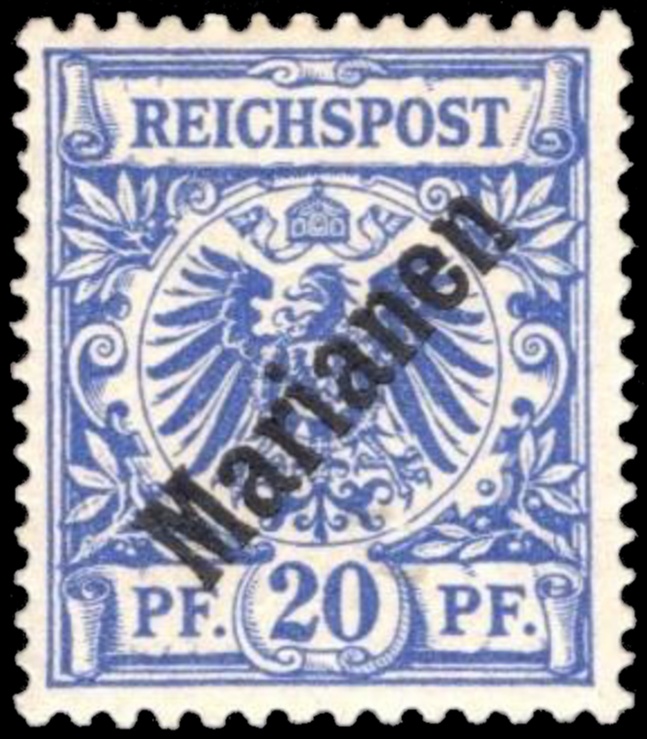
New stamps would be issued in May of 1900, as stamps with the “sloping” overprint were issued (below). The overprint on this issue was placed at 56° instead of 48°, and these stamps were issued in larger quantities than the prior issue.
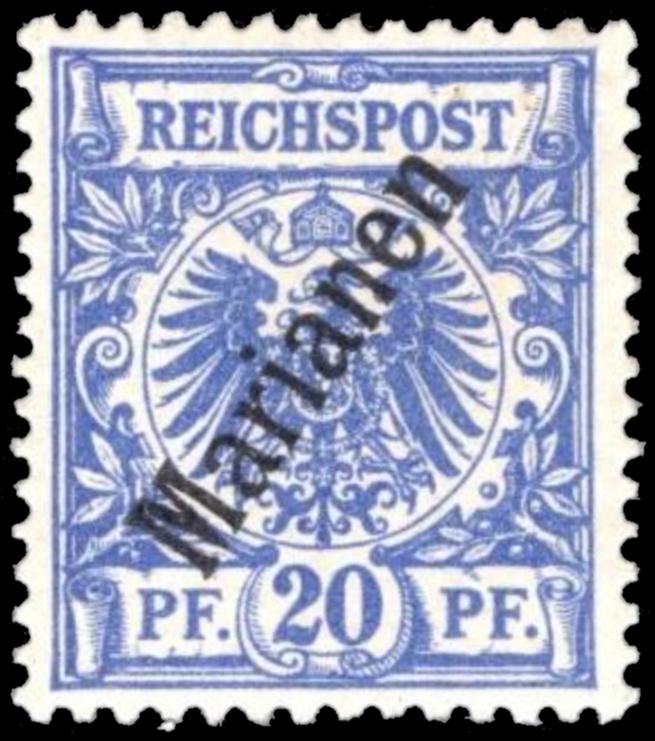
For the 1899 48° diagonal issue, it is known that 5,000 each of the 10 Pf and 20 Pf values were printed in Berlin and shipped to Saipan, along with 1,000 each of the 3 Pf, 5 Pf, 25 Pf, and 50 Pf values. Postal stationery was also prepared, in the form of 200 each of the 5 Pf and 10 Pf postal cards, and 50 each of the 5 Pf + 5 Pf and 10 Pf +10 Pf paid reply postal cards.
Unlike the majority of German colonies, the Marianas had no Vorläufer period, as distinctive stamps and postal cards were available from the first day of postal operations.
Mitläufer (uses of unoverprinted German stamps used after the first distinctive Mariana issues appeared) did occur, and are encountered occasionally.
Use of the Overprint Issues

Exactly why the colony would ever need so many stamps is something of a mystery, if only local demand is considered. From the first day of postal operations and for some time thereafter, the German population of the colony consisted of three individuals – the District Commissioner, the Assistant Commissioner, and the Postal Agent. The wider postal public included precisely one Spanish citizen who continued to live on the island of Rota after the arrival of the Germans. The rest of the 2,500 or so inhabitants of the Marianen colony were Chamorros (indigenous Mariana Islanders), who had not previously needed postal services to connect them to the outside world. Where, then, did local demand for postal services come from?
For this reason, genuinely used examples of both types of the “MARIANEN” overprints are scarcer than would seem to be the case from the philatelic marketplace. Some properly used stamps were created by the four Europeans when they sent correspondence home. Others were created by stamp collectors who sent correspondence to Saipan to have Mariana stamps affixed and returned via the post. But in contrast to other German colonies, Saipan’s postal agent was “extremely obliging” to the philatelic community of the day in ways that were not strictly legitimate.
The German postal agent on Saipan was known to routinely and frequently apply backdated cancels to his stamps to fulfill requests from collectors. While not forged cancels by any stretch of the imagination, catalogues routinely lower the values assigned to backdated cancels for obvious reasons. Their general abundance in the marketplace suggest that backdated cancels are likely the majority of used stamps on offer.
German catalogues typically divide cancelled examples of the two overprinted issues into three types (“Sorte” in German):
Type 1 (Sorte 1) cancels are those that were properly applied on the date shown – i.e., they are not examples of backdated or improperly applied cancels.
Type 2 (Sorte 2) (right) are backdated cancels applied to Mariana stamps during their period of validity, or which show a date that clearly fell after the stamp’s postal validity had ended. Demonetized stamps are not something most modern postal patrons have ever had to deal with. Prior to 1 January 1969, German stamps retained validity only for a short period after being withdrawn from sale. This practice also applied to German colonial stamps. In the case of the Marianas, overprinted stamps were withdrawn following the arrival of the “Yacht” series beginning in January 1901. But stamps from the overprint issues that had already been sold retained validity until 30 September 1901. German postal clerks were (and still are) forbidden from applying their postal cancels to invalid stamps – but the Saipan postmaster did so on a number of occasions. Cancels with dates on overprint issues with dates in October and November 1901 are known, as are cancels applied before October 1901 but showing earlier dates.
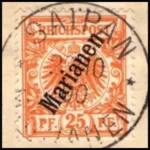
Backdated cancels applied before October 1901 are identified primarily through cancel device wear or through the presence of dust specks or other inclusions that have been documented on genuine uses with verified dates, which is why expertization is a requirement for such stamps. The question of why it would have been necessary to apply backdated cancels for some of the dates that fell within the period of the stamps’ validity is not fully understood, however. Type 2 cancels are typically valued at 50% of the value of Type 1 cancels.
Type 3 (Sorte 3) cancels are backdated cancels applied after the stamps ceased to be valid, i.e., in October 1901 or later. Backdated uses of the cancel device are known to have occurred at least as late as 1907, despite this being against postal regulations and the practice being strongly discouraged by the Reichspost. Of the three types of cancels, Type 3 are the hardest to determine; it is typically a case of knowing how the cancel device wore over time and when certain features associated with such wear occurred. Type 3 cancels are valued at 25% of Type 1 catalogue values.
The various types of Saipan cancels are typically grouped together by how the year part of the date appears in the cancel. Late 1899 usage of the Saipan cancel show the year as “99.” By the time 1899 ended, a new “00” year slug had not been received from Germany, so genuine cancels from most of January 1900 continued to show the old year. In this period, the year date was also changed manually to “1900” or “900” with a pen. By early February, the postal agent decided to remove the downward strokes from “99” to show a 1900 year date as “OO”. The year date remained OO until the arrival of the correct “00” year slug on 17 August 1900. Thereafter, the year slug for the date was regularly supplied to the colony by Berlin excepting a period between 1 January and 27 January 1911, when the year date was once again handwritten while the “11” year slug was enroute from Germany (right).
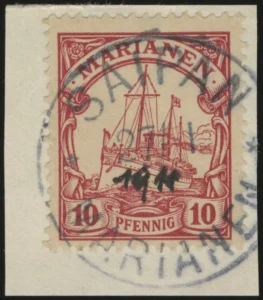
Type 1 cancels – cancels shown to have been applied on the dates shown:
Year shown as “99” (right)
18.11.99 – black
21.11.99 – black and violet
24.11.99 – violet
29.11.99 – violet
30.11.99 – violet
31.11.99 – black and violet
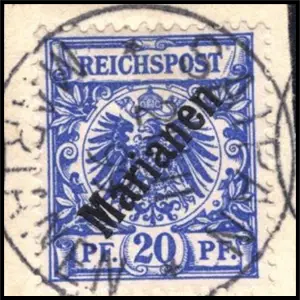
Cancels applied in January 1900 but showing the year date as “99″
9.1.99
11.1.99
27.1.99
Cancels applied in January 1900 with the year changed to “900” in manuscript
1.1.900
3.1.900
10.1.900
Year shown as “OO” by the removal of the downward strokes of the numbers “99” (right)
2.3.
31.3.
15.5
25.5
19.7.
6.3.
5.4.
16.5
1.6.
22.7
18.3
20.4
18.5
1.7.
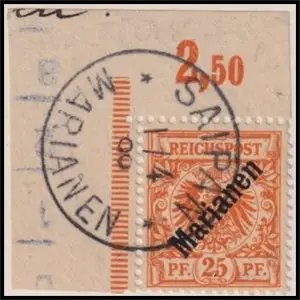
Year shown as “00” and “01”
12.9.00
22.9.00
10.11.00
19.11.00
22.12.00
7.1.01
31.1.01
3.4.01
18.4.01
24.4.01
23.5.01
10.6.01
30.7.01
Exactly why the colony would ever need so many stamps is something of a mystery, if only local demand is considered. From the first day of postal operations and for some time thereafter, the German population of the colony consisted of three individuals – the District Commissioner, the Assistant Commissioner, and the Postal Agent. The wider postal public included precisely one Spanish citizen who continued to live on the island of Rota after the arrival of the Germans. The rest of the 2,500 or so inhabitants of the Marianen colony were Chamorros (indigenous Mariana Islanders), who had not previously needed postal services to connect them to the outside world. Where, then, did local demand for postal services come from?
For this reason, genuinely used examples of both types of the “MARIANEN” overprints are scarcer than would seem to be the case from the philatelic marketplace. Some properly used stamps were created by the four Europeans when they sent correspondence home. Others were created by stamp collectors who sent correspondence to Saipan to have Mariana stamps affixed and returned via the post. But in contrast to other German colonies, Saipan’s postal agent was “extremely obliging” to the philatelic community of the day in ways that were not strictly legitimate.
The German postal agent on Saipan was known to routinely and frequently apply backdated cancels to his stamps to fulfill requests from collectors. While not forged cancels by any stretch of the imagination, catalogues routinely lower the values assigned to backdated cancels for obvious reasons. Their general abundance in the marketplace suggest that backdated cancels are likely the majority of used stamps on offer.
German catalogues typically divide cancelled examples of the two overprinted issues into three types (“Sorte” in German):
Type 1 (Sorte 1) cancels are those that were properly applied on the date shown – i.e., they are not examples of backdated or improperly applied cancels.
Type 2 (Sorte 2) (below) are backdated cancels applied to Mariana stamps during their period of validity, or which show a date that clearly fell after the stamp’s postal validity had ended.
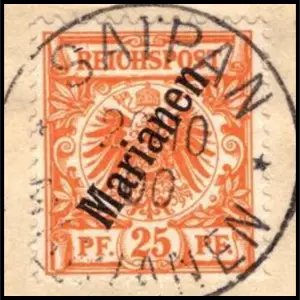
Demonetized stamps are not something most modern postal patrons have ever had to deal with. Prior to 1 January 1969, German stamps retained validity only for a short period after being withdrawn from sale. This practice also applied to German colonial stamps. In the case of the Marianas, overprinted stamps were withdrawn following the arrival of the “Yacht” series beginning in January 1901. But stamps from the overprint issues that had already been sold retained validity until 30 September 1901. German postal clerks were (and still are) forbidden from applying their postal cancels to invalid stamps – but the Saipan postmaster did so on a number of occasions. Cancels with dates on overprint issues with dates in October and November 1901 are known, as are cancels applied before October 1901 but showing earlier dates.
Backdated cancels applied before October 1901 are identified primarily through cancel device wear or through the presence of dust specks or other inclusions that have been documented on genuine uses with verified dates, which is why expertization is a requirement for such stamps. The question of why it would have been necessary to apply backdated cancels for some of the dates that fell within the period of the stamps’ validity is not fully understood, however. Type 2 cancels are typically valued at 50% of the value of Type 1 cancels.
Type 3 (Sorte 3) cancels are backdated cancels applied after the stamps ceased to be valid, i.e., in October 1901 or later. Backdated uses of the cancel device are known to have occurred at least as late as 1907, despite this being against postal regulations and the practice being strongly discouraged by the Reichspost. Of the three types of cancels, Type 3 are the hardest to determine; it is typically a case of knowing how the cancel device wore over time and when certain features associated with such wear occurred. Type 3 cancels are valued at 25% of Type 1 catalogue values.
The various types of Saipan cancels are typically grouped together by how the year part of the date appears in the cancel. Late 1899 usage of the Saipan cancel show the year as “99.” By the time 1899 ended, a new “00” year slug had not been received from Germany, so genuine cancels from most of January 1900 continued to show the old year. In this period, the year date was also changed manually to “1900” or “900” with a pen. By early February, the postal agent decided to remove the downward strokes from “99” to show a 1900 year date as “OO”. The year date remained OO until the arrival of the correct “00” year slug on 17 August 1900. Thereafter, the year slug for the date was regularly supplied to the colony by Berlin excepting a period between 1 January and 27 January 1911, when the year date was once again handwritten while the “11” year slug was enroute from Germany (below).
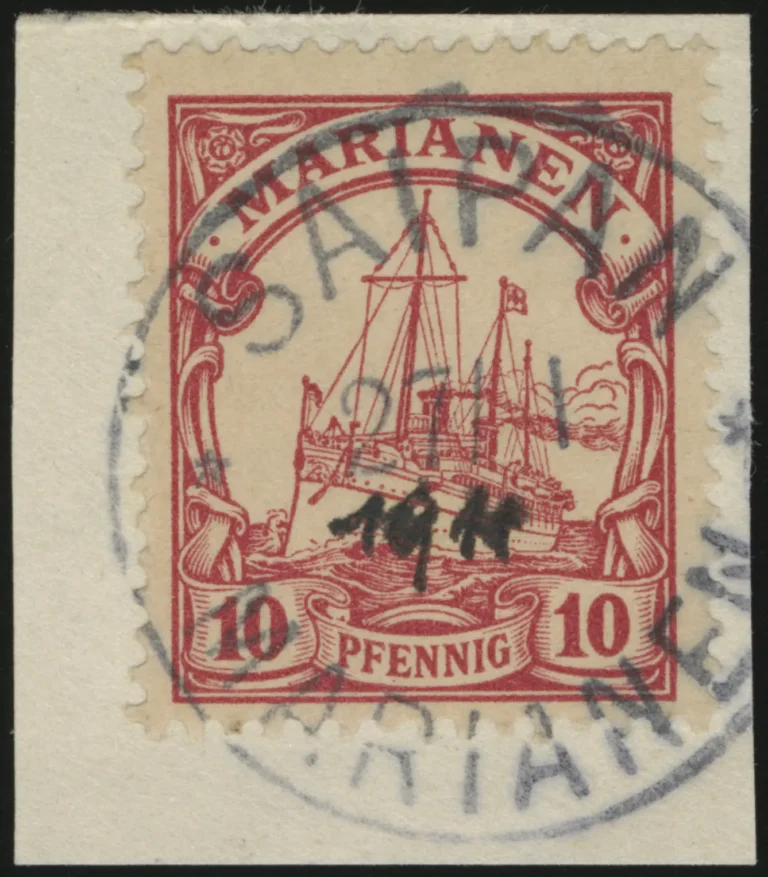
Type 1 cancels – cancels shown to have been applied on the dates shown:
Year shown as “99”
18.11.99 – black
21.11.99 – black and violet
24.11.99 – violet
29.11.99 – violet
30.11.99 – violet
31.11.99 – black and violet
Cancels applied in January 1900 but showing the year date as “99″
9.1.99
11.1.99
27.1.99
Cancels applied in January 1900 with the year changed to “900” in manuscript
1.1.900
3.1.900
10.1.900
Year shown as “OO” by the removal of the downward strokes of the numbers “99” (below)
2.3.
31.3.
15.5
25.5
19.7.
6.3.
5.4.
16.5
1.6.
22.7
18.3
20.4
18.5
1.7.
Year shown as “00” and “01”
12.9.00
22.9.00
10.11.00
19.11.00
22.12.00
7.1.01
31.1.01
3.4.01
18.4.01
24.4.01
23.5.01
10.6.01
30.7.01
The Yacht Series

With the issue of the Yacht stamps in January of 1901, the postal history of the Mariana Islands began to take a more typical turn. The full complement of Yacht stamps, from 3 Pf to 5 Mark in face value and in the standard colors, were issued on unwatermarked paper, and were in use until the end of German control of the colony.
The Marianas remained supplied with Yacht stamps until the end of German control, and emergency measures such as bisects or locally produced surcharges, were never needed. Printings on watermarked paper exist for the 3 Pf and 5 Mark values, but these exist only as war printings.
Unlike some of the other colonies, where the vignette and the frame of the 5 Mark value were sometimes mismatched, the war printing of the 5 Mark Marianas stamp was only created from correctly matched plates.
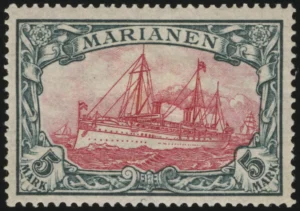
Only the same perforation varieties encountered on other colonies’ war time “Large Yacht” values is known to have occurred. As was the case with similar issues produced for the other colonies, some of the 5 Mark stamps were issued with perforations typical for war-time printings of all stamps of Germany proper, namely 25 perforation holes along the top and bottom edges, and 17 perforation holes on the left and right sides (right). Michel and other relevant literature refers to this as “25:17 perforations.”
The rest of the printing was issued with pre-war “26:17” perforations. Fortunately for collectors who wish to check for this variety, all of “Large Yachts” prepared for the Marianas from the 1901 printing exist only with 26:17 perforations, and can be used for comparison. Also fortunate for collectors of Mariana issues, the two perforation varieties are only slightly different with regard to their catalogue values. In the case of other colonies, one perforation variety can be significantly more valuable than the other.
With the issue of the Yacht stamps in January of 1901, the postal history of the Mariana Islands began to take a more typical turn. The full complement of Yacht stamps, from 3 Pf to 5 Mark in face value and in the standard colors, were issued on unwatermarked paper, and were in use until the end of German control of the colony.
The Marianas remained supplied with Yacht stamps until the end of German control, and emergency measures such as bisects or locally produced surcharges, were never needed. Printings on watermarked paper exist for the 3 Pf and 5 Mark values, but these exist only as war printings.
Unlike some of the other colonies, where the vignette and the frame of the 5 Mark value were sometimes mismatched, the war printing of the 5 Mark Marianas stamp was only created from correctly matched plates.
Only the same perforation varieties encountered on other colonies’ war time “Large Yacht” values is known to have occurred. As was the case with similar issues produced for the other colonies, some of the 5 Mark stamps were issued with perforations typical for war-time printings of all stamps of Germany proper, namely 25 perforation holes along the top and bottom edges, and 17 perforation holes on the left and right sides (below). Michel and other relevant literature refers to this as “25:17 perforations.”
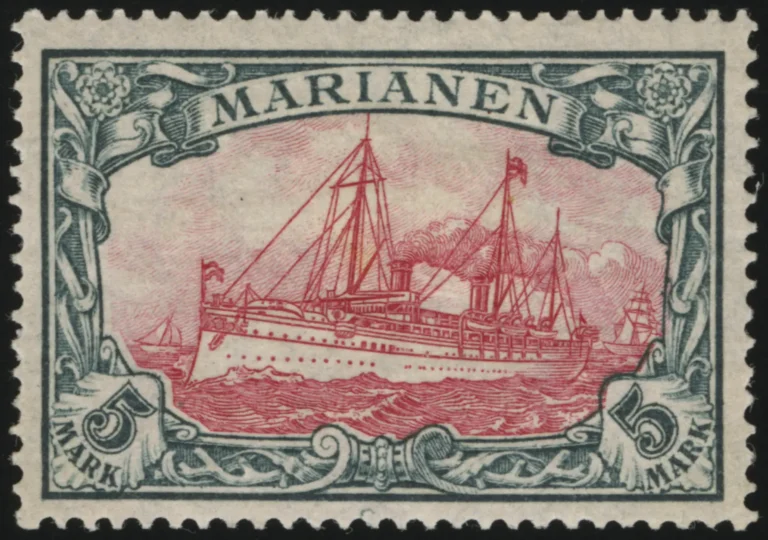
The rest of the printing was issued with pre-war “26:17” perforations. Fortunately for collectors who wish to check for this variety, all of “Large Yachts” prepared for the Marianas from the 1901 printing exist only with 26:17 perforations, and can be used for comparison. Also fortunate for collectors of Mariana issues, the two perforation varieties are only slightly different with regard to their catalogue values. In the case of other colonies, one perforation variety can be significantly more valuable than the other.
Post Offices & Postmarks
Saipan


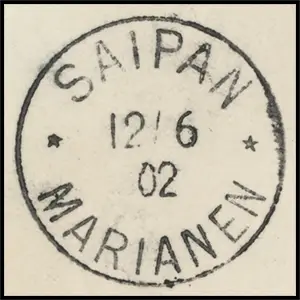
For collectors who wish to collect town cancels, the Marianas offer completeness that comes with remarkable ease. Only one actual cancel device was ever used in the Marianas, specifically the one that reads “Saipan / Marianen.” It appears on every properly cancelled Mariana stamp from the German period (right).
For collectors who wish to collect town cancels, the Marianas offer completeness that comes with remarkable ease. Only one actual cancel device was ever used in the Marianas, specifically the one that reads “Saipan / Marianen.” It appears on every properly cancelled Mariana stamp from the German period (below).
Rota

There are several additional marks that are commonly found of stamps from the German Marianas which are worth noting, even though they were not official German postal markings.
A common “unofficial” marking is from Rota. Rota is an island south of Saipan, and it was also part of the German Marianas.
In mid-June 1904, a German agronomist, Herr Volkmar Reichel, was transferred to Rota. For reasons that are unclear, Herr Reichel began operating an “auxiliary postal station” on the island. This “auxiliary postal station” was not authorized by German postal authorities. He initially used a small. hand-made “ROTA” handstamp to cancel his mail (below).
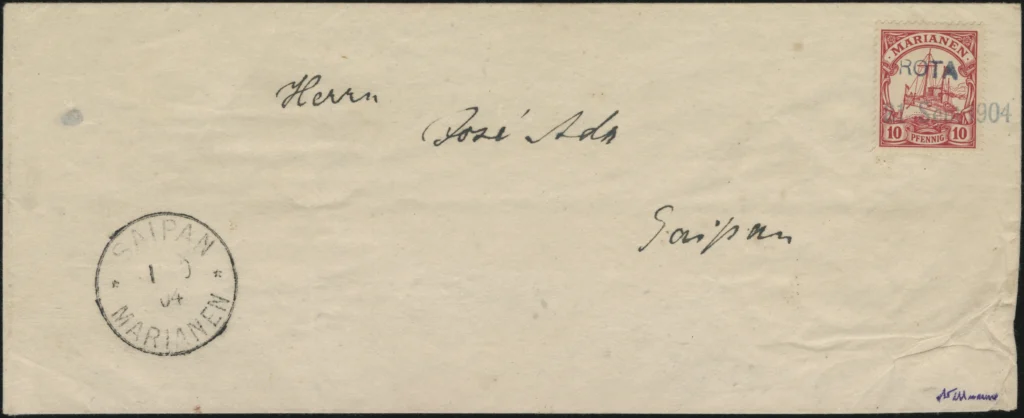
Upon Reichel’s return to Saipan due to illness in 1904, he surrendered the original handstamp to local authorities.
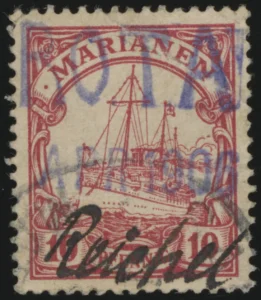
Upon his recovery and return to Rota, the handstamp could not be found in Saipan, so he created a new one. Additionally, he was informed that he was now required to affix his signature alongside the handstamp (right).
Due to philatelic interest, he manufactured a large quantity of these handstamps, typically unused, with date stamps and signatures, on stamps that were not the common rates.
Upon Reichel’s return to Saipan due to illness in 1904, he surrendered the original handstamp to local authorities.
Upon his recovery and return to Rota, the handstamp could not be found in Saipan, so he created a new one. Additionally, he was informed that he was now required to affix his signature alongside the handstamp (below).
Due to philatelic interest, he manufactured a large quantity of these handstamps, typically unused, with date stamps and signatures, on stamps that were not the common rates.
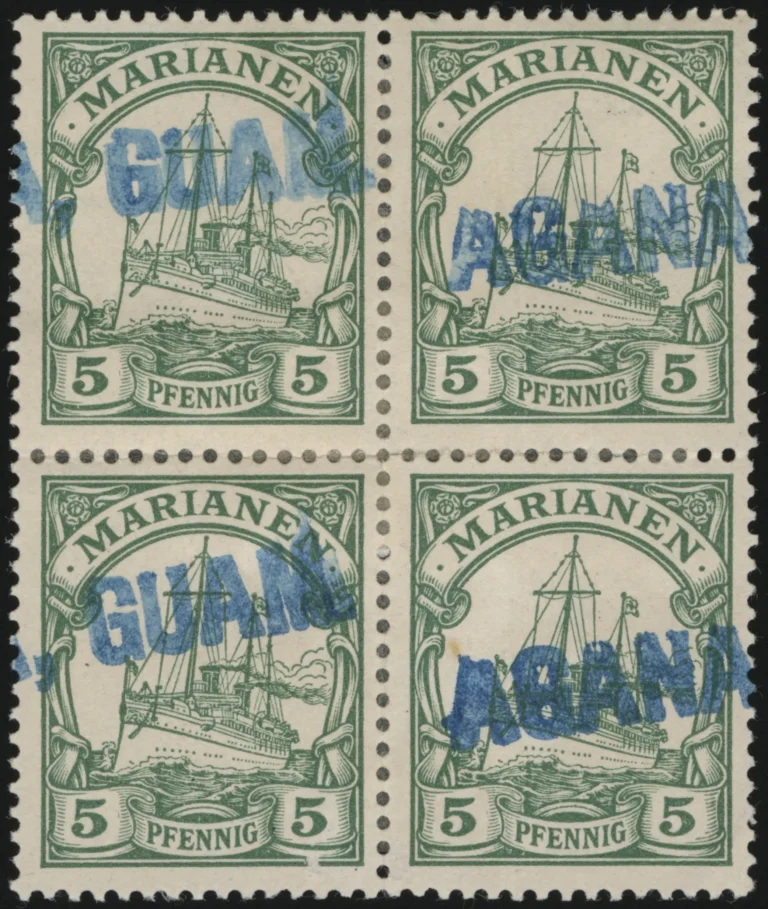
Another common marking found on stamps of Marianen is that of “AGANA, GUAM”.
From December 1900 to March 1903, Saipan was without regular mail steamer service. As a result, mail was loaded onto any passing vessel, civilian or military, that could transport it to a port of call that had regular mail service. One of these ports was Agana in the nearby U.S. possession of Guam.
On occasion, this mail arrived in Agana without being cancelled, so in Agana a handstamped “AGANA, GUAM” was applied to cancel the postage (right). Most, if not all, of these are philatelic creations.
Another common marking found on stamps of Marianen is that of “AGANA, GUAM”.
From December 1900 to March 1903, Saipan was without regular mail steamer service. As a result, mail was loaded onto any passing vessel, civilian or military, that could transport it to a port of call that had regular mail service. One of these ports was Agana in the nearby U.S. possession of Guam.
On occasion, this mail arrived in Agana without being cancelled, so in Agana a handstamped “AGANA, GUAM” was applied to cancel the postage (below). Most, if not all, of these are philatelic creations.
In any event, the Marianas ceased to be a German possession on the 14th of October 1914 – about two years before the first of the war printing stamps were created. As was the case with all German Pacific possessions north of the Equator, German administration of the Marianas ended following an invasion by the military forces of Imperial Japan. Although control of the Marianas was mandated to Japan by the League of Nations in the aftermath of the First World War, the Marianas were effectively colonized by Japan and remained a Japanese colonial outpost of the Japanese Empire until the end of the Second World War.
With the end of the Second World War, the United Nations mandated control of the Marianas to the United States as part of the U.N. Trust Territory of the Pacific. As such, this small territory would eventually become the only part of the German colonial empire that presently is part of the United States. While the people of the former German colonies of the Carolines and the Marshall Islands created independent nations from their portions of the UN Trust Territory, the residents of the Mariana Islands set about joining the US. The Marianas first proposed reunification with Guam in 1969, a political move rejected by Guam. The Marianas then set about forming a U.S. territorial government in 1978, before being fully integrated into the United States as the “Commonwealth of the Northern Mariana Islands” on 4 November 1986. Despite multiple changes of government, distinctive stamp issues were never resumed by any administration after the Germans left. US Stamps have been used there for the last 70 years.
References
Friedemann, A. (1980). The Stamps and Cancels of the German Colonies and the German Post Offices Abroad, Section XI Marshall Islands. Translated by Alfred K. Walter. Wilmington, DE: German Colonies Collector Group.
Michel Redaktion (ed.) (2025). Michel Germany Specialized Catalog 2025 (Part 1). Bobingen, Germany: Schwaneberger Verlag Gmbh.
Nössig, T. (ed.) (2019). Catalog of the Postmarks of the German Colonies & Post Offices Abroad (1st English ed). Berlin, Germany: Arbeitsgemeinschaft der Sammler deutscher Kolonialpostwertzeichen.
Illustrations courtesy of Gannon Sugimura & Jed Dorman.