Beginners Guide
Marshall-Inseln
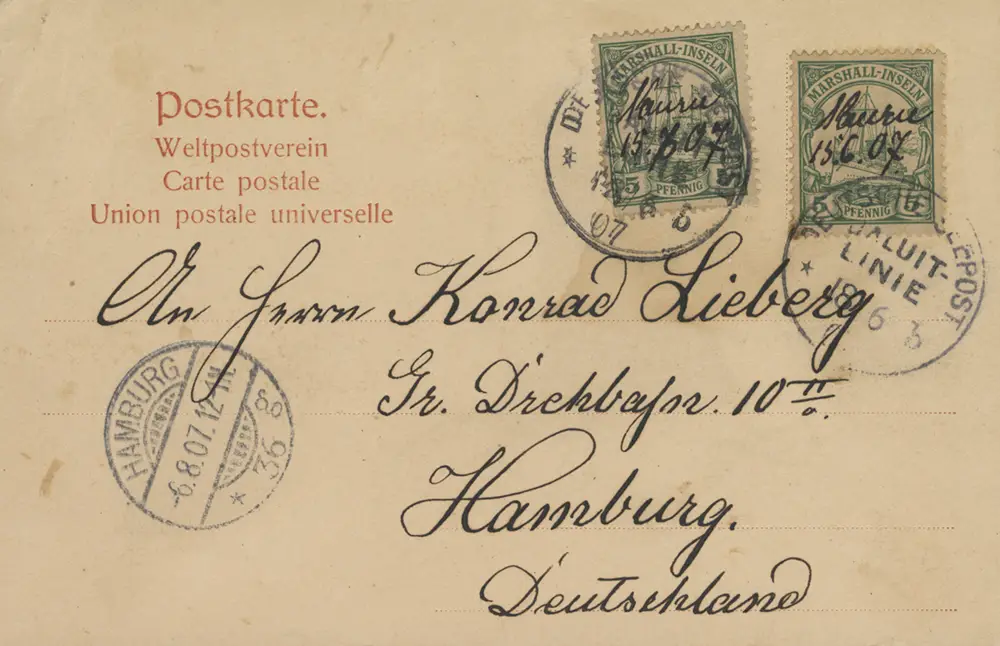
Atoll post card from Nauru via Jaluit Linie, June 1907
General
PO China
PO Morocco
PO Turkey
D-NG
D-OA
D-SWA
Kamerun
Karolinen
Kiautschou
Marianen
Marshall-In.
Samoa
Togo
Marshall-Inseln (Marshall Islands)
By Gannon Sugimura
Historical Background

The Marshall Islands, as a German colonial possession, were in some ways something of a hard sell. In other ways, it could have been seen as vital to German colonial expansion. Either way, the German presence in the Marshall Islands marked the beginning of the end for the Spanish colonial empire, and the end of the beginning for the German colonial empire.
Despite having been inhabited by the native Marshallese since the second millenium BC, Europeans declared the islands “unclaimed” when they arrived. The Spanish were the first Europeans to travel there, with the arrival of Spanish ships in 1526.
One of the first British ships to arrive was the Scarborough, one of the “First Fleet” ships that transported British convicts to Botany Bay, Australia in 1788. This event, generally seen as the beginning of Britain’s colonization of Australia and the Pacific Islands, involved sending ships full of convicts to Australia which then had to return to Britain largely empty. The captain of the Scarborough, one John Marshall, made the return voyage via China and Micronesia. He would become the first European to map the islands, which were later named after him.
Meanwhile, Spain’s control over the islands was largely theoretical until the 1870’s, when Madrid attempted to more fully exercise control in the nearby Caroline Islands. Germany, meanwhile, opened a consulate in the Marshall Islands in 1875. Germany purchased the islands from Spain in 1885, after which Germany regarded them as a “Schutzgebeit” (a protectorate), although it was a colony in all but name.
The German Marshall Islands had a surface area of just over 200 km² (roughly 80 square miles) spread out over 1,100 atolls and islands, all but about 30 of which are uninhabited. No island in the colony had a land area larger than 20 km² / 8 square miles. During the German period, only about 10,000 people lived in the Marshalls, which were known at the time as the largest source of copra (dried coconut) in Micronesia.
As was the case in other parts of the German colonial empire, initial control of the colony was exercised through a trading company rather than through a colonial government. German trading outposts began in the Marshalls in 1873, when the Hamburg firms of Godeffroy and Hernsheim established a post on the island of Ebon. All German commercial activity was merged into one company, the Jaluit Gesellschaft, in 1885. This company would run the colony until 1906, with the Imperial government limited to the presence of a Landeshauptmann, which in English is usually translated as “Commissioner.”
Additional economic incentive to cement German control came in 1900, when it was determined that the island of Nauru was very rich in phosphates. Nauru, colonized by the Germans in 1888 as part of the German Marshall Islands, is one of three islands in the Pacific with high concentrations of chemical compounds containing the element phosphorus. Phosphate mining on Nauru would continue through the 1990’s.
Jaluit Gesellschaft control of the Marshall Islands would end in 1906, when the islands were transferred to Imperial control. As was the case with the Caroline and Mariana colonies, the Marshall Islands at this point essentially transitioned to being a province of German New Guinea. All these other colonies were subordinate to the German Imperial Governor in New Guinea, with the administrative offices in Jaluit now answerable to those in Pohnpei (at the time Ponape) in the Carolines.
Vorläufer

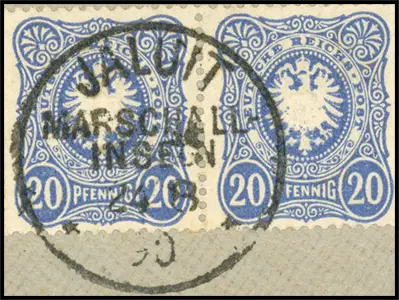
The Jaluit post office was the first (and for many years only) post office in the Marshall Islands, opening on 29 March 1889. The Vorläufer period for the Marshall Islands would last for just over eight years, until the first distinctive issues were printed in 1897. The initial shipment of stamps in 1889 consisted of German definitives from the 1880 “PFENNIG” series of the 5 Pf, 10 Pf, 20 Pf, and 50 Pf denominations, (Mi. 40, 41, 43, & 44) (top right) as well as the “internal use” 2 Mark stamp of 1875 (Mi. 37 c and 37 d).
Although some of the 3 Pf and 25 Pf stamps from this issue are known to have been used at Jaluit, no stamps of these denominations were sent there by the Reichspost. These stamps paid rates that were useful in Germany, but were not useful at this time in the colonies. Stamps of these denominations are therefore “improper Vorläufer” created because someone had these stamps in their possession when they visited the Marshall Islands or these stamps were sent there for cancellation by philatelists.
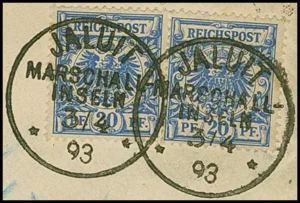
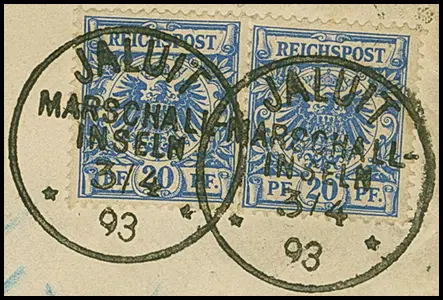
Although stamps from this issue were demonetized in Germany proper on 31 January 1891, their validity in the Pacific colonies was generally extended until the end of 1891. The Vorläufer period continued until 1897 with the uses of the 1889 “Krone / Adler” series at the Jaluit post office (bottom right). As before, the 3 Pf and 25 Pf values of this issue were never officially shipped to Jaluit, although genuinely used examples exist. Additionally, for those who seek out shade varieties, the red brown shade of the 50 Pf value (Mi. 50 b) is very hard to come by as only 200 examples of this shade were issued by the Jaluit postmaster.
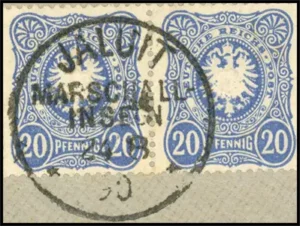
The Jaluit post office was the first (and for many years only) post office in the Marshall Islands, opening on 29 March 1889. The Vorläufer period for the Marshall Islands would last for just over eight years, until the first distinctive issues were printed in 1897. The initial shipment of stamps in 1889 consisted of German definitives from the 1880 “PFENNIG” series of the 5 Pf, 10 Pf, 20 Pf, and 50 Pf denominations, (Mi. 40, 41, 43, & 44) (below) as well as the “internal use” 2 Mark stamp of 1875 (Mi. 37 c and 37 d).
Although some of the 3 Pf and 25 Pf stamps from this issue are known to have been used at Jaluit, no stamps of these denominations were sent there by the Reichspost. These stamps paid rates that were useful in Germany, but were not useful at this time in the colonies. Stamps of these denominations are therefore “improper Vorläufer” created because someone had these stamps in their possession when they visited the Marshall Islands or these stamps were sent there for cancellation by philatelists.
Although stamps from this issue were demonetized in Germany proper on 31 January 1891, their validity in the Pacific colonies was generally extended until the end of 1891. The Vorläufer period continued until 1897 with the uses of the 1889 “Krone / Adler” series at the Jaluit post office (below).
As before, the 3 Pf and 25 Pf values of this issue were never officially shipped to Jaluit, although genuinely used examples exist. Additionally, for those who seek out shade varieties, the red brown shade of the 50 Pf value (Mi. 50 b) is very hard to come by as only 200 examples of this shade were issued by the Jaluit postmaster.
“Jaluit Issue” Overprints

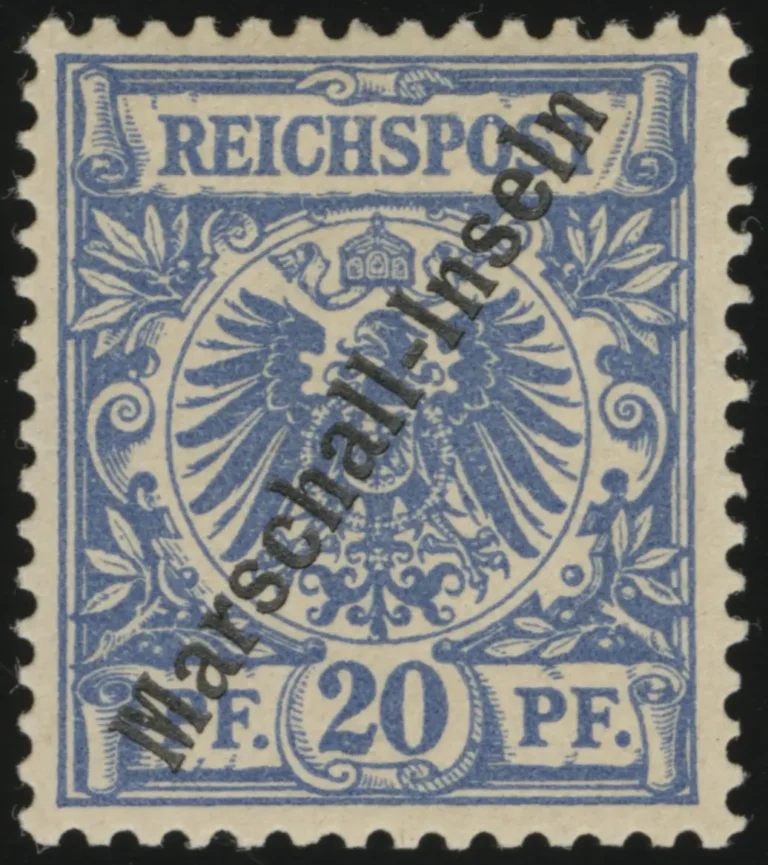
Beginning in April 1897, the Reichspost finally got around to issuing distinctive issues for the Marshall Islands. The first such stamps were overprinted “Marschall-Inseln”, which better conformed to German orthography. This first issue, the “Jaluit Issue”, initially consisted of only two values, the 10 Pf and 20 Pf (top right) values, listed in Michel as Mi. 3 I and Mi. 4 I, and in Scott as Sc. 3 and Sc. 4.
The reason for the choice of denominations was that the Marshall Islands were the only colony at the time which had a single post office, as well as the postal tariffs in effect at the time. Until 1899, international rates applied to mail from the colonies to all countries, including Germany. The 3 Pf stamp was unnecessary at this time, as pre-1899 printed matter rates from the colonies were in multiples of 5 Pf – and there really was not a lot of printed matter originating in the Marshalls in any event. Sufficient quantities of the more lightly used 5 Pf and 50 Pf stamps were still on hand, so only the stamps for postcards (10 Pf) or letters (20 Pf) sent to Germany needed to be issued in August and April 1897, respectively. This is the reason for something collectors have noted for a very long time, i.e. that catalogue values for these denominations are much lower than the other denominations in the series.
Yet this situation would not last. The Reichspost got around to issuing distinctive “Marschall-Inseln” overprinted 3 Pf and 5 Pf stamps (Mi. 1 I and Mi. 2 I) in early 1899, following a change in postal tariffs. In essence, the German domestic (“Inland”) rates were now applied to correspondence to and from the colonies. The 3 Pf stamp was now necessary, as printed matter could now be sent for that fee, and postcards now required 5 Pf instead of 10 Pf. Stamps of these new denominations were issued at Jaluit beginning on 21 July 1899 to pay the new rates.
Stamps of the 25 Pf and 50 Pf values, which would have been Mi. 5 I and Mi. 6 I, were actually never produced with the “Marschall-Inseln” overprint. The supply of 50 Pf stamps proved sufficient until late 1899, when new “Marshall-Inseln” overprints were issued; the 25 Pf denomination was still considered unnecessary, as it mostly applied to an express mail rate which did not apply in the colonies.
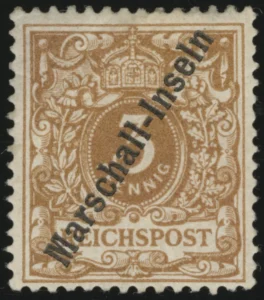
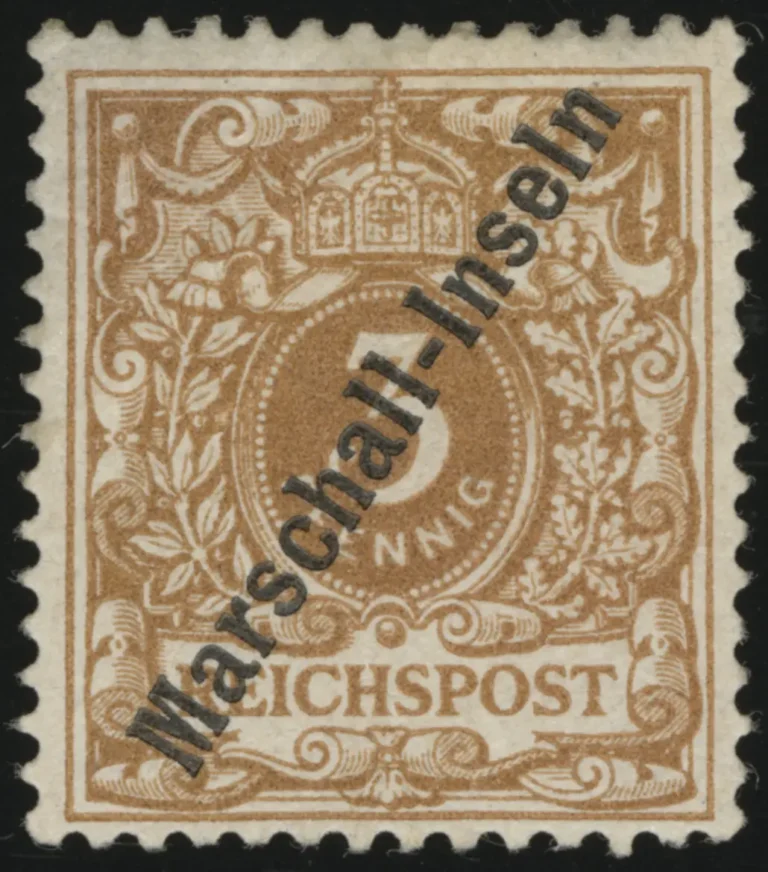
The Jaluit Issue is remarkably free of varieties, other than those which apply to the underlying stamps of the issue. For example, the 3 Pf “Break in the Lower Right Band” variety is listed in Michel as Mi. 1 I PF I. Otherwise, each of the higher values exists only in one listed shade; the 3 Pf value was issued in just two shades, “Light Ochre Brown” (bottom right) and “Bright Brown-Ochre.”
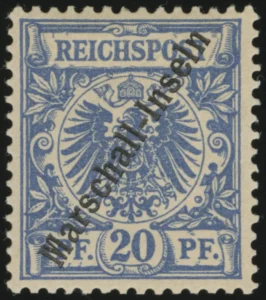
Beginning in April 1897, the Reichspost finally got around to issuing distinctive issues for the Marshall Islands. The first such stamps were overprinted “Marschall-Inseln”, which better conformed to German orthography. This first issue, the “Jaluit Issue”, initially consisted of only two values, the 10 Pf and 20 Pf (below) values, listed in Michel as Mi. 3 I and Mi. 4 I, and in Scott as Sc. 3 and Sc. 4.
The reason for the choice of denominations was that the Marshall Islands were the only colony at the time which had a single post office, as well as the postal tariffs in effect at the time. Until 1899, international rates applied to mail from the colonies to all countries, including Germany. The 3 Pf stamp was unnecessary at this time, as pre-1899 printed matter rates from the colonies were in multiples of 5 Pf – and there really was not a lot of printed matter originating in the Marshalls in any event. Sufficient quantities of the more lightly used 5 Pf and 50 Pf stamps were still on hand, so only the stamps for postcards (10 Pf) or letters (20 Pf) sent to Germany needed to be issued in August and April 1897, respectively. This is the reason for something collectors have noted for a very long time, i.e. that catalogue values for these denominations are much lower than the other denominations in the series.
Yet this situation would not last. The Reichspost got around to issuing distinctive “Marschall-Inseln” overprinted 3 Pf and 5 Pf stamps (Mi. 1 I and Mi. 2 I) in early 1899, following a change in postal tariffs. In essence, the German domestic (“Inland”) rates were now applied to correspondence to and from the colonies. The 3 Pf stamp was now necessary, as printed matter could now be sent for that fee, and postcards now required 5 Pf instead of 10 Pf. Stamps of these new denominations were issued at Jaluit beginning on 21 July 1899 to pay the new rates.
Stamps of the 25 Pf and 50 Pf values, which would have been Mi. 5 I and Mi. 6 I, were actually never produced with the “Marschall-Inseln” overprint. The supply of 50 Pf stamps proved sufficient until late 1899, when new “Marshall-Inseln” overprints were issued; the 25 Pf denomination was still considered unnecessary, as it mostly applied to an express mail rate which did not apply in the colonies.
The Jaluit Issue is remarkably free of varieties, other than those which apply to the underlying stamps of the issue. For example, the 3 Pf “Break in the Lower Right Band” variety is listed in Michel as Mi. 1 I PF I. Otherwise, each of the higher values exists only in one listed shade; the 3 Pf value was issued in just two shades, “Light Ochre Brown” (bottom right) and “Bright Brown-Ochre.”
“Bern Issue” Overprints

In February 1897, a small quantity of 800 sets of all six values (3 Pf, 5 Pf, 10 Pf, 20 Pf, 25 Pf & 50 Pf) of German Crown/Eagle series stamps available at that time were prepared with the “Marschall-Inseln” overprint, of which 760 sets were sent to the offices of the Universal Postal Union in Bern, Switzerland.
In an age when the post was the only means of long-distance communication, the members of the UPU had to know what genuine stamps looked like. This required samples of genuine stamps to compare to any incoming mailings. This printing was made in order to fulfill a UPU requirement, still in effect, for specimen examples of new stamps issued by any member state for distribution to other member states. An additional 200 sets were printed in March 1897, which were retained for the Reichspost archives along with 40 sets from the February printing.
In order to protect their postal revenue, some UPU members are known to have slightly defaced the samples provided to the UPU. This could be done by overprinting them with “Specimen” or something similar, or even punching small holes somewhere on the stamp as a means of invalidating them. Examples of the Bern Issue were not marked as such by the Reichspost, but the overprint that was applied to them is identifiable. It is notably heavier than the overprint applied to the regularly issued stamps. Additionally, the 3 Pf denomination is the shade Michel describes as “Medium Brown” (Germany Mi. 45 b) (right) as opposed to the issued stamps.
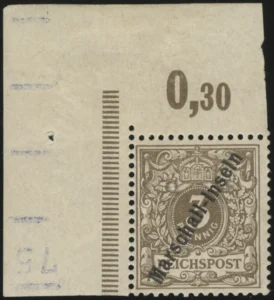
In February 1897, a small quantity of 800 sets of all six values (3 Pf, 5 Pf, 10 Pf, 20 Pf, 25 Pf & 50 Pf) of German Crown/Eagle series stamps available at that time were prepared with the “Marschall-Inseln” overprint, of which 760 sets were sent to the offices of the Universal Postal Union in Bern, Switzerland.
In an age when the post was the only means of long-distance communication, the members of the UPU had to know what genuine stamps looked like. This required samples of genuine stamps to compare to any incoming mailings. This printing was made in order to fulfill a UPU requirement, still in effect, for specimen examples of new stamps issued by any member state for distribution to other member states. An additional 200 sets were printed in March 1897, which were retained for the Reichspost archives along with 40 sets from the February printing.
In order to protect their postal revenue, some UPU members are known to have slightly defaced the samples provided to the UPU. This could be done by overprinting them with “Specimen” or something similar, or even punching small holes somewhere on the stamp as a means of invalidating them. Examples of the Bern Issue were not marked as such by the Reichspost, but the overprint that was applied to them is identifiable. It is notably heavier than the overprint applied to the regularly issued stamps. Additionally, the 3 Pf denomination is the shade Michel describes as “Medium Brown” (Germany Mi. 45 b) (below) as opposed to the issued stamps.
“Berlin Issue” Overprints

The final issue of “Marschall-Inseln” stamps would include all six values of the Crown/Eagle series. These are listed in Michel as Mi. 1 II- Mi. 6 II. This issue (known as the Berlin issue) was not, as will be explained, needed for postal purposes.
The initial printing of the Bern Issue, some 200 sets, was made in February 1897, and was created to be sent to the UPU in Bern. The Berlin Issue, by contrast, was produced for the “exchange and commercial purposes” of the Imperial Postal Museum.
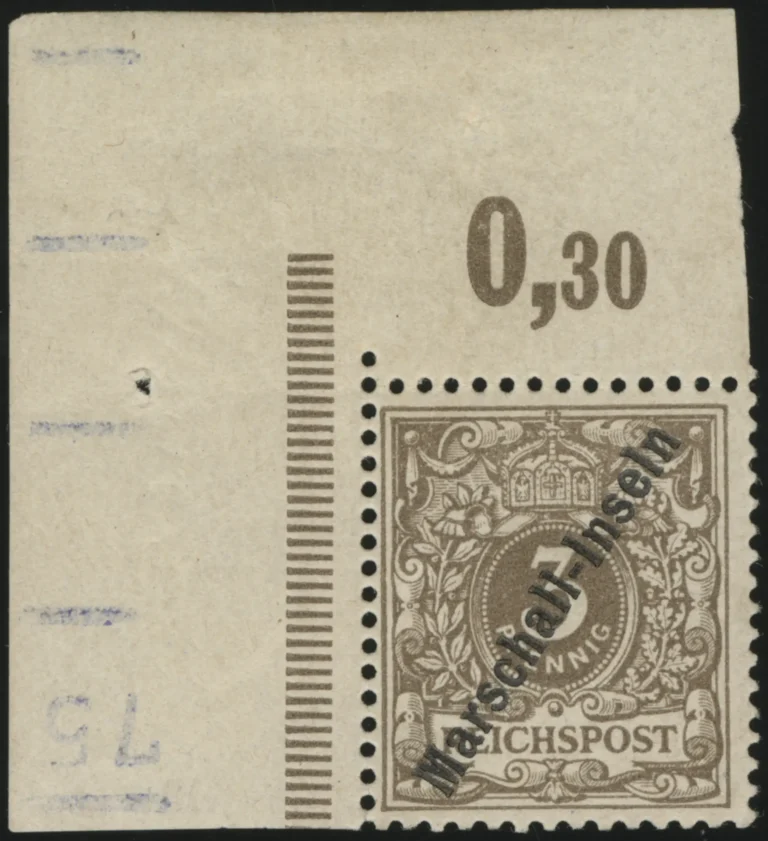
The first 200 sets of the Berlin issue is listed in Michel as the “Berlin Urdruckausgabe” (Berlin Original Printing) (Mi. 1 a U – Mi. 6 U) and is valued only in unused condition (right). It should be noted that the initial printing of these “Original Printings” included a shade of the 3 Pf denomination that did not exist until several months after the Bern Issue was printed.
The rest of the Berlin Issue has a much murkier provenance, as it was not made to fulfill a postal need. The Berlin issue, (Michel Mi. 1 II- Mi. 6 II, Scott Sc. 1-6) consisted of two printings created in 1899. The Berlin Issue consisted of all six denominations of the Crown/Eagle series, and the issue has multiple shades. The 10 Pf stamp alone has five shades listed in Michel, while the 3 Pf and 25 Pf stamps have two each.
Unlike the Jaluit Issue, stamps from the Berlin issue were never sold over the counter at Jaluit. For this reason, they are sometimes categorized as “reprints” although the term “special printing” is probably a better description.
The reason the issue was created at all was due to the actions Philipp Kosack, a Berlin stamp dealer (shop shown at right) who had a very close (and decidedly cozy) relationship with the Reichspost. Due in part to his role as a supplier to the Imperial Postal Museum, the Reichspost ended up owing him large sums of money – up to 200,000 Marks at one point. He was therefore able to extract a number of “concessions” from the Reichspost in the form of philatelic products not available to the general public. So egregious were these concessions that the Reichstag (the Imperial Parliament) would pass resolutions condemning them in 1908.
In 1899, though, Kosack still had enough clout to require the Reichspost to fill his orders, one of which included the initial quantity of the Berlin Issue. In November 1899, Kosack received a delivery of 2,500 sets of six stamps overprinted “Marschall-Inseln”, created from a new overprint plate distinct from the earlier one. These sets also included 25 Pf and 50 Pf stamps, which were printed for the first time. Officially, he would later receive exactly another 1,928 sets of stamps in 1903 for a total of 4,428 examples of each stamp, although evidence suggests that the actual print run is more likely 5,000 sets in total. Kosack also received overprinted postal cards and postal reply cards at this time.
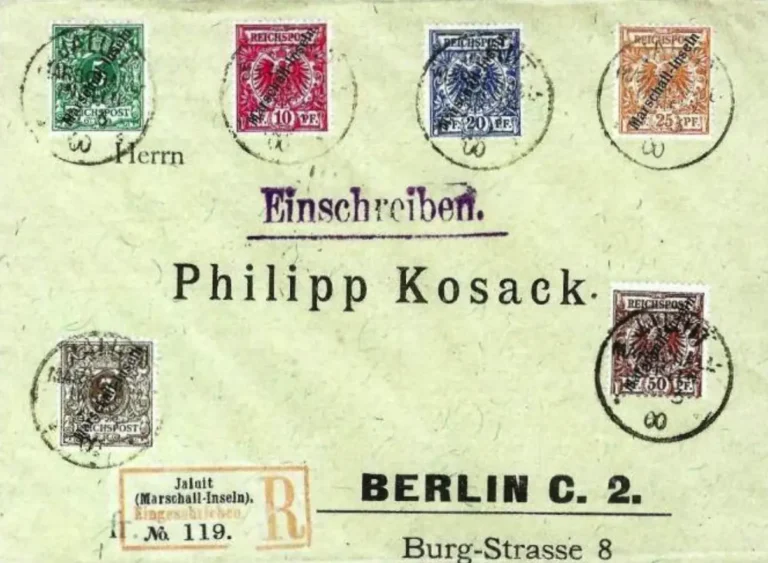
So is the Berlin Issue a regular issue? Not at all. The entire issue was created at the behest of Philipp Kosack, none of it was available directly to the general public either in Berlin or in Jaluit. Having said that, though, the stamps themselves were valid postage in the Marshall Islands for nearly two years after issue, and many were used philatelically in Jaluit after being privately sent there expressly for that purpose (see below cover created by Kosack, canceled in Jaluit on 31 March 1900, and offered by Kosack for 35 Marks – about 250€ today). So they are genuine stamps, regardless of any “reprint” status.
The final issue of “Marschall-Inseln” stamps would include all six values of the Crown/Eagle series. These are listed in Michel as Mi. 1 II- Mi. 6 II. This issue (known as the Berlin issue) was not, as will be explained, needed for postal purposes.
The initial printing of the Bern Issue, some 200 sets, was made in February 1897, and was created to be sent to the UPU in Bern. The Berlin Issue, by contrast, was produced for the “exchange and commercial purposes” of the Imperial Postal Museum.
The first 200 sets of the Berlin issue is listed in Michel as the “Berlin Urdruckausgabe” (Berlin Original Printing) (Mi. 1 a U – Mi. 6 U) and is valued only in unused condition (below). It should be noted that the initial printing of these “Original Printings” included a shade of the 3 Pf denomination that did not exist until several months after the Bern Issue was printed.
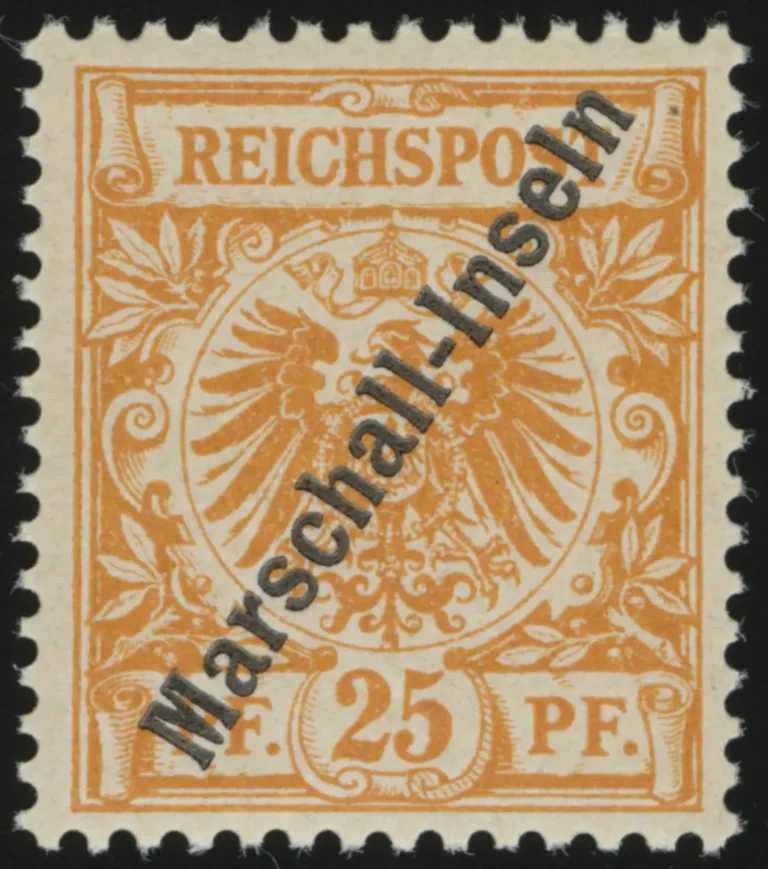
The rest of the Berlin Issue has a much murkier provenance, as it was not made to fulfill a postal need. The Berlin issue, (Michel Mi. 1 II- Mi. 6 II, Scott Sc. 1-6) consisted of two printings created in 1899. The Berlin Issue consisted of all six denominations of the Crown/Eagle series, and the issue has multiple shades. The 10 Pf stamp alone has five shades listed in Michel, while the 3 Pf and 25 Pf stamps have two each.
Unlike the Jaluit Issue, stamps from the Berlin issue were never sold over the counter at Jaluit. For this reason, they are sometimes categorized as “reprints” although the term “special printing” is probably a better description.
The reason the issue was created at all was due to the actions Philipp Kosack, a Berlin stamp dealer (shop shown at right) who had a very close (and decidedly cozy) relationship with the Reichspost. Due in part to his role as a supplier to the Imperial Postal Museum, the Reichspost ended up owing him large sums of money – up to 200,000 Marks at one point. He was therefore able to extract a number of “concessions” from the Reichspost in the form of philatelic products not available to the general public. So egregious were these concessions that the Reichstag (the Imperial Parliament) would pass resolutions condemning them in 1908.
In 1899, though, Kosack still had enough clout to require the Reichspost to fill his orders, one of which included the initial quantity of the Berlin Issue. In November 1899, Kosack received a delivery of 2,500 sets of six stamps overprinted “Marschall-Inseln”, created from a new overprint plate distinct from the earlier one. These sets also included 25 Pf and 50 Pf stamps, which were printed for the first time. Officially, he would later receive exactly another 1,928 sets of stamps in 1903 for a total of 4,428 examples of each stamp, although evidence suggests that the actual print run is more likely 5,000 sets in total. Kosack also received overprinted postal cards and postal reply cards at this time.
So is the Berlin Issue a regular issue? Not at all. The entire issue was created at the behest of Philipp Kosack, none of it was available directly to the general public either in Berlin or in Jaluit. Having said that, though, the stamps themselves were valid postage in the Marshall Islands for nearly two years after issue, and many were used philatelically in Jaluit after being privately sent there expressly for that purpose (see below cover created by Kosack, canceled in Jaluit on 31 March 1900, and offered by Kosack for 35 Marks – about 250€ today). So they are genuine stamps, regardless of any “reprint” status.
“Marshall-Inseln” Overprints

Stamps with a new overprint reading “Marshall-Inseln” were issued at the end of November 1899, and are listed in Michel as Mi. 7-12, and in Scott as Sc. 7-12. The new overprint corrected what was essentially a spelling mistake in the earlier overprints, involving the official name of the colony. From 1885 until 1892, the official spelling of the colony’s name was “Marschall-Inseln.” But by 1893, it was pointed out to the colonial office that the islands bore the name of a specific person, the previously named British sea captain John Marshall. The spelling of the colony’s name was changed by the Colonial Office in 1893 to reflect this. For whatever reason, the Reichspost did not use this spelling until the 1899 overprint issue was created. The Jaluit cancel device, which since 1889 had used the prior spelling, was also replaced by a second device with the correct spelling shortly thereafter in 1900.
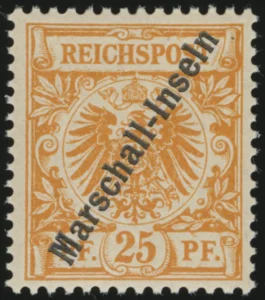
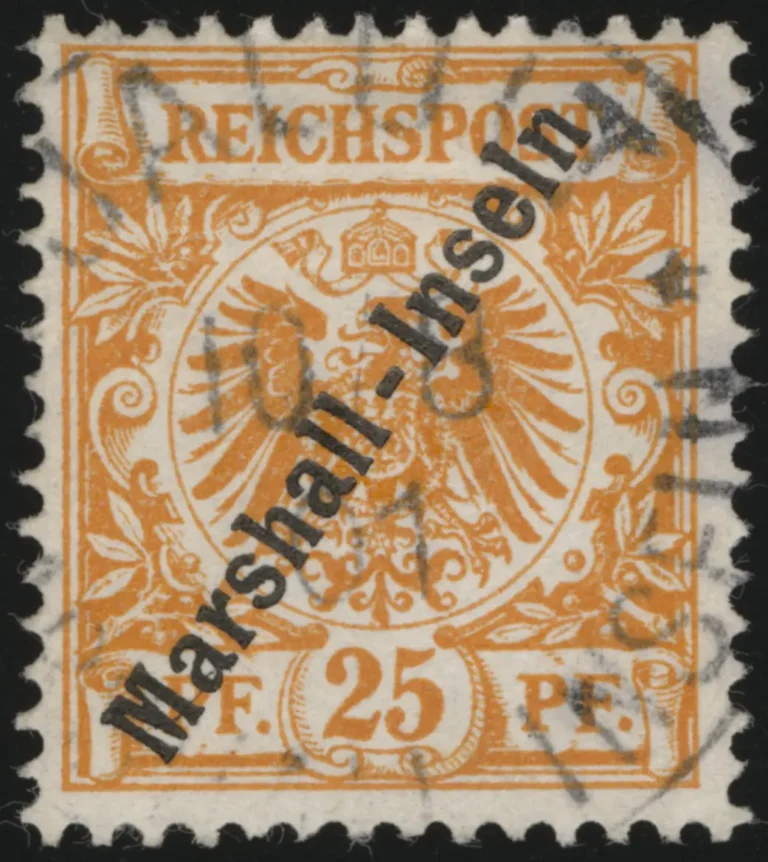
Stamps from this issue consisted of all six denominations of the 1889 Crown/Eagle series, including the 25 Pf value. Since it still had no rate to pay, it saw little use. For this reason, particularly when used, the 25 Pf stamp (right) is the key value to the series even though it is not the high value of it.
Stamps with both spellings of overprint were replaced by stamps from the “Yacht” issue beginning in January 1901. As was the case in any colony where overprinted Crown/Eagle series stamps were issued, stamps with the overprint lost validity on 30 September 1901 – although unoverprinted stamps from this series were valid until the end of December 1901 in Germany proper. The colony would use the new c-less spelling until the end of German control in 1914.
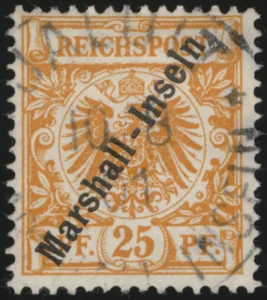
Stamps with a new overprint reading “Marshall-Inseln” were issued at the end of November 1899, and are listed in Michel as Mi. 7-12, and in Scott as Sc. 7-12. The new overprint corrected what was essentially a spelling mistake in the earlier overprints, involving the official name of the colony. From 1885 until 1892, the official spelling of the colony’s name was “Marschall-Inseln.” But by 1893, it was pointed out to the colonial office that the islands bore the name of a specific person, the previously named British sea captain John Marshall. The spelling of the colony’s name was changed by the Colonial Office in 1893 to reflect this. For whatever reason, the Reichspost did not use this spelling until the 1899 overprint issue was created. The Jaluit cancel device, which since 1889 had used the prior spelling, was also replaced by a second device with the correct spelling shortly thereafter in 1900.
Stamps from this issue consisted of all six denominations of the 1889 Crown/Eagle series, including the 25 Pf value. Since it still had no rate to pay, it saw little use. For this reason, particularly when used, the 25 Pf stamp (below) is the key value to the series even though it is not the high value of it.
Stamps with both spellings of overprint were replaced by stamps from the “Yacht” issue beginning in January 1901. As was the case in any colony where overprinted Crown/Eagle series stamps were issued, stamps with the overprint lost validity on 30 September 1901 – although unoverprinted stamps from this series were valid until the end of December 1901 in Germany proper. The colony would use the new c-less spelling until the end of German control in 1914.
Effects of the Spelling Change

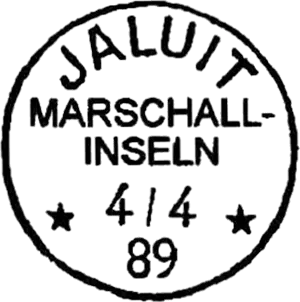
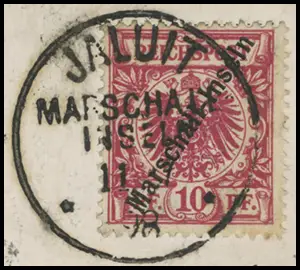
The change of spelling, though, does result in different values for used examples based on which cancel device was used. The first (“Type 1”) cancel device (top right), in use since 8 April 1889, was removed from service on 23 May 1900. A second (“Type 2”) device with the spelling corrected (bottom right) was placed in use on 21 May 1900, and remained in service until the end of German control.
These periods of use resulted in one cancel being more common on some issues but not on others. For example, catalogue values for the Jaluit Issue are generally two or three times higher if cancelled with the later Type 2 cancel device compared to the earlier Type 1 cancel. Conversely, postally used examples of the Berlin Issue are the opposite, with lower catalogue values for the cancel with the corrected spelling – although the differences in catalogue value are not so great.
With respect to the Marshall-Inseln overprint issue, only Mi. 7 b has a higher CV if cancelled with the Type 2 cancel. All the other stamps in this series, without exception, have noticeably lower values with the Type 2 cancel. In the case of Mi. 7 a / Sc. 7, which is the darker shade of the 3 Pf value, Michel values a used example with a Type 1 cancel at €500 – but just €6.50 with a Type 2 cancel.
The reasons for this should be obvious to most collectors. For the Jaluit Issue, the Type 1 cancel was the one in use at the time of issue, and most used stamps from this issue would have been already cancelled by the time the Type 2 canceller came into service. For the Marshall-Inseln issue, the Type 1 cancel was only in use for about 6 months after the stamps were issued before being replaced by the Type 2 cancel, which was in use for years thereafter.
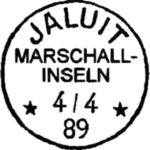

The change of spelling, though, does result in different values for used examples based on which cancel device was used. The first (“Type 1”) cancel device (below), in use since 8 April 1889, was removed from service on 23 May 1900.
A second (“Type 2”) device with the spelling corrected (below) was placed in use on 21 May 1900, and remained in service until the end of German control.

These periods of use resulted in one cancel being more common on some issues but not on others. For example, catalogue values for the Jaluit Issue are generally two or three times higher if cancelled with the later Type 2 cancel device compared to the earlier Type 1 cancel. Conversely, postally used examples of the Berlin Issue are the opposite, with lower catalogue values for the cancel with the corrected spelling – although the differences in catalogue value are not so great.
With respect to the Marshall-Inseln overprint issue, only Mi. 7 b has a higher CV if cancelled with the Type 2 cancel. All the other stamps in this series, without exception, have noticeably lower values with the Type 2 cancel. In the case of Mi. 7 a / Sc. 7, which is the darker shade of the 3 Pf value, Michel values a used example with a Type 1 cancel at €500 – but just €6.50 with a Type 2 cancel.
The reasons for this should be obvious to most collectors. For the Jaluit Issue, the Type 1 cancel was the one in use at the time of issue, and most used stamps from this issue would have been already cancelled by the time the Type 2 canceller came into service. For the Marshall-Inseln issue, the Type 1 cancel was only in use for about 6 months after the stamps were issued before being replaced by the Type 2 cancel, which was in use for years thereafter.
The Yacht Series

As was the case with other colonies, stamps from the Yacht series were placed on sale at the philatelic counter in Berlin in mid-December 1900. The “Small Yachts” (face values less than 1 Mark) were shipped to the colony first, arriving in January 1901, followed by the high value “Large Yachts” in March. From this point on, the postal issues of the Marshall Islands conform to those of any other small colony. In other words, the full series of Yacht stamps from 3 Pf to 5 M were available in the colony only on unwatermarked paper, with no stamps printed on watermarked paper being available for actual postal use prior to the First World War.
Also as was the case in other colonies, War Printings (Kriegsdruck) on paper watermarked with diamond lozenges (Michel Wz. 1, Scott Watermark 125) were created between 1916 and 1919 for the 3 Pf and 5 M values. The 3 Pf is inexpensive and has only one listed Michel variety. The 5 M value, though, has a total of four varieties some of which are noticeably more valuable than others.
Firstly, World War I happened to be the time period when the Reichspost was in the process of changing the way they perforated larger stamps. While the perforation gauge remained the same, all of the unwatermarked Large Yachts have 26 perforation holes across their longer edges, and 17 perforation holes on their shorter edges. The same is largely true for the Friedensdruck printings of such stamps on watermarked paper for those colonies that issued them.
Most of the Kriegsdruck printings of Large Yachts, in contrast, have 25 perforation holes along the longer edges instead of 26 holes. In the case of the Marshall Islands, only a small quantity of 5 M stamps were perforated to the “26 x 17” standard of peacetime.
Secondly, the 5 M stamp was the only one produced as a bicolor stamp. As such, it was necessary to print the frame and the vignette in separate print runs. Three varieties each of the frame and vignette were eventually created. In the context of the Marshall Islands, only the first two types apply. The combination of the Type I vignette and frame was intended to print the 5 M stamp for colonies with longer names, specifically for the Marshall Islands, German New Guinea, and German Southwest Africa. The other colonies had shorter names, for which additional folds in the scroll work across the top were added to the left and right of the colony name. This alteration required small “bites” to be removed from corresponding areas of the vignette, so that the two colors did not overlap each other when the stamp was printed. This combination is referred to as the “Type II” frame and vignette.
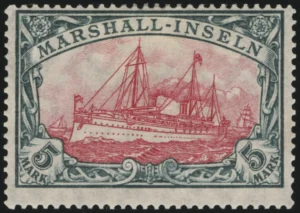
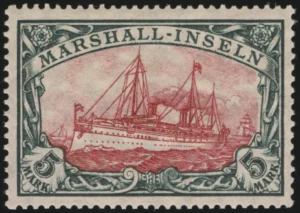
For Kriegsdruck printings of the Marshall Islands 5 M stamp, most examples were created from mismatched combinations of the Type I frame with the Type II vignette. This can be identified by additional white areas in the sky where the additional scrollwork would appear (top right). The correctly matched Type I frame and vignette (bottom right) always commands a higher price than the mismatched printings. An example of such a stamp which also has the pre-war style “26 x 17” perforations, the value of such a stamp rises to €3,000 compared to just €50 for a stamp with mismatched printing plates regardless of perforation type.
As was the case with other colonies, stamps from the Yacht series were placed on sale at the philatelic counter in Berlin in mid-December 1900. The “Small Yachts” (face values less than 1 Mark) were shipped to the colony first, arriving in January 1901, followed by the high value “Large Yachts” in March. From this point on, the postal issues of the Marshall Islands conform to those of any other small colony. In other words, the full series of Yacht stamps from 3 Pf to 5 M were available in the colony only on unwatermarked paper, with no stamps printed on watermarked paper being available for actual postal use prior to the First World War.
Also as was the case in other colonies, War Printings (Kriegsdruck) on paper watermarked with diamond lozenges (Michel Wz. 1, Scott Watermark 125) were created between 1916 and 1919 for the 3 Pf and 5 M values. The 3 Pf is inexpensive and has only one listed Michel variety. The 5 M value, though, has a total of four varieties some of which are noticeably more valuable than others.
Firstly, World War I happened to be the time period when the Reichspost was in the process of changing the way they perforated larger stamps. While the perforation gauge remained the same, all of the unwatermarked Large Yachts have 26 perforation holes across their longer edges, and 17 perforation holes on their shorter edges. The same is largely true for the Friedensdruck printings of such stamps on watermarked paper for those colonies that issued them.
Most of the Kriegsdruck printings of Large Yachts, in contrast, have 25 perforation holes along the longer edges instead of 26 holes. In the case of the Marshall Islands, only a small quantity of 5 M stamps were perforated to the “26 x 17” standard of peacetime.
Secondly, the 5 M stamp was the only one produced as a bicolor stamp. As such, it was necessary to print the frame and the vignette in separate print runs. Three varieties each of the frame and vignette were eventually created. In the context of the Marshall Islands, only the first two types apply. The combination of the Type I vignette and frame was intended to print the 5 M stamp for colonies with longer names, specifically for the Marshall Islands, German New Guinea, and German Southwest Africa. The other colonies had shorter names, for which additional folds in the scroll work across the top were added to the left and right of the colony name. This alteration required small “bites” to be removed from corresponding areas of the vignette, so that the two colors did not overlap each other when the stamp was printed. This combination is referred to as the “Type II” frame and vignette.
For Kriegsdruck printings of the Marshall Islands 5 M stamp, most examples were created from mismatched combinations of the Type I frame with the Type II vignette. This can be identified by additional white areas in the sky where the additional scrollwork would appear (below).
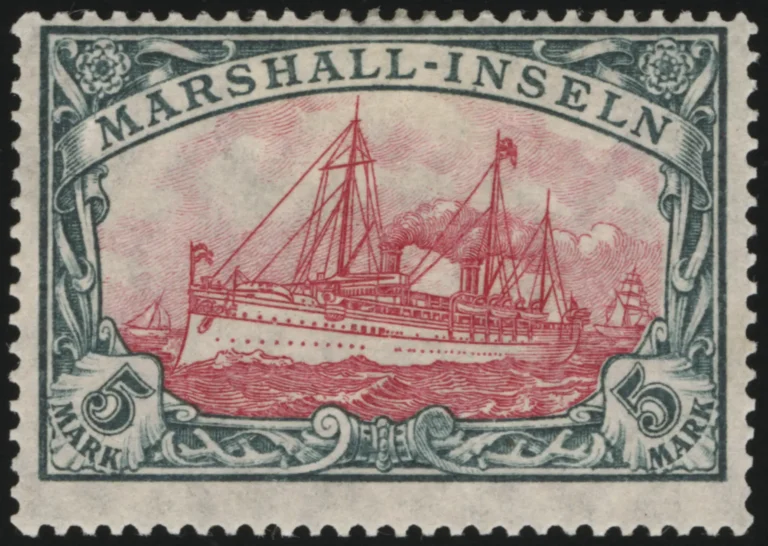
The correctly matched Type I frame and vignette (below) always commands a higher price than the mismatched printings.
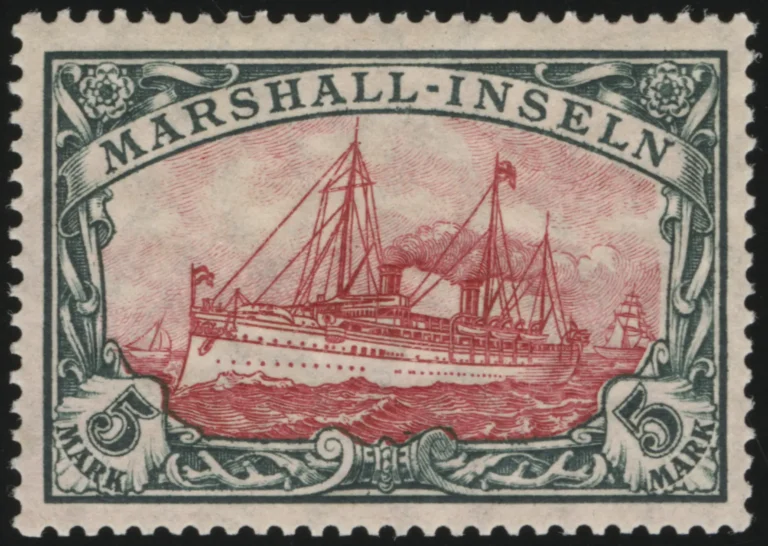
An example of such a stamp which also has the pre-war style “26 x 17” perforations, the value of such a stamp rises to €3,000 compared to just €50 for a stamp with mismatched printing plates regardless of perforation type.
Provisional Issues

As the Marshall Islands were one of the farthest flung colonies of the Empire, when postal problems arose, it could take a long time to remedy them. After all, since it took at least 40 days for a mailed article to transit the distance between Jaluit and the Fatherland – and a similar time for a reply – there were times when the Jaluit postmaster had to get creative. Two occasions come to mind in particular.
Michel 3 I H
In February 1900, all stocks of the 5 Pf stamp were exhausted. This value saw a lot of use, as it paid for the intra-Empire postcard rate as well as certain printed matter rates. To remedy the situation, the Jaluit postmaster used up his remaining stocks of Michel Mi. 3 I, the 10 Pf stamp with the overprint “Marschall-Inseln”, by vertically bisecting them to create new 5 Pf stamps (below). (Some 10 Pf stamps with the “Marshall-Inseln” stamp were also bisected in this manner.)
Although printed matter mailings could have been created with these bisected stamps, all legitimate uses currently known are on postcards dated between February and April 1900. Approximately 100 postcards are believed to have been mailed with bisected stamps in this period, cancelled with the Type 1 “Jaluit / Marschall-Inseln” cancel. Philatelic creations are also known with cancel type 2, dated in September 1901 and using bisected 10 Pf and 20 Pf stamps applied to envelopes.
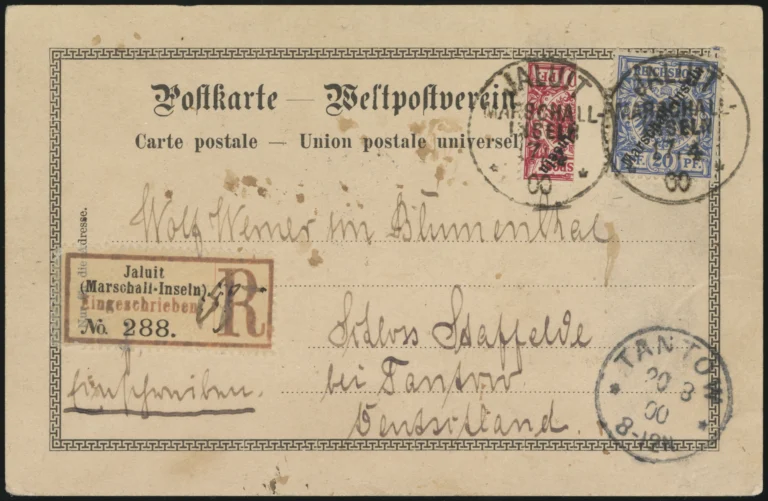
Although printed matter mailings could have been created with these bisected stamps, all legitimate uses currently known are on postcards dated between February and April 1900. Approximately 100 postcards are believed to have been mailed with bisected stamps in this period, cancelled with the Type 1 “Jaluit / Marschall-Inseln” cancel. Philatelic creations are also known with cancel type 2, dated in September 1901 and using bisected 10 Pf and 20 Pf stamps applied to envelopes.
In February 1900, all stocks of the 5 Pf stamp were exhausted. This value saw a lot of use, as it paid for the intra-Empire postcard rate as well as certain printed matter rates. To remedy the situation, the Jaluit postmaster used up his remaining stocks of Michel Mi. 3 I, the 10 Pf stamp with the overprint “Marschall-Inseln”, by vertically bisecting them to create new 5 Pf stamps (below). (Some 10 Pf stamps with the “Marshall-Inseln” stamp were also bisected in this manner.)
Although printed matter mailings could have been created with these bisected stamps, all legitimate uses currently known are on postcards dated between February and April 1900. Approximately 100 postcards are believed to have been mailed with bisected stamps in this period, cancelled with the Type 1 “Jaluit / Marschall-Inseln” cancel. Philatelic creations are also known with cancel type 2, dated in September 1901 and using bisected 10 Pf and 20 Pf stamps applied to envelopes.
Michel 9 H & 12 H
By early December 1900, stocks of the 5 Pf stamp were again exhausted. But this time, the 25 Pf stamp had also been sold out. To remedy this, the Jaluit postmaster bisected 10 Pf (below left) and 50 Pf stamps (below right) to make these values available, during the 8-day period from 2 December 1900 until 10 December 1900.
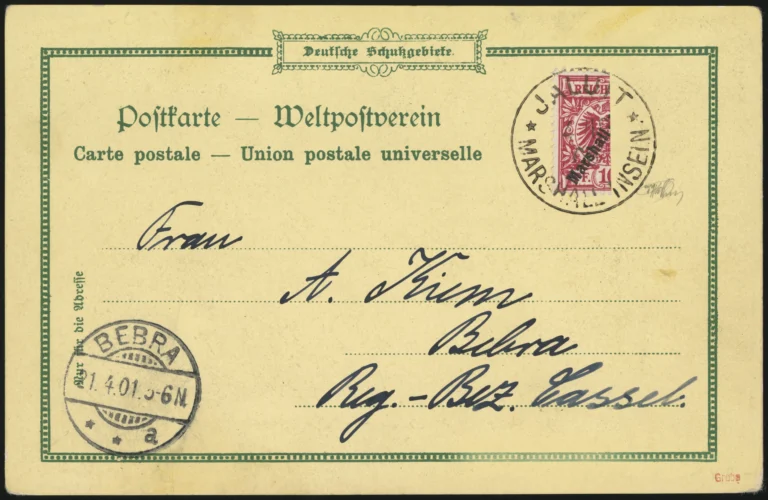
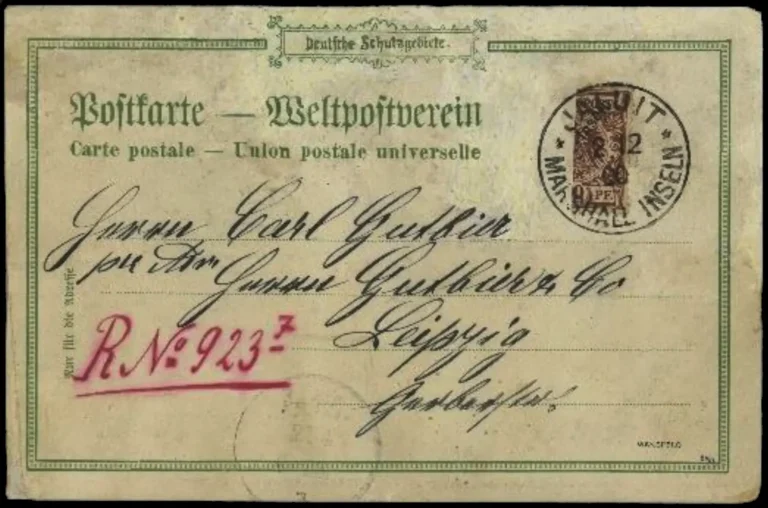
Listed in Michel as Mi. 9 H and Mi. 12 H, these stamps differed from the earlier bisected issues in several ways. Most importantly, stamps bisected in December 1900 were bisected both vertically and diagonally (following the line of the overprint), whereas the ones bisected earlier in 1900 were only bisected vertically.
All properly used examples from this period are for stamps on postcards or on cuttings from postcards. At the time, a 5 Pf stamp would have paid the intra-Empire postcard rate, while a 25 Pf stamp paid for such a postcard to be sent registered. Additional examples with a genuine Jaluit cancel dated 22 December 1900 and a genuine arrival cancel from Ponape are known, but are philatelic fantasies created by the postal staff of the respective colonies.
By early December 1900, stocks of the 5 Pf stamp were again exhausted. But this time, the 25 Pf stamp had also been sold out. To remedy this, the Jaluit postmaster bisected 10 Pf (below) and 50 Pf stamps (below) to make these values available, during the 8-day period from 2 December 1900 until 10 December 1900.
Although printed matter mailings could have been created with these bisected stamps, all legitimate uses currently known are on postcards dated between February and April 1900. Approximately 100 postcards are believed to have been mailed with bisected stamps in this period, cancelled with the Type 1 “Jaluit / Marschall-Inseln” cancel. Philatelic creations are also known with cancel type 2, dated in September 1901 and using bisected 10 Pf and 20 Pf stamps applied to envelopes.
Occupation

The end for the German Marshall Islands came abruptly. With such a small population spread out over a large area, the Germans were unable to put up much resistance to the Allies. By prior agreement, the military forces of the Japanese Empire were responsible for invading and for administering all of Germany’s colonies north of the Equator. The British, mostly through the actions of units from Australia and New Zealand, were responsible for the invasions of German colonies south of the Equator.
The Marshall Islands, however, were unique. While most of the German Marshall Islands lay north of the Equator, the island of Nauru lies one degree to the south of the Equator. or this reason, Nauru alone was mandated by the League of Nations to Australia while the rest of the islands were mandated to Japan.
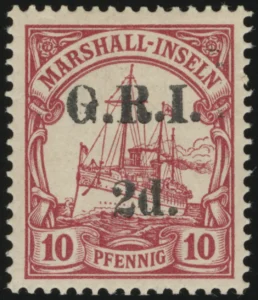
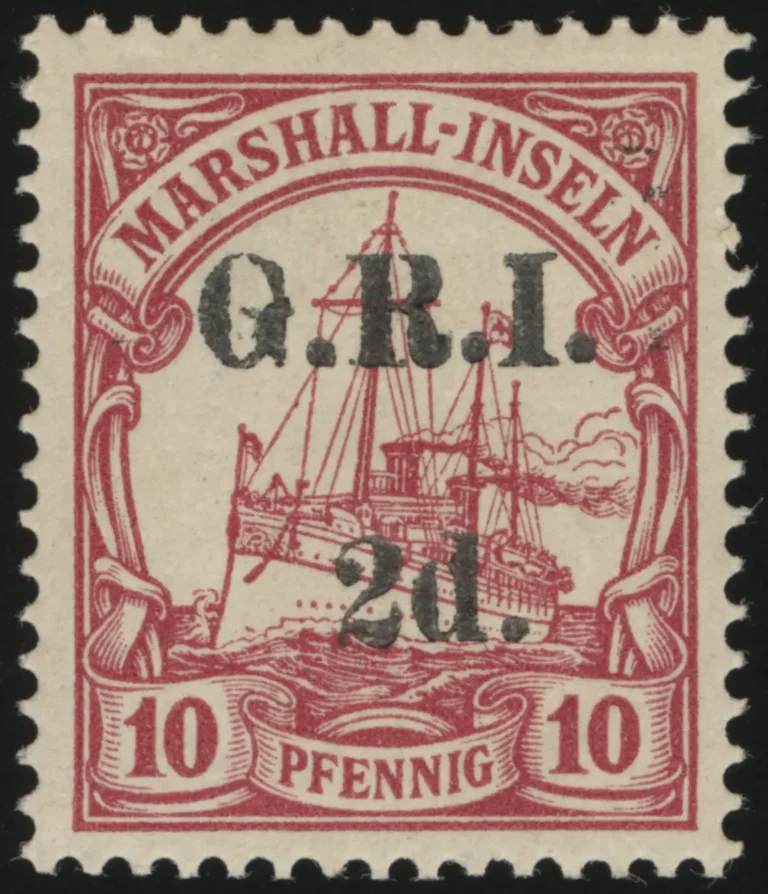
Although the Allies captured the Nauru post office and its stocks of stamps, these were never placed in use on Nauru. Although stamps of the Marshall Islands were overprinted “G.R.I.” and a new value in British currency (right), these stamps were actually used in the territory of the former German New Guinea.
On Nauru, by contrast, the Allies issued contemporary British stamps overprinted “NAURU”. These remained current until distinct Nauruan stamps were issued in 1923/1924. Nauru gained independence in 1968, and has continued to issue stamps to the present.
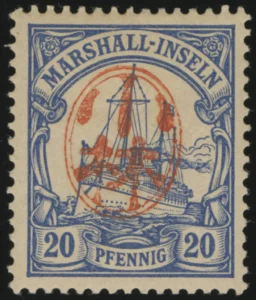
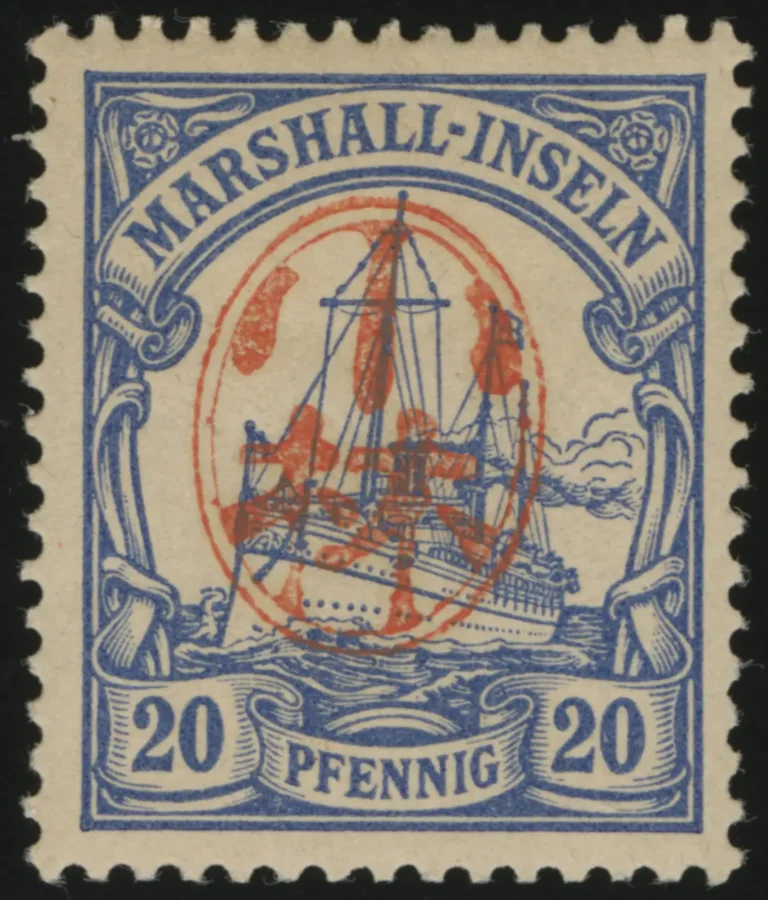
Although technically a League of Nations Mandate, Japan would end up essentially colonizing its portion of the Marshall Islands between 1920 and 1945. Japan quickly sent settlers to the islands, and incorporated them into the Empire as an outlying possession. Although some of the captured German colonial stamps from the Jaluit post office received a red, oval impression of an “inkan” or “personal seal” showing the family name of one of several officers attached to the Japanese occupation authorities (right), these were philatelic creations that were never valid postage during the Japanese occupation, as Japanese stamps were used throughout the former German colonies under Japanese control.
The end for the German Marshall Islands came abruptly. With such a small population spread out over a large area, the Germans were unable to put up much resistance to the Allies. By prior agreement, the military forces of the Japanese Empire were responsible for invading and for administering all of Germany’s colonies north of the Equator. The British, mostly through the actions of units from Australia and New Zealand, were responsible for the invasions of German colonies south of the Equator.
The Marshall Islands, however, were unique. While most of the German Marshall Islands lay north of the Equator, the island of Nauru lies one degree to the south of the Equator. or this reason, Nauru alone was mandated by the League of Nations to Australia while the rest of the islands were mandated to Japan.
Although the Allies captured the Nauru post office and its stocks of stamps, these were never placed in use on Nauru. Although stamps of the Marshall Islands were overprinted “G.R.I.” and a new value in British currency (below), these stamps were actually used in the territory of the former German New Guinea.
On Nauru, by contrast, the Allies issued contemporary British stamps overprinted “NAURU”. These remained current until distinct Nauruan stamps were issued in 1923/1924. Nauru gained independence in 1968, and has continued to issue stamps to the present.
Although technically a League of Nations Mandate, Japan would end up essentially colonizing its portion of the Marshall Islands between 1920 and 1945. Japan quickly sent settlers to the islands, and incorporated them into the Empire as an outlying possession. Although some of the captured German colonial stamps from the Jaluit post office received a red, oval impression of an “inkan” or “personal seal” showing the family name of one of several officers attached to the Japanese occupation authorities (below), these were philatelic creations that were never valid postage during the Japanese occupation, as Japanese stamps were used throughout the former German colonies under Japanese control.
Post Offices & Postmarks
Jaluit


The main post office at Jaluit was, for many years, the only one in the colony. It is one of the few colonial post offices for which several contemporary photos exist. The size of a small house perhaps 3 m by 3 m, the Jaluit office opened on 8 April 1889 and remained in operation until the army of Imperial Japan invaded in September 1914.
Two cancel devices were used at Jaluit (as shown above). The first was in use from 1889 until 23 May 1900, and indicates the name of the colony as “Marschall-Inseln” (right). The replacement cancel shows the corrected spelling of “Marshall-Inseln” and was used from 21 May 1900 until the end of German control.
The main post office at Jaluit was, for many years, the only one in the colony. It is one of the few colonial post offices for which several contemporary photos exist. The size of a small house perhaps 3 m by 3 m, the Jaluit office opened on 8 April 1889 and remained in operation until the army of Imperial Japan invaded in September 1914.
Two cancel devices were used at Jaluit (as shown above). The first was in use from 1889 until 23 May 1900, and indicates the name of the colony as “Marschall-Inseln” (below).
The replacement cancel shows the corrected spelling of “Marshall-Inseln” and was used from 21 May 1900 until the end of German control.
Nauru

Following the discovery of large quantities of phosphate compounds on Nauru in 1900, the German population jumped to 15, and this was enough to open a new post office.
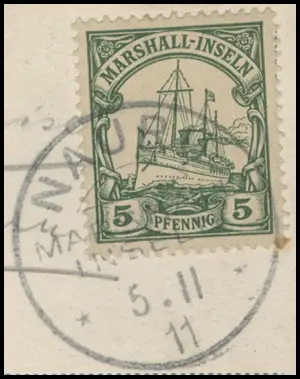
The cancellation device with the name “Nauru / Marshall-Inseln” (right) marked the official opening of the new office; the Atoll Post was functioning prior to this, however, and manuscript Nauru cancels are known with earlier dates.
Following the discovery of large quantities of phosphate compounds on Nauru in 1900, the German population jumped to 15, and this was enough to open a new post office.
The cancellation device with the name “Nauru / Marshall-Inseln” (below) marked the official opening of the new office; the Atoll Post was functioning prior to this, however, and manuscript Nauru cancels are known with earlier dates.
Atoll Post
The Atoll Post emerged as a postal service in 1902, following a decree from the colonial governor. The Marshall Islands were in a situation which did not (and still does not) lead to easily providing a postal service to residents. At the beginning of the 20th century, the majority of the indigenous population of about 15,000 did not need a lot of access to the postal service. The extent of the postal usage among the Marshallese would probably have consisted of communications addressed to the colonial government, of which examples are known. But as far as communications across distances, both within the colony and with the outer world, that would mostly have fallen to the colonists and anyone who came from outside the Marshall Islands.
The non-native population in question was enumerated in 1908, and consisted of the following residents who might conceivably have used the post more than the indigenous Marshallese: 13 Chinese nationals, 67 “Polynesians from other parts of Polynesia”, 89 persons described as “half-whites”, and 81 “Whites” for a total of 250 individuals. It should be noted that “White” in this case did not equate specifically to “German”; those members of this group included Reichspost agents of American, British, and Norwegian nationality who resided in the colony. Other nationalities were likely represented.
Of the 81 Whites, 49 resided on Jaluit to be near to the colonial government. Of the rest, fifteen (15) lived on Nauru, while the remaining seventeen (17) lived in groups of four or less on ten (10) different atolls in other parts of the colony. Those living on Jaluit never had any great difficulty accessing the post office. Once the Nauru post office opened in 1908, neither did those living on that island. Everyone else needed a little more assistance.
To this end, an Executive Order was issued by the Imperial Governor which authorized the “Atoll Post” effective 25 June 1902. This codified what had been a more informal arrangement in the prior years. Essentially, any ship captain who called on islands within the colony was required to accept certain types of mail and forward them to Jaluit. Ship captains who intended to travel via the outer islands after departing from Jaluit also had to carry mail out to them.
The mail that ship captains accepted was treated as follows: all mail had to have proper postage paid and stamps affixed to it. A manuscript cancellation was to be applied to the stamp consisting of the name of the ship and the date of acceptance. Items franked with more than one stamp could have the stamps cancelled with lines rather than the ship name and date. The captain was to give a receipt for any registered mail. All mail accepted by a ship captain was officially accepted into the postal system at Jaluit, where it was officially postmarked. (Once the Nauru office opened, atoll mail could be accepted there as well.)
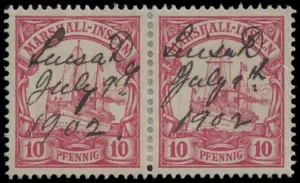
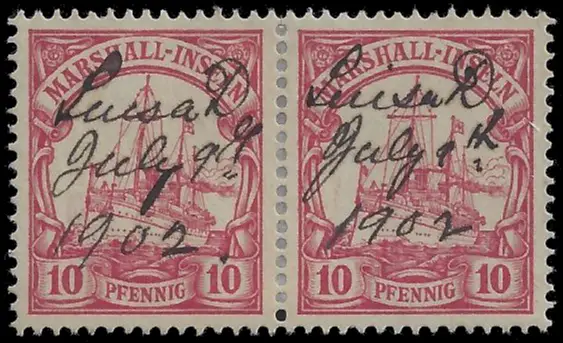
During the first year of operation, these manuscript cancels were not supposed to include the name of the atoll on which the item was posted – although examples exist – but rather the name of the ship and the date (right). The practice of indicating the island name did not begin officially until a further decree dated 16 June 1903, which appointed postal agents for each of the islands, who were then authorized to cancel stamps in the manner described above.
The “Atoll Post” serving the outer Marshall Islands would function for over three years before the philatelic press finally took notice of it in mid-1906. Due to the remoteness of the colony, philatelic creations did not begin to appear until early 1907, and it can be argued that the majority of covers dated from then until 1910 at the earliest did not serve any actual postal need. By 1910, though, the majority of German philatelists who wanted examples had obtained them, and these philatelic fantasies diminished. Genuine uses exist until the Germans lost control of the colony in 1914 during the First World War.
As is the case with other areas of German colonial philately, Atoll Post usages are categorized as one of five types.
The Atoll Post emerged as a postal service in 1902, following a decree from the colonial governor. The Marshall Islands were in a situation which did not (and still does not) lead to easily providing a postal service to residents. At the beginning of the 20th century, the majority of the indigenous population of about 15,000 did not need a lot of access to the postal service. The extent of the postal usage among the Marshallese would probably have consisted of communications addressed to the colonial government, of which examples are known. But as far as communications across distances, both within the colony and with the outer world, that would mostly have fallen to the colonists and anyone who came from outside the Marshall Islands.
The non-native population in question was enumerated in 1908, and consisted of the following residents who might conceivably have used the post more than the indigenous Marshallese: 13 Chinese nationals, 67 “Polynesians from other parts of Polynesia”, 89 persons described as “half-whites”, and 81 “Whites” for a total of 250 individuals. It should be noted that “White” in this case did not equate specifically to “German”; those members of this group included Reichspost agents of American, British, and Norwegian nationality who resided in the colony. Other nationalities were likely represented.
Of the 81 Whites, 49 resided on Jaluit to be near to the colonial government. Of the rest, fifteen (15) lived on Nauru, while the remaining seventeen (17) lived in groups of four or less on ten (10) different atolls in other parts of the colony. Those living on Jaluit never had any great difficulty accessing the post office. Once the Nauru post office opened in 1908, neither did those living on that island. Everyone else needed a little more assistance.
To this end, an Executive Order was issued by the Imperial Governor which authorized the “Atoll Post” effective 25 June 1902. This codified what had been a more informal arrangement in the prior years. Essentially, any ship captain who called on islands within the colony was required to accept certain types of mail and forward them to Jaluit. Ship captains who intended to travel via the outer islands after departing from Jaluit also had to carry mail out to them.
The mail that ship captains accepted was treated as follows: all mail had to have proper postage paid and stamps affixed to it. A manuscript cancellation was to be applied to the stamp consisting of the name of the ship and the date of acceptance. Items franked with more than one stamp could have the stamps cancelled with lines rather than the ship name and date. The captain was to give a receipt for any registered mail. All mail accepted by a ship captain was officially accepted into the postal system at Jaluit, where it was officially postmarked. (Once the Nauru office opened, atoll mail could be accepted there as well.)
During the first year of operation, these manuscript cancels were not supposed to include the name of the atoll on which the item was posted – although examples exist – but rather the name of the ship and the date (below).
The practice of indicating the island name did not begin officially until a further decree dated 16 June 1903, which appointed postal agents for each of the islands, who were then authorized to cancel stamps in the manner described above.
The “Atoll Post” serving the outer Marshall Islands would function for over three years before the philatelic press finally took notice of it in mid-1906. Due to the remoteness of the colony, philatelic creations did not begin to appear until early 1907, and it can be argued that the majority of covers dated from then until 1910 at the earliest did not serve any actual postal need. By 1910, though, the majority of German philatelists who wanted examples had obtained them, and these philatelic fantasies diminished. Genuine uses exist until the Germans lost control of the colony in 1914 during the First World War.
As is the case with other areas of German colonial philately, Atoll Post usages are categorized as one of five types.
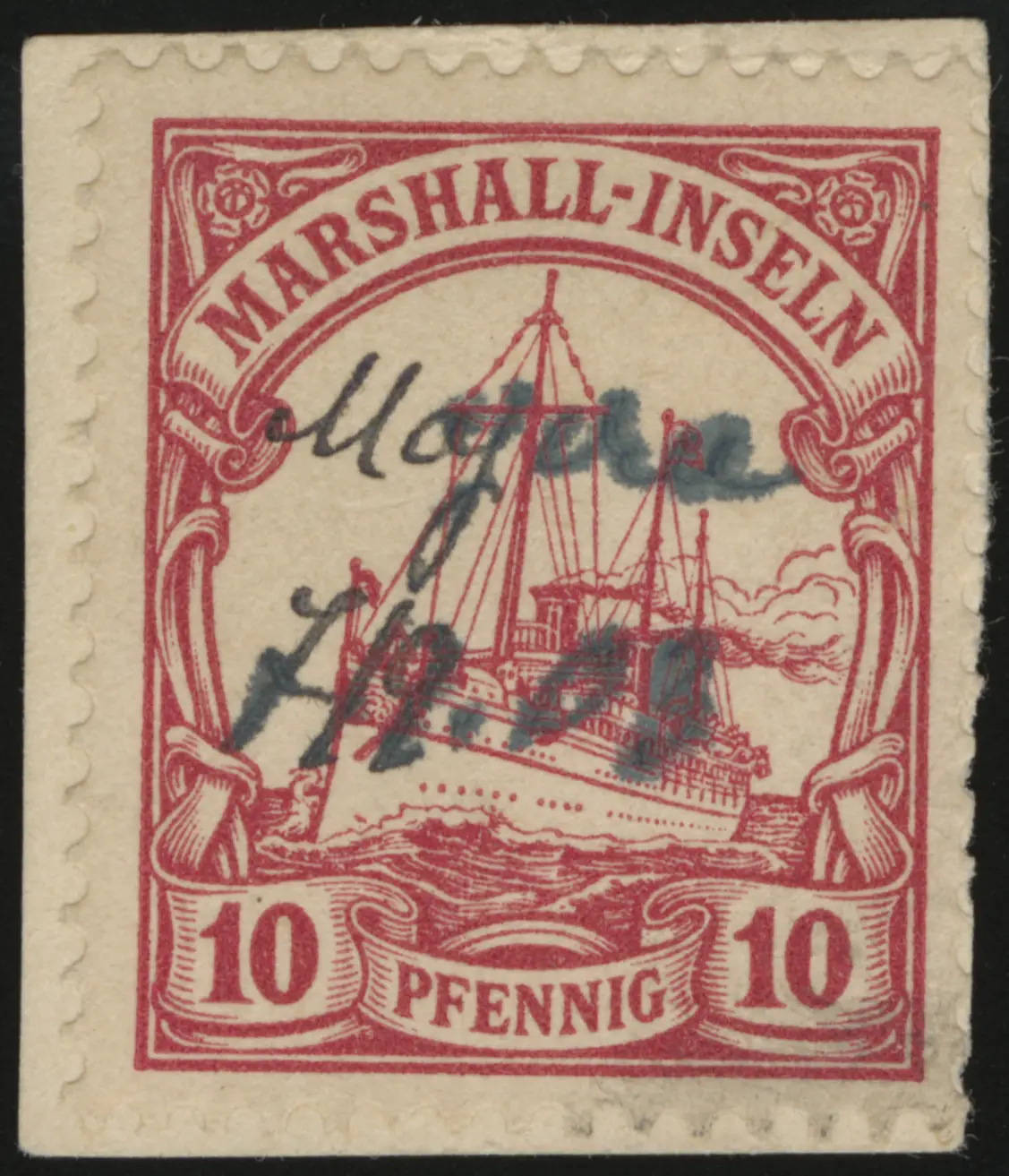
Sorte I / Type I
These are the “Bedarfs” usages or “Usage from Necessity.” Such covers were used in the course of some sort of genuine need for communication. Literature notes that such items are routinely franked with 5 Pf and 10 Pf stamps, and only occasionally with 20 Pf stamps. (Frankings involving 3 Pf stamps or any denomination above 20 Pf generally fall into one of the other types of covers.)
Bedarfs usage covers tend to be addressed to colonial officials, they are commercial covers of some kind, or they were sent to/from missionaries. Many were internal to the Marshall Islands, and includes communications between the Marshallese and the colonial government. While Bedarfs usages could occur any time between late June 1902 and September 1914, those dated between mid-1907 and 1910 are more typically one of the other, more philatelic types.
Sorte I / Bedarfs covers are generally considered the minority of all Atoll Post covers, and have much higher values as a result.
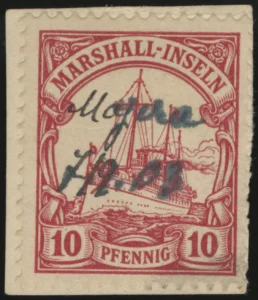
Sorte I / Type I
These are the “Bedarfs” usages or “Usage from Necessity.” Such covers were used in the course of some sort of genuine need for communication. Literature notes that such items are routinely franked with 5 Pf and 10 Pf stamps, and only occasionally with 20 Pf stamps. (Frankings involving 3 Pf stamps or any denomination above 20 Pf generally fall into one of the other types of covers.)
Bedarfs usage covers tend to be addressed to colonial officials, they are commercial covers of some kind, or they were sent to/from missionaries. Many were internal to the Marshall Islands, and includes communications between the Marshallese and the colonial government. While Bedarfs usages could occur any time between late June 1902 and September 1914, those dated between mid-1907 and 1910 are more typically one of the other, more philatelic types.
Sorte I / Bedarfs covers are generally considered the minority of all Atoll Post covers, and have much higher values as a result.
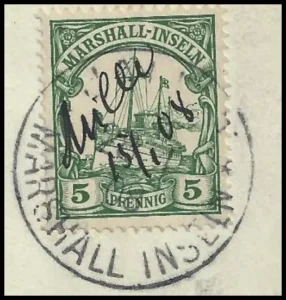
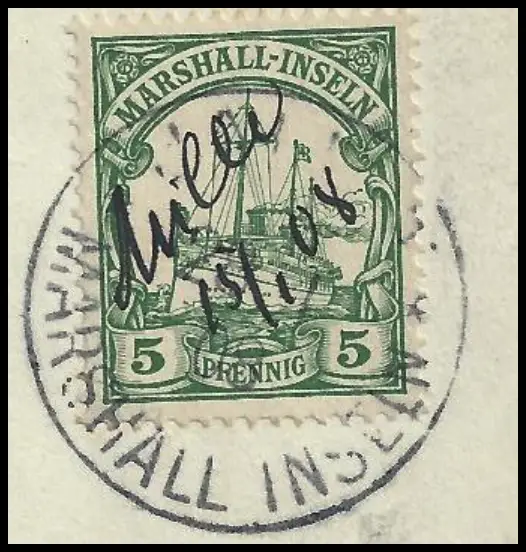
Sorte II / Type II
Covers of this sort are philatelic in nature, but were genuinely cancelled on the atoll and on the date noted in the cancel. This type of mailing was created when a collector sent a cover to someone on the atoll directly, or had someone they knew send a cover there to be cancelled.
Sorte II is further divided into five sections, labelled IIa-IIe, depending on whether the collector sent the cover him- or herself to the atoll or whether he/she had someone else do it for them, and whether the address of the collector is handwritten or is a rubber handstamp – but these covers were not connected to the “consortium” of cover creators listed under Sorte III.
Sorte II / Type II
Covers of this sort are philatelic in nature, but were genuinely cancelled on the atoll and on the date noted in the cancel. This type of mailing was created when a collector sent a cover to someone on the atoll directly, or had someone they knew send a cover there to be cancelled.
Sorte II is further divided into five sections, labelled IIa-IIe, depending on whether the collector sent the cover him- or herself to the atoll or whether he/she had someone else do it for them, and whether the address of the collector is handwritten or is a rubber handstamp – but these covers were not connected to the “consortium” of cover creators listed under “Sorte III”.
Sorte III / Type III
These covers were mass produced in 1908 and 1909 by one of five individuals who lived in the colony. These were Herr Domnick (the Jaluit postal agent), Frau Domnick, Captain Jeschke (captain of the Diana, a ship which is connected with many of the Sorte III covers), a woman known as “Fräulein E.H.”, and a Marshallese native named Likojur.
These individuals received orders for Atoll Post covers from dealers in Germany, and then filled them by making up quantities of envelopes and postcards addressed to themselves. These covers, however, did actually travel around the Marshall Islands unlike the Sorte IV or Sorte V covers.
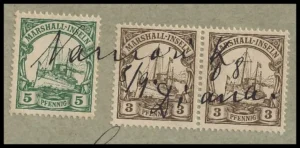
Sorte III / Type III
These covers were mass produced in 1908 and 1909 by one of five individuals who lived in the colony. These were Herr Domnick (the Jaluit postal agent), Frau Domnick, Captain Jeschke (captain of the Diana, a ship which is connected with many of the Sorte III covers), a woman known as “Fräulein E.H.”, and a Marshallese native named Likojur.
These individuals received orders for Atoll Post covers from dealers in Germany, and then filled them by making up quantities of envelopes and postcards addressed to themselves. These covers, however, did actually travel around the Marshall Islands unlike the Sorte IV or Sorte V covers.
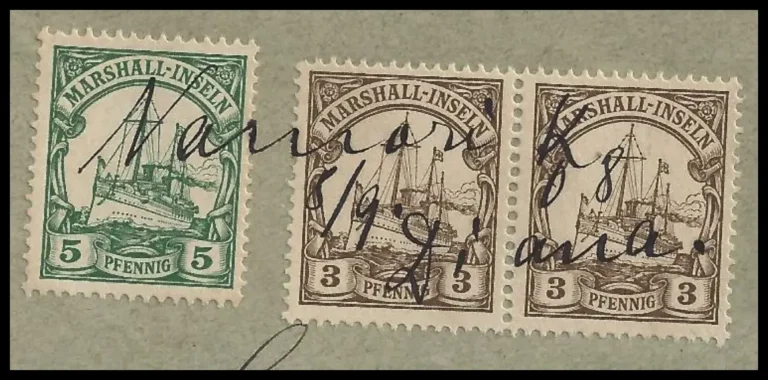
Sorte IV / Type IV
Covers of this type appear to be Atoll Post covers, but the cancels are not legitimate. These were typically created by ship captains who applied their manuscript cancels to the covers in Jaluit Harbor with an atoll name—but the cover never actually went there.
Sorte IV / Type IV
Covers of this type appear to be Atoll Post covers, but the cancels are not legitimate. These were typically created by ship captains who applied their manuscript cancels to the covers in Jaluit Harbor with an atoll name—but the cover never actually went there.
Sorte V / Type V
Sorte V covers are outright forgeries, made by people in Jaluit who had no authorization to apply manuscript cancels to stamps. Many of the covers connected in any way with “Fräulein E.H.” specifically fall into this category, but others are also known to have created them.
Knowing the handwriting of the various ship Captains and officials is critical to determining the difference between Sorte II to V.
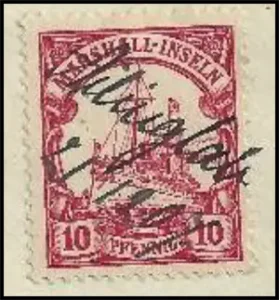
Sorte V / Type V
Sorte V covers are outright forgeries, made by people in Jaluit who had no authorization to apply manuscript cancels to stamps. Many of the covers connected in any way with “Fräulein E.H.” specifically fall into this category, but others are also known to have created them.
Knowing the handwriting of the various ship Captains and officials is critical to determining the difference between Sorte II to V.
Following the defeat of Japan in the Second World War, the Marshall Islands became one of six regions / states of a political entity called the “UN Trust Territory of the Pacific” which was overseen by the United States starting in 1947. Until distinctive Marshallese issues resumed in 1984, such stamps that were used were issues of the United States.Today, as in German times, the Marshall Islands has a post office on only one island. Unlike in German times, this post office is no longer on Jaluit. Instead, the island of Majuro has replaced Jaluit as the capital island, and is home to about half of the country’s population. Despite having its own stamps, the RMI postal service is for all practical purposes integrated into the US Postal Service. Mail to or from the Marshall Islands is essentially domestic mail and customers pay US domestic rates. The only difference is that US stamps have not been valid in the Marshall Islands since they began to issue their own stamps in 1984.
References
Friedemann, A. (1980). The Stamps and Cancels of the German Colonies and the German Post Offices Abroad, Section XI Marshall Islands. Translated by Alfred K. Walter. Wilmington, DE: German Colonies Collector Group.
Laup, W. (1987). The Atoll Posts or Manuscript Cancellations of the German Marshall Islands. Translated by David C. Robertson. Bedford, MA: Self-Published.
Michel Redaktion (ed.) (2025). Michel Germany Specialized Catalog 2025 (Part 1). Bobingen, Germany: Schwaneberger Verlag Gmbh.
Nössig, T. (ed.) (2019). Catalog of the Postmarks of the German Colonies & Post Offices Abroad (1st English ed). Berlin, Germany: Arbeitsgemeinschaft der Sammler deutscher Kolonialpostwertzeichen.
Illustrations courtesy of John Miller, Dave Robertson, Gannon Sugimura & Jed Dorman.