
Beginners Guide
Samoa
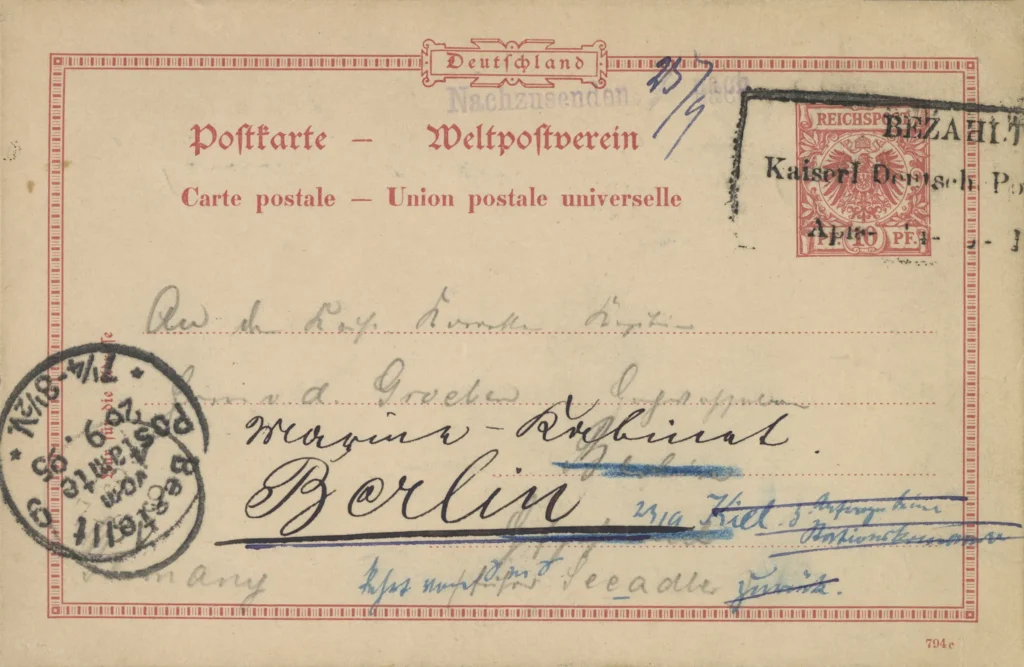
Postcard from Apia to Berlin, 14 August 1895
General

PO China
PO Morocco
PO Turkey
D-NG
D-OA

D-SWA

Kamerun

Karolinen

Kiautschou

Marianen

Marshall-In.
Samoa
Togo
Samoa
By Gannon Sugimura
Historical Background

Germany’s colonial empire can best be described as something of a race for the leftovers of whatever remained uncolonized. As it did not exist as a unified nation prior to 1871, Germany was not in a position to acquire colonial possessions in the same manner as the more unified European nations like Britain and France. Although German colonial establishments started to appear in 1884, other colonial powers had already been active for centuries.
By the time Germany came on to the scene, the best areas for colonization (from a European point of view) had already been taken. One of the areas of the world which had not been totally gobbled up already was the Pacific. This was true in part because the Pacific islands do not have anywhere near as much land area as the continents do, so there is less to take advantage of. It also cannot be discounted that distance is a factor; nowhere in the world is further away from Europe than Polynesia.
Even so, by the time that Germany wanted to establish a colony in Samoa, there was precious little of Polynesia left to colonize. With British colonization of New Zealand (1841) and Fiji (1874), French colonization of Tahiti (1888) and American colonization of Hawaii (1898), most of Polynesia was quickly being spoken for.
Having said this, Germans had had something of a presence in Samoa for quite some time before the colony was established, and even before the German Empire existed. As early as 1857, the Hamburg firm of Godeffroy & Sohn (later the DHPG, Deutsche Handels- und Plantagen-Gesellschaft der Sudsee-Inseln zu Hamburg) began operations in Samoa in 1857, and was producing copra for shipment to Europe by 1864. In 1861, the Free City of Hamburg opened a consulate in Samoa. Postal operations would take a few decades more, as a Postal Agency (i.e. a Post Office Abroad) was opened by Berlin in 1886.
The transition to a German colony began in earnest as the 19th century drew to a close. Prior to 1887, Samoa was a sort of kingdom in which the paramount chief had the title of “Malietoa.” Although usually translated as “King” in English, there is a very important difference between the two. While western monarchs of the time could be absolute rulers of their domains, the Malietoa was more accurately the most senior among a small group of chiefs who each ruled a specific portion of the country independent of the others. Keeping the title required not only ability, but also the support of those of similar rank. The titleholder could be overthrown, and the succession to the title was often accompanied by armed conflict if not civil war.
In early 1887, Germany was trying to assert her will in Samoa, but was being countered by the efforts of the British and the Americans. Into this mix jumped a representative from a most unusual corner. King Kalakaua of Hawaii was trying to form a “Polynesian Confederation” under his leadership, and sent his entire navy (one ship) to Samoa to propose a treaty of friendship to help create this. The incumbent Malietoa, Susuga Laupepa, eventually signed the treaty with Hawaii. Although the Hawaiians tried to gain the support of the rest of the Samoan nobility to make their treaty stick, they were unable to do so. Instead, the treaty with Hawaii led in part to the overthrow of Malietoa Laupepa, who was exiled in August 1887. The conflict between the various factions over the succession, each backed by a different Western power, would become known as the “Samoan Crisis” or the “First Samoan Civil War.”
The Crisis was put aside – temporarily – when a tropical cyclone (i.e. a hurricane) struck Apia on 15 March 1889. Ships from the three Western powers with interest in Samoa were docked in Apia Harbor at the time, and were warned by the locals that a cyclone was coming. The best approach would have been to go out to sea to try to ride out the storm in deeper water. None of the Western ships actually put out to sea, however, as none of them wanted to lose face by being the first to “flee”. As a result only one badly damaged British vessel managed to escape being sunk in the harbor by the cyclone; all of the German and American ships in Apia Harbor were destroyed or badly damaged. Shortly thereafter, the Western powers signed the Treaty of Berlin, which turned Samoa into a British / American / German condominium similar to the British / French arrangement in the New Hebrides decades later.
Locally, this meant that Malietoa Laupepa was restored to his position, and Samoan internal affairs were left largely untouched by the Western powers. Nearly ten years later in 1898, Malietoa Laupepa died. His passing touched off the Second Samoan Civil War, as pretenders to the title staked their claims. The power sharing structure of the Treaty of Berlin fell apart, leading to a new solution. The main Samoan islands of Upolu and Savaii, along with a few small islands closest to them were given to Germany, while the islands to the east of Upolu were annexed by the United States. These two territories would now be known as German Samoa and American Samoa. Britain completely withdrew from Samoa, in exchange for a German withdrawal from Tonga, where Germany and Britain had similar conflicting interests.
The Germans officially established a colonial administration in Samoa on 1 March 1900, the first day on which they also regarded the postal administration there as being a colonial operation rather than an office abroad. The Apia post office would eventually become the headquarters of the German postal operations in Samoa, although no other post office would open until November 1903. Now a colony, Samoa would also start to receive distinctive stamps from the Reichspost, and Berlin would also apply domestic German rates to Samoan mail, much as was the case in other German colonial possessions.
Vorläufer

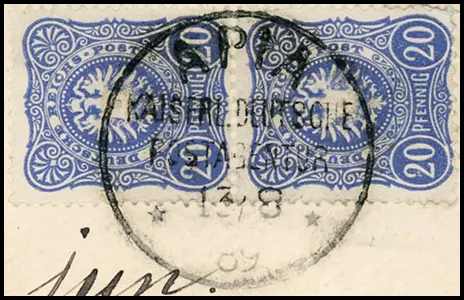
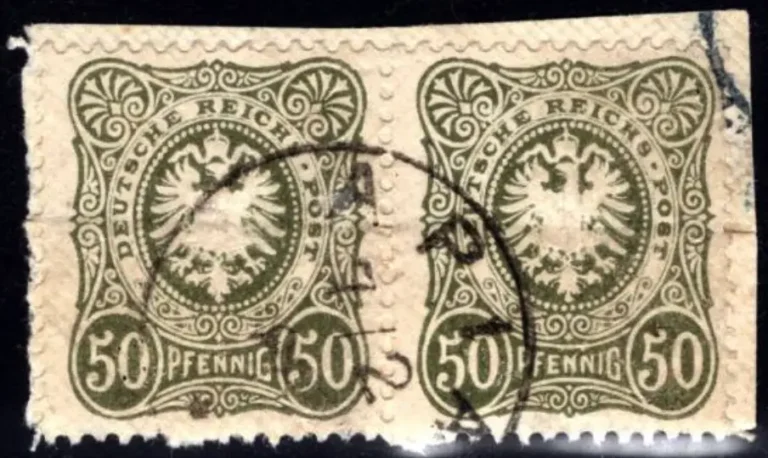
As was the case with most other German operations abroad, the earliest postal artifacts of German Samoa are forerunners identifiable only by cancel. Five (5) different Apia CDS type cancels from this period were applied to stamps of the German Empire from the definitive series of 1880 (right) and 1889, as well as to the 2 Mark “internal use” issue of 1875.
The forerunner period in Samoa lasted for nearly 14 years, until the first colonial issues of 1900. This ended up being longer than the forerunner period of any other German colony, and roughly equal to the forerunner period at the German Offices in Turkey.
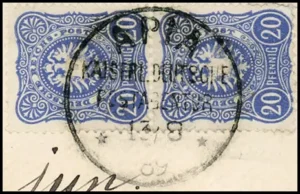
As was the case with most other German operations abroad, the earliest postal artifacts of German Samoa are forerunners identifiable only by cancel. Five (5) different Apia CDS type cancels from this period were applied to stamps of the German Empire from the definitive series of 1880 (below) and 1889, as well as to the 2 Mark “internal use” issue of 1875.
The forerunner period in Samoa lasted for nearly 14 years, until the first colonial issues of 1900. This ended up being longer than the forerunner period of any other German colony, and roughly equal to the forerunner period at the German Offices in Turkey.
Overprints

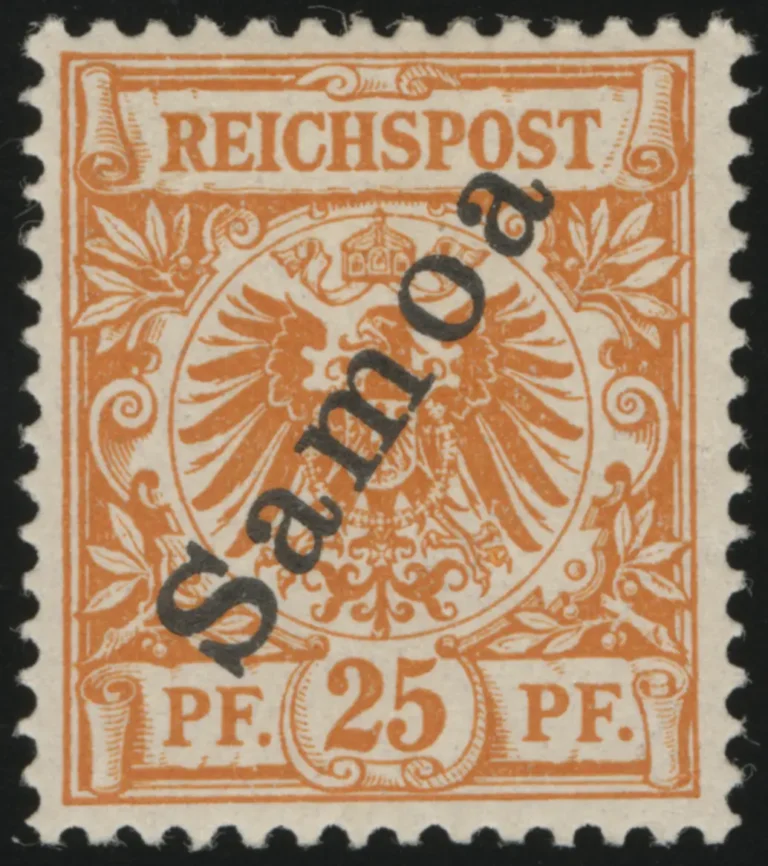
The first distinctively Samoan stamps in the German period were 1889 “Crown and Eagle” stamps overprinted diagonally with the word “SAMOA”.
Like its counterparts in other colonies, the “SAMOA” overprint stamps were valid until the end of September, 1901. But as the overprinted issues were issued on 17 May 1900 and the pfennig values of the “Yacht” series were received in December, the Samoa overprints had the shortest period of issue of any German colonial issue barring only provisional and emergency issues.
Also unlike other colonies like the Carolines and the Marianas, the “SAMOA” overprint exists at only one angle.
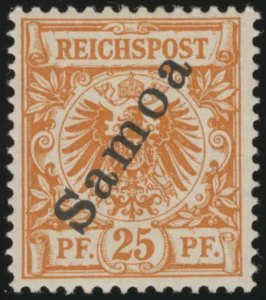
The first distinctively Samoan stamps in the German period were 1889 “Crown and Eagle” stamps overprinted diagonally with the word “SAMOA”.
Like its counterparts in other colonies, the “SAMOA” overprint stamps were valid until the end of September, 1901. But as the overprinted issues were issued on 17 May 1900 and the pfennig values of the “Yacht” series were received in December, the Samoa overprints had the shortest period of issue of any German colonial issue barring only provisional and emergency issues.
Also unlike other colonies like the Carolines and the Marianas, the “SAMOA” overprint exists at only one angle.
The Yacht Series

As was the case with other colonies, stamps from the Yacht series were issued for use in Samoa in December 1900. The “Small Yachts” (face values less than 1 Mark) were shipped to the colony first, arriving in early December 1900, followed by the high value “Large Yachts” in January 1901. The full series of Yacht stamps from 3 Pf to 5 M were available in the colony only on unwatermarked paper, with no stamps printed on watermarked paper being available for actual postal use prior to the First World War.
Also as was the case in other colonies, War Printings (Kriegsdruck) on paper watermarked with diamond lozenges (Michel Wz. 1, Scott Watermark 125) were created between 1915 and 1919 for the 3 Pf, 5 Pf, 10 Pf, and 5 M values. These were never used in the colony, and were only available for sale in Berlin. The Pf values are inexpensive and have only one listed Michel variety each. The 5 M value, though, has a total of three varieties.
World War I happened to be the time period when the Reichspost was in the process of changing the way they perforated larger stamps. While the perforation gauge remained the same, all of the unwatermarked Large Yachts have 26 perforation holes across their longer edges, and 17 perforation holes on their shorter edges. The same is largely true for the Friedensdruck printings of such stamps on watermarked paper for those colonies that issued them.
With regard to the Samoa 5 M watermarked issues, the Friedensdruck 5 M stamps, with 26×17 perforations (top right), are the highest-valued. The two Kriegsdruck 5 M issues – one with 26×17 and one with 25×17 perforations (bottom right) – are more common.
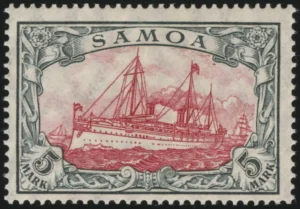
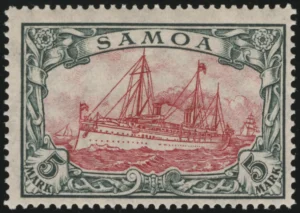
As was the case with other colonies, stamps from the Yacht series were issued for use in Samoa in December 1900. The “Small Yachts” (face values less than 1 Mark) were shipped to the colony first, arriving in early December 1900, followed by the high value “Large Yachts” in January 1901. The full series of Yacht stamps from 3 Pf to 5 M were available in the colony only on unwatermarked paper, with no stamps printed on watermarked paper being available for actual postal use prior to the First World War.
Also as was the case in other colonies, War Printings (Kriegsdruck) on paper watermarked with diamond lozenges (Michel Wz. 1, Scott Watermark 125) were created between 1915 and 1919 for the 3 Pf, 5 Pf, 10 Pf, and 5 M values. These were never used in the colony, and were only available for sale in Berlin. The Pf values are inexpensive and have only one listed Michel variety each. The 5 M value, though, has a total of three varieties.
World War I happened to be the time period when the Reichspost was in the process of changing the way they perforated larger stamps. While the perforation gauge remained the same, all of the unwatermarked Large Yachts have 26 perforation holes across their longer edges, and 17 perforation holes on their shorter edges. The same is largely true for the Friedensdruck printings of such stamps on watermarked paper for those colonies that issued them.
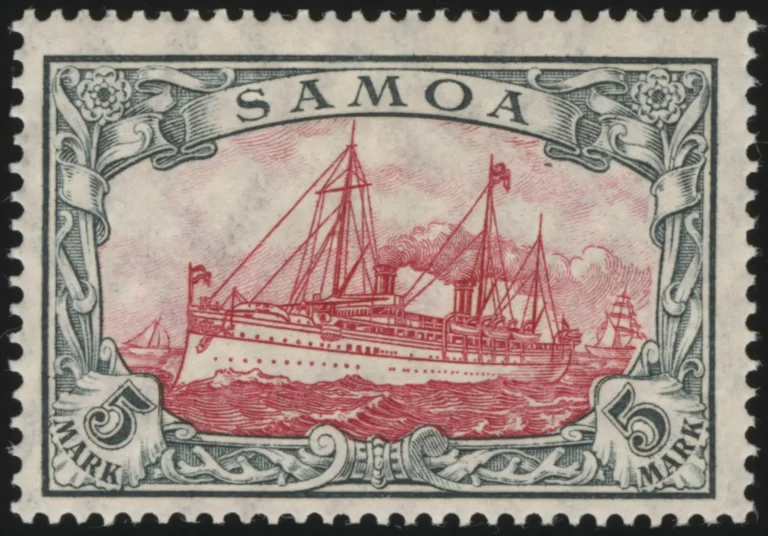
With regard to the Samoa 5 M watermarked issues, the Friedensdruck 5 M stamps, with 26×17 perforations (below), are the highest-valued.
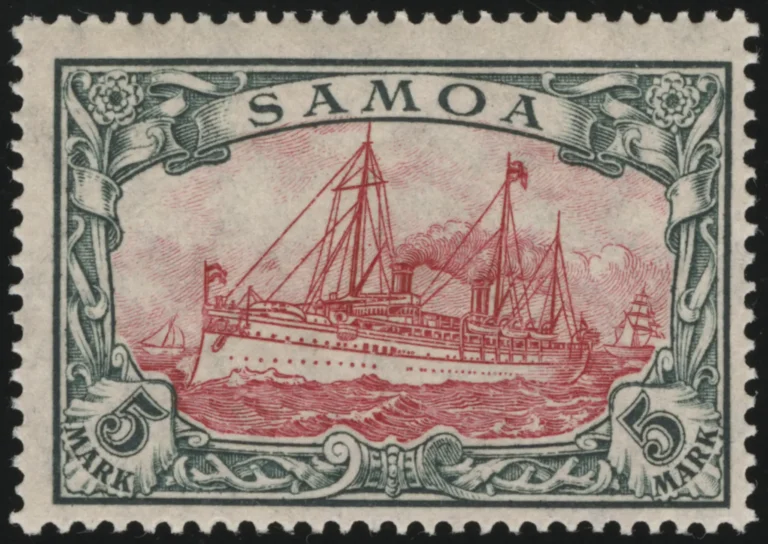
The two Kriegsdruck 5 M issues – one with 26×17 and one with 25×17 perforations (below) – are more common.
Occupation

German Samoa bounced out of the First World War with some haste. On 29 August 1914 – 25 days after the official start of the war – Allied troops from New Zealand landed at Apia and took over control of Samoa. At that point, Germany had no military stationed in Samoa other than the local police force, numbering about 100 men, which was unable to provide any real resistance to the approximately 1,400 British and New Zealand troops. Two German cruisers, SMS Scharnhorst and SMS Gneisenau, arrived in Samoan waters in mid-September, but despite the departure of the Allied ships a few days prior, no attempt was made to retake Apia. Exactly why is unclear. These two ships would later take part in the German bombardment of French installations at Papeete, Tahiti, which caused a great deal of damage to that city.
Unlike other German colonies, where individual post offices have end dates depending on when the towns they were in fell to the Allies, the end of the German post office in Samoa happened all at once on 29 August 1914. All mail in Samoa was routed through Apia, so once Apia fell to the Allies, the German post office was essentially dead. While postal traffic within Samoa could have theoretically happened on an intra-island basis between points that did not involve transiting Apia, any such traffic was negligible to the point of non-existence prior to the British assuming control of postal affairs.
Additionally, collectors of cancels with “war dates” (“Weltkriegsdatum”) must hunt long and hard to find any such examples. Such dates are limited to the 25 days between 4 August and 29 August 1914. Only Togo, which fell three days prior on 26 August, had a shorter war date period than Samoa.
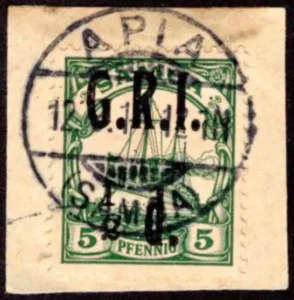
German control of Samoa would never resume. Once British control had started, the German postal issues and cancel devices found a new life. The British overprinted German Samoa stamps with the letters “G.R.I.” and new face values in British currency (right). These were issued in 1914 for provisional use, to be quickly replaced by New Zealand issues overprinted “SAMOA” or “WESTERN SAMOA.” An independent country since 1962, Samoa continues to issue stamps for those interested in collecting new issues.
German Samoa bounced out of the First World War with some haste. On 29 August 1914 – 25 days after the official start of the war – Allied troops from New Zealand landed at Apia and took over control of Samoa. At that point, Germany had no military stationed in Samoa other than the local police force, numbering about 100 men, which was unable to provide any real resistance to the approximately 1,400 British and New Zealand troops. Two German cruisers, SMS Scharnhorst and SMS Gneisenau, arrived in Samoan waters in mid-September, but despite the departure of the Allied ships a few days prior, no attempt was made to retake Apia. Exactly why is unclear. These two ships would later take part in the German bombardment of French installations at Papeete, Tahiti, which caused a great deal of damage to that city.
Unlike other German colonies, where individual post offices have end dates depending on when the towns they were in fell to the Allies, the end of the German post office in Samoa happened all at once on 29 August 1914. All mail in Samoa was routed through Apia, so once Apia fell to the Allies, the German post office was essentially dead. While postal traffic within Samoa could have theoretically happened on an intra-island basis between points that did not involve transiting Apia, any such traffic was negligible to the point of non-existence prior to the British assuming control of postal affairs.
Additionally, collectors of cancels with “war dates” (“Weltkriegsdatum”) must hunt long and hard to find any such examples. Such dates are limited to the 25 days between 4 August and 29 August 1914. Only Togo, which fell three days prior on 26 August, had a shorter war date period than Samoa.
German control of Samoa would never resume. Once British control had started, the German postal issues and cancel devices found a new life. The British overprinted German Samoa stamps with the letters “G.R.I.” and new face values in British currency (below).
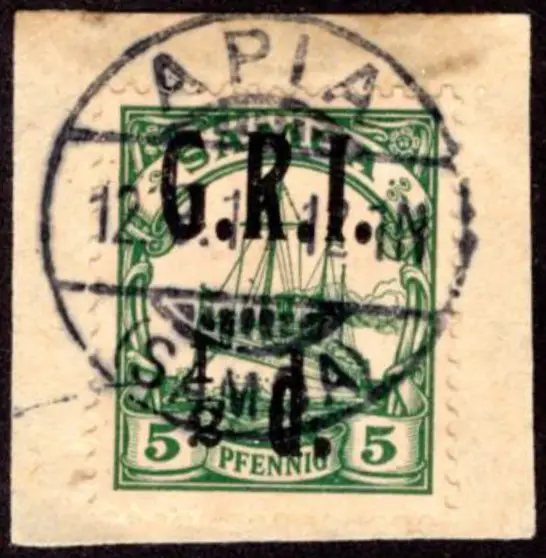
These were issued in 1914 for provisional use, to be quickly replaced by New Zealand issues overprinted “SAMOA” or “WESTERN SAMOA.” An independent country since 1962, Samoa continues to issue stamps for those interested in collecting new issues.
Post Offices & Postmarks
For collectors of town cancels, it appears at first that completion would be easy to achieve. Excluding Apia, there are just seven other towns in Samoa that had post offices – Aleipata, Fagamalo, Malua, Mulifanua, Palauli, Salelavalu, and Salailua.
Although it would seem that such a short list would provide completeness very quickly, that is just not the case. The vast majority of all used stamps were cancelled at Apia, since the German settlers tended to congregate there. Collectors can search through hundreds or even thousands of used stamps before finding any stamps cancelled anywhere else.
So many Apia cancelled stamps exist that the ArGe catalogue lists a value for stamps cancelled with either of the two Swiss-style Apia cancels at just €3 – the only cancels listed in the catalogue with values lower than €5.
Conversely, the cancels from the Samoan post offices outside of Apia all have much higher values due to their scarcity. Several have on-cover ArGe values in the €650 – €1500 range, which is notably higher than most such values. This is largely due to the fact that the vast majority of non-Samoans lived in Apia. Additionally, most of the other post offices opened in towns which might have had economic significance but not a large population that would need postal services.
Samoa would gain the distinction of being one of two colonies that were economically self-sufficient. Along with Togo, Samoa would eventually no longer need monies from the Imperial treasury to stay afloat. All the others required regular infusions of cash from Berlin for the entirety of their existence. As the economy of German Samoa was largely based on agriculture, many of the post offices outside Apia would serve plantation towns which were large in area but not in population. Even today, the largest of the towns that had German post offices have no more than 1,000 residents; several have in the range of 300-400 residents or fewer.
Apia


The first postal agent in Samoa, operating as a “Postal Steam Ship Agency” (Postdampfschiffsagentur), (below) began operations at Apia in September 1886.
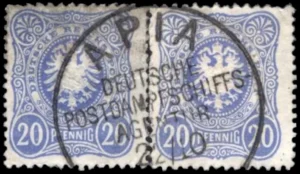
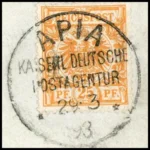
This office would later transition to an “Imperial German Postal Agency” (Kaiserlich Deutsche Postagentur) in late 1887 / early 1888, a designation already applied to Reichspost offices in Turkey and China by that date, and most cancel devices in use until 1900 would all include wording “Kaiserl. Deutsche Postagentur” (right) to show that the office was run as a German Imperial Postal Agency. As was the case in those other countries, the post office initially operated out of the local German consulate. Thus, even if Germany had not colonized Samoa, Germany would likely still have operated a foreign office there until the advent of the First World War as it did in China, Morocco, and Turkey.
During the period of the Samoan Crisis, Apia used the canceller shown below.
This cancel is one of the shortest lived cancel devices used in the German colonial empire other than the Wanderstempel of German South West Africa. This Apia cancel was in use only between 12 December 1887 and the middle of May 1888. The primary reason was probably the appearance of the cancel. Literature records that the Reichspost determined in February of 1888 that this cancel was not distinctive enough considering that there was another Apia post office run in the name of the Kingdom of Samoa and with connections to foreign powers (primarily the British.)
Additionally, the appearance of this cancel – a single rim cancel with the name of the town at the top, the date in the middle, and a single star at the bottom – probably would have caused some difficulty with the other foreign powers in conflict over the future of Samoa. During this period, this type of cancel was used only in areas firmly under German control, i.e. only in other German colonies and at the German post office in Shanghai. While such a detail seems trivial today, it was far from trivial at the time. In the late 19th century, stamps were used to communicate a lot of information besides postage rates. The placement, location, and angle of a stamp affixed to an envelope could be used to convey subtle messages like “when will you write to me” or “I love you.” Stamps also announced changes of government or the formation of a colony. The appearance of a cancel used in Samoa that was identical to those from at least one town in every existing German colony of the time would not have gone unnoticed. Retiring this cancel had the added effect of not leaving Germany open to charges of having annexed Samoa while other powers tried to press their claims.
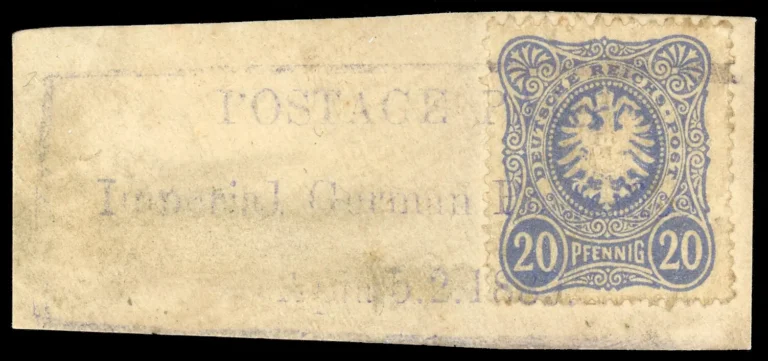
During the forerunner period, Apia used a postal marking unique in German colonial philately – namely one inscribed in English. For a two month period, between 1 February and 27 March 1889, the Apia post office is known to have applied a boxed postmark (below) reading “POSTAGE PAID / Imperial German Post Office / Apia (date)”, used on mail sent to English speaking countries.
It was used concurrently with an equivalent mark inscribed “BEZAHLT / Kaiserl. Deutsche Postagentur / Apia – (date)” (below) for mail sent to Germany.
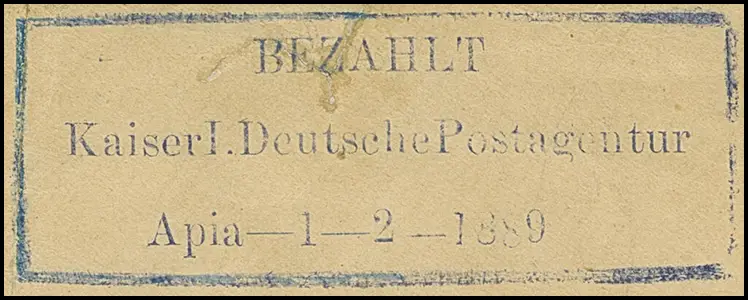
The reason these marks came into use is fairly simple. The post office had no other option! As was often the case in this era, fire was a constant threat to Western buildings in particular. On 8 January 1889, a fire burned down the German Consulate in which the postal agency was housed, destroying all of the postal agency’s stamps and postal equipment. These two postal markings were made locally and used until a new cancel device was received from Germany on 31 March. Specialist collectors should note that stamped mail would still have been possible during February and March of 1889, and the boxed Bezahlt markings can be found on stamps. Stamps previously sold to the public were still valid and were used during this period.
These marks made a reappearance between April and September of 1895. On April Fool’s Day 1895, fire threatened to destroy the consulate again. This time, the post office was mostly evacuated in time to prevent the stamps going up in flames, but the cancel device was permanently lost in the process of evacuating the post office. The German language BEZAHLT mark was placed in use again until a new cancel was received from Germany in September.
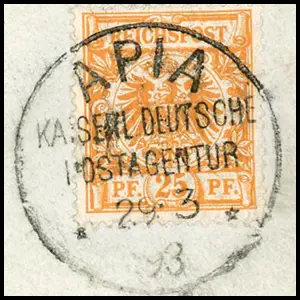
The canceller sent to replace the one lost on the fire was similar in appearance, but can be easily distinguished as the pre-fire 1895 cancel (below left) lacks the “segment” under the word “APIA” while the one used from September 1895 has such a segment (below right).
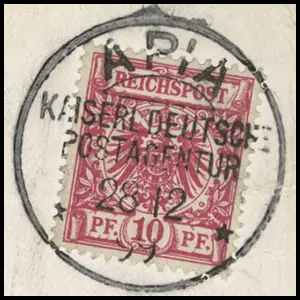
Upon the formal elevation of German Samoa to the status of a colony, the Apia post office would replace its postal agency (Kaiserlich Deutsche Postagentur) cancel with a cancel removing that designation.
When the first of the “Yacht” series stamps arrived in Samoa on 10 December 1900, a new “Swiss style” cancel device which lacked the reference to the KD Postagentur was brought with them. When the ship departed again on the 14th of December, it took the old postal agency cancel device back to Germany. In essence, there was a period of barely four days when both cancel devices were at the Apia post office simultaneously.
Finding impressions of the Swiss cancel on overprinted stamps is relatively easy, as those stamps were still valid for nearly a year after the cancel device arrived in Samoa. But finding examples of the Yacht stamps cancelled with the Postal Agency cancel is extremely difficult as it was only possible for a few days. As Michel routinely states, “expertization is recommended!”
Such was the volume of mail at the Apia post office that the first Swiss canceller had to be replaced in June of 1907 due to wear. The first cancel (below left) is clearly distinguishable as the letters in “APIA” are in a sans-serif font known in German as “Groteskschrift” or “Blockschrift”. A similar cancel put into service in June 1907 shows “APIA” in a serifed font called “Antiquaschrift” (below right).
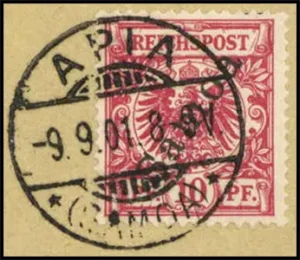
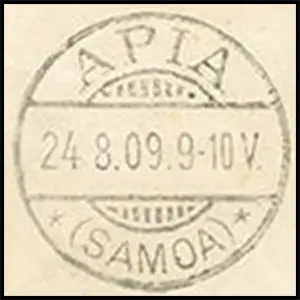
Even though the Blockschrift cancel was retired from daily use in 1907, the cancel device itself was kept in reserve and used on occasion until 1914. For post-June 1907 strikes, though, the sans-serif cancel was altered in one notable way. As can be seen, there are stars on either side of “(SAMOA)” in the cancel as used prior to 1907. Once the new Antiquaschrift cancel was put in use, the stars were removed from the old cancel.
The first postal agent in Samoa, operating as a “Postal Steam Ship Agency” (Postdampfschiffsagentur), (below) began operations at Apia in September 1886.
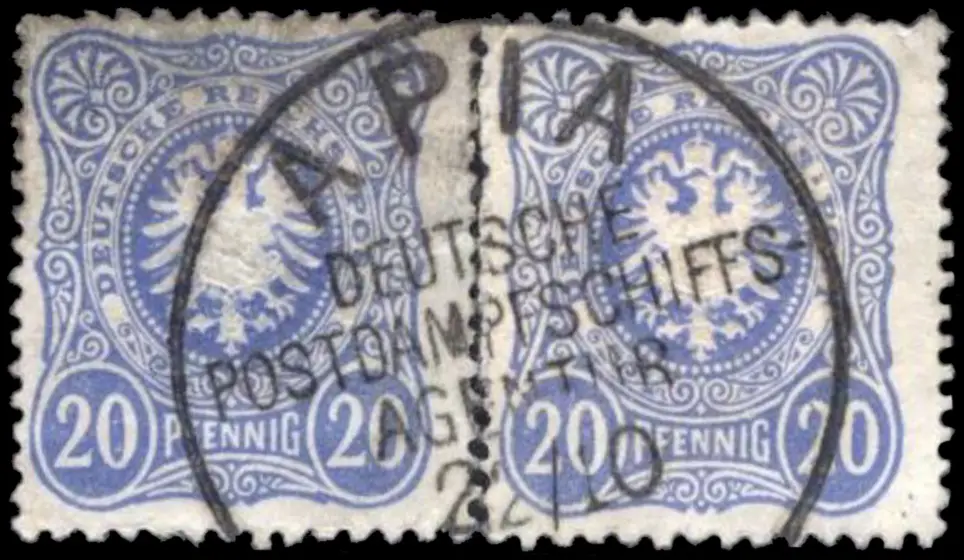
This office would later transition to an “Imperial German Postal Agency” (Kaiserlich Deutsche Postagentur) in late 1887 / early 1888, a designation already applied to Reichspost offices in Turkey and China by that date, and most cancel devices in use until 1900 would all include wording “Kaiserl. Deutsche Postagentur” (below) to show that the office was run as a German Imperial Postal Agency.
As was the case in those other countries, the post office initially operated out of the local German consulate. Thus, even if Germany had not colonized Samoa, Germany would likely still have operated a foreign office there until the advent of the First World War as it did in China, Morocco, and Turkey.
During the period of the Samoan Crisis, Apia used the canceller shown below.
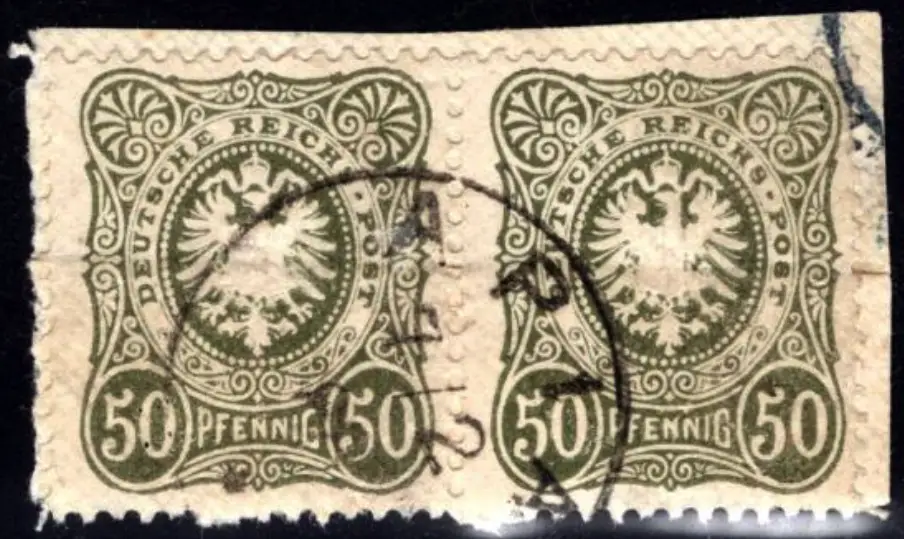
This cancel is one of the shortest lived cancel devices used in the German colonial empire other than the Wanderstempel of German South West Africa. This Apia cancel was in use only between 12 December 1887 and the middle of May 1888. The primary reason was probably the appearance of the cancel. Literature records that the Reichspost determined in February of 1888 that this cancel was not distinctive enough considering that there was another Apia post office run in the name of the Kingdom of Samoa and with connections to foreign powers (primarily the British.)
Additionally, the appearance of this cancel – a single rim cancel with the name of the town at the top, the date in the middle, and a single star at the bottom – probably would have caused some difficulty with the other foreign powers in conflict over the future of Samoa. During this period, this type of cancel was used only in areas firmly under German control, i.e. only in other German colonies and at the German post office in Shanghai. While such a detail seems trivial today, it was far from trivial at the time. In the late 19th century, stamps were used to communicate a lot of information besides postage rates. The placement, location, and angle of a stamp affixed to an envelope could be used to convey subtle messages like “when will you write to me” or “I love you.” Stamps also announced changes of government or the formation of a colony. The appearance of a cancel used in Samoa that was identical to those from at least one town in every existing German colony of the time would not have gone unnoticed. Retiring this cancel had the added effect of not leaving Germany open to charges of having annexed Samoa while other powers tried to press their claims.
During the forerunner period, Apia used a postal marking unique in German colonial philately – namely one inscribed in English. For a two month period, between 1 February and 27 March 1889, the Apia post office is known to have applied a boxed postmark (below) reading “POSTAGE PAID / Imperial German Post Office / Apia (date)”, used on mail sent to English speaking countries.
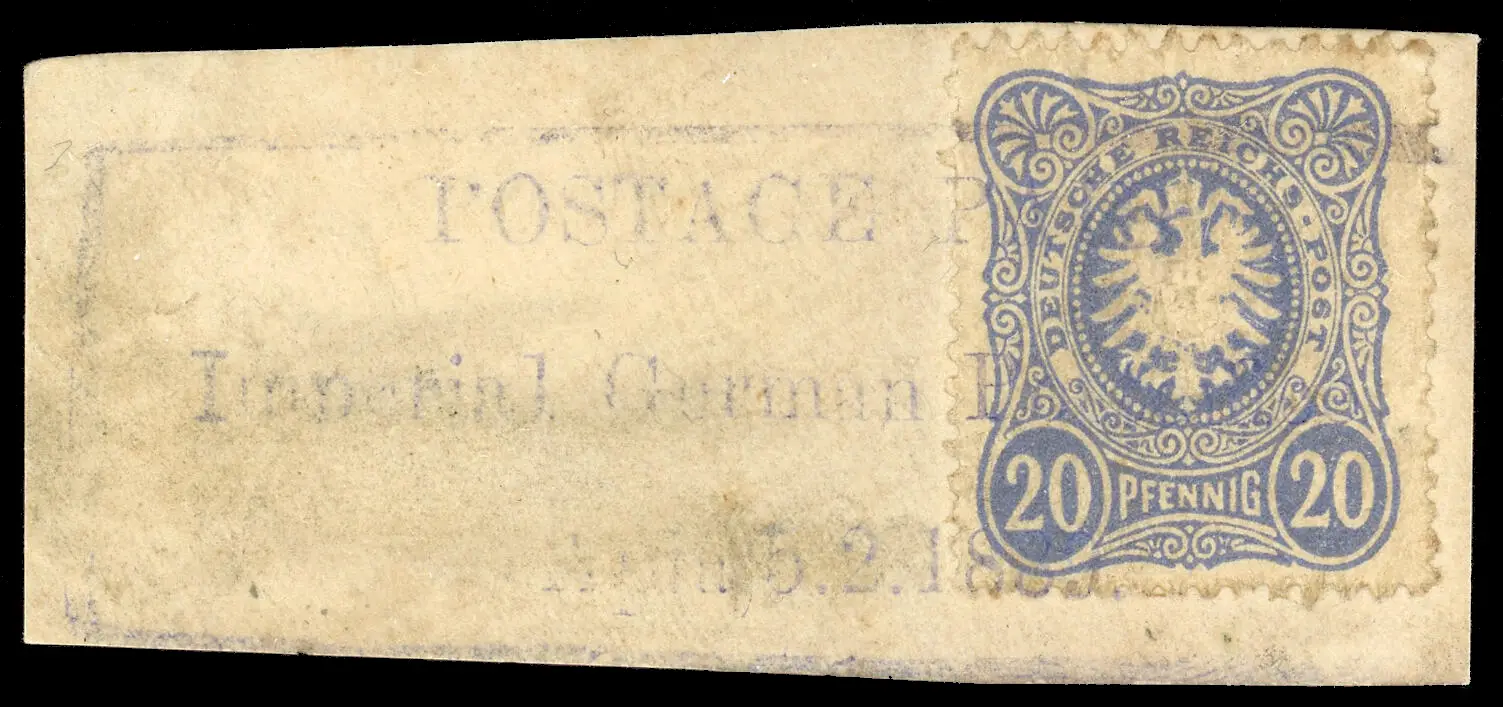
It was used concurrently with an equivalent mark inscribed “BEZAHLT / Kaiserl. Deutsche Postagentur / Apia – (date)” (below) for mail sent to Germany.
The reason these marks came into use is fairly simple. The post office had no other option! As was often the case in this era, fire was a constant threat to Western buildings in particular. On 8 January 1889, a fire burned down the German Consulate in which the postal agency was housed, destroying all of the postal agency’s stamps and postal equipment. These two postal markings were made locally and used until a new cancel device was received from Germany on 31 March. Specialist collectors should note that stamped mail would still have been possible during February and March of 1889, and the boxed Bezahlt markings can be found on stamps. Stamps previously sold to the public were still valid and were used during this period.
These marks made a reappearance between April and September of 1895. On April Fool’s Day 1895, fire threatened to destroy the consulate again. This time, the post office was mostly evacuated in time to prevent the stamps going up in flames, but the cancel device was permanently lost in the process of evacuating the post office. The German language BEZAHLT mark was placed in use again until a new cancel was received from Germany in September.
The canceller sent to replace the one lost on the fire was similar in appearance, but can be easily distinguished as the pre-fire 1895 cancel (below left) lacks the “segment” under the word “APIA” while the one used from September 1895 has such a segment (below right).
Upon the formal elevation of German Samoa to the status of a colony, the Apia post office would replace its postal agency (Kaiserlich Deutsche Postagentur) cancel with a cancel removing that designation.
When the first of the “Yacht” series stamps arrived in Samoa on 10 December 1900, a new “Swiss style” cancel device which lacked the reference to the KD Postagentur was brought with them. When the ship departed again on the 14th of December, it took the old postal agency cancel device back to Germany. In essence, there was a period of barely four days when both cancel devices were at the Apia post office simultaneously.
Finding impressions of the Swiss cancel on overprinted stamps is relatively easy, as those stamps were still valid for nearly a year after the cancel device arrived in Samoa. But finding examples of the Yacht stamps cancelled with the Postal Agency cancel is extremely difficult as it was only possible for a few days. As Michel routinely states, “expertization is recommended!”
Such was the volume of mail at the Apia post office that the first Swiss canceller had to be replaced in June of 1907 due to wear. The first cancel (below left) is clearly distinguishable as the letters in “APIA” are in a sans-serif font known in German as “Groteskschrift” or “Blockschrift”.
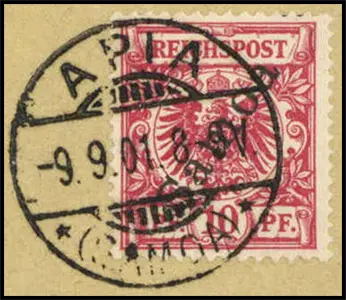
A similar cancel put into service in June 1907 shows “APIA” in a serifed font called “Antiquaschrift” (below right).
Even though the Blockschrift cancel was retired from daily use in 1907, the cancel device itself was kept in reserve and used on occasion until 1914. For post-June 1907 strikes, though, the sans-serif cancel was altered in one notable way. As can be seen, there are stars on either side of “(SAMOA)” in the cancel as used prior to 1907. Once the new Antiquaschrift cancel was put in use, the stars were removed from the old cancel.
Aleipata

The last post office opened under German administration, on 9 August 1909, this post office is also the rarest of the marks from German Samoa. Like Palauli, “Aleipata” is the name of the district at the relatively sparsely populated eastern tip of Upolu rather than a specific town.
The most valuable cancel (right) listed in ArGe from Samoa, this one has an on-piece value of €500.
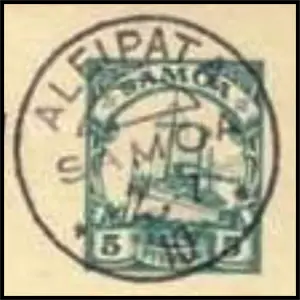
The last post office opened under German administration, on 9 August 1909, this post office is also the rarest of the marks from German Samoa. Like Palauli, “Aleipata” is the name of the district at the relatively sparsely populated eastern tip of Upolu rather than a specific town.
The most valuable cancel (below) listed in ArGe from Samoa, this one has an on-piece value of €500.
Fagamalo

Fagamalo is located on the north coast of Savaii at that island’s northern-most point. As such, it is the main administrative center for its region – despite having a modern population of just over 300.
Under German rule, Fagamalo had the only post office on the entire northern half of the island, which opened on 6 Novemeber 1903. As such, its cancel is seen with some regularity owing to the larger volume of mail passing through the only office in the district.
Although Fagamalo’s cancel device is seen more regularly, dates in 1914 (right) should be closely examined. It is noted in literature that the Fagamalo device was used to create a number of CTO marks with 1914 dates. The ArGe catalogue takes this into consideration, as the 1914 CTO examples are valued at just €5 compared to valid usage examples, which are valued at a minimum of €40.
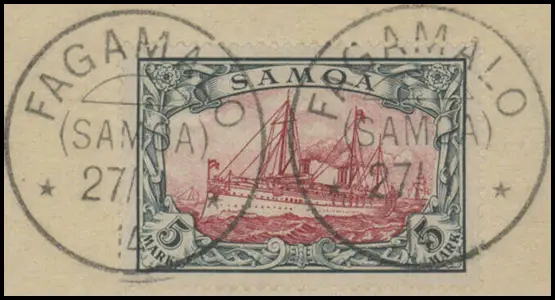
Fagamalo is located on the north coast of Savaii at that island’s northern-most point. As such, it is the main administrative center for its region – despite having a modern population of just over 300.
Under German rule, Fagamalo had the only post office on the entire northern half of the island, which opened on 6 Novemeber 1903. As such, its cancel is seen with some regularity owing to the larger volume of mail passing through the only office in the district.
Although Fagamalo’s cancel device is seen more regularly, dates in 1914 (below) should be closely examined.
It is noted in literature that the Fagamalo device was used to create a number of CTO marks with 1914 dates. The ArGe catalogue takes this into consideration, as the 1914 CTO examples are valued at just €5 compared to valid usage examples, which are valued at a minimum of €40.
Malua

Located on the north-west coast of Upolu, Malua (right) appears to have been an office serving the area between Apia to the east and the ferry port at Mulifanua to the west.
In part due to its late opening (24 April 1909) just over five years before the end of German colonial administration, examples of this cancel are noticeably rarer than for most of the other offices. ArGe values complete examples on piece at €150.
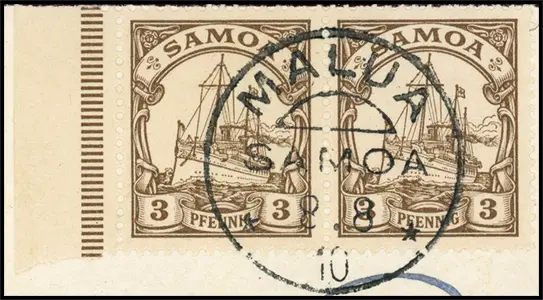
Located on the north-west coast of Upolu, Malua (below) appears to have been an office serving the area between Apia to the east and the ferry port at Mulifanua to the west.
In part due to its late opening (24 April 1909) just over five years before the end of German colonial administration, examples of this cancel are noticeably rarer than for most of the other offices. ArGe values complete examples on piece at €150.
Mulifanua

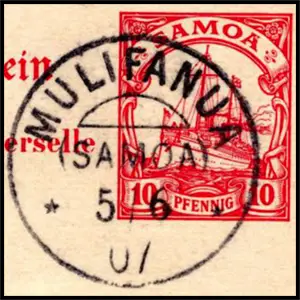
The first office to open outside of Apia was at Mulifanua, a small town at the far western tip of Upolu, on 3 November 1902. Mulifanua has long been the Upolu port from which the ferries to and from Savaii operate, as this town is physically the closest that the island of Upolu approaches the island of Savaii. The modern town is also a few minutes’ drive away from Faleolo, Samoa’s international airport.
Together with the post office at Salelavalu, Mulifanua was essential for the transport of mail between the two main islands of German Samoa.
Although the post office here is listed as being opened in November 1903, some sources state that the cancel device for this office (right) was probably not available at the office until sometime in 1904.
The first office to open outside of Apia was at Mulifanua, a small town at the far western tip of Upolu, on 3 November 1902. Mulifanua has long been the Upolu port from which the ferries to and from Savaii operate, as this town is physically the closest that the island of Upolu approaches the island of Savaii. The modern town is also a few minutes’ drive away from Faleolo, Samoa’s international airport.
Together with the post office at Salelavalu, Mulifanua was essential for the transport of mail between the two main islands of German Samoa.
Although the post office here is listed as being opened in November 1903, some sources state that the cancel device for this office (below) was probably not available at the office until sometime in 1904.
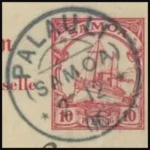
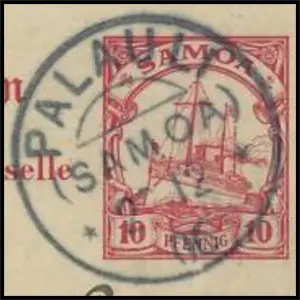
Palauli

Salailua

Located in the south-west corner of Savaii, this is another post office which served the south-western corner of the island. This post office, which opened on 14 January 1905, appears to have been quite busy, as strikes of its cancel are among the more numerous than others.
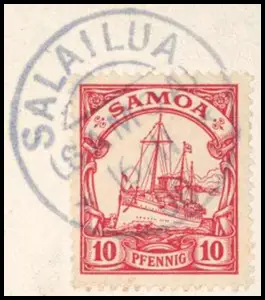
Partial strikes of this town’s postmark (right) can be confused with those of Malua, which are much rarer, when only the end of the town’s name is visible. The defining factor in such cases is the letter “A” at the end of the name. In the case of Salailua, the point of the “segment” between “SALAILUA” and “(SAMOA)” points to the cross-bar in the letter “A”. In the case of Malua, the point of the segment points to the right-hand foot of the letter “A”. Additionally, the Malua post office opened in 1909, so cancels with dates prior to the opening of the Malua post office must really be Salailua.
Located in the south-west corner of Savaii, this is another post office which served the south-western corner of the island. This post office, which opened on 14 January 1905, appears to have been quite busy, as strikes of its cancel are among the more numerous than others.
Partial strikes of this town’s postmark (below) can be confused with those of Malua, which are much rarer, when only the end of the town’s name is visible.
The defining factor in such cases is the letter “A” at the end of the name. In the case of Salailua, the point of the “segment” between “SALAILUA” and “(SAMOA)” points to the cross-bar in the letter “A”. In the case of Malua, the point of the segment points to the right-hand foot of the letter “A”. Additionally, the Malua post office opened in 1909, so cancels with dates prior to the opening of the Malua post office must really be Salailua.
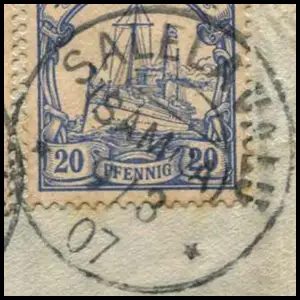
Salelavalu

It is probably no secret why the Salelavalu post office opened when it did, on 4 November 1903. Salelavalu is located on Savaii in the district just across the Apolima strait from Mulifanua on Upolu.
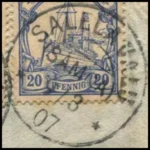
Also as was the case with Mulifanua, the postmark for Salelavalu (right) is not known to have been used in 1903. Salelavalu was apparently a mail collection point rather than an official post office until mid-1905.
It is probably no secret why the Salelavalu post office opened when it did, on 4 November 1903. Salelavalu is located on Savaii in the district just across the Apolima strait from Mulifanua on Upolu.
Also as was the case with Mulifanua, the postmark for Salelavalu (below) is not known to have been used in 1903. Salelavalu was apparently a mail collection point rather than an official post office until mid-1905.
References
Friedemann, A. (1980). The Stamps and Cancels of the German Colonies and the German Post Offices Abroad, Section XI Marshall Islands. Translated by Alfred K. Walter. Wilmington, DE: German Colonies Collector Group.
Laup, W. (1987). The Atoll Posts or Manuscript Cancellations of the German Marshall Islands. Translated by David C. Robertson. Bedford, MA: Self-Published.
Michel Redaktion (ed.) (2025). Michel Germany Specialized Catalog 2025 (Part 1). Bobingen, Germany: Schwaneberger Verlag Gmbh.
Nössig, T. (ed.) (2019). Catalog of the Postmarks of the German Colonies & Post Offices Abroad (1st English ed). Berlin, Germany: Arbeitsgemeinschaft der Sammler deutscher Kolonialpostwertzeichen.
Steinmetz, G. (2007). The Devil’s Handwriting; Precoloniality and the German Colonial State in Qingdao, Sāmoa, and Southwest Africa. Chicago, IL: The University of Chicago Press.
Illustrations courtesy of Gannon Sugimura, Oliver Wyrtki, George Holschauer, & Jed Dorman.