Beginners Guide
Deutsch-Südwestafrika
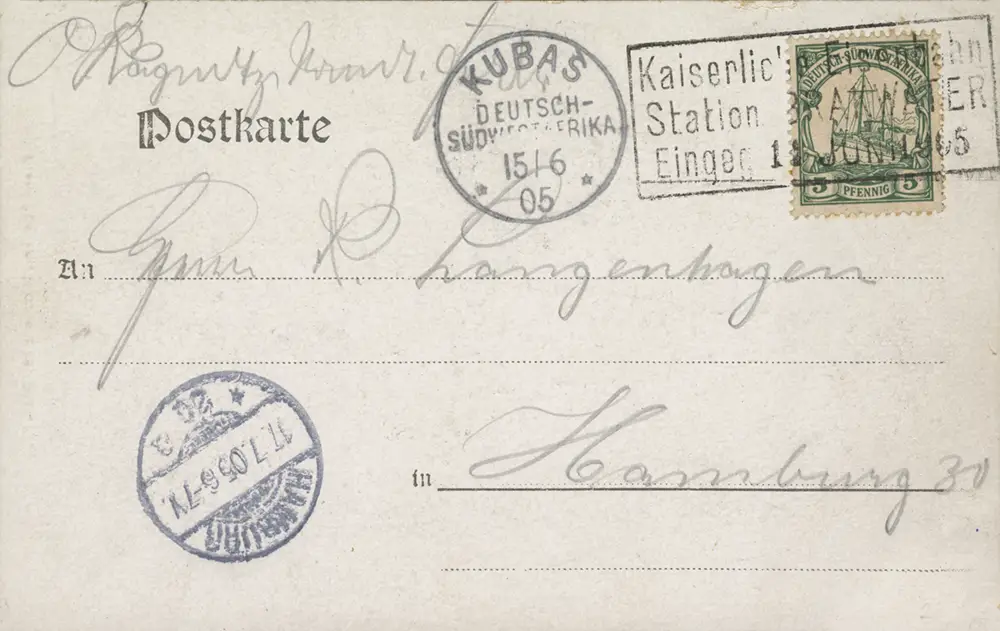
Postcard from Brakwater train station via Kubas to Hamburg, 11 June 1905
General
PO China
PO Morocco
PO Turkey
D-NG
D-OA
D-SWA
Kamerun

Karolinen

Kiautschou

Marianen

Marshall-In.
Samoa
Togo
Deutsch-Südwestafrika (German Southwest Africa)
By Gannon Sugimura
Historical Background

The Germans’ first steps into southern Africa were made, perhaps typically enough, by missionaries. As early as the 1840’s, German missionaries from Prussia came to spread the word of God. It did not go that well. As in other parts of the world, the Prussian missionaries were outsiders in a world dominated by fighting between various groups of indigenous people. The missionaries had to ask for the assistance of the Prussian government as early as the late 1860’s, but Prussia was at that time absorbed with a war against Austria, forming the North German Confederation, and by 1871, another war with France that would end up creating the German Empire. Colonization of Africa would have to wait.
The first moves towards settlement were made by a Bremen merchant by the name of Adolf Lüderitz (right), who established a German trading post at a bay named by the Portuguese “Angra Pequena” during their explorations about 400 years prior. The settlement here, named “Lüderitzbucht” was the first German presence in southern Africa when it opened in 1882. Not yet an official colony, Lüderitz sought the protection of the German crown. This was received in 1884, and the German flag was raised on 7 August 1884. As such, German Southwest Africa or Deutsch-Südwestafrika (GSWA/DSWA), was the third colony of the Empire – the prior two being Togo and Kamerun. German East Africa would follow in 1885, but would not be a colony until 1891. Before the end of German control in 1915, DSWA would attract roughly 60% of all Germans who chose to emigrate to the colonies. In 1913, the German population of all the colonies combined was approximately 25,000 of which just under 15,000 lived in German Southwest Africa.

The Germans’ first steps into southern Africa were made, perhaps typically enough, by missionaries. As early as the 1840’s, German missionaries from Prussia came to spread the word of God. It did not go that well. As in other parts of the world, the Prussian missionaries were outsiders in a world dominated by fighting between various groups of indigenous people. The missionaries had to ask for the assistance of the Prussian government as early as the late 1860’s, but Prussia was at that time absorbed with a war against Austria, forming the North German Confederation, and by 1871, another war with France that would end up creating the German Empire. Colonization of Africa would have to wait.
The first moves towards settlement were made by a Bremen merchant by the name of Adolf Lüderitz (below), who established a German trading post at a bay named by the Portuguese “Angra Pequena” during their explorations about 400 years prior.

The settlement here, named “Lüderitzbucht” was the first German presence in southern Africa when it opened in 1882. Not yet an official colony, Lüderitz sought the protection of the German crown. This was received in 1884, and the German flag was raised on 7 August 1884. As such, German Southwest Africa or Deutsch-Südwestafrika (GSWA/DSWA), was the third colony of the Empire – the prior two being Togo and Kamerun. German East Africa would follow in 1885, but would not be a colony until 1891. Before the end of German control in 1915, DSWA would attract roughly 60% of all Germans who chose to emigrate to the colonies. In 1913, the German population of all the colonies combined was approximately 25,000 of which just under 15,000 lived in German Southwest Africa.
Yet what drew them there? Initially, it was hoped that large areas of the new colony could be opened to hosting large farms, since there were reports that the native peoples practiced cattle farming. While there was some truth to that, the Germans may not have realized that most of the new colony was arid desert. The desert was the primary reason that other colonial empires, like the Portuguese, the Dutch, and the British, never settled here. The more agricultural areas are limited to the north near the border with Angola, as are the areas that receive the most rain. That should have been evident from the fact that relatively few people lived there; on the eve of the First World War, a population of roughly 100,000 lived in a colony more than 2 ½ times the size of the modern Federal Republic of Germany. Even today, modern Namibia is the 34th largest country in the world in area, but has a population of roughly 3 million. This is slightly less than the present population of Berlin, and is close to the population of Arkansas.
Since Germany, from a colonial perspective, was left with only the parts other powers did not want to claim, the Germans attempted to make the best of the situation. This ended up creating an odd quirk of geography known as the Caprivi Strip in the north-east of the colony, a “panhandle” of land roughly 280 miles / 450 km from east to west, but as little as 20 miles / 32 km from north to south. Securing it via the 1890 Helgoland-Zanzibar Treaty swapping British-held Helgoland for German controlled Zanzibar, the British also gave up claim to the Caprivi Strip. The Germans wanted the strip as that would give them access to the Zambezi River, which forms part of the border between the Caprivi Strip and modern Botswana, Zambia, and Zimbabwe. It was thought at the time that the Zambezi flowed all the way to the Indian Ocean through the former Portuguese East Africa (modern Mozambique) and would have allowed the Germans with river access between Southwest Africa and East Africa. What the Germans did not know – but the British probably did know – was that the Zambezi is not navigable. Any shipping to the Indian Ocean would have to go over the 300 foot / 100 meter height of Victoria Falls, which also has a tendency to run dry during the summer months.
Despite all of this, Germans were drawn to this colony above all others. What, then drew the Germans there? Largely, it was the mineral wealth. Deposits of metals like zinc and copper were found in the northern part of what became DSWA earlier in the 19th century, while diamonds were discovered primarily in the southern part of the colony in the early 20th century. Until even richer diamond fields were discovered in neighboring lands, DSWA was one of the world’s leading producers of diamonds. Even today, diamonds represent roughly 10% of modern Namibia’s economy.
One of the more unfortunate parts of history affected by this colony related to events that occurred back in German proper – specifically the Holocaust. As was the case in other colonies the world over, the indigenous inhabitants did not particularly like being colonized. In the case of DSWA, this occurred in the period 1904-1908, with an event known as the Herero and Nama Uprising. The story of the Herero Uprising merits its own discussion separate from this; but in brief, the native Herero and Nama peoples militarily resisted the control of the German colonial authorities. What happened next has been described as the first genocide of the 20th century, with the establishment of concentration camps to which large numbers of Herero and Nama were sent.
Although concentration camps were not a German invention – the British had developed them during the Second Boer War in South Africa which had ended in 1902 – the scale that the Germans used them was without precedent. Somewhere around 25,000 Boer women and children died in the British concentration camps, but it could be argued that this occurred more due to mismanagement and neglect than due to active attempts to exterminate them. Additionally, 25,000 people represented less than 0.05% of the population from which they came.
In German Southwest Africa, by comparison, as many as 110,000 people died in the German concentration camps. By some estimates, up to 80% of the Herero, and a similarly high proportion of the Nama, perished. Even at the very low end of estimates – 35,000 dead Herero and Nama – that represents about 40% of the indigenous population of 88,000 recorded by the colonial authorities in 1912. Prisoners in these camps were the subject of medical and scientific experiments which could never be carried out today – but which were similar to experiments performed in the concentration camps of Europe in the 1930’s and 1940’s. For these and a number of other reasons, the Herero-Nama Uprising has been called a “dress rehearsal” for the Holocaust. It certainly set an evil precedent which the Third Reich would eventually chose to follow.
The response on the part of Germany afterwards did not follow that of the German response to the Holocaust. For much of the intervening 120 years, Germany did not acknowledge it at all. Skulls sent to Germany from the colony during the Uprising started to be sent back to Namibia, but not until 2008. The remaining known skulls were repatriated to Namibia in stages over the next several years. Reparations payments were promised, but not until 2021, when Germany agreed to give €1.1 billion to Namibia.
In any event, geography, such as it was, would prove very harmful to German colonial interests. Although the Germans had a large presence there, the countries which would become the Allies in the First World War had an even greater presence. The Portuguese colony of Angola lies directly north of German Southwest Africa, while British colonies in the form of Bechuanaland (Botswana) and the Cape of Good Hope (now part of South Africa) effectively surrounded the Germans on three sides, with the Atlantic on the fourth. Additionally, an exclave of the Cape of Good Hope colony called “Walvis Bay” lay right in the middle of the Southwest African coast. All of that would seem to make this colony ripe for the taking by the Allies, but it did not quite turn out that way.
The relatively large German population of this colony allowed the Germans to mount an initially successful defense against the Allied invasion. The British, in the form of the South Africans, invaded from the south. Sort of. As was the case in Europe, German Southwest Africa had its own version of the “Sitzkrieg.” Despite knowing that war had been declared in August 1914, no real attempts at an Allied invasion occurred immediately. Apart from minor skirmishes in September of that year, life largely continued as normal in the colony, excepting only that the colonists were more or less cut off from Germany proper by the Allied blockade in Europe that sealed off Germany’s sea connections with other countries and her colonial empire.
When it came, the military invasion came from South Africa. The South Africans had attempted the September 1914 invasion, and they were largely in charge once efforts to dislodge the Germans began in earnest in February 1915. Once this intervention began, the Germans were able to resist for about five months. Overall, the Germans managed to hold out for nearly a year, not allowing the Allies to take control over the last German outpost until 9 July 1915. Because Germany lost control of this colony in 1915, Portugal would not play much of a role here, as Portugal did not declare war on Germany until 1916. In any event, German Southwest Africa held out longer than any of the other colonies, save only Kamerun and German East Africa, where some aspect of German control endured until 1916 and 1919 respectively.

In any event, geography, such as it was, would prove very harmful to German colonial interests. Although the Germans had a large presence there, the countries which would become the Allies in the First World War had an even greater presence. The Portuguese colony of Angola lies directly north of German Southwest Africa, while British colonies in the form of Bechuanaland (Botswana) and the Cape of Good Hope (now part of South Africa) effectively surrounded the Germans on three sides, with the Atlantic on the fourth. Additionally, an exclave of the Cape of Good Hope colony called “Walvis Bay” lay right in the middle of the Southwest African coast. All of that would seem to make this colony ripe for the taking by the Allies, but it did not quite turn out that way.
The relatively large German population of this colony allowed the Germans to mount an initially successful defense against the Allied invasion. The British, in the form of the South Africans, invaded from the south. Sort of. As was the case in Europe, German Southwest Africa had its own version of the “Sitzkrieg.” Despite knowing that war had been declared in August 1914, no real attempts at an Allied invasion occurred immediately. Apart from minor skirmishes in September of that year, life largely continued as normal in the colony, excepting only that the colonists were more or less cut off from Germany proper by the Allied blockade in Europe that sealed off Germany’s sea connections with other countries and her colonial empire.
When it came, the military invasion came from South Africa. The South Africans had attempted the September 1914 invasion, and they were largely in charge once efforts to dislodge the Germans began in earnest in February 1915. Once this intervention began, the Germans were able to resist for about five months. Overall, the Germans managed to hold out for nearly a year, not allowing the Allies to take control over the last German outpost until 9 July 1915. Because Germany lost control of this colony in 1915, Portugal would not play much of a role here, as Portugal did not declare war on Germany until 1916. In any event, German Southwest Africa held out longer than any of the other colonies, save only Kamerun and German East Africa, where some aspect of German control endured until 1916 and 1919 respectively.

Because of the large numbers of Germans who moved to Southwest Africa, traces of German culture remain in many more places here than elsewhere. A number of German colonial buildings remain both in existence and in use in most of the major settlements, including in the capital of Windhoek, as well as the smaller cities like Keetmanshoop, Luderitz (formerly Lüderitzbucht), and Swakopmund. It is quite rare, actually, that any Namibian settlement where Germans lived during the colonial period does not retain some church or other such structure from that time.
German Southwest Africa remained in limbo until the signing of the Treaty of Versailles in 1919. German control ended, and the colony was mandated by the League of Nations to the British. As was the case in the Pacific, where British control was exercised via Australia, the territory was mandated to South Africa rather than to the UK directly. South Africa maintained the mandate until 1966, when it was revoked by the United Nations in response to South Africa’s “apartheid” policies being extended to what was now known as “South West Africa.” South African control, now legally regarded as an occupation, continued until the former colony gained independence as the Republic of Namibia in 1990.
Modern Namibia is also the only former German colony where German remains a recognized national language. It is even still spoken as a first language, although by about 1% of the population. German language television and radio broadcasts are still produced in Namibia, and one of the largest circulation newspapers in the country, the Allgemeine Zeitung, is in German. While not spoken everywhere in the country, Namibia has the reputation of being one of the few countries outside of Europe where German speakers can make themselves understood in most places visitors would want to visit.
Vorläufer & Mitläufer

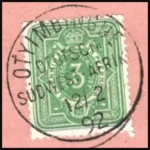
Even though the Germans had had a presence there since the 1840’s, the first postal facility in German Southwest Africa at Otjimbingue would not open until 7 July 1888. Initial postal traffic here was light by the standards of later years; examples of on-piece strikes of the first cancel – with the town name spelled “OTYIMBINGUE” (right) – on Vorläufer have catalogue values of between €400 and €2,000 depending on the date of use. The use of this cancel device also reflects the very fluid nature of the colonial administration at this time, as the government was forced to decamp from one place or another. In the period between July 1888 and March 1892, it had five distinct periods of use in four different locations. While two of these were in Otjimbingue itself, the cancel was also used for between 2 and 6 months in three other locations. Its move in March 1892 would actually mark the establishment of Windhoek as the colonial capital city, and the diminished importance of Otjimbingue.
Stamps used at Otjimbingue were initially Mi. 39-44, the definitive series with the denominations represented in “PFENNIG”, as well as the “internal use” 2 Mark stamp listed as Mi. 37 c and Mi. 37 d. In theory, examples of the 1875 version of this series, with the denominations stated in “PFENNIGE”, could have been used in the new colony, although these would have had to have been sent there from Germany by a private individual. They would have been officially replaced by stamps with the newer spelling in 1880; the Reichspost would not have provided them to the new colonial post office eight years after they were withdrawn from sale. Such usages are not noted in the Michel Specialized catalogue. Additionally, no examples of the 3 Pf (Mi. 39) or 25 Pf (Mi. 43) were ever officially sent to the colony as neither paid a useful rate there. However, usages do exist, resulting from the stamps either being sent to the colony for any number of reasons, or arriving there in the possession of German travelers before being used on the mail. Such Vorläufer usages are rare enough that Michel does not assign a specific catalogue value to them.
Michel assigns the prefix “V” to any Vorläufer usage. DSWA is one of the only cases where this specific prefix is not used. In the case of DSWA, the prefix “VO” is assigned to any Vorläufer usage from Otjimbingue specifically, while the prefix “VS” is assigned to a Vorläufer usage from any other post office in existence prior to the issue of distinct issues. (The only such post offices where Vorläufer could have occurred are Cap Cross, Gibeon, Keetmanshoop, Luderitzbucht, Okahandja, Omaruru, Rehoboth, Swakopmund, Uhabis, Warmbad, & Windhoek.) The “VO” prefix can refer to used examples of Mi. 37, Mi. 39-44, and Mi. 45-50 as all of these stamps were issued at Otjimbingue at one time or another. The other offices were not yet open when the 1880 series was demonetized, so only later printing of Mi. 37 and Mi. 45-50 can be “VS” issues.
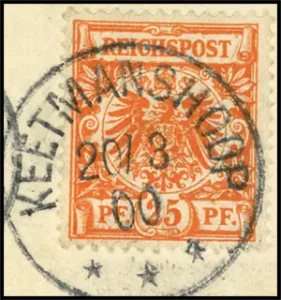
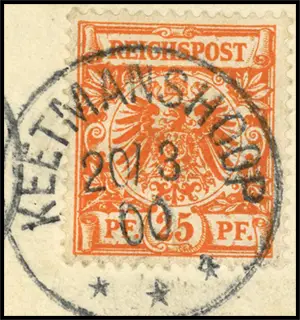
As was the case previously, not all members of the 1889 series were issued in DSWA officially. The same four denominations as the 1880 series (5 Pf, 10 Pf, 20 Pf, and 50 Pf) were issued promptly in 1891. But the 3 Pf was still not officially issued there until 1896, as it did not pay any valid rate prior to that point. The 25 Pf stamp never paid any valid rate during the Vorläufer period, so was never issued officially. Used examples were sent there in very small quantities or otherwise found their way there in the possession of new arrivals. For this reason, the 25 Pf Vorläufer (Mi. VO49 and VS49 (right)) has a notably higher catalogue value (CV) than any other denomination.
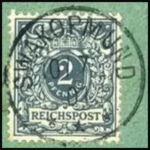
As is the case with the other German colonies and offices, Mitläufer usages could occur at any time after the first of the overprint issues was released. The majority of such issues seem to have appeared prior to the appearance of the Yacht series. One somewhat unusual value to see usage that deserves mention as a Mitläufer is probably the 2 Pf denomination of the 1889 series, which was not issued until 1900 (right). This is the one stamp from this series which cannot exist as a legitimate Vorläufer, as it was not issued until several years after the first DSWA overprints. It was never issued in any of the colonies as it paid a local post card rate which really did not exist on a practical level in any colony.
The existence of 2 Pf stamps cancelled in DSWA has two explanations. On the one hand, the 2 Pf denomination was the lowest one in existence at this time; it may have simply cost less for the philatelic firms of the day to send multiples of them to the colony to be cancelled. It may also be that collectors in Germany who wished to have full sets of Vorläufer believed they needed this denomination to complete their sets. So a number of them were sent to the colony to be cancelled there in the late 19th century once this denomination was issued. At no time, either before or after 2 Pf stamps were issued in Germany, would this denomination be created for the colonies. Proofs of this denomination are the only sign they were even contemplated.
Even though the Germans had had a presence there since the 1840’s, the first postal facility in German Southwest Africa at Otjimbingue would not open until 7 July 1888. Initial postal traffic here was light by the standards of later years; examples of on-piece strikes of the first cancel – with the town name spelled “OTYIMBINGUE” (below) – on Vorläufer have catalogue values of between €400 and €2,000 depending on the date of use.
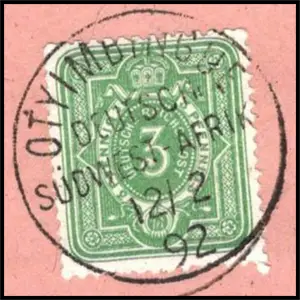
The use of this cancel device also reflects the very fluid nature of the colonial administration at this time, as the government was forced to decamp from one place or another. In the period between July 1888 and March 1892, it had five distinct periods of use in four different locations. While two of these were in Otjimbingue itself, the cancel was also used for between 2 and 6 months in three other locations. Its move in March 1892 would actually mark the establishment of Windhoek as the colonial capital city, and the diminished importance of Otjimbingue.
Stamps used at Otjimbingue were initially Mi. 39-44, the definitive series with the denominations represented in “PFENNIG”, as well as the “internal use” 2 Mark stamp listed as Mi. 37 c and Mi. 37 d. In theory, examples of the 1875 version of this series, with the denominations stated in “PFENNIGE”, could have been used in the new colony, although these would have had to have been sent there from Germany by a private individual. They would have been officially replaced by stamps with the newer spelling in 1880; the Reichspost would not have provided them to the new colonial post office eight years after they were withdrawn from sale. Such usages are not noted in the Michel Specialized catalogue. Additionally, no examples of the 3 Pf (Mi. 39) or 25 Pf (Mi. 43) were ever officially sent to the colony as neither paid a useful rate there. However, usages do exist, resulting from the stamps either being sent to the colony for any number of reasons, or arriving there in the possession of German travelers before being used on the mail. Such Vorläufer usages are rare enough that Michel does not assign a specific catalogue value to them.
Michel assigns the prefix “V” to any Vorläufer usage. DSWA is one of the only cases where this specific prefix is not used. In the case of DSWA, the prefix “VO” is assigned to any Vorläufer usage from Otjimbingue specifically, while the prefix “VS” is assigned to a Vorläufer usage from any other post office in existence prior to the issue of distinct issues. (The only such post offices where Vorläufer could have occurred are Cap Cross, Gibeon, Keetmanshoop, Luderitzbucht, Okahandja, Omaruru, Rehoboth, Swakopmund, Uhabis, Warmbad, & Windhoek.) The “VO” prefix can refer to used examples of Mi. 37, Mi. 39-44, and Mi. 45-50 as all of these stamps were issued at Otjimbingue at one time or another. The other offices were not yet open when the 1880 series was demonetized, so only later printing of Mi. 37 and Mi. 45-50 can be “VS” issues.
As was the case previously, not all members of the 1889 series were issued in DSWA officially. The same four denominations as the 1880 series (5 Pf, 10 Pf, 20 Pf, and 50 Pf) were issued promptly in 1891. But the 3 Pf was still not officially issued there until 1896, as it did not pay any valid rate prior to that point. The 25 Pf stamp never paid any valid rate during the Vorläufer period, so was never issued officially. Used examples were sent there in very small quantities or otherwise found their way there in the possession of new arrivals. For this reason, the 25 Pf Vorläufer (Mi. VO49 and VS49 (below)) has a notably higher catalogue value (CV) than any other denomination.
As is the case with the other German colonies and offices, Mitläufer usages could occur at any time after the first of the overprint issues was released. The majority of such issues seem to have appeared prior to the appearance of the Yacht series. One somewhat unusual value to see usage that deserves mention as a Mitläufer is probably the 2 Pf denomination of the 1889 series, which was not issued until 1900 (below).
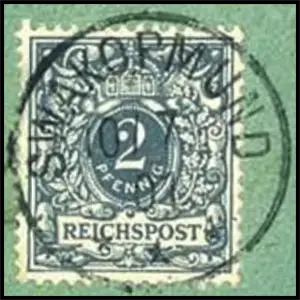
This is the one stamp from this series which cannot exist as a legitimate Vorläufer, as it was not issued until several years after the first DSWA overprints. It was never issued in any of the colonies as it paid a local post card rate which really did not exist on a practical level in any colony.
The existence of 2 Pf stamps cancelled in DSWA has two explanations. On the one hand, the 2 Pf denomination was the lowest one in existence at this time; it may have simply cost less for the philatelic firms of the day to send multiples of them to the colony to be cancelled. It may also be that collectors in Germany who wished to have full sets of Vorläufer believed they needed this denomination to complete their sets. So a number of them were sent to the colony to be cancelled there in the late 19th century once this denomination was issued. At no time, either before or after 2 Pf stamps were issued in Germany, would this denomination be created for the colonies. Proofs of this denomination are the only sign they were even contemplated.
Overprints

The same events in the late 1890’s that led to overprinting of German stamps to create distinctive colonial issues would also affect German Southwest Africa. Sources disagree, but the first overprints were issued in 1897 by overprinting stamps from the 1889 definitive series issued in Germany proper. (Michel states July, other sources say May or even March.) It was certainly not until the second half of 1897 when most DSWA post offices received them. As was the case with other colonies, postal agents were under orders to use up existing stocks of ordinary stamps before issuing the new overprints. Unlike the other colonial issues, the overprint for this colony exists only at one angle. Also, unlike the other colonies, two different overprints were created to show the colony name.
The first overprint issue consisted of just four values: 3 Pf, 5 Pf, 10 Pf, and 20 Pf (Michel 1, 2, 3, and 4), and show the colony name in three words – “Deutsch- / Südwest-Afrika.” These were the most typically used denominations at the time, and paid a variety of rates. As was the case initially, mail within the colony was tariffed at domestic German rates, while mail to any other destination (including Germany proper) was tariffed at international rates. For example, a 10 Pf stamp could have paid for a postcard sent to Germany or a letter sent within South West Africa. Domestic German rates would apply on mail to/from Germany only from 1 May 1899.
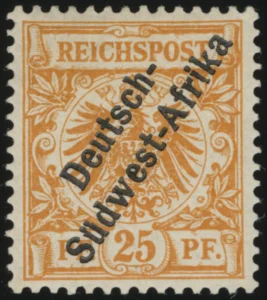
Stamps from two additional denominations, the 25 Pf and 50 Pf, were printed but never issued for use in the colony, and are listed as Mi. I (right) and Mi. II. (Michel uses Roman numerals for unissued stamps known in the market.) In fact, it appears that these two stamps were not prepared in 1897 at all. Friedemann says that these stamps were not sold anywhere until the second half of 1900, when the Postal Museum sold a large consignment of both values to a dealer in Hamburg, with a smaller quantity to a different Berlin firm. Once so procured, some of the stamps did eventually make their way to the colony despite being never officially issued. Examples were sent to DSWA to be cancelled in 1901; the stamps themselves were postally valid until 31 October 1901. This is the reason that legitimately cancelled examples have very high catalogue values and are almost never seen in the market.
When additional stamps were needed in 1899, the decision was made to alter the overprint applied to them. Stamps from the second overprint issue showed the name of the colony in two words – “Deutsch- / Südwestafrika”. In part, this was done to conform to local usage. As early as 1893, the practice of writing the colony name in this manner was widespread if not yet the standard orthography.
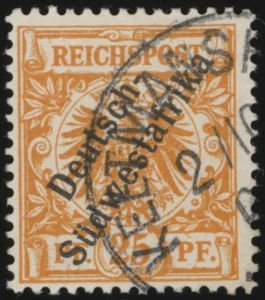
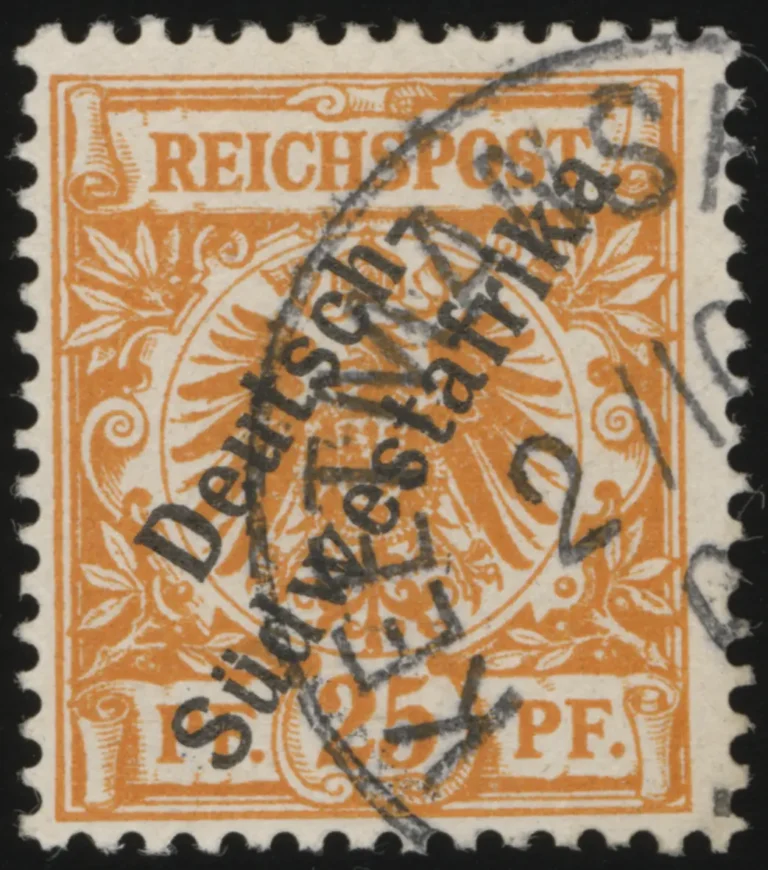
Unlike the prior issue, all six denominations of the 1889 issue were overprinted and were issued in the colony. Of the two higher values issued this time, cancelled examples of the 50 Pf were genuinely used for postal purposes. The 25 Pf value, however, remained a stamp with little purpose. The only genuine rate paid exactly by such a stamp would have been a registered postcard or possibly a commercial mailing weighing 550 g (over a pound). Such rates were very seldom, if ever, encountered. 25 Pf stamps were issued in much lower quantities to begin with, and cancelled ones (right) are more highly valued in the catalog – but remain much more affordable than cancelled examples of Mi. I or Mi II.
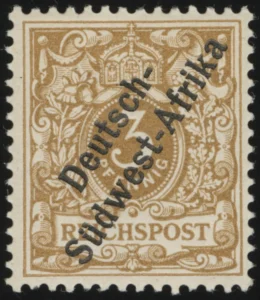
Both overprint issues provide a wealth of challenges to the collector. The same plate flaws that apply to the underlying 1889 series stamps also occur with both overprinted issues, provided the underlying stamp existed with those plate flaws when the overprints were applied. For this reason, many collectors look for the famous “break in the band roll” variety on the 3 Pf stamp (right), which is well known to collectors.
Additionally, the overprint itself exists in multiple varieties. While flaws in the overprint plate are not generally noted in Michel, Friedemann notes flaws in specific letters in sixteen (16) different positions on the printing plate. The overprint for the first issue is also known in three varieties having nothing to do with flaws. These are “thin overprint”, “medium overprint,” and “heavy overprint.” Of the sixteen overprint flaws, some occur only with one of the three strengths of overprint while others occur throughout. To say it is complex is something of an understatement.
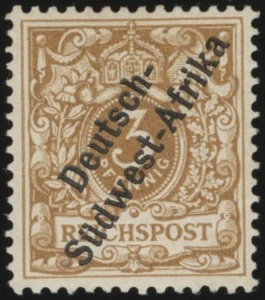
With regard to the shades of the underlying stamps, the same variety of shades exist. There are probably more shades with DSWA stamps than there are for other colonial stamps. For the first issue, Michel notes three (3) shades for the 3 Pf issue, and a single shade for the other three issued stamps. For the two unissued stamps, the 25 Pf comes in two (2) shades, while the 50 Pf is listed in just one. As for the second overprint issue, the 3 Pf is listed in five (5) shades, the 10 Pf in five (5) shades, and the 25 Pf in two (2) shades, with just a single shade for the 5 Pf, 20 Pf, and 50 Pf denominations.
Owing to all of these varieties, a “complete” collection of all the overprint possibilities would be prohibitively expensive. A mint collection of each possible shade of all denominations would include 23 stamps. If every possible combination of plate flaw and printing plate flaw are included with the shades, the actual count is significantly more. By my count, just for the 3 Pf stamp of the first issue, a collector would have to obtain 94 stamps to include every combination of shade, overprint strength, overprint flaw, and plate flaw. That assumes all combinations actually exist. Considering that fifteen (15) of the most expensive shade, Mi. 1 f (right), are needed at €350 each, the cost of the entire series is not worth contemplating for most collectors.
The same events in the late 1890’s that led to overprinting of German stamps to create distinctive colonial issues would also affect German Southwest Africa. Sources disagree, but the first overprints were issued in 1897 by overprinting stamps from the 1889 definitive series issued in Germany proper. (Michel states July, other sources say May or even March.) It was certainly not until the second half of 1897 when most DSWA post offices received them. As was the case with other colonies, postal agents were under orders to use up existing stocks of ordinary stamps before issuing the new overprints. Unlike the other colonial issues, the overprint for this colony exists only at one angle. Also, unlike the other colonies, two different overprints were created to show the colony name.
The first overprint issue consisted of just four values: 3 Pf, 5 Pf, 10 Pf, and 20 Pf (Michel 1, 2, 3, and 4), and show the colony name in three words – “Deutsch- / Südwest-Afrika.” These were the most typically used denominations at the time, and paid a variety of rates. As was the case initially, mail within the colony was tariffed at domestic German rates, while mail to any other destination (including Germany proper) was tariffed at international rates. For example, a 10 Pf stamp could have paid for a postcard sent to Germany or a letter sent within South West Africa. Domestic German rates would apply on mail to/from Germany only from 1 May 1899.
Stamps from two additional denominations, the 25 Pf and 50 Pf, were printed but never issued for use in the colony, and are listed as Mi. I (below) and Mi. II. (Michel uses Roman numerals for unissued stamps known in the market.)
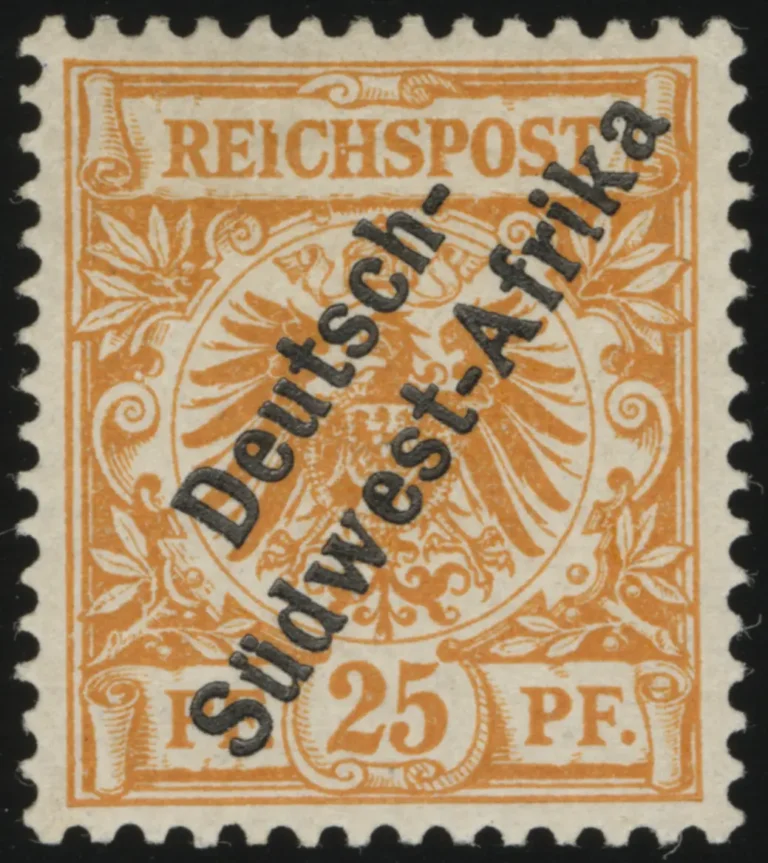
In fact, it appears that these two stamps were not prepared in 1897 at all. Friedemann says that these stamps were not sold anywhere until the second half of 1900, when the Postal Museum sold a large consignment of both values to a dealer in Hamburg, with a smaller quantity to a different Berlin firm. Once so procured, some of the stamps did eventually make their way to the colony despite being never officially issued. Examples were sent to DSWA to be cancelled in 1901; the stamps themselves were postally valid until 31 October 1901. This is the reason that legitimately cancelled examples have very high catalogue values and are almost never seen in the market.
When additional stamps were needed in 1899, the decision was made to alter the overprint applied to them. Stamps from the second overprint issue showed the name of the colony in two words – “Deutsch- / Südwestafrika”. In part, this was done to conform to local usage. As early as 1893, the practice of writing the colony name in this manner was widespread if not yet the standard orthography.
Unlike the prior issue, all six denominations of the 1889 issue were overprinted and were issued in the colony. Of the two higher values issued this time, cancelled examples of the 50 Pf were genuinely used for postal purposes. The 25 Pf value, however, remained a stamp with little purpose. The only genuine rate paid exactly by such a stamp would have been a registered postcard or possibly a commercial mailing weighing 550 g (over a pound). Such rates were very seldom, if ever, encountered. 25 Pf stamps were issued in much lower quantities to begin with, and cancelled ones (below) are more highly valued in the catalog – but remain much more affordable than cancelled examples of Mi. I or Mi II.
Both overprint issues provide a wealth of challenges to the collector. The same plate flaws that apply to the underlying 1889 series stamps also occur with both overprinted issues, provided the underlying stamp existed with those plate flaws when the overprints were applied. For this reason, many collectors look for the famous “break in the band roll” variety on the 3 Pf stamp (below), which is well known to collectors.
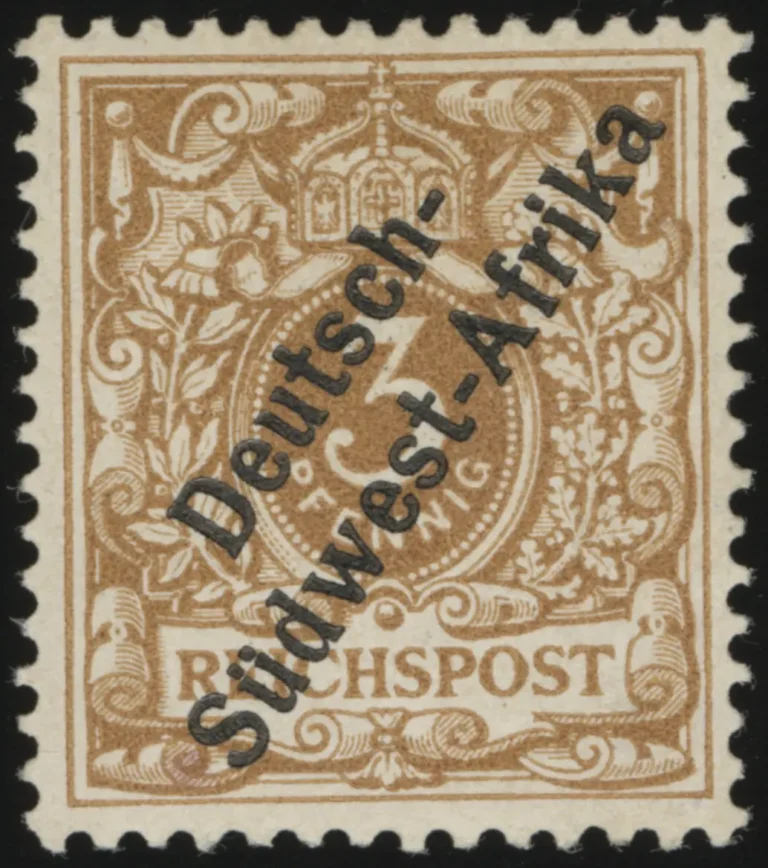
Additionally, the overprint itself exists in multiple varieties. While flaws in the overprint plate are not generally noted in Michel, Friedemann notes flaws in specific letters in sixteen (16) different positions on the printing plate. The overprint for the first issue is also known in three varieties having nothing to do with flaws. These are “thin overprint”, “medium overprint,” and “heavy overprint.” Of the sixteen overprint flaws, some occur only with one of the three strengths of overprint while others occur throughout. To say it is complex is something of an understatement.
With regard to the shades of the underlying stamps, the same variety of shades exist. There are probably more shades with DSWA stamps than there are for other colonial stamps. For the first issue, Michel notes three (3) shades for the 3 Pf issue, and a single shade for the other three issued stamps. For the two unissued stamps, the 25 Pf comes in two (2) shades, while the 50 Pf is listed in just one. As for the second overprint issue, the 3 Pf is listed in five (5) shades, the 10 Pf in five (5) shades, and the 25 Pf in two (2) shades, with just a single shade for the 5 Pf, 20 Pf, and 50 Pf denominations.
Owing to all of these varieties, a “complete” collection of all the overprint possibilities would be prohibitively expensive. A mint collection of each possible shade of all denominations would include 23 stamps. If every possible combination of plate flaw and printing plate flaw are included with the shades, the actual count is significantly more. By my count, just for the 3 Pf stamp of the first issue, a collector would have to obtain 94 stamps to include every combination of shade, overprint strength, overprint flaw, and plate flaw. That assumes all combinations actually exist. Considering that fifteen (15) of the most expensive shade, Mi. 1 f (below), are needed at €350 each, the cost of the entire series is not worth contemplating for most collectors.
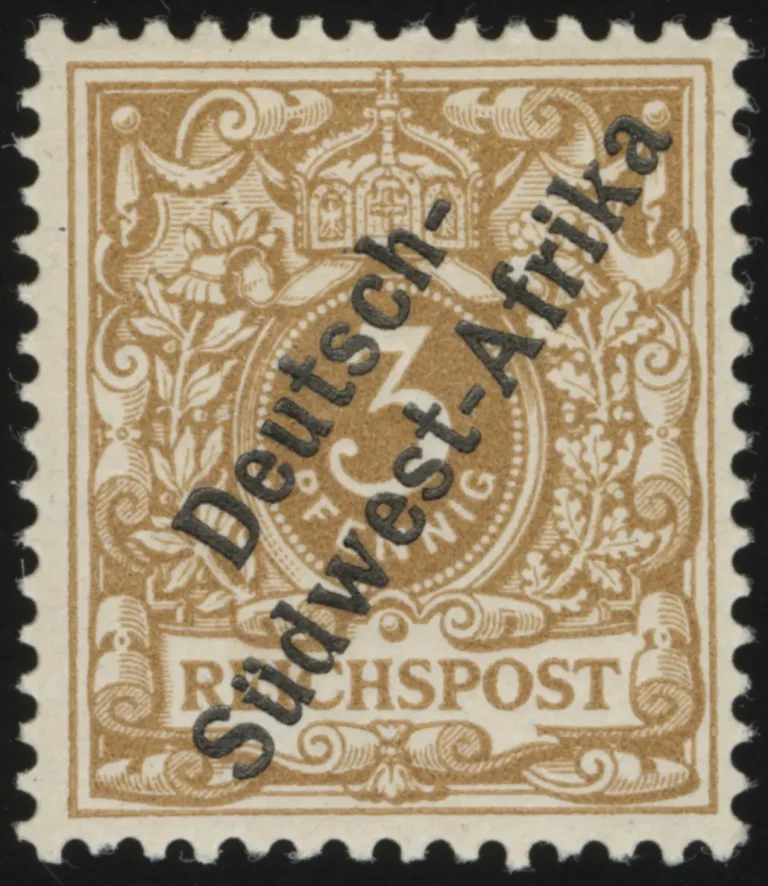
Keetmanshoop Provisionals

The Keetmanshoop post office ran out of 5 Pf stamps in mid-1900. In June and July of that year, 10 Pf stamps were bisected to create provisional 5 Pf stamps. Such stamps were bisected diagonally along the overprint, and also horizontally and vertically.
These are listed as Mi. 7 H (right), but are not mentioned in Scott. Michel notes that a number of such bisects were created for the philatelic market; on cover examples are worth full catalogue value (CV) only with arrival postmarks showing they actually passed through the mails.
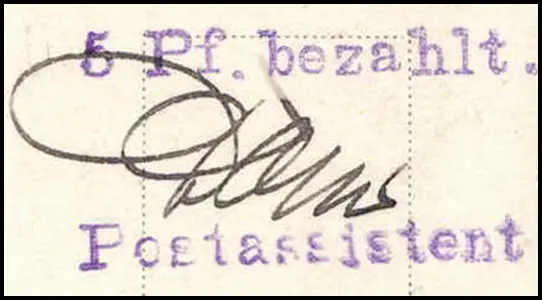
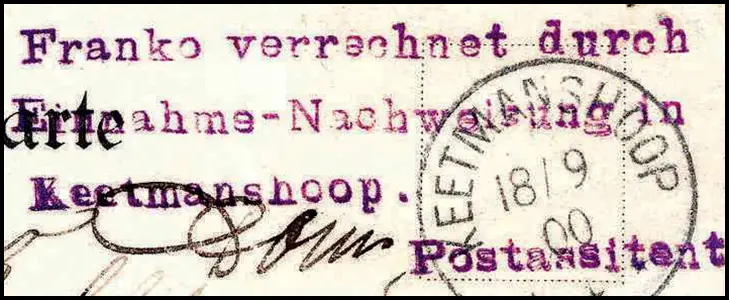
The lack of 5 Pf stamps at Keetmanshoop continued into September of that year. In that month, two different handstamps and a manuscript notation were applied indicating cash prepayment of 5 Pf, were applied to mail and signed off by the postal agent (a man named “Doms.”) Examples of these markings are exceedingly difficult to obtain.
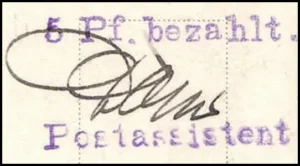
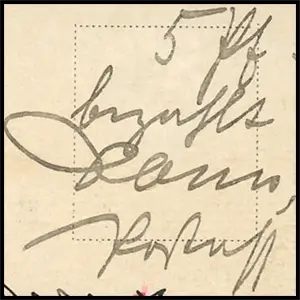
The manuscript notation “5 Pf. bezahlt. Dom Postass” is known on a single postcard cancelled on 4 September 1900.
The 2-line handstamp with signature “Dom” is known on nine postcards and one piece, all on 4 September 1900.
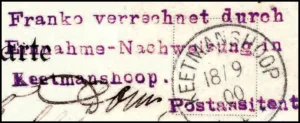
The 3-line handstamp cash payment franking signed “Dom”, with 1-line “Postassistent” handstamp, is know on two postcards, one of which is dated 18 September 1900.
Cases of stamp shortages like this led to a decree by the Reichspost on 26 February 1901 which prohibited the creation of bisects to solve stamp shortages. Postal agents were admonished to make sure they had enough stock, and in the event they could not do so, they were to obtain stamps from neighboring post offices. This decree was, on a practical level, hard to enforce. What was a colonial postmaster to do when the “next post office” was 1,000 km away or there was no other post office in the colony? Bureaucratic logic defies explanation in the early 20th century as it does now. Despite this, it made little difference. In DSWA alone, philatelic creations involving bisecting happened numerous times and as late as 1915. Never underestimate the persuasiveness of the stamp collector!
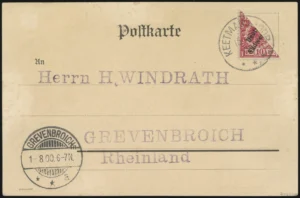
The Keetmanshoop post office ran out of 5 Pf stamps in mid-1900. In June and July of that year, 10 Pf stamps were bisected to create provisional 5 Pf stamps. Such stamps were bisected diagonally along the overprint, and also horizontally and vertically.
These are listed as Mi. 7 H (below), but are not mentioned in Scott.
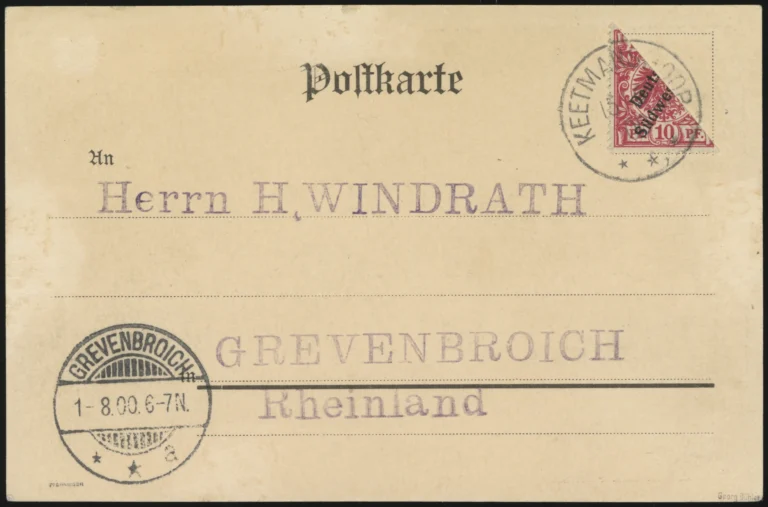
Michel notes that a number of such bisects were created for the philatelic market; on cover examples are worth full catalogue value (CV) only with arrival postmarks showing they actually passed through the mails.
The lack of 5 Pf stamps at Keetmanshoop continued into September of that year. In that month, two different handstamps and a manuscript notation were applied indicating cash prepayment of 5 Pf, were applied to mail and signed off by the postal agent (a man named “Doms.”) Examples of these markings are exceedingly difficult to obtain.
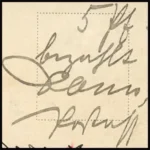
The manuscript notation “5 Pf. bezahlt. Dom Postass” (below) is known on a single postcard cancelled on 4 September 1900.
The 2-line handstamp with signature “Dom” (below) is known on nine postcards and one piece, all on 4 September 1900.
The 3-line handstamp cash payment franking signed “Dom”, with 1-line “Postassistent” handstamp (below), is know on two postcards, one of which is dated 18 September 1900.
Cases of stamp shortages like this led to a decree by the Reichspost on 26 February 1901 which prohibited the creation of bisects to solve stamp shortages. Postal agents were admonished to make sure they had enough stock, and in the event they could not do so, they were to obtain stamps from neighboring post offices. This decree was, on a practical level, hard to enforce. What was a colonial postmaster to do when the “next post office” was 1,000 km away or there was no other post office in the colony? Bureaucratic logic defies explanation in the early 20th century as it does now. Despite this, it made little difference. In DSWA alone, philatelic creations involving bisecting happened numerous times and as late as 1915. Never underestimate the persuasiveness of the stamp collector!
The Yacht Series

Just as was the case with the rest of the German colonial empire, as the 20th century dawned, the Yacht stamps made their appearance. Although available in Berlin in December 1900, the first Yacht stamps did not appear in this colony until January 1901.
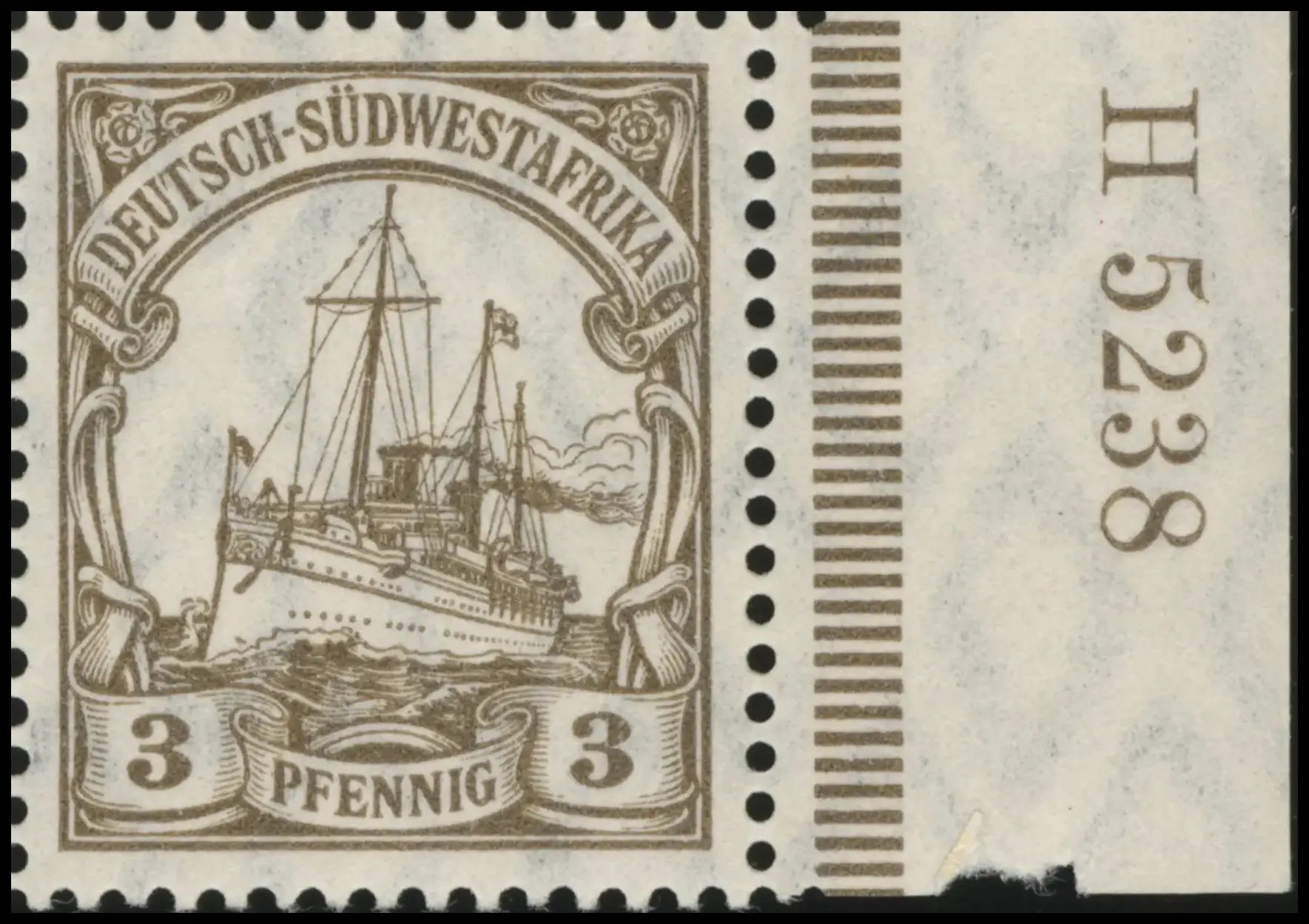
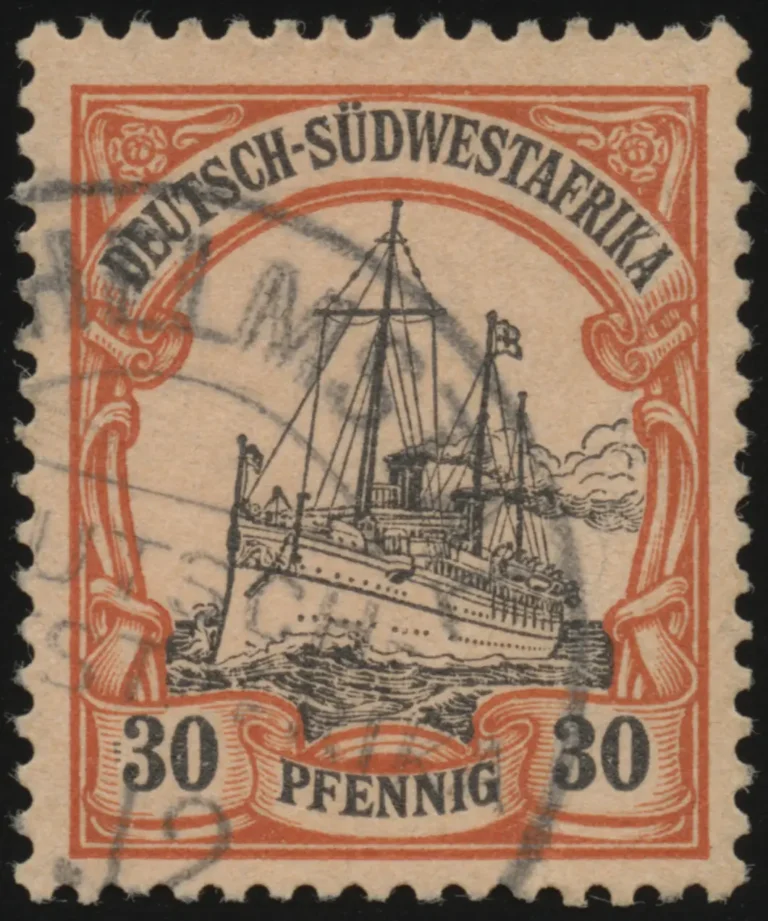
This first Yacht issue was typical in that all of the stamps in this first issue were printed on paper without watermark, and in the same range of denominations and colors as those issued in the other colonies. Production control did a good job on this issue; only one plate flaw is noted, and only for the 30 Pf denomination (top right).
The main way in which the DSWA stamps were different from the other colonies’ Yachts lies in the pattern of their catalog values. Among the small Yachts (80 Pf or less) the general pattern is that the mint stamps are worth less than the used ones; this is particularly true for the smaller Pacific colonies which did not exhaust their supply of such stamps prior to the beginning of the First World War.
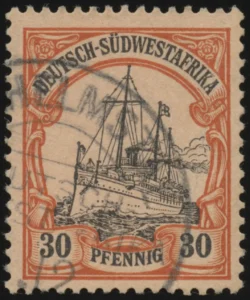
In the case of DSWA, however, the most highly used denominations are the ones that have the higher CV’s in mint. Of these – the 5 Pf, 10 Pf, 20 Pf, and 30 Pf – the lowest CV is €17 for the 10 Pf and it goes up to €90 for the 30 Pf in mint hinged condition. (The 30 Pf in never hinged condition pushes €300.) Compare this with the CV’s for the Mariana Islands, where all of the individual CV’s are between €1.30 and €10 excepting only the 5 M (Mi. 19) and the contrast is clear.
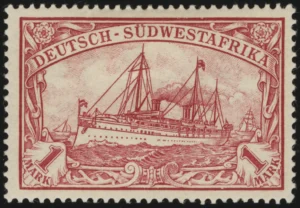
Among the DSWA Large Yachts, a similar pattern occurs where the 1 M (bottom right) and the 5 M have the highest CV’s, but never hinged 1 M and 5 M stamps have nearly identical values (€450 for the 1 M and €480 for the 5 M) while the 2 M and 3 M values have significantly lower CV’s. In most colonies, the 5 M is the most highly valued as it is here – but the 1 M is more in line with the 2 M and 3 M for values.
The reason for all of this likely lies in the realities of life in this colony. The much larger colonial population required more stamps. Fewer people in the colony kept the stamps in unused condition, and there were none of the first issues on hand when control of the colony fell to the Allies. Other denominations, even ones which had higher face values, were not used as much so survived in greater numbers in mint condition.
Stamps of the Second Yacht series began to appear in 1906. These are largely identical to those of the first series except that the second series is printed on paper watermarked with a pattern of diamond lozenges (top right), referred to as Wasserzeichen 1 in Michel and Watermark #125 in Scott.
Unlike Kiautschou, which managed to replace all of its unwatermarked stamps with watermarked versions prior to the start of the First World War, DSWA only replaced the more highly used 3 Pf, 5 Pf, 10 Pf, 20 Pf, 30 Pf, 1 M, 2 M and 5 M values. No watermarked versions of the 25 Pf, 40 Pf, 50 Pf, or 80 Pf were produced at all. (War printings of some of the Large Yachts were printed, however.) In general, these stamps were issued and used in larger quantities, with one exception.
That one exception involved the 30 Pf value. This stamp (Mi. 28) exists in two varieties which involve the tint of the stamp paper. The more common printing, Mi. 28 x (left stamp at bottom right), is describe as being dark reddish-orange / yellow-black” on white to medium yellow chrome yellow paper and according to Michel was issued in 1911. According to Friedemann, this stamp was issued in August or September 1913. Regardless of which is correct, Mi. 28 y was issued much later, possibly on the eve of the War. The more common Mi. 28 x has a value of €20 in mint and €65 in used.
The less common printing, Mi. 28 y (right stamp at bottom right), is printed instead on orange-white paper. And although the later Mi. 28 y has a much lower CV of €7.50 in mint, used examples are so uncommon that Michel notes their existence but does not show a value. When any catalog does this, it is due to too little information to set a value. In other words, used examples are exceedingly rare and should be treated with caution.
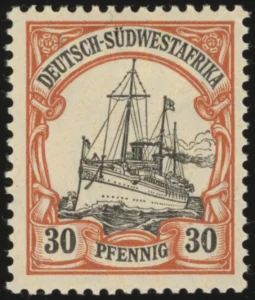
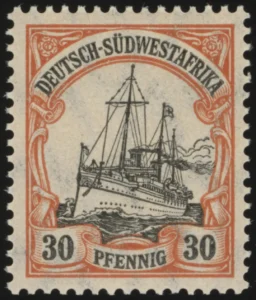
In 1905, proofs of the full range of denominations were printed of the DSWA Yacht stamps printed on watermarked paper. Friedemann notes that these proofs are difficult to distinguish from peace printings of the same stamps, excepting the denominations that were never issued. Friedemann states limits this to the 40 Pf, 50 Pf and 80 Pf, yet this neglects to mention that the 25 Pf was also produced as a proof and not issued as a stamp. As in all things concerning rarity, authentication is required.
Just as was the case with the rest of the German colonial empire, as the 20th century dawned, the Yacht stamps made their appearance. Although available in Berlin in December 1900, the first Yacht stamps did not appear in this colony until January 1901.
This first Yacht issue was typical in that all of the stamps in this first issue were printed on paper without watermark, and in the same range of denominations and colors as those issued in the other colonies. Production control did a good job on this issue; only one plate flaw is noted, and only for the 30 Pf denomination (below).
The main way in which the DSWA stamps were different from the other colonies’ Yachts lies in the pattern of their catalog values. Among the small Yachts (80 Pf or less) the general pattern is that the mint stamps are worth less than the used ones; this is particularly true for the smaller Pacific colonies which did not exhaust their supply of such stamps prior to the beginning of the First World War.
In the case of DSWA, however, the most highly used denominations are the ones that have the higher CV’s in mint. Of these – the 5 Pf, 10 Pf, 20 Pf, and 30 Pf – the lowest CV is €17 for the 10 Pf and it goes up to €90 for the 30 Pf in mint hinged condition. (The 30 Pf in never hinged condition pushes €300.) Compare this with the CV’s for the Mariana Islands, where all of the individual CV’s are between €1.30 and €10 excepting only the 5 M (Mi. 19) and the contrast is clear.
Among the DSWA Large Yachts, a similar pattern occurs where the 1 M and the 5 M have the highest CV’s, but never hinged 1 M and 5 M stamps have nearly identical values (€450 for the 1 M and €480 for the 5 M) while the 2 M and 3 M values have significantly lower CV’s. In most colonies, the 5 M is the most highly valued as it is here – but the 1 M is more in line with the 2 M and 3 M for values.
The reason for all of this likely lies in the realities of life in this colony. The much larger colonial population required more stamps. Fewer people in the colony kept the stamps in unused condition, and there were none of the first issues on hand when control of the colony fell to the Allies. Other denominations, even ones which had higher face values, were not used as much so survived in greater numbers in mint condition.
Stamps of the Second Yacht series began to appear in 1906. These are largely identical to those of the first series except that the second series is printed on paper watermarked with a pattern of diamond lozenges (below), referred to as Wasserzeichen 1 in Michel and Watermark #125 in Scott.
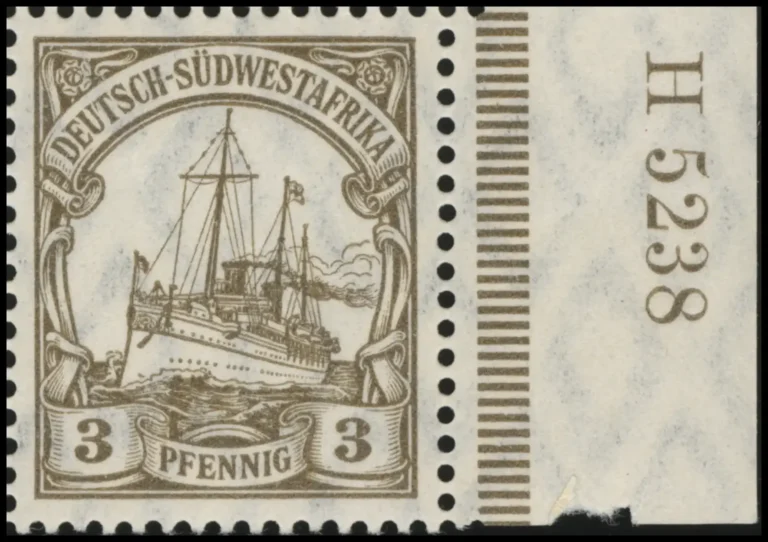
Unlike Kiautschou, which managed to replace all of its unwatermarked stamps with watermarked versions prior to the start of the First World War, DSWA only replaced the more highly used 3 Pf, 5 Pf, 10 Pf, 20 Pf, 30 Pf, 1 M, 2 M and 5 M values. No watermarked versions of the 25 Pf, 40 Pf, 50 Pf, or 80 Pf were produced at all. (War printings of some of the Large Yachts were printed, however.) In general, these stamps were issued and used in larger quantities, with one exception.
That one exception involved the 30 Pf value. This stamp (Mi. 28) exists in two varieties which involve the tint of the stamp paper. The more common printing, Mi. 28 x (below left), is describe as being dark reddish-orange / yellow-black” on white to medium yellow chrome yellow paper and according to Michel was issued in 1911. According to Friedemann, this stamp was issued in August or September 1913. Regardless of which is correct, Mi. 28 y was issued much later, possibly on the eve of the War. The more common Mi. 28 x has a value of €20 in mint and €65 in used.
The less common printing, Mi. 28 y (below right), is printed instead on orange-white paper. And although the later Mi. 28 y has a much lower CV of €7.50 in mint, used examples are so uncommon that Michel notes their existence but does not show a value. When any catalog does this, it is due to too little information to set a value. In other words, used examples are exceedingly rare and should be treated with caution.
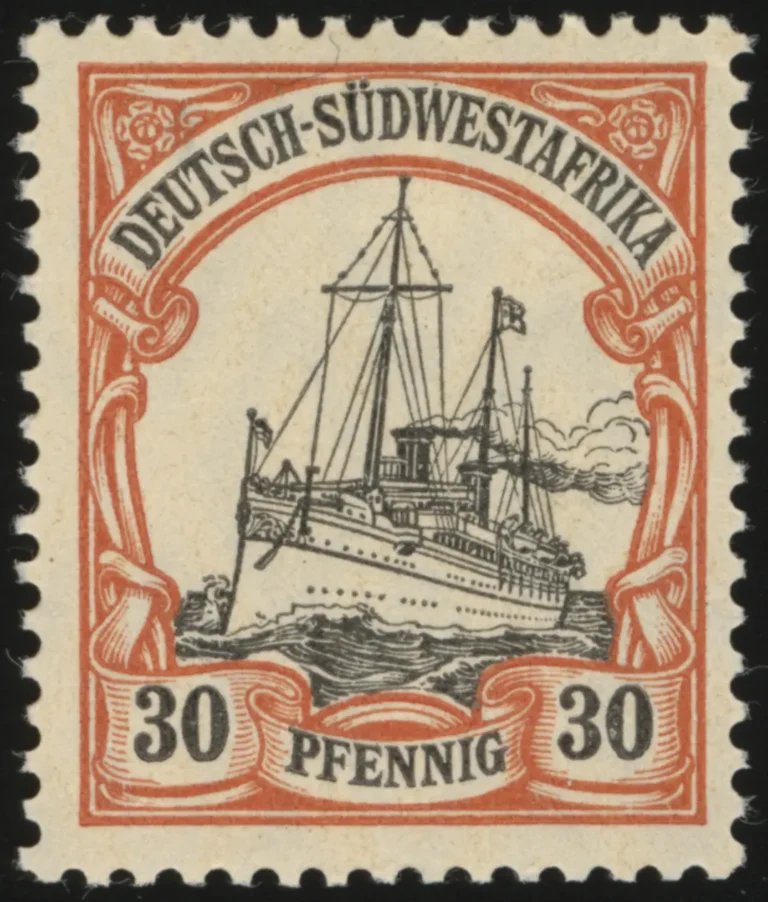
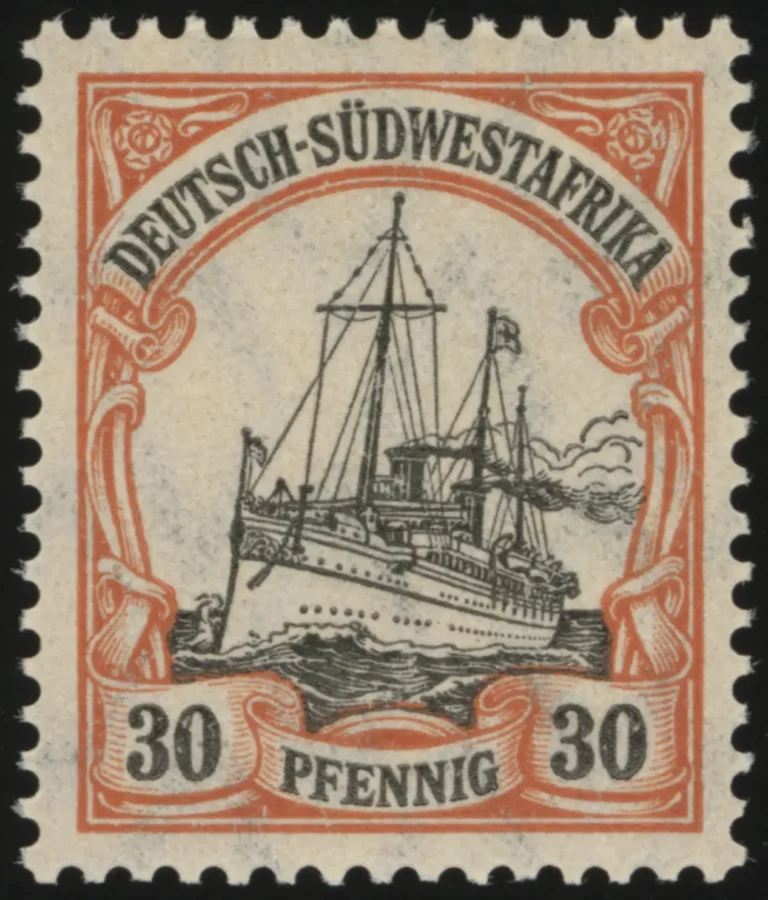
In 1905, proofs of the full range of denominations were printed of the DSWA Yacht stamps printed on watermarked paper. Friedemann notes that these proofs are difficult to distinguish from peace printings of the same stamps, excepting the denominations that were never issued. Friedemann states limits this to the 40 Pf, 50 Pf and 80 Pf, yet this neglects to mention that the 25 Pf was also produced as a proof and not issued as a stamp. As in all things concerning rarity, authentication is required.
Postal Stationery

The postal stationery of DSWA is relatively straightforward and follows the pattern set in other colonies. Following Vorläufer usage of ordinary German postal cards, the typical range of distinctive postal cards was produced. This included 5 Pf and 10 Pf cards, both in single use and paid-reply formats.
It also included “privat post” printings of cards with a stamp indicia produced by a private firm (right), which the Reichspost accepted as valid.
In the case of DSWA, overprinted cards of the 1889 series were issued with both the two- and three-word versions of the colony’s name as were the stamps. The same denominations were produced once Yacht series cards were printed in the early 1900’s.
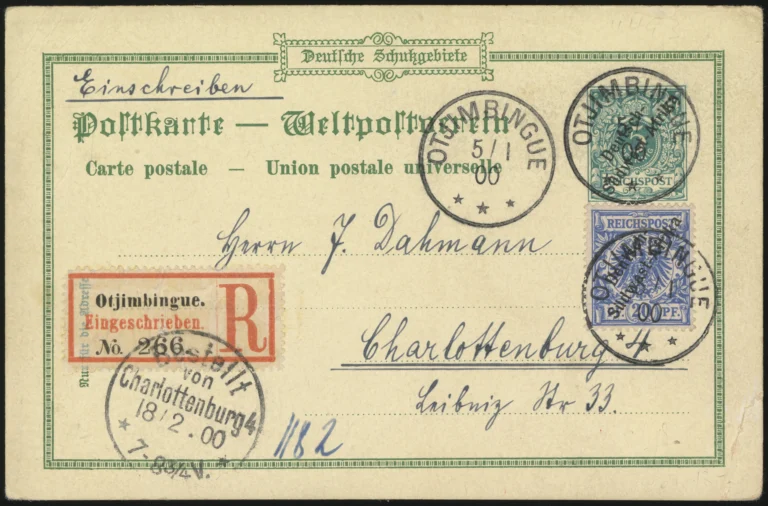
The postal stationery of DSWA is relatively straightforward and follows the pattern set in other colonies. Following Vorläufer usage of ordinary German postal cards, the typical range of distinctive postal cards was produced. This included 5 Pf and 10 Pf cards, both in single use and paid-reply formats.
It also included “privat post” printings of cards with a stamp indicia produced by a private firm (below), which the Reichspost accepted as valid.
In the case of DSWA, overprinted cards of the 1889 series were issued with both the two- and three-word versions of the colony’s name as were the stamps. The same denominations were produced once Yacht series cards were printed in the early 1900’s.
Booklets

DSWA was one of three German colonies which had stamp booklets. A total of four (4) different booklets were produced, which contained 2 Marks face value in stamps. Each booklet contained 20 of the 5 Pf stamps and 10 of the 10 Pf denomination, but in different configurations. All the stamps in each booklet were printed on watermarked paper. Stamps detached from booklet panes, with a few specific exceptions, are generally not distinguishable from ordinary sheet stamps. Stamps with natural straight edges, however, might come from booklets as the printer was unable to cut the panes apart accurately. Stamps from ordinary sheets of stamps are always perforated on all sides.
Each booklet was printed with orange cardboard covers describing the stamps inside on the outside of the front cover, and typically some sort of ad on the inside front cover and both sides of the back cover. Interleaving pages of glassine or another waxy paper separated stamp panes from each other, to make sure the stamps did not stick together. The first three booklets printed each have an identifying letter printed on the lower left corner of the booklet’s front cover, while the fourth booklet has no index letter on the front cover. This booklet also differed from the others in that in place of ads on the back cover, it had a chart of postal rates the stamps could be used to pay.
For booklet panes from any booklet, one variety concerning the perforations is noted in Michel. Each intact booklet pane, most particularly visible in panes from exploded booklets, has selvage on the left side of the pane, and a row of perforations separating the top row of stamps from the bottom row. Panes with Michel suffix “A” have these perforations going all the way to the left edge of the selvage (top right). Panes with Michel suffix “B” also have these perforations, but they stop about ½ cm from the edge of the pane and do not go through to the edge (bottom right). For DSWA, panes with Type “B” perforations always have a higher CV than panes with Type “A” perforations.
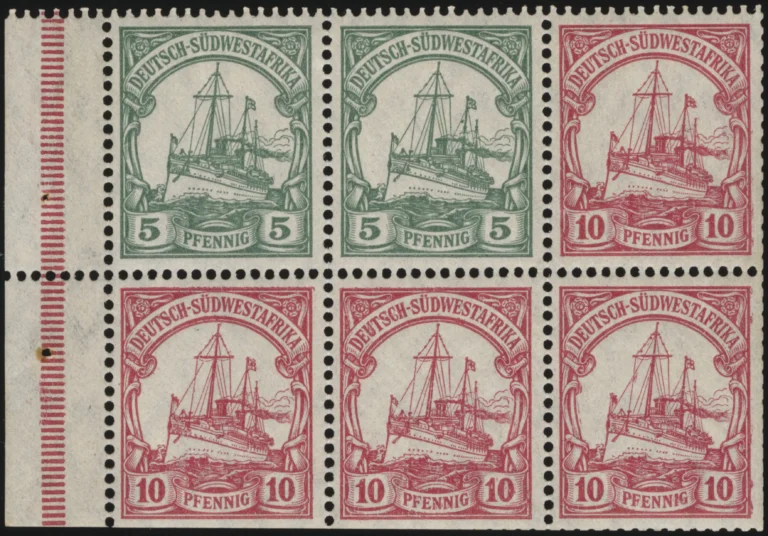
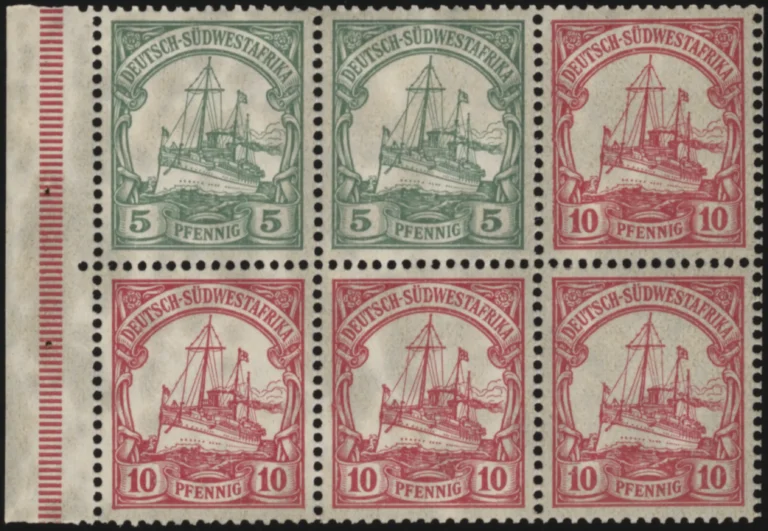
Because the booklet panes of these and all German stamp booklets of the period contained six (6) stamps, the printers had to be a little creative. The first two booklets (Booklet “A” and “B”) had the stamps printed so that five stamps and one of ten (10) ad labels were in each booklet pane, which appears as two rows of three stamp positions each. The label always appears in position 1, i.e. the left hand stamp of the top row of three. The entire pane is printed in the same color as the stamps in the other five positions on the pane, i.e. green or red, and this includes the label with the ad.
The earliest booklet, issued with an “A” index, had four (4) panes of 5 Pf stamps, one each with four different labels designated as Labels 1-4 in Michel. Two additional panes of 10 Pf stamps, each with either Label 5 or Label 6, rounded out the booklet. Booklet “A” had white paper pages separating the panes of stamps and was issued in October 1911. 5,000 booklets were printed; all were shipped to the colony and none were available at the Berlin philatelic office.
The next booklet, printed with the “B” index on the front cover, differed in that the ad labels were all rearranged. Booklet “B” also contained one pane of 5 Pf stamps identical to the earlier Booklet “A”, specifically a pane with Label #2. It also contained one pane of 5 Pf stamps with label #6 printed in green; this was the only label that changed colors from red to green as it had previously been printed in a pane of red 10 Pf stamps. Two additional panes of 5 Pf stamps were included with two labels (#7 and #8) which did not appear in Booklet “A”, as were two panes of 10 Pf stamps with two other labels (#9 and #10) which also did not appear in Booklet “A”.
Other changes to Booklet B involved changing the ads printed on the covers, which were all now completely different from what had appeared there previously. The interleaving paper was likewise changed from white to a different paper that is very rough, waxy, and brown. As was the case previously, 5,000 booklets were printed and all were shipped to the colony in April 1912, with none reserved for sale in Berlin.
Owing to the low print run and the fact that all booklets were shipped to the colony, intact examples of complete booklets command premiums. Individual panes have CV’s of between €480 and €600, while intact booklets of six panes are valued between €6,000 and €7,500, all based on which type of perforations they have. Also commanding premiums are used pairs consisting of a label and a stamp, either horizontal or vertical; covers with such used pairs on cover are so infrequently encountered that Michel does not value them. Michel does, however, assign a value to entire used panes from booklets roughly equal to intact booklets. Specialists in this area have said that such valuations are fantasies; very few if any such used panes exist.
The third of the four booklets printed, Booklet “C” is the one most likely to be encountered in the marketplace. Unlike its counterparts from Kamerun and German East Africa, the quantity printed of this booklet is recorded: 15,400 booklets were produced.
Unlike Booklets “A” and “B”, Booklet “C” was prepared primarily for sale at the Berlin post office’s philatelic counter. Stamps from the “C” booklet were also printed in a different manner. All ads were moved to the booklet covers or the interleaving pages, while ad labels in the stamp panes were dispensed with entirely. This led to the booklet having just five panes; three panes of 6 of the 5 Pf stamps, one pane of 6 of the 10 Pf, and one se-tenant pane with two 5 Pf stamps in positions 1 and 2 along with four 10 Pf stamps in the other positions. Of these, the se-tenant pane is the most sought after, as are se-tenant pairs from it. Booklet “C” was printed in mid-1913, and remainders were sold at auction in 1921 when the post office was dispensing with all of its colonial stock.
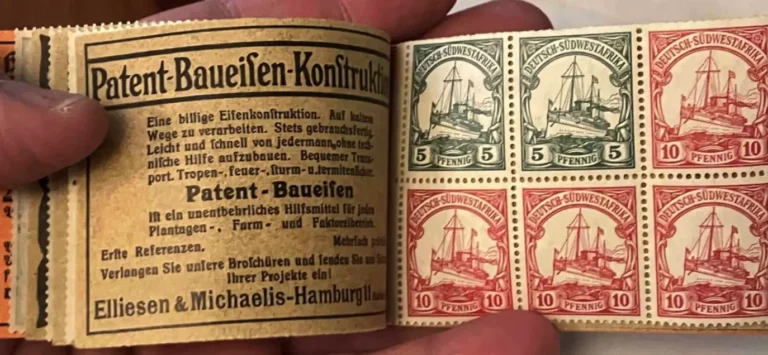
The fourth booklet, without an index letter on the front, is the most mysterious of any of the booklets. This booket was printed in an unknown, but likely much smaller quantity. The stamp panes on the inside matched what was provided in Booklet “C” but the ads were completely gone. The inside covers of this booklet are blank, while the outside back cover has a chart of postal rates. This booklet was believed to have been printed in 1914. Intact examples of the fourth booklet are, based on Michel CV’s, equally as rare as Booklets A and B.
The fourth booklet was something unique to DSWA. The other two colonies that issued booklets had no equivalent to it. Another unique facet deals with a small quantity of booklets, either Booklet “C” or the fourth booklet without an identifying index, were actually sent to the colony. At least one intact pane of six of the 5 Pf stamps, which was not available in either of the earlier booklets, exists in used condition and is in pictured in Friedemann. A few other examples of used panes or used se-tenant pairs from that pane, are now known to exist. This is arguably one of the great rarities of German colonial philately.
DSWA was one of three German colonies which had stamp booklets. A total of four (4) different booklets were produced, which contained 2 Marks face value in stamps. Each booklet contained 20 of the 5 Pf stamps and 10 of the 10 Pf denomination, but in different configurations. All the stamps in each booklet were printed on watermarked paper. Stamps detached from booklet panes, with a few specific exceptions, are generally not distinguishable from ordinary sheet stamps. Stamps with natural straight edges, however, might come from booklets as the printer was unable to cut the panes apart accurately. Stamps from ordinary sheets of stamps are always perforated on all sides.
Each booklet was printed with orange cardboard covers describing the stamps inside on the outside of the front cover, and typically some sort of ad on the inside front cover and both sides of the back cover. Interleaving pages of glassine or another waxy paper separated stamp panes from each other, to make sure the stamps did not stick together. The first three booklets printed each have an identifying letter printed on the lower left corner of the booklet’s front cover, while the fourth booklet has no index letter on the front cover. This booklet also differed from the others in that in place of ads on the back cover, it had a chart of postal rates the stamps could be used to pay.
For booklet panes from any booklet, one variety concerning the perforations is noted in Michel. Each intact booklet pane, most particularly visible in panes from exploded booklets, has selvage on the left side of the pane, and a row of perforations separating the top row of stamps from the bottom row. Panes with Michel suffix “A” have these perforations going all the way to the left edge of the selvage (below).
Panes with Michel suffix “B” also have these perforations, but they stop about ½ cm from the edge of the pane and do not go through to the edge (below).
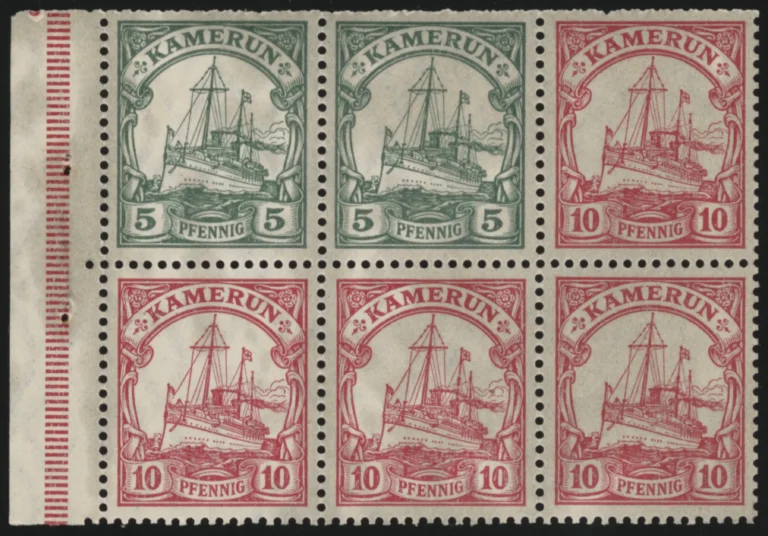
For DSWA, panes with Type “B” perforations always have a higher CV than panes with Type “A” perforations.
Because the booklet panes of these and all German stamp booklets of the period contained six (6) stamps, the printers had to be a little creative. The first two booklets (Booklet “A” and “B”) had the stamps printed so that five stamps and one of ten (10) ad labels were in each booklet pane, which appears as two rows of three stamp positions each. The label always appears in position 1, i.e. the left hand stamp of the top row of three. The entire pane is printed in the same color as the stamps in the other five positions on the pane, i.e. green or red, and this includes the label with the ad.
The earliest booklet, issued with an “A” index, had four (4) panes of 5 Pf stamps, one each with four different labels designated as Labels 1-4 in Michel. Two additional panes of 10 Pf stamps, each with either Label 5 or Label 6, rounded out the booklet. Booklet “A” had white paper pages separating the panes of stamps and was issued in October 1911. 5,000 booklets were printed; all were shipped to the colony and none were available at the Berlin philatelic office.
The next booklet, printed with the “B” index on the front cover, differed in that the ad labels were all rearranged. Booklet “B” also contained one pane of 5 Pf stamps identical to the earlier Booklet “A”, specifically a pane with Label #2. It also contained one pane of 5 Pf stamps with label #6 printed in green; this was the only label that changed colors from red to green as it had previously been printed in a pane of red 10 Pf stamps. Two additional panes of 5 Pf stamps were included with two labels (#7 and #8) which did not appear in Booklet “A”, as were two panes of 10 Pf stamps with two other labels (#9 and #10) which also did not appear in Booklet “A”.
Other changes to Booklet B involved changing the ads printed on the covers, which were all now completely different from what had appeared there previously. The interleaving paper was likewise changed from white to a different paper that is very rough, waxy, and brown. As was the case previously, 5,000 booklets were printed and all were shipped to the colony in April 1912, with none reserved for sale in Berlin.
Owing to the low print run and the fact that all booklets were shipped to the colony, intact examples of complete booklets command premiums. Individual panes have CV’s of between €480 and €600, while intact booklets of six panes are valued between €6,000 and €7,500, all based on which type of perforations they have. Also commanding premiums are used pairs consisting of a label and a stamp, either horizontal or vertical; covers with such used pairs on cover are so infrequently encountered that Michel does not value them. Michel does, however, assign a value to entire used panes from booklets roughly equal to intact booklets. Specialists in this area have said that such valuations are fantasies; very few if any such used panes exist.
The third of the four booklets printed, Booklet “C” is the one most likely to be encountered in the marketplace. Unlike its counterparts from Kamerun and German East Africa, the quantity printed of this booklet is recorded: 15,400 booklets were produced.
Unlike Booklets “A” and “B”, Booklet “C” was prepared primarily for sale at the Berlin post office’s philatelic counter. Stamps from the “C” booklet were also printed in a different manner. All ads were moved to the booklet covers or the interleaving pages, while ad labels in the stamp panes were dispensed with entirely. This led to the booklet having just five panes; three panes of 6 of the 5 Pf stamps, one pane of 6 of the 10 Pf, and one se-tenant pane with two 5 Pf stamps in positions 1 and 2 along with four 10 Pf stamps in the other positions. Of these, the se-tenant pane is the most sought after, as are se-tenant pairs from it. Booklet “C” was printed in mid-1913, and remainders were sold at auction in 1921 when the post office was dispensing with all of its colonial stock.
The fourth booklet, without an index letter on the front, is the most mysterious of any of the booklets. This booket was printed in an unknown, but likely much smaller quantity. The stamp panes on the inside matched what was provided in Booklet “C” but the ads were completely gone. The inside covers of this booklet are blank, while the outside back cover has a chart of postal rates. This booklet was believed to have been printed in 1914. Intact examples of the fourth booklet are, based on Michel CV’s, equally as rare as Booklets A and B.
The fourth booklet was something unique to DSWA. The other two colonies that issued booklets had no equivalent to it. Another unique facet deals with a small quantity of booklets, either Booklet “C” or the fourth booklet without an identifying index, were actually sent to the colony. At least one intact pane of six of the 5 Pf stamps, which was not available in either of the earlier booklets, exists in used condition and is in pictured in Friedemann. A few other examples of used panes or used se-tenant pairs from that pane, are now known to exist. This is arguably one of the great rarities of German colonial philately.
Bahnpost

The Germans had numerous problems with mail transportation within DSWA. Initially, even in good weather, mail could take 12 days to transport mail between Windhoek and the closest port facilities at Walvis Bay. If there were any difficulties at all, mail transportation could take significantly longer. Some mail could take longer transiting between the port and the interior of DSWA than between the port in Africa and being delivered in Germany. Unusual sources of frustration that did not appear in Germany were routine here. For instance, in a desert climate, rain was not often an issue – but the colony did have a rainy season, and when rain did fall, it could create all sorts of difficulties including flooding. This slowed the mail considerably. All sorts of animal transport, including by horse, oxen and camel, were employed in order to try to get around the difficulties in transportation. None proved all that viable for different reasons.
Much of this was solved by the completion of railroads connecting most parts of the colony with Windhoek and the port facilities at Swakopmund and Lüderitzbucht. This allowed mail to circulate more freely. The rail was built with relative speed, and left traces on the mails not seen in other colonies.
Building of the rails under the Germans began in 1897, and continued until the end of German control.

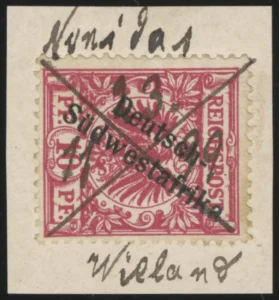
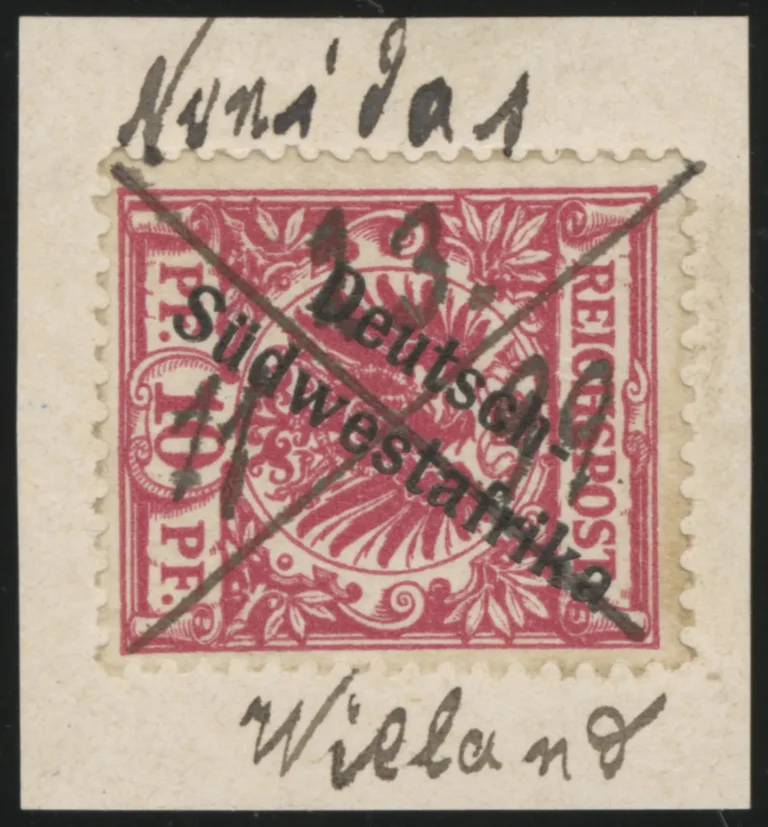
Initially, mail posted at railway stations without their own post office would receive a manuscript cancellation of some sort, typically crossing out the stamp with an “X” and also noting the date and, sometimes, the name of the station (right).
Several varieties are known, mostly at locations along the rail lines between Swakopmund and Windhoek.
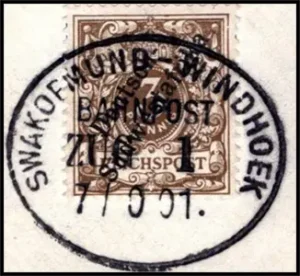
The speed with which the rails were built left other traces on the mails not seen in other colonies. Once operational, DSWA postal authorities put oval cancels into use for “Bahnpost” services between Windhoek and Swakopmund (right).
Such Bahnpost was seen in a few locations in the colonial empire, notably in Kiautschou / North China, German East Africa, and (briefly) Kamerun. Unlike those other colonies, though, such distinctive cancels were used during a very short period. Actual cancels applied on the trains were used between 1 February 1901 and 28 June 1903, with some strikes of a Bahnpost cancel known to have been “improperly used” in Windhoek on 22 April 1899. The Bahnpost cancels were then taken out of use, but were kept in storage. They would appear later during the British occupation in 1915.
Additionally, DSWA’s railways helped to create one of the most distinctive areas of German colonial philately – the Wanderstempel.
The Germans had numerous problems with mail transportation within DSWA. Initially, even in good weather, mail could take 12 days to transport mail between Windhoek and the closest port facilities at Walvis Bay. If there were any difficulties at all, mail transportation could take significantly longer. Some mail could take longer transiting between the port and the interior of DSWA than between the port in Africa and being delivered in Germany. Unusual sources of frustration that did not appear in Germany were routine here. For instance, in a desert climate, rain was not often an issue – but the colony did have a rainy season, and when rain did fall, it could create all sorts of difficulties including flooding. This slowed the mail considerably. All sorts of animal transport, including by horse, oxen and camel, were employed in order to try to get around the difficulties in transportation. None proved all that viable for different reasons.
Much of this was solved by the completion of railroads connecting most parts of the colony with Windhoek and the port facilities at Swakopmund and Lüderitzbucht. This allowed mail to circulate more freely. The rail was built with relative speed, and left traces on the mails not seen in other colonies.
Building of the rails under the Germans began in 1897, and continued until the end of German control.
Initially, mail posted at railway stations without their own post office would receive a manuscript cancellation of some sort, typically crossing out the stamp with an “X” and also noting the date and, sometimes, the name of the station (below). Several varieties are known, mostly at locations along the rail lines between Swakopmund and Windhoek.
The speed with which the rails were built left other traces on the mails not seen in other colonies. Once operational, DSWA postal authorities put oval cancels into use for “Bahnpost” services between Windhoek and Swakopmund (below).
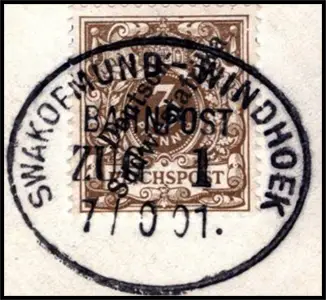
Such Bahnpost was seen in a few locations in the colonial empire, notably in Kiautschou / North China, German East Africa, and (briefly) Kamerun. Unlike those other colonies, though, such distinctive cancels were used during a very short period. Actual cancels applied on the trains were used between 1 February 1901 and 28 June 1903, with some strikes of a Bahnpost cancel known to have been “improperly used” in Windhoek on 22 April 1899. The Bahnpost cancels were then taken out of use, but were kept in storage. They would appear later during the British occupation in 1915.
Additionally, DSWA’s railways helped to create one of the most distinctive areas of German colonial philately – the Wanderstempel.
Airmail

Airmail is an area that German colonial philatelists usually do not have to deal with. DSWA provides the only such example available to us.
Trial airmail flights occurred in DSWA just weeks before the outbreak of the First World War, in May of 1914. Pilot Bruno Büchner flew along the railway line from Swakopmund-Usakos-Karibib-Okahandja-Windhuk, landing at each town to load/unload mail. Büchner departed Swakopmund on 18 May, arriving in Usakos that afternoon. He departed Usakos the following morning, arriving in Karibib 20 minutes later. Due to the weather, his departure from Karibib was delayed until 22 May. On that date, he flew to Okahandja, then departed for Windhuk on 24 May. Due to bad weather, he made two emergency landings en route, eventually arriving in Windhuk on 27 May 1914.
Mail transported on the flights bears one of five markings, or nebenstempel. Each point of departure had its own marking, with Karibib having two – one for mail collected for the originally scheduled flight, and one for mail collected during the period the flight was delayed.
Such covers are fairly rare, and command CV’s of €5,000 or more.
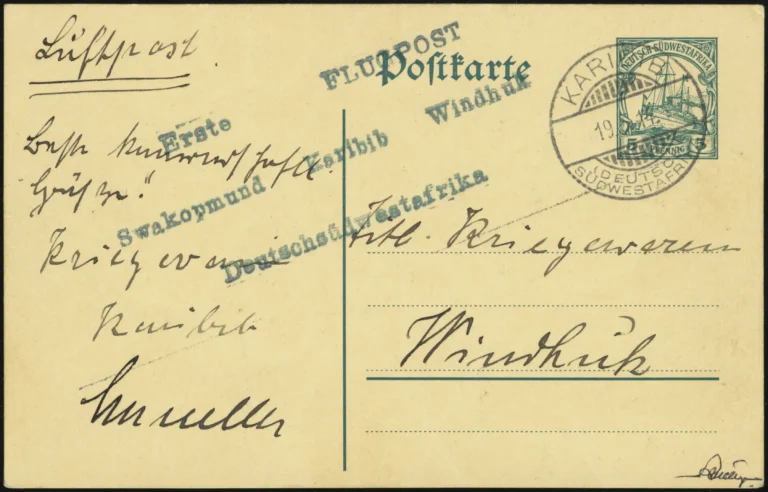
Airmail is an area that German colonial philatelists usually do not have to deal with. DSWA provides the only such example available to us.
Trial airmail flights occurred in DSWA just weeks before the outbreak of the First World War, in May of 1914. Pilot Bruno Büchner flew along the railway line from Swakopmund-Usakos-Karibib-Okahandja-Windhuk, landing at each town to load/unload mail. Büchner departed Swakopmund on 18 May, arriving in Usakos that afternoon. He departed Usakos the following morning, arriving in Karibib 20 minutes later. Due to the weather, his departure from Karibib was delayed until 22 May. On that date, he flew to Okahandja, then departed for Windhuk on 24 May. Due to bad weather, he made two emergency landings en route, eventually arriving in Windhuk on 27 May 1914.
Mail transported on the flights bears one of five markings, or nebenstempel. Each point of departure had its own marking, with Karibib having two – one for mail collected for the originally scheduled flight, and one for mail collected during the period the flight was delayed.
Such covers are fairly rare, and command CV’s of €5,000 or more.
Feldpost / Military Mail

Military mail from DSWA falls into two general periods. The first occurred between 1904-1907, in the course of the Herero Uprising. The second occurred in 1914-1915 during the First World War.
The influx of military personnel into the colony starting in 1904 saw an increase in mail to/from those military personnel. As was the case elsewhere, soldiers on duty had the right to use the military mails (“Feldpost”) free of charge. As such, many of the pieces of mail connected to the soldiers sent to put down the Herero Uprising either have German stamps and origin cancels, or were sent stampless from DSWA. In part due to the large number of soldiers in the colony, much of the military mail also has a purple circular stamp (below) identifying the specific attachment of the soldier to the military, i.e. which company or battalion to which the soldier was attached.
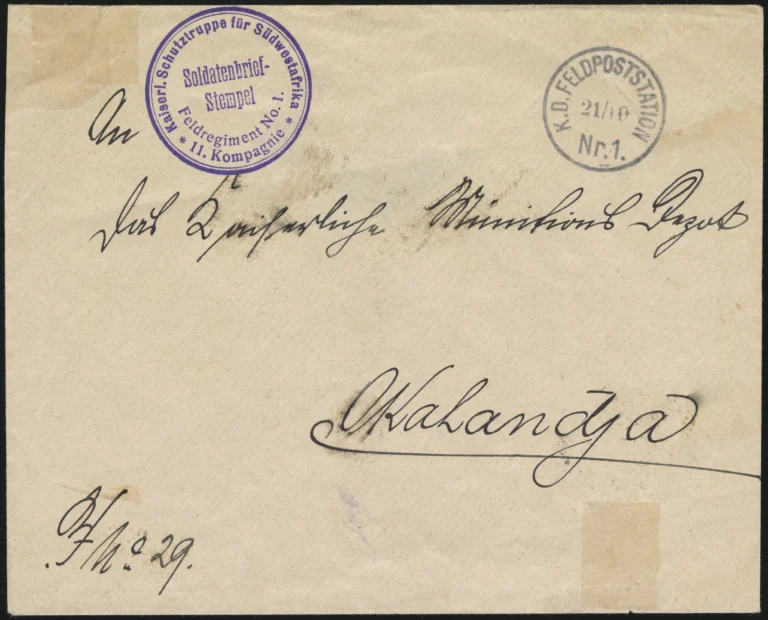
The initial military post office opened with a circular date stamp reading “K.D. FELDPOSTEXPED.” across the top of the circle, and “SÜDWESTAFRIKA” across the middle. The military eventually opened four numbered post offices with cancels similar to those encountered several years earlier during the Boxer Rebellion in China. These cancels read “K.D. Feldpoststation / Nr. ___”. The numbers used in Southwest Africa were 1, 2, 3, and 4 (above). (Note: these cancels differ from the earlier cancels used in China as the bottom of the CDS in China read “No.___” while those used in Southwest Africa read “Nr. ___”.) Otherwise, all of the military cancels have a date showing the day and the month, but no year.
In addition, military mail is encountered on occasion with Wanderstempel V with a town designation of “Feld-Poststation”, and with the application of the negative “Dienstsiegel” (official seal) of the postal agent of Keetmanshoop, Okahandja, Karibib, Windhoek, or Rehoboth in place of a postmark. The one from Rehoboth is very rarely encountered. All of the military cancels described above can be found on stamps, but are most typically encountered on covers or perhaps larger pieces of covers and post cards.
During the First World War, Feldpost resumed. However, distinctive postmarks were not available from Germany this time around, so ordinary cancel devices from the civilian post were used. For this reason, most Feldpost mail must be collected as entires, with markings showing its military connections (like an endorsement “Feldpost” or something similar). The one exception would be Wanderstempel IV, which was placed in use with a town designation of “Otavifontein”. This cancel is known only from its usage in connection with Feldpost, and not items handled by the civilian post office. Feldpost dates are from 5 September 1914 to 9 July 1915.
Wartime

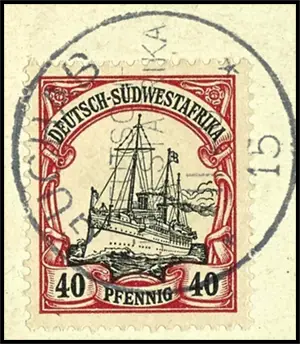
As was the case with other German colonies, stamps with cancel dates following the declaration of war on 1 August 1914 are considered “War Dates”.
In the case of DSWA, possible war dates run until May 1915 according to ArGe. The official date of the loss of control of the colony was 9 July 1915, when the German armed forces surrendered to the Allies. Some post offices continued to operate for a few more days, particularly in more outlying areas. By mid-1915, Germany had fully lost control of all her other colonies except German East Africa and Kamerun. Owing to the combination of a relatively large German population and nearly a year of German control during the First World War, war date mail is relatively more plentiful than that from other areas of the former German colonial empire.
Post-War Developments

The newly mandated territory of South West Africa began to use South African stamps initially and began to use stamps of that country overprinted “SWA” until distinctive issues began. But traces of the Germans would remain. In many places, the German place names remained, although some spellings were changed to conform more to the orthography of either of the official languages of South Africa, i.e. English or Afrikaans. The town of Kolmannskuppe, for example, was renamed “Kolmanskop”, a name by which it is still known.
It would end up being in the realm of cancels that more directly German traces would remain. The cancel devices used in German South West Africa fell into one of three types. Some cancels were returned to Germany, and now reside in the Museum für Kommunikation in Berlin. Some cancel devices were buried in the Namibian desert and were never retrieved after they were hidden. Still others were either captured directly by the South Africans, or were found in their desert hiding places.
Those cancel devices that were captured by the Allies were placed back into service in the post offices of the Mandate, as they were made of “good German steel.” Those cancels of the types used in the 1890’s which included only references to the name of the town were returned to use immediately, provided that the South Africans kept the name of the town unchanged.
Other cancels of later types had their inscriptions changed. For example, ones that read “DEUTSCH- / SÜDWESTAFRIKA” had letters removed so that this portion of the cancel now read “S. W. AFRICA” (top right). The old c. 1900 Bahnpost cancels had one town name (either Swakopmund or Windhoek) chiseled out, along with the “BAHN” part of “BAHNPOST” (bottom right). Numerous possibilities exist.
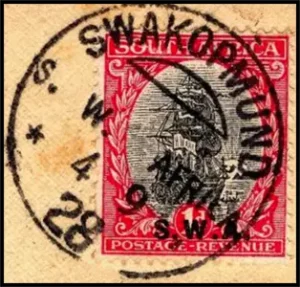
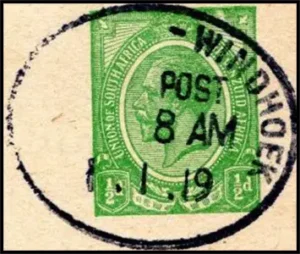
The newly mandated territory of South West Africa began to use South African stamps initially and began to use stamps of that country overprinted “SWA” until distinctive issues began. But traces of the Germans would remain. In many places, the German place names remained, although some spellings were changed to conform more to the orthography of either of the official languages of South Africa, i.e. English or Afrikaans. The town of Kolmannskuppe, for example, was renamed “Kolmanskop”, a name by which it is still known.
It would end up being in the realm of cancels that more directly German traces would remain. The cancel devices used in German South West Africa fell into one of three types. Some cancels were returned to Germany, and now reside in the Museum für Kommunikation in Berlin. Some cancel devices were buried in the Namibian desert and were never retrieved after they were hidden. Still others were either captured directly by the South Africans, or were found in their desert hiding places.
Those cancel devices that were captured by the Allies were placed back into service in the post offices of the Mandate, as they were made of “good German steel.” Those cancels of the types used in the 1890’s which included only references to the name of the town were returned to use immediately, provided that the South Africans kept the name of the town unchanged.
Other cancels of later types had their inscriptions changed. For example, ones that read “DEUTSCH- / SÜDWESTAFRIKA” had letters removed so that this portion of the cancel now read “S. W. AFRICA” (below).
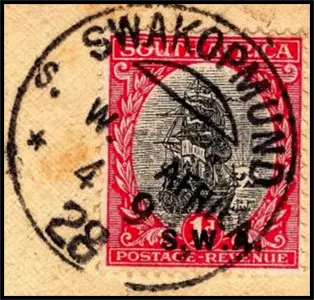
The old c. 1900 Bahnpost cancels had one town name (either Swakopmund or Windhoek) chiseled out, along with the “BAHN” part of “BAHNPOST” below).
Numerous possibilities exist.
Postal Markings
A detailed list of post offices wthl sample postmarks will follow at some point in the future. Should you wish to see a list of the post offices with basic information, see the GCCG’s page with maps of the DSWA post offices.
Wanderstempel

For those who have not encountered this term before, the Wanderstempel is a form of cancellation which moved around (“wandered”) around the colony. Five (5) different devices were created by altering the cancel devices of offices which had closed, never opened, or who had to retire usable cancel devices for any reason. The name of the office was removed, leaving a cancel which read “Südwest-Afrika” or “Deutsch- / Südwestafrika” and a date but no place name. The cancel was then placed in use at newly opened or temporary post offices, many of which were connected with railroad construction.
In all cases, the Wanderstempel was used to cancel stamps or otherwise date mail, and the name of the place where it was used was applied either with a rubber hand stamp showing the place name, or the place name was written in by hand. For post offices that eventually transitioned to a more permanent status, the Wanderstempel was replaced by a normal circular date stamp. The Wanderstempel was then available to be sent somewhere else. For those, more temporary post offices, examples of the Wanderstempel are typically the only traces that place was ever inhabited on anything resembling a permanent basis. Most Wanderstempel were used at any location for between a few days to as long as a year and a half. Those listed below that straddle between two years were placed in use at the end of one calendar year and continued into the following year.
The following is the list of the five Wanderstempel and where they were used:
Wanderstempel I
Created by removing the town name from the original “Otyimbingue” cancel used in the 1880’s, as well as the word “DEUTSCH”. The remaining cancel reads “SÜDWEST-AFRIKA” in two words.
Used at Okahandja (1895), Rossing (1898), Khanrivier (1898), Jakalswater (1899-1900), Aus (1906), Brackwasser (1907) and Kuibis (1907).
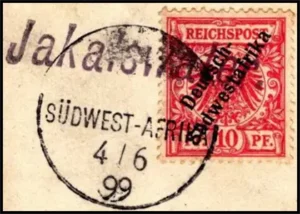
Wanderstempel II
This appears to have been produced without a town name. This and the following cancels all read ““DEUTSCH- / SÜDWESTAFRIKA” above the date.
Used at: Otavi (1900), Hatsamas (1900), Kapenousseu (1903), Nauchas (1903-1904), Okahandja (1904), Waterberg (1904), Okowakuatjiwi (1907), and Feldpost No. 3 (1914-1915).
The usage period of this device at Waterberg appears to be the shortest period of use of any Wanderstempel in DSWA. It was in use for four days between 20 and 23 November 1904.
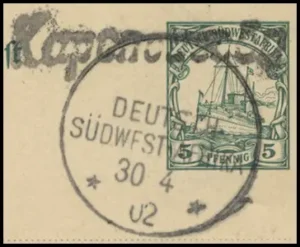
Wanderstempel III
This was formerly the cancel device for Hasis, which changed its name to Kubas in 1900.
This was used only in Hasuur (1903-1904), Epukiro (1905-1906), and Osona (1907-1908.)
This Wanderstempel use at Epukiro appears to have been the longest period of use of any Wanderstempel and was in use between June 1905 and the end of 1906.
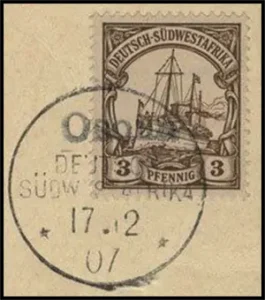
Wanderstempel IV
This was formerly the cancel prepared for use at Okongava, a post office which never actually opened. (The cancel was used with that town name briefly in 1899.)
This cancel was used at Gochas (1903-1904), Abbabis (1904), Kalkfontein-Sud (1906), Seeheim (1906), and at Feldpost No. 1 (1915).
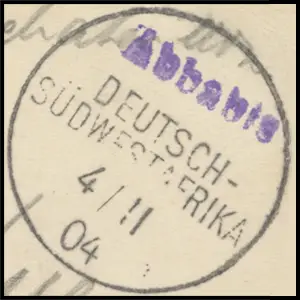
Wanderstempel V
Formerly the cancel used with the town name “Uhabis”, this was in use as the “Feld-Poststation” (1903-1904), Gochas (1905-1906), Otjiwarongo (1906) and at Feldpost 2 (1915).
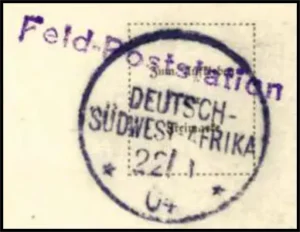
Event Postmark

One area of German philately which extends into modern times is the “event cancel”. For a number of years, the German post office has applied special cancels to mail during special events like exhibitions and anniversaries, most of which have no connection to philately. Early 20th century cancels were typically just words, while more recent ones are typically pictorial.
German Southwest Africa provides the only example of such an event cancel in the German colonial empire, applied during the “Landes Austellung” (State Exhibition) held between 29 May and 1 June 1914. The post office must have been busy cancelling mail here. Despite only being in use for four days, examples of this cancel have a CV of €40 on piece and €100 on cover, which is in the low- to mid-range of cancel values for this colony.
One area of German philately which extends into modern times is the “event cancel”. For a number of years, the German post office has applied special cancels to mail during special events like exhibitions and anniversaries, most of which have no connection to philately. Early 20th century cancels were typically just words, while more recent ones are typically pictorial.
German Southwest Africa provides the only example of such an event cancel in the German colonial empire, applied during the “Landes Austellung” (State Exhibition) held between 29 May and 1 June 1914. The post office must have been busy cancelling mail here. Despite only being in use for four days, examples of this cancel have a CV of €40 on piece and €100 on cover, which is in the low- to mid-range of cancel values for this colony.
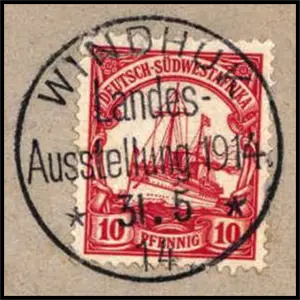
References
Friedemann, A. (1980). The Stamps and Cancels of the German Colonies and the German Post Offices Abroad, Section XI Marshall Islands. Translated by Alfred K. Walter. Wilmington, DE: German Colonies Collector Group.
Michel Redaktion (ed.) (2025). Michel Germany Specialized Catalog 2025 (Part 1). Bobingen, Germany: Schwaneberger Verlag Gmbh.
Nössig, T. (ed.) (2019). Catalog of the Postmarks of the German Colonies & Post Offices Abroad (1st English ed). Berlin, Germany: Arbeitsgemeinschaft der Sammler deutscher Kolonialpostwertzeichen.
Illustrations courtesy of Reinhard Fischer, Jerry Miller, Jochen Vogenbeck, Oliver Wyrtki, Gannon Sugimura, & Jed Dorman.